
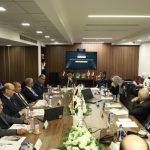
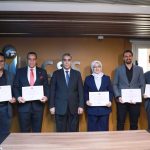
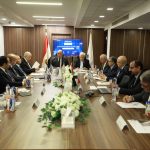
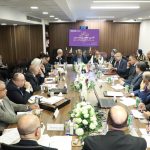
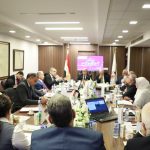


Continuing its efforts to advance peace in Libya, Egypt hosted talks in the framework of the 5+5 Joint Military Commission on Monday in the Red Sea resort city of Hurghada. The meeting is a crucial step in the preparatory talks for the comprehensive Libyan National Dialogue that will be held in Geneva in October.
The 5+5 Joint Military Commission, which brings together five military officials from the eastern and western camps in the Libyan conflict, is one of the three tracks of the settlement process that emerged during the Berlin Conference on Libya in mid-January. It was subsequently adopted by the UN Security Council.
Holding the meeting has been a goal since Aguila Saleh, speaker of the eastern-based House of Representatives (HoR), and Fayez Al-Sarraj, head of the Tripoli-based Government of National Accord (GNA), agreed to a ceasefire two months ago. Among the issues the 5+5 Joint Military Commission is tasked with are the reunification of the Libyan army, how to transfer foreign mercenaries out of Libya, and how to guarantee the security of Sirte so it can serve as an interim capital.
The military talks in Hurghada follow on the heels of another important meeting hosted by Cairo between Saleh and Commander General of the Libyan National Army (LNA) Field Marshal Khalifa Haftar. The two also met with President Abdel-Fattah Al-Sisi and senior Egyptian officials.
President Al-Sisi lauded Saleh’s efforts to promote the political process and reunify Libya’s executive and legislative institutions, and expressed appreciation for Haftar’s efforts in the war against terrorism and his commitment to the ceasefire. The president appealed to all Libyan stakeholders to engage constructively in the three tracks emanating from the Berlin Conference, adopted by the UN and enshrined in the Cairo Declaration.
Cairo secured a breakthrough by bringing Haftar and Saleh together. Although both from the western camp the differences between them have grown acute in recent months and Cairo was keen to contain any tensions that could jeopardise the diplomatic processes.
According to sources close to Saleh, the differences centre on the interim phase in which Saleh is likely to play a key role. It appears that the HoR and GNA have reached an informal agreement that Saleh should succeed Al-Sarraj as the head of a newly reconstituted Presidential Council.
Al-Sarraj announced in late September that he would step down at the end of October. Saleh replacing Al-Sarraj also appears to have some international backing judging by the EU’s decision to lift the sanctions they imposed on him in 2016.
Haftar, on the other hand, seems to have been sidelined. “He has not, however, abandoned his ambitions for power,” an informed source told Al-Ahram Weekly. “Even though he lost the battle for Tripoli Haftar still believes that he holds some trump cards. He commands a military force that controls large parts of the country and still controls the petroleum crescent and oil terminals in the Gulf of Sirte.”
The source believes that Haftar is using his remaining advantages to pursue a path parallel to the UN process, towards which end he has established a line of communication to discuss the resumption of oil production and exports, possibly under Russian auspices, with Ahmed Maiteeq, vice chairman of the Presidential Council. Ahmed Al-Mismari, spokesman for the LNA General Command, has made it clear that Haftar opposes both the Berlin process and the outputs of the Montreux talks of 7-9 September.
Al-Mismari said the LNA was not obliged to commit to these outputs since it was not a party to the talks. Although a “quota” of seats has reportedly been reserved for Haftar in the forthcoming National Dialogue observers believe his disapproval extends to encompass the dialogue as well.
In remarks to the press after meeting with Haftar in Cairo Saleh avoided any suggestion of acrimony. He said that the parliament (HoR) and the army (LNA) were on the same track with respect to a solution to the Libyan crisis. A source close to Saleh explained that the parliamentary leader was keen to forestall or contain tensions with any Libyan stakeholder since he would soon become the chairman of “a Presidential Council for all Libyans”.
Official sources in Cairo have not disclosed the substance of their talks with Haftar. Nevertheless, observers interpret the fact the 5+5 meeting in Hurghada went ahead as a sign that Haftar is now responding more positively to recent developments. Quite how compliant he will be though is unclear.
One of the outputs of the Montreux consultative meeting that will be put to the participants in the National Dialogue is the proposal that the Presidential Council should serve as the Supreme Commander of the Armed Forces.
Under this formula the three members of the new Presidential Council (the president and two vice presidents, each representing one of Libya’s three main regions) will share the authorities of the post, thereby ensuring no faction monopolises decision-making. Sources doubt this formula will appease Haftar, even if he is appointed defence minister in the interim government.
The international community nonetheless sounded an upbeat note on the results of this week’s meeting in Hurghada. The UN Support Mission in Libya (UNSMIL) released a statement extending “its deep gratitude to the Egyptian government for making these important talks possible and for its generous hosting of the delegations. We also extend our thanks to the two delegations who have demonstrated a positive and proactive attitude aimed at de-escalation of the situation in central Libya”.
Although a closing statement had not yet emerged from Hurghada by the time this article was submitted, sources contacted by the Weekly were optimistic, especially when it comes to the ceasefire and the security arrangements needed to move the capital to Sirte.
On the sidelines of the Montreux consultations participants discussed a proposal calling for the creation of a 5,000 member national police force, half of which would be subordinate to an eastern-based interior minister, half to a western-based one. This proposal appears to have expanded in Hurghada to include members of the Armed Forces as well. Although the LNA General Command would be unlikely to cede the areas it controls under the terms of a political agreement to which it is not a party it is believed Haftar might welcome an arrangement of this sort in which he retains a role as commander of his forces.
It has also been suggested that these forces would be redeployed in the vicinity of petroleum facilities in Sirte while the newly-formed police force would protect government institutions. On the other hand, some question the feasibility of the proposed police force, noting that its members would retain their partisan affiliations. Given that the point of moving the capital temporarily is to free it from the grip of the consortium of militias in Tripoli and, simultaneously, to buffer it from the east-west polarisation, this would be a far from ideal situation.
There are indications that the Hurghada talks also discussed moves towards the reunification of Libya’s Armed Forces. Although Cairo’s mediation made considerable progress on this issue in 2016 and 2017 the Tripoli campaign launched by the LNA on 4 April 2019 threw a spanner into the works, deepening the institutional bifurcation in Libya. Recent military-related developments in western Libya further call into question the possibility of reunifying the armed forces at this stage.
In addition to the appointments of Salah Al-Manqoush and Mohamed Al-Haddad as GNA defence minister and chief of staff, respectively, military contractual arrangements between the GNA and Turkey and Qatar, and Turkish control over the Watiya, Matiga and Misrata military bases, present formidable obstacles in the way of reunification.
There are additional inhibiting factors, most notably the current balance of power in favour of the western forces, and recognition and support for these forces by the US and some European powers determined to curtail Russia’s influence in Libya. Moscow is one of Haftar’s main backers. Just this week it confirmed it would repair and maintain the MiG 23s in the LNA arsenal.
Given the difficulties in bridging the gap between the two sides the question of reunifying the army may well be deferred until a comprehensive political agreement has been reached.