


By using ECSS site, you agree to the Privacy Policy and Terms of Use.
Accept
ECSS - Egyptian Center for Strategic StudiesECSS - Egyptian Center for Strategic Studies
  • Home
  • International Relations
    International Relations
    Show More
    Top News
    Another obstacle on the Grand Ethiopian Renaissance Dam?
    June 5, 2020
    Varied paths of reform in Africa
    March 22, 2019
    G20 Membership Justified: Africa and the Road to the G20
    June 14, 2020
    Latest News
    2025 Yearender: Flood fallout
    January 20, 2026
    A Strategic reorientation: A critical reading of the 2025 US National Security Strategy
    January 18, 2026
    A diplomatic maneuver: Israel’s recognition of Somaliland
    January 17, 2026
    2025 Yearender: China’s multipolar world
    January 15, 2026
  • Defense & Security
    Defense & Security
    Show More
    Top News
    A Multi-dimensional Affair: Women and Terrorism in Africa
    June 14, 2020
    On deradicalisation: Marc Sageman and the psychology of jihadists
    June 22, 2020
    Assessing Deterrent Measures and the Prospects of War: US Military Movement in the Gulf to Confront Iran
    June 22, 2020
    Latest News
    Israel-Iran War: Does Israel Stand Alone?
    June 18, 2025
    Navigating Security and Diplomacy: What Russia’s Delisting of the Taliban Means for Bilateral Ties
    May 17, 2025
    Lakurawa: Armed Bandit Violence in Nigeria
    May 12, 2025
    Europe amid US–Iran Escalation: Can It Play the Diplomat or Become Entangled in the Crisis?
    April 13, 2025
  • Public Policy
    Public Policy
    Show More
    Top News
    Sinai: A Strategy for Development amid Fighting Terrorism
    June 17, 2020
    Egypt’s Comprehensive Vision for Human Rights
    June 22, 2020
    The Right to Health in Egypt
    June 22, 2020
    Latest News
    Weaponization of Resources: The Role of Rare Earth Metals in the US-China Trade War
    May 25, 2025
    The Carbon Border Adjustment Mechanism: A Catalyst or a Challenge for Egypt’s Export Ambitions?
    May 15, 2025
    The Suez Canal amidst Global Competition (3): National Strides Outpacing Time
    April 29, 2025
    Gaza’s Changing Demographics: The Toll of War and Blockade
    March 9, 2025
  • Analysis
    • Opinion
    • Analysis
    • Situation Assessment
    • Readings
  • Activities
    • Conferences
    • ECSS Agenda
    • Panel Discussion
    • Seminar
    • Workshops
  • ECSS Shop
  • العربية
  • Defense & Security
  • International Relations
  • Public Policy
All Rights Reserved to ECSS © 2022,
Reading: Gaza Crisis between Israeli and American Perspectives
Share
Notification Show More
Latest News
Book Review | The struggle for economic sovereignty: Who owns the instruments of power?
Readings
Displacement from Gaza: Deconstructing the idea, doctrine, and plan
Readings
The Egyptian Center for Strategic Studies participates in the 57th Cairo International Book Fair for the sixth year
Readings
2025 Yearender: Flood fallout
Iranian Studies Palestinian & Israeli Studies
A Strategic reorientation: A critical reading of the 2025 US National Security Strategy
Palestinian & Israeli Studies
Aa
ECSS - Egyptian Center for Strategic StudiesECSS - Egyptian Center for Strategic Studies
Aa
  • اللغة العربية
  • International Relations
  • Defense & Security
  • Special Edition
  • Public Policy
  • Analysis
  • Activities & Events
  • Home
  • اللغة العربية
  • Categories
    • International Relations
    • Defense & Security
    • Public Policy
    • Analysis
    • Special Edition
    • Activities & Events
    • Opinions Articles
  • Bookmarks
Follow US
  • Advertise
All Rights Reserved to ECSS © 2022, Powered by EgyptYo Business Services.
Opinions Articles

Gaza Crisis between Israeli and American Perspectives

Gen. Mohamed Eldewery
Last updated: 2025/05/15 at 8:03 PM
Gen. Mohamed Eldewery
Share
7 Min Read
SHARE

Gen. Mohamed El-Dewery

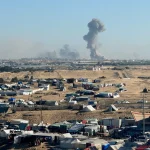
As US President Donald Trump prepares to visit Saudi Arabia, Qatar, and the United Arab Emirates beginning 13 May, questions, expectations, and ambitions are rising around the potential outcomes of this critical tour—particularly in light of the ongoing Israeli war on the Gaza Strip.

Many are asking whether the visit might be preceded, accompanied, or immediately followed by an announcement of a ceasefire, potentially paving the way for subsequent steps such as a prisoner exchange and the entry of humanitarian aid.

Setting aside speculation about supposed differences between President Trump and Prime Minister Netanyahu regarding various issues—including the Gaza war, though I find such claims unconvincing—there is, in fact, considerable alignment between the two countries’ positions on this conflict.

This convergence is particularly evident on four central points: 1) the necessity of eliminating Hamas and ensuring that Gaza never again poses a threat to Israel; 2) the release of all hostages; 3) the refusal to abandon the population transfer project officially from either country’s agenda; and 4) advocacy for delivering humanitarian aid to Gaza through a completely new mechanism agreed upon by both sides, with the strict condition that Hamas cannot access or distribute any part of it.

While the US administration prefers that Israel avoid broadening its military operations in Gaza to preserve space for negotiations, it has not called for a halt to the campaign or a withdrawal from the areas Israel now controls—territory that constitutes nearly half of the Gaza Strip. Nor is Washington calling for a permanent ceasefire. As such, it is inaccurate to speak of any fundamental divergence between Washington and Tel Aviv on Gaza or to draw conclusions from hypothetical disagreements between the two capitals.

It has recently become clear that the United States is placing greater emphasis on the entry of humanitarian aid into Gaza, framing it as an urgent priority. That’s led to a proposal to involve American and other international companies in distributing aid within Gaza under strict oversight and total isolation from Hamas.

Despite the undeniable importance of humanitarian relief, this approach carries two problematic dimensions. First, there appears to be a US–Israeli agreement on terminating the role of UNRWA—effectively erasing the refugee question altogether. Second, it reduces the Palestinian cause to a purely humanitarian issue, stripping it of its political dimensions—a step toward liquidating the Palestinian question itself.

Despite the complex and challenging reality, Egypt’s efforts have not ceased. Cairo continues to seek middle-ground solutions that bridge Israeli and Palestinian positions. Serious attempts are underway to reach a temporary truce that would enable a prisoner exchange and provide a window for addressing key issues: Israel’s complete withdrawal from Gaza, a permanent ceasefire, reconstruction, and the future of armed factions, particularly Hamas.

Undoubtedly, Egypt’s mediation, coordinated with Qatar and supported by the United States, aims to achieve a truce as soon as possible. This is not only a humanitarian imperative but a critical security requirement. The question remains: What can be expected of more than two million citizens facing a deadly triad of hunger, disease, and death? Desperate populations will likely pursue any path offering the slightest hope of escape.

A realistic reading of the current situation leads me to believe that the most we can expect in the coming days is a short-term truce, lasting several weeks, to allow for negotiation on core issues. If achieved, it would be a significant development given the scale of the humanitarian catastrophe in Gaza. This responsibility now rests with President Trump.

We are not asking him to resolve the entire Palestinian issue—but to pressure Israel into accepting a temporary truce, giving people space to breathe and a calmer environment in which to address deeper challenges. I believe Trump still can broker such a ceasefire, and we hope this is realized soon, regardless of the outcomes of his Gulf tour. 

As for “the day after” arrangements, it is now clear that these extend far beyond Gaza. They encompass broader regional dynamics, including Palestine, Syria, Lebanon, Yemen, and Iran, as well as the evolving relationship between President Trump and the Gulf states. In my estimation, the most significant dimension is the future integration of Israel into the regional system—not only politically and militarily but also economically, socially, and culturally. This is what we are likely to witness in the coming phase.

In conclusion, Egypt’s efforts have not—and will not—cease, despite Israel’s unprecedented intransigence and refusal to end hostilities in Gaza, which it views as essential to preserving its ruling coalition. I believe Egyptian and Qatari efforts are moving seriously toward a near-term truce.

Meanwhile, the American administration is proceeding quietly, with its primary goal being to secure a ceasefire that allows the release of the American captive and the entry of humanitarian aid, an outcome President Trump could present as a political success. Beyond that, Washington has effectively given Israel a green light to take whatever measures it deems necessary—whether in Gaza, the West Bank, against the Houthis, or on other fronts, with the sole exception of Iran. In that case, military action would require prior American coordination.

Ultimately, we await President Trump’s decisions as his broader vision for the region comes into focus.

This article was originally published on Ahram Online on May 11, 2025.

Related Posts

The End of Globalization?

Troubled Waters in Jenin Camp

Is It Time for the Arab Deal of the Century?

A Noteworthy Palestinian-Israeli Peace Proposal (1)

Gen. Mohamed Eldewery May 15, 2025
Share this Article
Facebook Twitter Whatsapp Whatsapp LinkedIn Telegram Email Copy Link Print
Gen. Mohamed Eldewery
By Gen. Mohamed Eldewery
Deputy Manager

Stay Connected

Facebook Like
Twitter Follow
Instagram Follow
Youtube Subscribe

Latest Articles

Rethinking Europe’s Defense after America’s Pullback (1): An Introduction
European Studies May 3, 2025
The German Policy towards migrants
Uncategorized March 9, 2022
Goals and Mechanisms: Integrating the Informal Economy into the Formal Economy
Economic & Energy Studies September 23, 2023
Will Iran Escalate Against the Gulf Following the Latter’s Openness to Israel?
International Relations September 29, 2020

Latest Tweets

//

The Egyptian Center for Strategic Studies is an independent non-profit think tank providing decision-makers by Policy alternatives, the center was established in 2018 and comprises a group of experts and researchers from different generations and scientific disciplines.

International Relations

  • African Studies
  • American Studies
  • Arab & Regional Studies
  • Asian Studies
  • European Studies
  • Palestinian & Israeli Studies

Defence & Security

  • Armament
  • Cyber Security
  • Extremism
  • Terrorism & Armed Conflict

Public Policies

  • Development & Society
  • Economic & Energy Studies
  • Egypt & World Stats
  • Media Studies
  • Public Opinion
  • Women & Family Studies

Who we are

The Egyptian Center for Strategic Studies (ECSS) is an independent Egyptian think tank established in 2018. The Center adopts a national, scientific perspective in examining strategic issues and challenges at the local, regional, and international levels, particularly those related to Egypt’s national security and core national interests.

The Center’s output is geared toward addressing national priorities, offering anticipatory visions for policy and decision alternatives, and enhancing awareness of various transformations through diverse forms of scientific production and research activities.

All Rights Reserved to Egyptian Center for Strategic Studies - ECSS © 2023

Removed from reading list

Undo
Welcome Back!

Sign in to your account

Lost your password?