





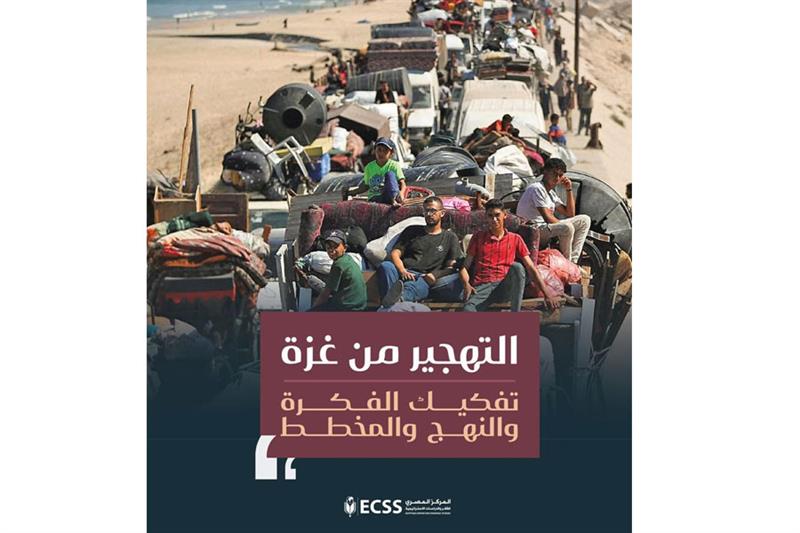
Drawing on the proceedings of the international conference “Gaza and the Future of Peace and Stability in the Middle East,” held in Cairo on 26 February 2025, by the Egyptian Centre for Strategic Studies and the Egyptian Council for Foreign Affairs, the volume brings together the analyses of senior policymakers, diplomats, scholars, and experts from Egypt, the Arab world and the United States to expose displacement not as a by-product of war, but as an idea, a long-standing Israeli doctrine, and a deliberate political plan aimed at emptying Gaza of its people and transforming it into an uninhabitable space.
Through a careful synthesis of historical inquiry, comparative reconstruction experiences, and contemporary policy analysis, the volume demonstrates that the continued presence of populations on their land is the indispensable foundation of sustainable peace and political stability. In parallel, it presents Egypt’s integrated vision, which unequivocally rejects displacement and proposes a coherent roadmap that begins with an immediate ceasefire, moves through humanitarian relief and reconstruction, and culminates in a political process leading to a two-state solution—while dismantling a range of recent international proposals that the book characterizes as detached from reality and strategically hazardous.
The first chapter, “Reconstruction Experiences and Conflict Settlement,” establishes that reconstruction succeeds only when people remain on, or are enabled to return to, their land. Population presence is treated not as a secondary humanitarian concern, but as a structural condition for political, economic, and security sustainability.
Introducing the concept of “sustainable return,” the chapter draws on African case studies to show that addressing forced displacement and reintegrating communities are central to long-term stability, and that land functions not merely as an economic asset but as a vessel of identity, memory, and historical continuity.
The chapter extends this comparative lens to Syria, Iraq, Lebanon, and Libya, demonstrating that reconstruction efforts in these contexts have consistently been linked to keeping populations in place or facilitating their return, while displacement has never constituted a viable solution. These experiences, the chapter concludes, lend strong empirical support to the Egyptian approach in Gaza, which places Palestinian presence at the heart of early recovery and post-war stabilization.
The second chapter, “Displacement Projects and the Future of the Palestinian Cause,” traces the ideological lineage of the “transfer” concept within Zionist thought, from the Peel Commission of 1937 to contemporary plans associated with Israel’s current leadership. It maps a series of historical displacement schemes—including the 1953 “Sinai Plan,” the 2000 “Eiland Project,” and the 2023 document issued by Israel’s Ministry of Intelligence explicitly calling for relocating Gaza’s population to Sinai—revealing a persistent strategic pattern rather than episodic proposals. Against this backdrop, the chapter outlines Egypt’s vision for managing the “day after” in Gaza, centred on the establishment of a Palestinian Community Support Committee to administer the Strip temporarily under the supervision of the legitimate Palestinian Authority. This vision articulates a phased roadmap encompassing a ceasefire, humanitarian access, reconstruction, and the reopening of a political track toward a two-state solution, alongside full Israeli withdrawal. The chapter further warns that displacement in Gaza would reverberate far beyond Palestine, threatening the stability of neighboring states—especially Jordan—and potentially opening the door to wider population transfers from the West Bank, with profound implications for regional demography and national identities.
The third chapter, “The U.S. Position on the Gaza War and Its Regional Repercussions,” examines shifting international alignments and the intensifying struggle over narratives. It evaluates proposals attributed to former President Donald Trump and features a dialogue with journalist Thomas Friedman, who describes the notion of displacing Palestinians as “crazy and illogical,” cautioning that it would destabilize Egypt and Jordan and generate a serious diplomatic rupture with Washington.
The chapter treats media and information as a central battlefield, arguing that the Gaza war has unfolded simultaneously in physical space and across a global digital arena. It exposes the selective framing adopted by much of the Western media, which often detaches current events from decades of occupation and blockade, reflecting entrenched double standards. At the same time, the chapter highlights the erosion of narrative monopoly, as alternative media and social platforms have enabled images of civilian suffering to challenge official discourse and reshape global public opinion.
The fourth chapter, “The Impact of Displacement Projects on Middle East Security,” explores the long-term strategic consequences of forced population transfers. It shows how coerced demographic change weakens states, fuels fragmentation, and encourages separatist dynamics, as seen in cases such as South Sudan and Iraq. The chapter also warns that displacement generates fertile ground for extremist recruitment, as militant groups exploit anger, marginalization, and despair among displaced youth. In addition, it documents the immense economic and security burdens imposed on host countries, noting that Egypt and Jordan already shoulder responsibilities that exceed their capacities amid declining international humanitarian funding.
The book’s concluding statement crystallizes a unified strategic position: any attempt to displace Gaza’s population must be categorically rejected as an act of ethnic cleansing, a grave violation of international law, and a pathway toward reproducing historic catastrophes inflicted on the Palestinian people. It affirms that reconstruction can succeed only if Palestinians remain on their land and are fully engaged in rebuilding their society, while emphasizing the urgency of humanitarian relief and infrastructure rehabilitation.
Ultimately, the volume positions Egypt’s approach as a coherent and realistic alternative to destabilizing schemes. By linking Gaza’s reconstruction to the preservation of its population and to a comprehensive settlement of the Palestinian question, and by insisting on a political horizon anchored in the two-state solution, the book presents a vision grounded in international legality, regional stability, and the fundamental principle that peace cannot be built on the erasure of a people.
Published in cooperation between the Egyptian Center for Strategic Studies, Al-Ahram Weekly, and the English-language portal Ahram Online.


