







Since the outbreak of Gaza war on October 7, 2023, Gaza has endured unprecedented destruction, rendering basic living conditions unsustainable. Essential services, including healthcare and food supply, have collapsed, leading to an unparalleled humanitarian crisis. The situation in Gaza has been defined by two simultaneous tragedies: mass waves of forced displacement and an overwhelming toll of casualties, particularly among children, women, and the elderly, which have profoundly impacted the living conditions and future of the population.
After a devastating 15-month war, a ceasefire agreement—brokered by Egypt and Qatar—was announced as a step toward de-escalation and temporary relief from a brutal and asymmetric conflict. However, the war left behind a deep humanitarian catastrophe, affecting all aspects of life in Gaza—socially, psychologically, and economically. In light of these realities, this article examines the demographic consequences of the Gaza War on Gaza Strip’s population.
Signs of Gaza’s Demographic Shift
The term “demographic transition” traditionally refers to historical changes in population size influenced by natural factors such as birth and death rates, as well as migration patterns. These factors typically shape societies over decades.
While natural population shifts occur in Palestinian society, Gaza’s demographic transformation has been forcibly shaped by a long history of a settler-colonial project that does not merely seek to eliminate the Palestinian demographic presence but aims to replace it with a hostile and entirely different demographic composition. Through carefully orchestrated Israeli policies, which have relied on a dual strategy of obstructing development and pushing for forced displacement, the demographic makeup of the Palestinian people has inevitably changed over time, according to the Palestine Economic Policy Research Institute (MAS).
Israeli strategic planning and structural policies collectively represent an attempt to empty the geographic space of its indigenous population—a concept widely recognized today as “spatial cleansing.” This strategy entails both occupation and the systematic destruction of inhabited areas, forcibly removing their original residents. This process leads to another phenomenon known as “transfer” or “silent deportation,” which relies on indirect methods to force relocation by making life in Gaza nearly unlivable, compelling Palestinians to migrate voluntarily.
This highlights the direct correlation between forced displacement and settlement expansion, reinforcing the deeply ingrained replacement strategy within the Israeli settler-colonial project—one designed to systematically reduce the Palestinian population while simultaneously seizing as much land as possible. This policy is evident today in Israel’s ongoing efforts to depopulate northern Gaza of its Palestinian inhabitants, reinforcing its long-term demographic and territorial objectives.
Gaza: Before and After the October 2023 War
According to the 2024 data of th Palestinian Central Bureau of Statistics (PCBS), prior to October 7, 2023, Gaza was home to approximately 2.3 million Palestinians living within an area of 365 km². This accounted for nearly 40% of the total population of the Palestinian territories, with around 400,000 Palestinian families residing in the Strip. Gaza’s population was notably young, with 47% of its residents under the age of 18 (as per UNICEF’s definition of children), while 70% were below 30 years old. In contrast, the elderly population (65 years and older) accounted for just 3%. The annual birth rate in Gaza was estimated at 60,000 births, while the recorded annual death rate under normal conditions was approximately 9,000 deaths.
Fifteen months into the war, Palestinian Health Ministry figures indicate that 49,130 Palestinians have been killed, and 118,365 have been injured. According to the PCBS, by the end of 2024, the total estimated Palestinian population stood at 5.5 million—with 3.4 million in the West Bank. Meanwhile, Gaza’s estimated population declined by 160,000 people, reducing it to 2.1 million, marking a 6% decrease from 2023 statistics.
Despite the devastation, children under 18 years old still make up 47% of Gaza’s population, while the proportion of individuals under 30 years old has declined to 65%. Conversely, the percentage of elderly residents (65 years and older) has risen to 4%, reflecting a shift in the population structure due to the high number of casualties among the younger demographic. Figure 1 shows pre- and post-war indicators regarding population and economic contribution.
Figure 1: Pre-war vs. post-war indicators

Source: Palestinian Ministry of Health, January 2025 and the International Labor Organization, June 2024
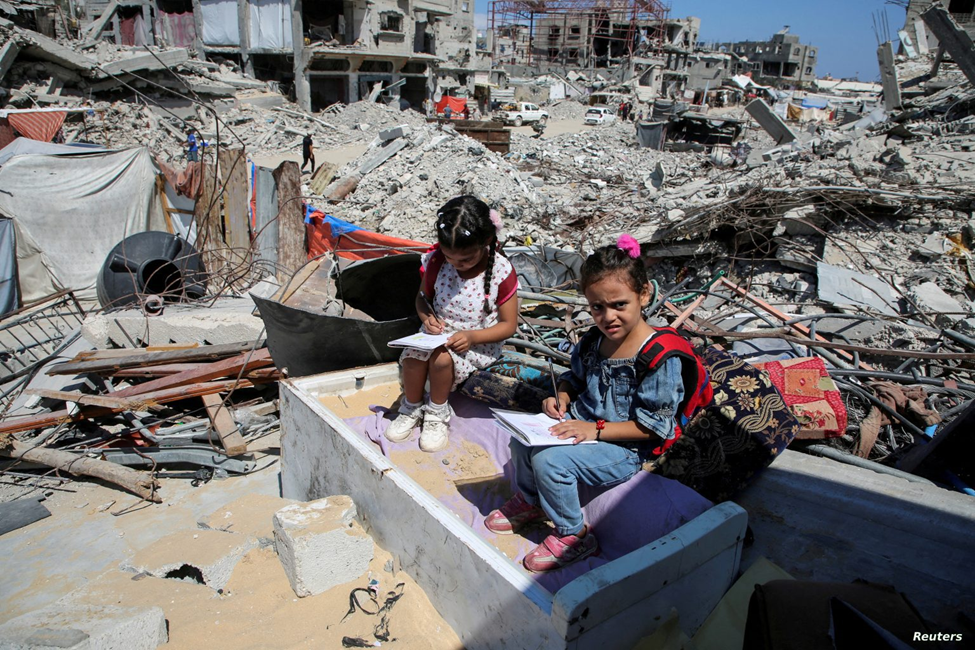
It is estimated that more than 170,000 homes were destroyed by the bombing, while more than 40,000 housing units were completely destroyed, leaving more than 1.8 million people currently in need of shelter in Gaza, according to the United Nations Office for the Coordination of Humanitarian Affairs. Estimates also indicate that at least 1.9 million people across the Gaza Strip are “forcibly displaced” from the north to the south of the Strip, meaning that about 90% of the population of the Strip was displaced in stages during the period from October 7, 2023 to January 14, 2025. This has left us with no less than half a million people in need of psychological treatment, in addition to the social consequences of the war, which have had a devastating impact on children and families in Gaza. More than 17,000 children have been orphaned, having lost both their parents. Figures 2 depicts the widespread destruction in the Gaza Strip and the level of devastation in most affected cities.
Figure 2: Widespread destruction in Gaza and its most affected cities

Sources: Damage analysis of Copernicus Sentinel-1 satellite data by Corey Scher of CUNY Graduate Center and Jamon Van Den Hoek of Oregon State University; the United Nations Office for the Coordination of Humanitarian Affairs (OCHA), OpenStreetMap, and the European Commission’s Global Human Settlement Layer (GHSL).
The Gaza Strip’s contribution to the total Palestinian economy has declined to less than 5%, down from 17% before October 7, 2023. Initial estimates indicate that the GDP in the Gaza Strip has contracted by more than 85%, and about 22% in the West Bank, so that the Palestinian economy has declined by a third compared to what it was before the war. The unemployment rate has also risen to 80% in the Gaza Strip and 35% in the West Bank, which has raised the unemployment rate in Palestine to 51%.
Limits to Recovery
The war has inflicted severe demographic disruptions on the Palestinian population, particularly in the Gaza Strip. A rapid recovery remains highly challenging due to several key factors, including the geopolitical shifts resulting from the war and their adverse effects on Gaza’s economic and social landscape; the high cost and prolonged timeline for reconstruction, which will delay the restoration of destroyed residential areas, prolong internal displacement within Gaza, leading to ongoing instability in the population’s geographic distribution until reconstruction is fully completed; and the severe damage to the healthcare and education systems, coupled with a rising dependency ratio, which will negatively impact the quality of life for Palestinians for years to come.
The Way to Reconstruction
- The ceasefire agreement is structured in three phases, with the final phase initiating the reconstruction of Gaza’s homes, civil infrastructure, and essential facilities. This phase will also involve the reopening of border crossings to facilitate the movement of people and goods.
- Egyptian companies bring prior experience in Gaza’s reconstruction, having previously participated in clearing the rubble left by Israeli airstrikes in May 2021. At that time, Egyptian technical teams, equipped with engineering machinery, assisted in removing debris from destroyed homes and towers as part of efforts to restore normal life in Gaza. Cairo also allocated $500 million in aid for reconstruction.
- Favorable environmental conditions exist for integrating Gaza into Egypt’s electricity grid.
- Egypt is the only Arab country sharing a land border with Palestine, enabling faster humanitarian aid deliveries, including essential food and medical supplies.
In conclusion, the demographic shifts in Gaza reflect the deep impact of war and blockade on the population. These factors have triggered fundamental changes in population growth rates, migration patterns, and age distribution. Beyond the direct impact on demographics, these transformations have significant social and economic implications, posing long-term challenges to development and stability in the region.
Given these circumstances, it is crucial to adopt comprehensive strategies to mitigate the effects of these changes—ranging from immediate humanitarian relief efforts to long-term development plans that strengthen the resilience of Gaza’s population and gradually restore demographic balance.
Sources
Palestinian Central Bureau of Statistics (PCBS), Women and Men in Palestine: Issues and Statistics, 2024.
The Risks of Demographic Shifts in Gaza, RA’ Strategic Studies Center, January 2025.
Economic Summary on the War in Gaza, Palestine Economic Policy Research Institute (MAS), December 2023.
Palestinian Central Bureau of Statistics (PCBS), A Year After the Assault, November 2024.
ILO assessment, War propels unemployment to close to 80 per cent and shrinks GDP by 83.5 per cent in the Gaza Strip, ILO, June 2024
Gaza War Devastation in Figures, BBC, January 2025.