





Since the outset of the Israeli-Palestinian conflict and the successive rounds of war it has witnessed, culminating in the recent Israeli war on the Gaza Strip and the subsequent regional escalation that extended to the confrontation between Israel and Iran, Egypt has continued to play its pivotal role in ceasefire and de-escalation efforts through sustained diplomatic initiatives aimed at containing tensions and preventing the conflict from expanding across the region. Egypt remains at the forefront of regional and international efforts advocating the implementation of an immediate and permanent ceasefire, while confronting all Israeli attempts aimed at liquidating the Palestinian cause.
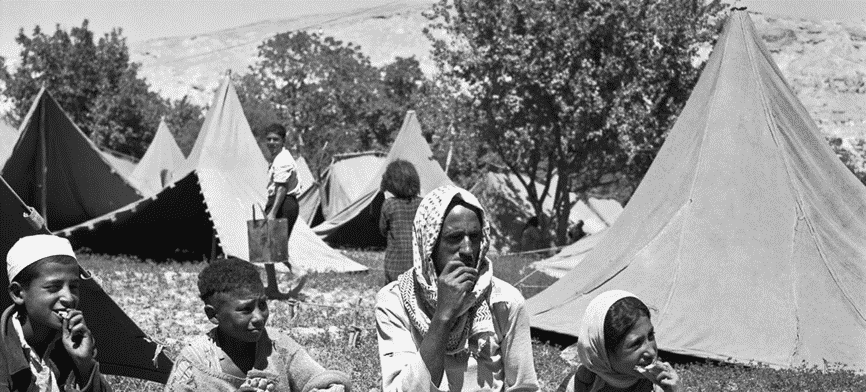
Egypt’s current efforts represent a continuation of its historic role toward the foremost Arab cause, a role that has remained unaffected by shifts in Egypt’s domestic political landscape, as the Palestinian issue has consistently remained at the top of the Egyptian leadership’s priorities. This role is not derived solely from the imperatives of geography and history, which oblige Egypt to assume an active role in this file, but also from a steadfast belief in the justice of the Palestinian cause and in the Palestinians’ right to establish their independent state, a right that was usurped by Israel 78 years ago at the onset of the Palestinian Nakba, when Israel occupied the lands of historic Palestine, forcibly displaced its inhabitants from their homes and lands, and committed some of the most horrific massacres against the rightful owners of the land.
First: The Nakba of 1948 and the Intervention of the Arab Armies
For decades, Egypt has worked to mobilize political, diplomatic, and military efforts in defense of Palestinian rights to their land.
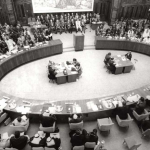
On the diplomatic front, Egyptian efforts took multiple forms, ranging from participation in and calls for conferences supporting the Palestinian cause to the presentation of just solutions to the conflict. This was reflected in Egypt’s participation in numerous events related to the Palestinian issue, including the First Islamic Conference in Jerusalem in 1931, the Bloudan Conference in 1937, and the Parliamentary Conference of Arab and Islamic Countries held in Cairo in 1938. Egypt also called for the convening of the Eastern Conference in Cairo in the same year and participated in the London Conference in 1939. That same year, Egypt rejected the White Paper, which affirmed the principle of establishing a Jewish national homeland. In addition, Egypt organized the Arab Women’s Conference in Cairo in 1944.
In this regard, Egypt was keen, within the framework of efforts to establish the League of Arab States, to formulate a unified Arab position toward the Palestinian issue. This was reflected in the outcomes of the Alexandria Protocol meetings (September 25 – October 7, 1944), which affirmed that Palestine constituted an integral part of the Arab world. The Charter of the League of Arab States, signed on March 22, 1945, further consolidated this orientation, as the Arab states called for Palestine to be represented within the work of the League through a delegate or representative, thereby underscoring the centrality of the Palestinian cause to joint Arab action.
In addition to the foregoing, Egypt hosted the first Arab Summit in Anshas in May 1946 in response to the recommendations of the Anglo-American Committee, which had called for the admission of one hundred thousand Jews fleeing Nazi persecution into Palestine. The findings of the committee were viewed as deeply unjust to the Arabs of Palestine, disregarding their rights to their land and homeland while demonstrating clear bias toward Zionist demands.
These developments unfolded in the aftermath of the Second World War, amid the emergence of multiple international initiatives aimed at reorganizing the situation in Palestine. Britain succeeded in preparing the conditions for the establishment of a Jewish state in Palestine by enabling Jewish groups to acquire vast tracts of land and accumulate large quantities of weapons. At the same time, numerous attempts were made to impose the partition of Palestine between Arabs and Jews. Parallel to this, the United States moved to advance these objectives through the Anglo-American Committee of Inquiry, which introduced the Morrison Plan in 1946. The plan was based on the division of Palestine into four regions: a Jewish region and an Arab region, both enjoying autonomous authority under the supervision of the British High Commissioner and a central government, in addition to the regions of Jerusalem and the Negev, which would remain under the authority of the central government. Consequently, Egypt emphasized during the conference that the Palestinian issue was the cause of all Arabs and that the Arab states therefore bore collective responsibility for defending the rights of the Palestinian people.
Britain subsequently attempted to persuade the Arab parties participating in the 1946 London Conference to accept the proposal. However, Egypt and the other Arab participants rejected the plan. Abdel Razzaq Al-Sanhuri, Egypt’s representative at the conference, warned that the project in its proposed form was not intended to establish a federal state, but would inevitably lead to the de facto partition of Palestine. Following the conference, Egypt launched an organized diplomatic campaign to oppose all partition plans concerning Palestine.
In the aftermath of the issuance of the United Nations Partition Resolution for Palestine on November 29, 1947, Egypt defined its position by emphasizing the necessity of providing both material and moral support to the people of Palestine to enable them to defend themselves against Zionist militias, particularly in light of Britain’s intention to terminate its mandate over Palestine and withdraw its administration and forces. Egypt also undertook military preparations along the Palestinian border in anticipation of the developments unfolding there.
On the military front, and in response to the horrific massacres committed by Zionist groups against numerous Palestinian villages with the aim of spreading terror among Palestinians and forcing them to flee their homes and villages, as well as their seizure of the city of Haifa and Egyptian-owned property there, in addition to the massacres committed against Egyptian nationals residing in the city—most notably the “Haifa Refinery Massacre” of December 30, 1947, in which Zionist elements targeted Arab workers, including Egyptians, employed at the refinery—mass demonstrations erupted across Egyptian cities demanding intervention to rescue Palestine.
Accordingly, the Egyptian government announced its approval of supporting joint Arab action, initially through the dispatch of volunteers to Palestine under the umbrella of the League of Arab States, while Egyptian army officers supervised their military training and preparation. Egypt also handed over the Heliopolis military camp to the League of Arab States for the training of volunteers, which subsequently led to the formation of a volunteer force known as the “Arab Salvation Army.”
As conditions in Palestine continued to deteriorate and Zionist militias intensified their crimes and massacres, it became increasingly evident that Arab resistance forces lacked the manpower and weaponry necessary to confront those militias effectively. Consequently, Major General Ismail Safwat, head of the Military Committee affiliated with the League of Arab States, traveled to Cairo to inform the League’s Political Committee that the Arab volunteers were incapable of confronting the Zionist militias and that resolving the situation required the direct intervention of Arab armies.
Despite the clarity of the declared political objective of the war—upon which the Arab states had collectively agreed—namely preserving the Arab identity of Palestine, the military-political objective remained ambiguous. The directive issued to the chiefs of staff of the Arab armies merely called for “taking decisive measures to thwart the partition plan and pursuing the battle to its victorious conclusion.” This ambiguity was reflected in the absence of a clearly defined strategic objective for the forces involved. What ultimately emerged was a broad conceptual framework rather than a concrete military plan, centered on achieving rapid military gains in favor of the Palestinian cause before United Nations intervention, without specifying the means to achieve such an outcome, whether through the destruction of enemy forces, their encirclement and surrender, or the seizure of specific territories to secure a partial victory in support of the broader political cause.
Second: Egypt’s Role in the 1948 War
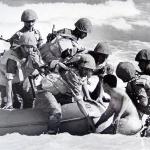
Despite the lack of clarity surrounding the war plan, Egypt played a pivotal role throughout the course of the war in Palestine, which lasted for eight months and passed through several phases marked by a number of truces imposed by the United Nations Security Council. Egypt’s military intervention was carried out through both army forces and volunteers; Egyptian troops crossed into Palestinian territory on May 15, 1948. Egyptian forces advanced along the southern sector, taking control of areas in Gaza and Rafah, while extending their operations toward positions in the Negev, including Beersheba and its surrounding areas. They also conducted military operations along multiple axes in southern Palestine. Egyptian operations witnessed periods of both advance and retreat in accordance with battlefield developments and the temporary truces imposed during the war.
On June 11, 1948, with the implementation of the first truce imposed by the Security Council, the southern front witnessed attempts by Israeli forces to threaten Egyptian supply lines between Al-Majdal and Ashdod, in addition to sporadic attacks on Arab villages near the Iraq Suwaydan axis. Egyptian forces, however, succeeded in repelling these attacks and consolidating their positions.
Following the expiration of the first truce on July 9, 1948, military operations resumed along the front lines. Egyptian forces continued to consolidate their positions in southern Palestine while maintaining the siege imposed on strategic areas, most notably Fallujah. At the same time, attacks against several positions continued, yet Egyptian forces managed to withstand and repel a number of those offensives.
With the fighting halted for a second time, and despite the clear disparity in troop numbers and military capabilities between the Egyptian and Israeli forces, this phase was characterized by alternating offensives and counteroffensives between the two sides, while Egyptian forces maintained the cohesion of their defensive lines and the stability of their positions. Meanwhile, Israeli forces continued launching sporadic attacks in several areas, including the assault on Fallujah on July 27. However, the steadfastness of Egyptian forces and local volunteers inside the town prevented the attack from achieving its objectives, forcing Israeli forces to withdraw. The area of Iraq Al-Manshiyya was also subjected to bombardment from multiple directions before the attacking forces retreated under the pressure of resistance and the field losses they sustained.
On August 1, Israeli forces attempted to advance east of Fallujah toward the south in order to supply their isolated settlements in the Negev. However, the operation was forced to retreat after entering a minefield that destroyed several of its vehicles. On August 18, one month after the commencement of the second truce, Israeli forces launched an attack on Jabal Al-Mukabber in Jerusalem but failed to capture it due to the resistance mounted by Egyptian forces and volunteers.
Fighting on the Egyptian front during the 1948 war soon resumed when Israeli forces launched Operation Yoav in mid-October, aimed at breaking Egyptian control in southern Palestine and reopening the route to the Negev. The operation focused on targeting Egyptian supply and communication lines, including the vital roads surrounding Gaza, Rafah, and Al-Majdal, in addition to attacking Egyptian positions in the areas of Deir Sunayd and Iraq Suwaydan. This intensified pressure on Egyptian forces, compelling them to reinforce their defensive positions and maintain their lines of contact in the south. The operations were also accompanied by Israeli attempts to isolate the Egyptian pocket in Fallujah and Iraq Al-Manshiyya from the rest of the Egyptian forces in the north. Nevertheless, those forces remained steadfast within their besieged positions despite the intensifying combat.
On November 4, 1948, the United Nations Security Council adopted Resolution 61, which called for a ceasefire in Palestine and for strengthened United Nations efforts to contain the military escalation between Arab and Israeli forces, within the framework of international efforts aimed at consolidating calm across the various fronts. During this stage, and amid the ongoing battlefield challenges faced by Egyptian forces in southern Palestine—particularly shortages in supplies and ammunition and the increasing complexity of the military situation—the Egyptian military command in Palestine underwent reorganization in November 1948. Major General Ahmed Fouad Sadeq assumed command of the Egyptian forces as part of efforts to improve operational management and enhance battlefield performance.
As military operations continued and pressure on the southern front intensified, discussions emerged within Egyptian political and military circles regarding a reassessment of the military situation and Egypt’s presence in Palestine, though no immediate decision was taken concerning a full withdrawal. With the escalation of operations, Israeli forces launched Operation Horev on December 22, 1948, aimed at securing full control over the Negev and ending the Egyptian military presence there. The operation involved large-scale attacks across multiple southern axes, alongside attempts to advance northwestward toward the vicinity of Al-Arish in order to pressure and isolate Egyptian forces. However, these movements encountered resistance from Egyptian units stationed in their defensive positions, limiting the attacking forces’ ability to achieve a decisive breakthrough on several fronts.
In the later stages of the operation, Israeli forces concentrated their efforts on intensifying pressure toward Rafah and the Gaza axis with the aim of reducing the operational scope of Egyptian forces. These military operations coincided with escalating international efforts to consolidate a ceasefire, which ultimately paved the way for the final armistice agreements concluded in 1949.
Operation Horev came to an end in January 1949 after Israeli forces penetrated the Sinai Peninsula as far as the Auja area (Nitzana), in an attempt to pressure Egyptian forces and compel their withdrawal from southern Palestine and the Gaza Strip. This incursion provoked international reactions, as Britain warned Israel against continuing its advance into Sinai and signaled the possibility of intervention pursuant to its obligations under the 1936 Anglo-Egyptian Treaty. This pressure contributed to the withdrawal of Israeli forces from Egyptian territory and their retreat beyond the border.
With the cessation of hostilities, Egypt was compelled to enter into armistice negotiations with Israel under United Nations sponsorship through the international mediator Ralph Bunche, who was tasked with facilitating ceasefire agreements between the concerned parties. Bunche formulated a number of provisions that favored Israel and aligned with the American vision. He also succeeded in stripping the eastern areas of Sinai and the Gaza Strip of any major Egyptian offensive military presence. The agreement imposed reductions on Egyptian forces in Gaza, Rafah, and Bethlehem to levels sufficient solely for defensive purposes, while restricting armaments to those of a defensive nature. In addition, the Auja area was designated a demilitarized zone to be administered by the United Nations pending the settlement of military arrangements. The agreement also enabled Israel to maintain military forces on the opposite side of the armistice line equivalent to the combined strength of Egypt and Jordan, effectively granting Israel a force twice the size of the Egyptian contingent.
The Permanent Armistice Agreement, commonly referred to as the “Rhodes Agreement,” was signed on February 24, 1949. Nevertheless, the Egyptian delegation skillfully succeeded in ensuring that the Palestinian issue remained unresolved and was not conclusively settled during the negotiations. The delegation also refrained from engaging in political matters, focusing exclusively on military aspects. The agreement explicitly stipulated that the armistice line should not be interpreted as a political or territorial boundary. The armistice line was drawn largely along the 1922 international border between Egypt and Mandatory Palestine, with the exception of the Mediterranean coastal area, where Egypt retained control over a strip of territory that subsequently became known as the “Gaza Strip.” The agreement also allowed the Egyptian forces besieged in the Fallujah pocket to return to Egypt with their weapons, while the area itself was transferred to Israeli military control.
Third: The Post-Nakba Period
The 1948 war resulted in consolidating the foothold of the Zionist entity within Palestine, compelling the Egyptian state to continue adopting a multidimensional approach to ensure that regional and international momentum surrounding the Palestinian cause would not diminish.
• Egypt and the “All-Palestine Government”: Following the end of the British Mandate, the declaration of the State of Israel, and the entry of Arab armies into Palestine, Palestine became an arena of conflict among competing forces seeking control over its territory or disputing authority and jurisdiction. At the time, the Arab Higher Committee for Palestine—which had ostensibly represented the Palestinian entity since 1946—had no effective presence or meaningful role in Palestinian affairs. In response, the League of Arab States sought to rectify the situation by announcing the establishment of a civil administration for Palestine on September 22, 1948, under the nominal leadership of Hajj Amin Al-Husseini, while Ahmad Hilmi Abdel Baqi assumed the position of prime minister. The objective was to provide political representation for the Palestinians during that phase. However, with the resumption of fighting after the expiration of the truce, the inability of this administration to function effectively became evident.
Disagreements among the Arab states intensified on September 16, 1948, following the release of the report of the United Nations mediator, Count Folke Bernadotte, who stated that the Arabs had shown no intention of establishing a government in the Arab section of Palestine. In response, the Arab Higher Committee became increasingly active, and Hajj Amin Al-Husseini, along with others, mobilized to oppose such assertions. Meanwhile, Jamal Al-Husseini, the Palestinian political figure, embarked on a tour of Arab countries in an effort to secure governmental approval for the establishment of a Palestinian government.
Accordingly, the Political Committee of the League of Arab States convened and approved the establishment of such a government. On September 23, 1948, the Arab Higher Committee officially announced the formation of the “All-Palestine Government,” temporarily headquartered in the city of Gaza under the leadership of Ahmad Hilmi Abdel Baqi. It was also decided to convene a Palestinian National Congress in Gaza on September 30 in order to confer legitimacy upon the government, with full encouragement from the Egyptian government, which supported the view that the establishment of a Palestinian government would present the international community with a political reality consistent with the Arab League’s decision not to recognize the Jewish state.
Egypt officially recognized the government on October 12, 1948, and pledged to provide five million Egyptian pounds to support the establishment of its administrative institutions and the formation of a Palestinian army to be trained by Egypt in preparation for the continuation of the struggle to save Palestine.
- Egypt and the Administration of the Gaza Strip: The Gaza Strip came under Egyptian administration on May 26, 1948. Given the ongoing military confrontations at the time, this administration was naturally military in nature. The Strip remained under Egyptian control pursuant to the Egyptian-Israeli Armistice Agreement signed on February 24, 1949. On August 8, 1949, the Egyptian Minister of War authorized the Administrative Governor-General of the Strip to exercise all powers and authorities previously vested in the British High Commissioner prior to the termination of the Mandate. Major General Ahmed Salem Pasha, Director General of the Royal Border Guards and Military Governor of the Eastern Desert and other border regions, was appointed Administrative Governor of the Gaza Strip.
The Egyptian administration governed the Strip through a civil administration that was often overseen by military officials. It restored the governmental departments that had operated during the British Mandate period, including education, health, agriculture, and civil and Sharia courts. Egypt also implemented its own educational system within the Strip and expanded the establishment of schools. Egyptian universities admitted large numbers of students from Gaza, while Al-Azhar, as the leading Islamic university, supervised the religious institute established by the people of the Strip. In the healthcare sector, Egypt established Al-Shifa Hospital and equipped a fully integrated medical laboratory. The Egyptian Ministry of Health also carried out numerous campaigns to combat various diseases.
In practice, the Gaza Strip remained under Egyptian administration despite the fact that Egypt never laid claim to any Palestinian territory nor annexed it. Consequently, Egypt did not grant Egyptian nationality to Palestinians. Even when the “All-Palestine Government” issued passports in 1949 to Palestinians residing in the Gaza Strip, Egypt did not permit unrestricted movement into Egyptian territory, out of concern that such measures might contribute to depopulating the Strip of its Palestinian inhabitants.
- Egypt and the Palestinian Refugees: A number of Palestinians who were displaced prior to the outbreak of war on May 15, 1948 sought refuge in Egypt. In response, the Egyptian government established the “Higher Committee for Palestinian Migrants Affairs” and allocated the necessary resources for their care. Following the war, large numbers of Palestinians fled to Egypt, prompting the authorities to allocate a camp for them in Abbassia, before subsequently establishing a larger camp in the Qantara area as their numbers increased. Thousands of Palestinians also resided in Egypt using official travel documents and lived there at their own expense.
Egypt also sought to coordinate with international bodies to secure the return of Palestinian refugees to Palestine and compensation for those who had lost their property, in accordance with the United Nations General Assembly resolution issued on December 11, 1948. Egypt participated in the Beirut Conference held from March 31 to April 15, 1949, during which it insisted that the refugee issue be placed at the forefront of priorities and emphasized the necessity of confronting Israeli measures against Arabs residing in the areas occupied by Israel.
In addition to its political, diplomatic, military, and humanitarian roles, Egypt made immense sacrifices in defense of the Palestinian cause. During the battles in Palestine in 1948 and 1949, large numbers of Egyptian army officers and personnel, as well as civilians, lost their lives. Official Egyptian reports stated that 98 Egyptian officers were killed during the military operations in Palestine, while other sources indicated that the total number of Egyptian martyrs reached 926 officers, soldiers, and civilians, excluding civilian volunteers who participated in the war and were not included in those figures. The greatest losses occurred during the final phase of the war, in December 1948 and January 1949, after Egyptian forces shifted to a defensive posture and came under Israeli attack.
In conclusion, 78 years after the Palestinian Nakba, and despite the numerous United Nations resolutions affirming Palestinian rights, Israel’s denial of those rights continues through ongoing policies of genocide, displacement, forced expulsion, land confiscation, home demolitions, and the establishment of illegal settlements, all aimed at eliminating any possibility or hope for the establishment of an independent Palestinian state. Accordingly, the memory of the Nakba will remain not only a reminder of the tragic events of 1948, but also of the enduring injustice suffered by the Palestinian people throughout these decades.