







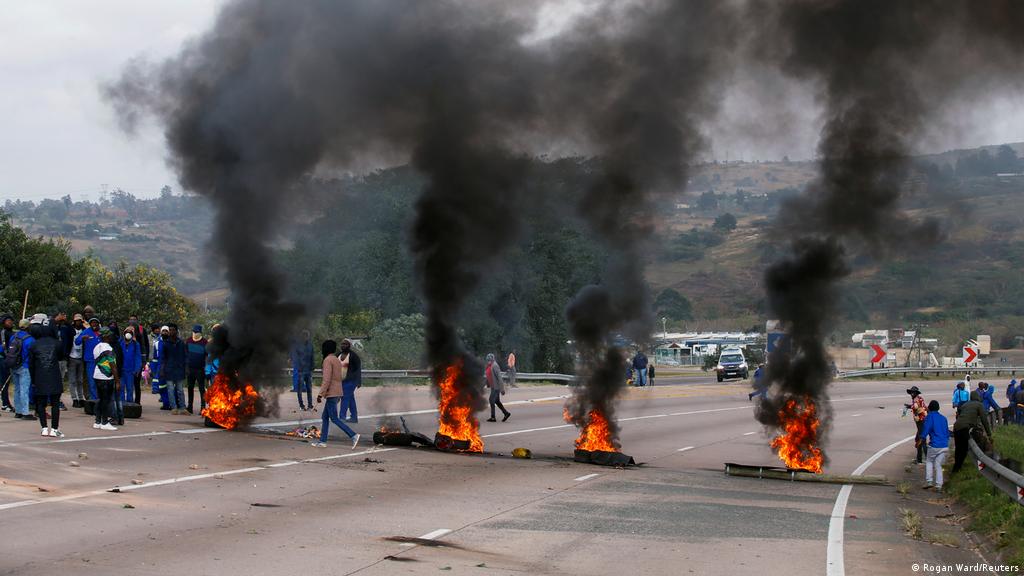
The flare of violence that raced across South Africa for the first time since Apartheid, particularly in KwaZulu-Natal and Gauteng provinces in July 2021, wasn’t merely a reflection of the polarization within the ruling African National Congress (ANC) party nor of the country’s economic and social poor conditions manifested in the widespread protests that later developed into violent riots after Pro- Zuma demonstrations went out against the backdrop of the Constitutional Court’s ruling ordering jailing him for involvement in corruption charges but was rather a revealing test for South Africa’s democratic model, being a shining example amid numerous instances of democratic transitions that stumbled in many sub-Saharan African countries.
South Africa’s Democratic Model
Of all democratic transformations in sub-Saharan Africa, South Africa’s model –adopted since the end of Apartheid and the ANC coming to power in 1994– posed an exception, with the country enjoying relative stability, principles of constitutional democracy being adhered to, and the army maintaining its professionalism shifting away from interference in politics. Unlike sub-Saharan African countries, South Africa didn’t see any military coups, maintained constitutional stability, and experienced an economic boom that qualified it to be one of the fastest growing economies in sub-Saharan Africa. Further, the country witnessed relative stability and a peaceful transfer of power despite the generated polarization and splits within the ruling party.
The year 2008 marked a significant milestone in the history of constitutional democracy in South Africa, where the considerable polarization within the ruling party resulted in the resignation of President Thabo Mbeki, the second president of South Africa who succeeded Nelson Mandela. Following a transitional period under Galema Motlanthe, the ANC elected Jacob Zuma as president and he took power from 2009-2018. In 2018, given the escalated polarization within the ANC and the widespread corruption, the party forced Zuma to resign which marked another landmark in the history of democracy in South Africa. Zuma was succeeded by the current President Cyril Ramaphosa, who pledged to eliminate corruption and prosecute those involved in it, including President Jacob Zuma.
Bringing Zuma to trial was the spark that ignited the fire and led to the expansion of violence in South Africa last July after Zuma was sentenced to 15 months in prison for refusal to comply with the judiciary and stand before the court. Between Zuma’s supporters, who threatened to destabilize the country if he was arrested, and supporters of incumbent Ramaphosa who accused Zuma’s supporters of blocking Ramaphosa’s institutional and economic reform, the recent events uncovered the imbalance of the South African model and the deteriorating economic and social conditions the country suffers. This situation revealed that the transformation that took place in the 1990s hadn’t put an end to racial inequality between the white and the black communities but rather took root in the social and economic environment, a situation that could be attributed to the structural imbalance the country inherited with the white community and a minority of the black elite that came to power in the mid-1990s controlling vital sectors of the economy while the vast majority of the population continued to suffer marginalization.
Irrespective of these political polarizations, the crisis carries within it dimensions of the economic crisis and vulnerability of the South African model adopted after Apartheid, a model that contributed to promoting inequality and the poor distribution of wealth and income. For their part, South Africans see that their country is not a failed state but it is the global economic model that is failed. For them, it is the global economic model that took South Africa to dwindling levels on the Gini index measuring income or wealth inequality within a nation or a social group.
In the last decade during Zuma’s tenure, the economic situation had worsened. Since 2011, the gross domestic product (GDP) growth rate has not exceeded 3 percent, with persistently high rates of unemployment and crime. Estimates indicate that the recent unrest cost the country R50 billions of its GDP. Losses of Durban’s businesses amounted to R1.5 billion in addition to property loss of R15 billion with 50,000 traders and 40,000 businesses impacted by violence. This economic situation affected 150,000 jobs leaving 1.5 million people jobless.
A Test for the Democratic Model
The looting, theft, and vandalism of commercial centers and banks that KwaZulu-Natal and Gauteng provinces –where the city of Johannesburg and the capital Pretoria are located– posed a test for the political cohesion of the ruling party and the ethnic policies adopted by ethnic-base parties in South Africa.
The protests and cases of looting reflected the economic and social deprivation suffered by the black majority in South Africa, an outcome of mismanagement and corruption entrenched during Zuma’s rule, both exacerbated the suffering of the country which inherited a structural imbalance which consolidated inequality and the poor distribution of income and wealth, typical features of economic liberalism that dominated South Africa’s economy, rendering it one of the most prominent examples of economic inequality globally.
Indeed, the Black Economic Empowerment (BEE) program has only made the black elite richer, with investment opportunities curtailed in most regions of the country due to land policies that has yet to be reformed and corruption that extended to the productive and service sectors of the most prominent industrialized country in Africa.
Now, South Africa is suffering high unemployment rates standing at about 30 percent, with unemployment rates among youth reaching about 70 percent. This proves the failure of the NCP to achieve just and comprehensive national development Worse, the economic repercussions of the lockdown due to Covid-19 have exacerbated the economic crisis of South Africa.
Irreconcilability between promises to promote economic and social rights and the exacerbation of economic crisis, resulted in escalation of anger and a decline in the popularity of the ruling party. Further, suspicions of corruption led the ruling party to suffer dwindling popular support at the municipal level, as has been evidenced in the 2016 elections. When Ramaphosa assumed power, he couldn’t move forward with his program aimed at eliminating corruption and implementing institutional reform due to the resistance of Zuma loyalists’ and their control over most sectors. However, recently, Ramaphosa took a series of measures that transformed the NCP situation. In July 2020, he introduced changes to the regulations, allowing law enforcement agencies to use evidence presented to the State Fund Seizure Commission, making it easier to lay charges against officials.
By the time Zuma was indicted, anger had reached a boiling point among his loyalists. As Ramaphosa was defending the rule of law, the security sector, particularly the police and intelligence agencies, were paralyzed by corruption, nepotism, and political interference which affected the state’s ability to uphold the rule of law and prevent crime, posing another test for South Africa’s security and judicial institutions measuring the state’s ability to enforce law, abide by principles of impartiality and neutrality, and refrain from engaging in political polarization among members of the ruling party. Under no circumstances can the recent acts of violence negate the NCF’s failure in reducing inequalities and the growing unemployment and perhaps this situation is the reason for the repeated reform calls and demands for an income grant instead of a wealth tax in an attempt to address structural disparities and avoid further turmoil.
Given the high levels of crime and impunity, South Africa needs to reform its police institutions and the politicized security sector in a way that would likely help citizens restore trust in the government. In the 2020 Corruption Perceptions Index (CPI) –an index that measures the perceived levels of public sector corruption – South Africa ranked 69th out of 180 countries and on the Global Peace Index (GPI), it ranked 123rd although it showed an improvement in the Internal Peace Index scores, particularly with regard to political terrorism, violence, and human rights violations, with the number of prison decreasing despite the continuing high rates of crime and the widespread violence in the country.
In the period between 2011 and 2018, unrest in the country increased by 86 percent, with the largest levels recorded in the period between 2017 and 2018, during Zuma’s tenure with student protests mounting.
Likewise, South Africa’s score on the African Governance Index saw a decline in all sub-indicators pertaining to security, rule of law, accountability, transparency, and anti-corruption. Among all countries on the index, South Africa was the only country witnessing a decline in human development over the last ten years.
According to the 2020 Index of Economic Freedom, the South African economy remained on the list of non-free economies. This requires South Africa to regain momentum towards greater economic freedom by giving priority to improving the judicial system and confronting the ongoing stalemate in the labor market, with the need for the government to reconsider the Land Reform Act, particularly its “land confiscation without reimbursement” practice that hampers investment and development.
According to 2020 estimates, the budget deficit accounted for 4.9 percent of South Africa’s GDP while public debt accounted for 62.2 percent of it. In addition, the cost of obtaining electricity continued to rise, as corruption continued to surround the state-owned company, ESCOM, despite government promises to reform it.
Overall, despite the political and economic achievements of South Africa, Zuma’s capture of the state, the corruption charges in which family-owned companies and businessmen loyal to Zuma were involved, the involvement of businesses in financing electoral campaigns, and the 1990s arms deal in which Zuma was involved are all factors that contributed to derailing South Africa’s economic progress.
That said, corruption alone can’t be blamed for the entire challenges South Africa is facing. Inequality and the economic and social imbalance reveal the structural imbalance that can be attributed to the system inherited in the 1990s which requires an in-depth re-examination of the current economic and social structure, so as to spare the country further deterioration.


