




In his speech at the military colleges’ commencement on 12 October, President Abdel-Fattah Al-Sisi emphasized the importance of the international community shouldering its responsibility to ensure the timely delivery of humanitarian aid to the Gaza Strip. This appeal comes as the humanitarian situation in the occupied territories has been deteriorating since 7 October due to the nonstop bombing and the imposition of a complete siege beginning, as well as the refusal of the occupation authorities to open safe corridors for civilians or to allow the entry of relief convoys, in violation of international humanitarian law, threatening an unprecedented humanitarian catastrophe.
Status Quo: It is Getting Worse
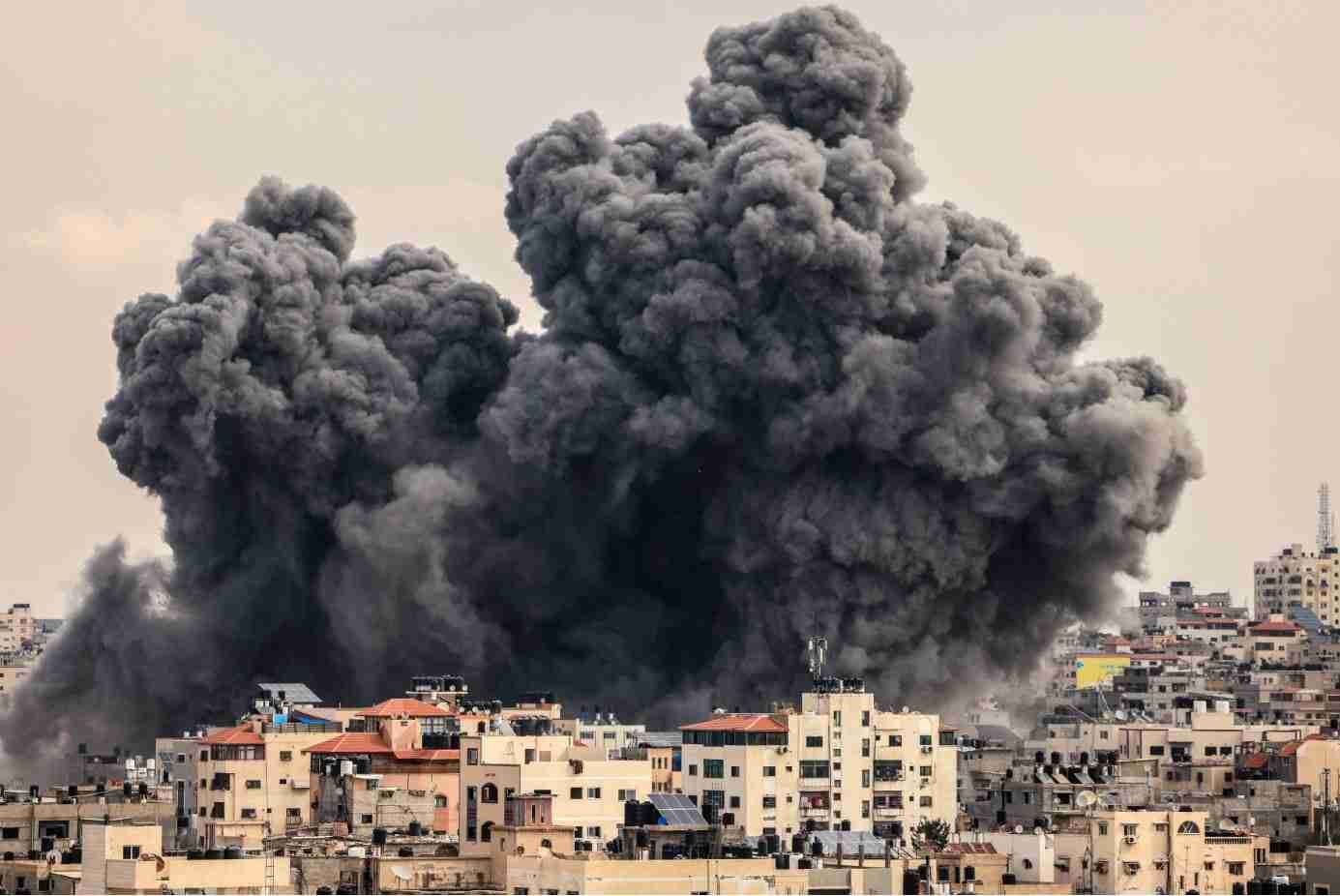
According to Article 33 of the Fourth Geneva Convention relative to the Protection of Civilian Persons in Time of War, “no protected person may be punished for an offence he or she has not personally committed. Collective penalties and, likewise, all measures of intimidation or terrorism are prohibited. Pillage is prohibited. Reprisals against protected persons and their property are prohibited.” Nevertheless, over the course of seven days, the Israeli occupation forces broke every rule in this article, killing more than 2,750 Palestinians in the Gaza Strip, destroying the infrastructure that had already been harmed by years of Israeli bombing, intimidating the remaining 2.2 million Palestinians in the Strip, and displacing more than 423,000 people.
It continued past the brutal bombardment of the Gaza Strip, during which the occupation forces used more than 4,000 tons of explosives, and included cutting off water, electricity, and fuel supplies as well. As a result, the Gaza Strip was plunged into total darkness, with only 3 or 4 hours of electricity per day, and medical facilities and hospitals were rendered inoperable, making it impossible for medical teams to help the more than 7,000 injured people.
Despite the fact that 60 percent of Gaza’s population lives below the national poverty line and relies on UNRWA and the World Food Program’s (WFP) assistance, the occupation forces’ blockade threatens to deplete the Strip’s food supply. According to the WFP spokesperson, most stores on the Strip are nearly out of food supplies, and there will not be enough for more than a week. Additionally, the WFP has access to only 44,000 people’s worth of food supplies. The WFP has ordered food supplies from a variety of locations for delivery to the Palestinians, but the occupation forces will not allow safe entryways for this aid.
The occupation forces in Gaza were not content with the deliberate killing and starvation operations against defenseless civilians; they have pushed for forcible displacement of the population since day one. On the seventh day of the escalation, the occupation army reiterated its call for Gazans to head south and not approach the border fence with Israel in preparation for expanded military operations inside the Strip, which portends an unprecedented humanitarian catastrophe in the region.
The West’s Support for Israel’s Occupation Worsens the Crisis
According to the UN High Commissioner for Human Rights, it is against international humanitarian law to impose a siege that puts civilian lives in danger by depriving them of necessities for survival. Human Rights Watch also described the occupation army commanders’ statements as “a call to engage in war crimes.” Starvation as a weapon and depriving the people of occupied Palestine of food and electricity both qualify as war crimes.
Despite warnings from the United Nations and international organizations that the occupation forces are committing war crimes against Palestinian civilians, the United States and European Union countries have taken measures that would worsen the humanitarian catastrophe in the occupied territories. The Western nations’ show of support for the Israeli occupation did not end with their 7 October statement of solidarity with the victims of Hamas’ attack. It has grown to include American military assistance to Israel, which now includes an aircraft carrier with a crew of 5,000, the provision of warplanes to support American military bases in the Middle East, and a cell of special operations forces to liberate hostages.
In the same context, Germany, France, the United Kingdom, and Italy expressed their solidarity and unwavering support for Israel, emphasizing that they are working to ensure Israel’s ability to defend itself and its citizens. Germany has made available two drones to the occupation forces, whereas the British government confirmed that its naval and air patrol forces would begin on 13 October to monitor what they described as threats to regional stability.
This exaggerated military support makes it abundantly clear that the strategy of the occupation forces goes beyond simply releasing the hostages that Hamas managed to seize or dismantling the infrastructure of the Palestinian resistance to include committing a significant crime against the Palestinians in order to put an end to their cause, which would necessitate the intervention of some regional powers.
Western support did not end with solidarity and providing military support to the occupation forces, but the European Union announced the suspension of aid to the Palestinians before reversing its decision in response to opposition from Ireland, Spain, and Luxembourg. This decline, though, was only pro forma because Sweden, Denmark, Germany, and Austria all announced they were stopping their aid to the Palestinian territories. Thus, the Western nations, which have poured more than $160 billion into Ukraine’s war against Russia, are placing the Palestinians in a difficult position and contributing directly to the deterioration of the humanitarian situation in Palestine. In other words, we are currently complicit in the war crimes committed against the Palestinians by the occupation forces.
Egyptian Efforts to Ease the Crisis
In contrast to the Western position, which is biased in favor of the Israeli occupation, Egypt’s stance on the Palestinian cause remains unchanged.
The Egyptian state, represented by President Al-Sisi and the Ministry of Foreign Affairs, placed a strong emphasis on protecting the rights of the Palestinian people to stay on their land and resist attempts at forced eviction by the occupation forces, which have been practiced for a week. Since the outbreak of the escalation between the resistance and the occupation forces, Egypt has been attempting to calm the situation between the two sides and provide humanitarian aid to the Palestinians at the Rafah border crossing, which has been bombed multiple times. Occupation forces, however, insist that all hostages be released from Hamas’s control before they will restore calm or open humanitarian corridors for international aid to enter.
In response to the continued Israeli bombing of Gaza and the severing of water, electricity, and food supplies to the population there, the National Alliance for Civil Development Work announced on 10 October that President Al-Sisi had ordered the preparation of an aid convoy. Along with the significant efforts being made by the Egyptian Red Crescent on the Egyptian side of the Rafah crossing to receive the injured and other people in need of assistance, this convoy contains enormous amounts of humanitarian, food, and medical aid.
Egyptian efforts extended beyond preparing Egyptian relief convoys and guiding them to the Rafah crossing. They also included coordinating all international relief efforts by parties wishing to provide aid to Gaza, as well as receiving international aid at Al-Arish International Airport and directing it to Gaza through the Rafah land crossing when humanitarian corridors were opened. Egyptian efforts with the United States to open humanitarian corridors resulted in US confirmation of aid delivery to Gaza residents. Aid vehicles and aircraft from Jordan and Turkey have already touched down at Al-Arish Airport in preparation for the opening of the Rafah crossing.
Egyptian efforts also included communicating with all international actors and reaching an agreement with the European Union to ensure humanitarian aid could enter the Gaza Strip. Additionally, there was agreement with the British Prime Minister on the significance of stepping up efforts to ease tension, safeguard civilians on both sides, and stop a decline in security and humanitarian conditions.
Given the aforementioned, it is obvious that the humanitarian situation in the Gaza Strip is on the verge of catastrophe as long as the occupation forces continue to engage in war crimes-level atrocities against civilians. Despite widespread Western support for Israel, a glimmer of hope for the Palestinian people comes from Egypt’s tireless efforts to coordinate with Europe and the United States to halt the occupation’s attack on Gaza and open humanitarian corridors, as well as to mobilize international relief efforts and deliver them to the Palestinians.