


Sustainable development issues and the repercussions of climate change have become the focus of international attention on all levels. With the global consensus around the 2030 Vision for achieving Sustainable Development Goals, most scientific and industrial specialties are striving to become green, especially education.
The momentum that accompanies Egypt’s hosting of the COP27 Climate Change Conference in November leads us to question the relationship between the development of the curriculum and sustainability issues, and whether the new curriculum is really green. Does the development of the education reform project’s curricula meet the requirements of sustainable development? How will its future results affect students?
The Structure of New Curricula and their Relationship to Sustainable Development
The organization of the curriculum’s structure means identifying interest frameworks around which the curriculum activities and experiences will revolve, affecting learning outcomes. As for the curriculum of the new education system (2.0), it was built in light of the national strategy to develop pre-university education in 2014, so the Egypt Vision 2030 can be translated according to general frameworks of pre-university education curriculum 2011 and the standards and indicators of international education. This is done with the aim of defining a general framework of general and technical education graduate specifications, achieving good behavior for the development of life and scientific skills, and developing values that support the development of a good citizen who seeks sustainable self-learning, and can employ technology to achieve integration and interconnection of knowledge, testing its honesty and treating it.
The philosophy of the new curriculum’s framework seeks to achieve multiple goals including developing life skills, developing entrepreneurial skills, promoting positive values, achieving an overall growth of learners, using critical thinking skills and evaluating knowledge, and mastering continuous self-learning skills by integrating technology into education.
The new curriculum structure depends on eliminating the separation of knowledge between subjects by learning four main areas, which are:
- Languages: This includes Arabic as a mother tongue, English as a first foreign language, alongside another foreign language
- Personal, Social, and Physical Education: This includes physical, health, religious, and vocational education
- Science and Technology: This includes social studies, science, and mathematics
- Finally, Arts: This includes artistic, music, and theatrical education, as well as libraries and educational media
These fields are integrated to achieve knowledge, skill, and value development. Explaining further, the new curriculum includes courses incorporated into a book of interdisciplinary fields for the kindergarten and elementary levels, according to a “spiral” organization structure that achieves the development of knowledge, values, and skill across school stages. The boundary between what the child learns at school and what they do outside is dropped, where education shifts from studying traditional subjects separate from life to a cognitive map intertwined to integrate its issues according to the knowledge path determined by the learner, per their cognitive assessment.
The new curriculum teaches and discusses 7 local and global issues and challenges, according to figure 1, which include development and environmental issues and themes. Generally, these issues are dealt with through fixed themes across school stages, which include, who am i, the world around me, how it works, and self-expression, to achieve four main goals, which are, learning to be, learning to know, learning to work, and learning to live, according to figure 2.
Figure (1): Topics and Issues of the General Curriculum Framework in the New Education System 2.0

Figure (2): Curriculum Building Themes in the New Education System 2.0

These goals are achieved by implementing a variety of activities and projects, inside and outside the classroom, covered by all subjects of study. The presence of development and environmental issues in the framework for building the new curriculum demonstrates that the development and sustainability goals are properly integrated into the education system. Additionally, this was confirmed by the “Environmental Education in Arab Countries” report, which was done by the Arab Forum for Environment and Development, in 2019, where Egypt was one of the three countries that made promising progress in integrating the subjects of education for sustainable development into the curriculum. In this context, building new subjects and issues in the curriculum according to the “world around me” and “how the world works” themes, reflects making the students aware of their roles towards the environment.
Analyzing the New Curricula from a Green Perspective
Egyptian education reform measures, which launched in 2018, included the introduction of new curricula at some levels of education, specifically from kindergarten (level I and II) to primary fourth grade until the last academic year, with curricula being introduced to the fifth grade and subsequent stages successively year after year.
We can analyze new curricula from a green perspective according to the availability of environmental education and sustainable development topics and activities in specialized scientific curricula directly related to the environment such as multidisciplinary curricula, science curricula, social studies curricula, and skills curricula such as vocational skills curriculum, international communication, and technology (ICT) curriculum which was first applied at the primary level last 2021.
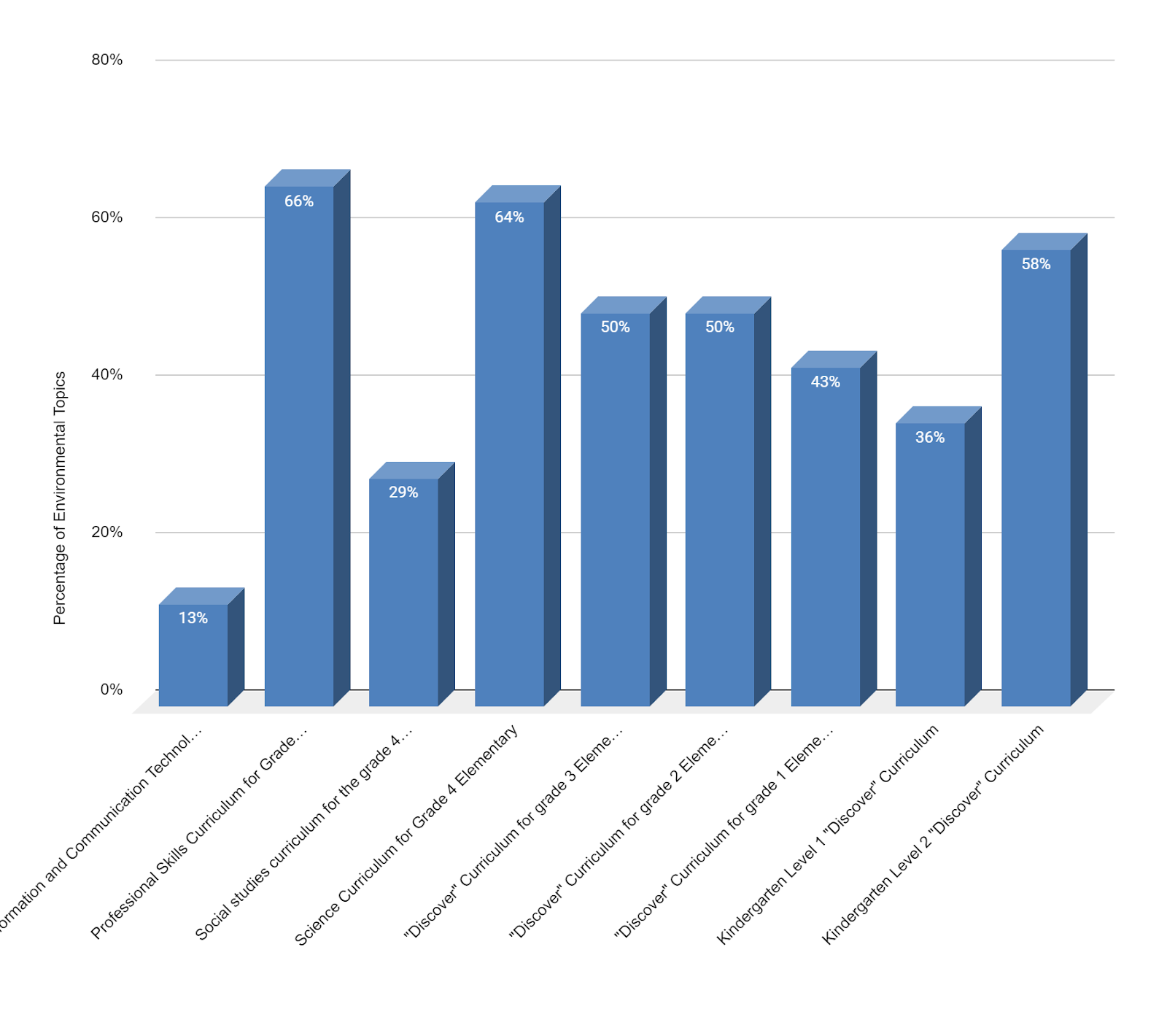
As for specialized curricula, the “Discover” curriculum at the Kindergarten level (level 1) includes seven topics that directly discuss the issue of the environment, out of 12 topics in total, over 58 percent of the curriculum. Moreover, this percentage decreases to 36 percent in the “discover” Kindergarten level 2 curriculum, where at this point, the curriculum includes only four topics about the environment and sustainable development, which are two feet and four claws, our natural science, a man-made world, and welcome to our society. On the other hand, the curriculum is rich with many activities that develop sustainability skills, such as recycling. Environmental activities account for more than 72 percent of the total activities in the “Discover” curriculum in Kindergarten.
As for the elementary level, up until the third grade, the issues of environment and sustainable development in the “Discover” curriculum count for 43 percent of the first grade, meaning 6 out of 14 topics in total, in addition to 50 percent in the second and third grades. Furthermore, most of the topics discussed in that stage were water issues, the effect of climate change, and the Nile in Egypt. Generally, in all three grades, included activities take up more than two-thirds of the curriculum.
The “Discover” curriculum for the fourth grade is divided into three curricula, science, mathematics, and social studies, as separate subjects. The science curriculum accounted for the largest share of the topics that discuss environment and sustainable development, where the environmental topics reach 63 percent of the curriculum, meaning 7 out of 11 total topics. It is worth mentioning that the fourth-grade science curriculum includes the implementation of scientific projects called “performance tasks” of which 75 percent were environmental projects, and included the design of environmental models for the coexistence of some animals.
On the other hand, the new fourth-grade social studies curriculum contains only 9 topics about sustainable development and environmental education out of a total of 31 topics. Additionally, these topics discuss sustainable life, the environmental problems in our country, a topic on smart transport, and saving energy, as well as future occupations and skills. In terms of skills curriculum, the professional skills curriculum has higher rates than the ICT curriculum, with 18 topics in the first, and only two topics in the second, with rates of 66 percent and 13 percent respectively.
Figure (3): Proportion of Environmental Education and Sustainable Development Subjects in the Curriculum of the New Education System 2.0.
In conclusion, the high rates of environmental education and sustainable development topics demonstrate that the new curriculum manages to reduce the gap between what education offers and what the world needs for development and sustainability, especially with the availability of scientific activities and projects that allow students to grasp sustainable development concepts and skills by direct practice. However, the optimal use of the new curriculum remains accompanied by the qualification and training of teachers for optimal application, as well as the restriction of the application of the new curriculum to the early stages of education, which calls for examining the situation of higher grades that have not yet developed and are still learning according to the old curriculum.