



By using ECSS site, you agree to the Privacy Policy and Terms of Use.
Accept
ECSS - Egyptian Center for Strategic StudiesECSS - Egyptian Center for Strategic Studies
  • Home
  • International Relations
    International Relations
    Show More
    Top News
    Egypt, Ethiopia Discord over the Nile
    June 15, 2020
    United Kingdom: The Muslim Brotherhood’s European Stronghold
    February 18, 2021
    Egypt, Israel, and natural gas
    September 19, 2021
    Latest News
    Employing maritime corridors in conflicts: Lessons learned
    May 20, 2026
    Israel’s security and economic conundrum:How does Israel confront the challenges of a protracted war with Iran?
    May 2, 2026
    Reshaping the US position toward Israel: From the erosion of the old consensus to a new conflict across parties, state, and society
    April 23, 2026
    Israel’s African gambit
    March 6, 2026
  • Defense & Security
    Defense & Security
    Show More
    Top News
    War in Yemen: Iran’s changing tactics
    December 12, 2020
    From Damascus to Sana’a: Israel’s Anti-Houthi Strategy after Assad’s Fall
    January 14, 2025
    Encrypted messages “Roaring Lion”: The hidden messages behind the name of the operation against Iran
    March 11, 2026
    Latest News
    Between two camps: Reading into ISIS discourse on the US-Israeli war on Iran
    April 15, 2026
    Encrypted messages “Roaring Lion”: The hidden messages behind the name of the operation against Iran
    March 11, 2026
    Iran war developments
    March 9, 2026
    Manufacturing the enemy : Reframing terrorism in contemporary Western discourse
    March 7, 2026
  • Public Policy
    Public Policy
    Show More
    Top News
    Egypt’s Diplomacy of Humanitarian Aid
    September 27, 2020
    Universal Health Insurance: Challenges and Aspirations
    October 12, 2021
    Pre-emptive Education and Protection towards a Violence-Free Childhood
    September 27, 2022
    Latest News
    Analysis| Egypt economic path and IMF negotiations amid escalating regional energy crisis
    May 11, 2026
    From global shock to Egypt’s economy: Analyzing the impact of the Iran war on energy security
    May 3, 2026
    Egypt as a balancing power: Why Cairo rejects the logic of wars in the Middle East
    April 30, 2026
    Militarizing water in Middle East wars A strategic analysis of the Iran-US-Israel war
    April 18, 2026
  • Analysis
    • Opinion
    • Analysis
    • Situation Assessment
    • Readings
  • Activities
    • Conferences
    • ECSS Agenda
    • Panel Discussion
    • Seminar
    • Workshops
  • ECSS Shop
  • العربية
  • Defense & Security
  • International Relations
  • Public Policy
All Rights Reserved to ECSS © 2022,
Reading: Sudan Matters, Always
Share
Notification Show More
Latest News
Employing maritime corridors in conflicts: Lessons learned
Arab & Regional Studies
Analysis| Egypt economic path and IMF negotiations amid escalating regional energy crisis
Economic & Energy Studies
From global shock to Egypt’s economy: Analyzing the impact of the Iran war on energy security
Economic & Energy Studies
Israel’s security and economic conundrum:How does Israel confront the challenges of a protracted war with Iran?
Palestinian & Israeli Studies Research Programs
Egypt as a balancing power: Why Cairo rejects the logic of wars in the Middle East
Media Studies
Aa
ECSS - Egyptian Center for Strategic StudiesECSS - Egyptian Center for Strategic Studies
Aa
  • اللغة العربية
  • International Relations
  • Defense & Security
  • Special Edition
  • Public Policy
  • Analysis
  • Activities & Events
  • Home
  • اللغة العربية
  • Categories
    • International Relations
    • Defense & Security
    • Public Policy
    • Analysis
    • Special Edition
    • Activities & Events
    • Opinions Articles
  • Bookmarks
Follow US
  • Advertise
All Rights Reserved to ECSS © 2022, Powered by EgyptYo Business Services.
Opinion

Sudan Matters, Always

Khaled Okasha
Last updated: 2025/05/08 at 8:43 PM
Khaled Okasha
Share
8 Min Read
SHARE

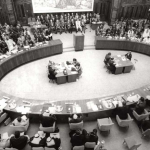
This headline, a powerful snippet from a standout comment, came up during the thought-provoking discussions at a top-notch seminar hosted by the Egyptian Council for Foreign Affairs (ECFA) in Cairo last week. Titled “The Sudanese Crisis: What’s Next and How to Resolve It,” the event was a masterclass in picking well-researched topics with depth and breadth. Opening the floor were Ambassador Mohamed Orabi, Chairman of the ECFA, and Ambassador Yasser Sorour, Assistant Foreign Minister for Sudan and South Sudan, who broke down Egypt’s extensive work since the Sudanese popular uprising in December 2018 and the people-powered leadership change in April 2019. Sorour’s presentation highlighted the genuine richness and sincerity of Egypt’s official and grassroots endeavors, marked by the characteristic clarity and seriousness of Egypt’s stance toward sisterly Sudan, underscoring the enduring historical bond between the two countries and their peoples, and positioning their “common destiny” as a real necessity beyond mere catchphrases.

The seminar’s first session dove into critical topics, including the current state of Sudan’s overall landscape, the balance of power among conflicting military forces, the perspectives of key political players on a potential settlement, and the dire humanitarian crisis left by two years of armed turmoil, which has pushed Sudan to the forefront of global humanitarian concerns regarding health, food security, and the challenges of internal and external displacement, alongside strategies to address these through collaboration between neighboring countries and regional and international organizations. 

The second session explored opportunities and prospects for resolution and reconstruction, offering an in-depth analysis of various regional and international settlement initiatives proposed to tackle the Sudanese crisis, while objectively presenting plans and visions for rebuilding Sudan, and concluded with an Egyptian approach to resolving the crisis, built on Egypt’s official efforts over the past year, which attendees unanimously praised as the most mature and realistic, leveraging prior achievements. Indeed, the ECFA deserves real recognition for developing this holistic vision, which offers an urgent, step-by-step, and balanced roadmap, centered—as Egyptian diplomacy always is—on the collective will and goals of the Sudanese people.

The seminar hosted by the ECFA featured a vibrant blend of Sudanese and Egyptian experts as speakers and attendees, adding unique value and flair to an event that tackled intricate issues with a grounded perspective, opening the door to more earnest discussions fueled by its compelling content. Amid praise for the seminar’s organization and the significance of its diverse topics, one participant praised the perfect timing of the seminar, prompting a thoughtful Egyptian response that captured the attention of all present—Egyptians and Sudanese alike—stating that Sudan, both its state and its people, matters at all times.

The conversation deepened with striking candor, addressing the immense changes sweeping the region, the nature of major crises with their novel, interwoven patterns, and the new types of challenges they reflect, which demand a high level of readiness to engage and provide solutions to safeguard the region’s countries and peoples through approaches aligned with current and future threats. One of the most poignant and truthful points raised was that Sudan’s ongoing experience, far from over, has revealed the critical need for a cohesive, collaborative approach between Sudan and Egypt to confront the future—its challenges and aspirations—with a framework that rises to the magnitude of the responsibilities ahead.

Coinciding with this timing, the United Nations Security Council (SC) issued a statement dated April 14, 2025, addressed to the Council’s President in their capacity as Chair of the Security Council Committee established pursuant to resolution 1591 (2005) concerning the Sudan, and in accordance with paragraph 2 of Security Council Resolution 2725 (2024), presenting the final report of the Panel of Experts on Sudan, established under these resolutions.

The report, submitted to the Committee on December 23, 2024, and reviewed on April 9, 2025, urges the Security Council President and Member States to consider the attached report an official Security Council document. Spanning 50 pages, this highly significant report—though delayed—remains critically important as a comprehensive document offering ample information and analysis on the forms and patterns of challenges that have driven Sudan’s current complex and intertwined crisis, necessitating concerted regional and international efforts to support the Sudanese state in navigating this major, open-ended challenge with multiple potential outcomes. The report concludes that the most likely scenario is a form of fragmentation and the entrenchment of chronic internal conflicts.

Notably, the UN report, in line with the usual style of reports tackling internal armed conflicts and following the standard approach of the United Nations, where experts craft their analyses and recommendations, consistently uses the term “parties to the conflict,” treating them as equals even when clearly denouncing one for greater violations and legal or security infractions. Here, the experts prioritize a comprehensive evaluation of outcomes over pinning blame on a single party, to steer clear of claims of political partiality. As such, it’s best not to linger on these procedural nuances; the real value lies in objectively engaging with the report, which delivers a wealth of critical information that serves to rein in the chaos and violations perpetrated by illegitimate armed factions fueling this crisis. The report specifically called out the “Rapid Support Forces” by name, detailing and condemning the extent of their violations and threats, paving the way for measures to contain and hold those behind these actions accountable.

One standout aspect of the United Nations Experts’ report on Sudan is the significant attention it devotes to Darfur and its current dynamics, a critically important and nuanced focus that paves the way for thoughtful and dynamic initiatives to introduce new strategies for containing other forms of fallout that are certainly undesirable.


Related Posts

Egypt as a balancing power: Why Cairo rejects the logic of wars in the Middle East

The future of US-Iran negotiations

Analysis | Manufacturing opposition: How Israel uses digital platforms to shape Iranian public opinion

The end of economic globalization: Reading into the 2025 U.S. National Security Strategy

TAGGED: ECSS, Egypt, Sudan
Khaled Okasha May 8, 2025
Share this Article
Facebook Twitter Whatsapp Whatsapp LinkedIn Telegram Email Copy Link Print
Khaled Okasha
By Khaled Okasha
General Manager

Stay Connected

Facebook Like
Twitter Follow
Instagram Follow
Youtube Subscribe

Latest Articles

The Will to Return: Implications of the Recrudescence of IS’ Qualitative Operations
Analysis February 7, 2022
The Grand Ethiopian Renaissance Dam .. Risk, fallacies and Potential Partnerships
Publications September 8, 2020
Whither the Arms Race and Defense Spending?
Opinions Articles January 14, 2023
Trumpism without Trump
Opinions Articles November 19, 2020

Latest Tweets

//

The Egyptian Center for Strategic Studies is an independent non-profit think tank providing decision-makers by Policy alternatives, the center was established in 2018 and comprises a group of experts and researchers from different generations and scientific disciplines.

International Relations

  • African Studies
  • American Studies
  • Arab & Regional Studies
  • Asian Studies
  • European Studies
  • Palestinian & Israeli Studies

Defence & Security

  • Armament
  • Cyber Security
  • Extremism
  • Terrorism & Armed Conflict

Public Policies

  • Development & Society
  • Economic & Energy Studies
  • Egypt & World Stats
  • Media Studies
  • Public Opinion
  • Women & Family Studies

Who we are

The Egyptian Center for Strategic Studies (ECSS) is an independent Egyptian think tank established in 2018. The Center adopts a national, scientific perspective in examining strategic issues and challenges at the local, regional, and international levels, particularly those related to Egypt’s national security and core national interests.

The Center’s output is geared toward addressing national priorities, offering anticipatory visions for policy and decision alternatives, and enhancing awareness of various transformations through diverse forms of scientific production and research activities.

All Rights Reserved to Egyptian Center for Strategic Studies - ECSS © 2023

Removed from reading list

Undo
Welcome Back!

Sign in to your account

Lost your password?