


Introduction
The October 6, 1973 War, which coincided with Yom Kippur, the Jewish Day of Atonement, began with a simultaneous Egyptian-Syrian attack on Israeli forces in the Sinai Peninsula and the Golan Heights. The attack took the Israeli political and military leadership by surprise. Egyptian forces succeeded in crossing the Suez Canal and breaching the Bar-Lev Line, while Syrian forces advanced in the Golan Heights. Following these military developments, the war ended with a ceasefire on October 24, 1973. However, the human toll was heavy for Israel, with thousands killed, wounded, or taken prisoner, in addition to the profound psychological shock. The war exposed the fragility of the “myth of the invincible army,” which had taken hold following the 1967 victory, and undermined public confidence in Israel’s military and political establishments. In Israeli public consciousness, the war came to be viewed as a “tragedy” or a “failure,” sparking heated debates over military preparedness, intelligence, and leadership. In light of the failures exposed by the war, mounting public pressure, and growing demands for accountability for the surprise attack and the ensuing failures, the Israeli government decided in November 1973 to establish an official commission of inquiry chaired by Supreme Court President Shimon Agranat to examine prewar intelligence, the army’s state of preparedness, and its performance during the war’s early days.
The commission’s work and the subsequent publication of its report provided a more detailed understanding of the nature of these failures, underscoring the importance of studying the report from several perspectives. First, it reveals how the intelligence services, military, and political leadership operated beyond the official, propagandistic narrative. Second, it demonstrates how the “Concept” hypothesis led to the dismissal of genuine indications of an impending attack. Third, it highlights the tensions between the political and military echelons over the allocation of responsibility. Fourth, it constitutes a primary source for any study seeking to understand the October War from the adversary’s own perspective. Accordingly, examining the report contributes to a more accurate and objective interpretation of the war and its repercussions, while also revealing the extent of the failures acknowledged by the Israeli establishment itself.
Against this backdrop, this paper examines the Agranat Commission’s report to uncover the dimensions of the Israeli intelligence and military failures laid bare by the October War. It aims to dissect the fundamental shortcomings that led to the complete strategic surprise and the severe setbacks suffered during the war’s early days, as well as to deconstruct the intellectual and organizational mechanisms that made this collapse possible. The paper also traces the commission’s recommendations and their far-reaching effects within Israel, including the resulting upheavals across the military establishment, intelligence agencies, and political leadership. In doing so, it demonstrates how the report evolved from an official investigative document into an explicit acknowledgment of the fragility of Israel’s security apparatus, with domestic repercussions that persisted for decades.
First: The Context Behind the Establishment of the Agranat Commission, Its Mandate, and Its Framework of Operations
On November 18, 1973, the Israeli government decided to establish an official commission of inquiry pursuant to the Commissions of Inquiry Law of 1968 to examine the circumstances surrounding the outbreak of the October War and the causes of the failures that occurred during its early days. On November 21, 1973, Supreme Court President Shimon Agranat issued the decision appointing the commission’s members, with himself as its chair.
The government defined the commission’s mandate along two main lines of inquiry. The first concerned the intelligence available in the days preceding the war regarding Egypt’s and Syria’s movements and intentions, the accuracy of the assessments based on that intelligence, and the decisions taken by the relevant military and civilian authorities in light of it.
The second focused on the Israeli military’s preparations for war in general and its state of readiness in the days leading up to the outbreak of hostilities, as well as an assessment of its operational performance through the stage at which the initial attack was repelled. Under this specific legal mandate, the commission was established as an independent official body and granted broad powers enabling it to summon witnesses and examine relevant documents.
The scope of the investigation did not extend to the subsequent course of the war. The commission itself confirmed in its reports that it was not authorized to examine the stages of the war following the containment of the initial attack, maintaining that its task was confined to investigating the causes of the strategic surprise, inadequate preparedness, and the initial response. This narrow temporal scope subsequently drew criticism within Israel, with some observers arguing that it concentrated blame on the military and intelligence leadership without fully examining political responsibility or the conduct of the war as a whole. Nevertheless, this remained the official framework within which the commission conducted its investigations.
1. Commission Members and Their Backgrounds
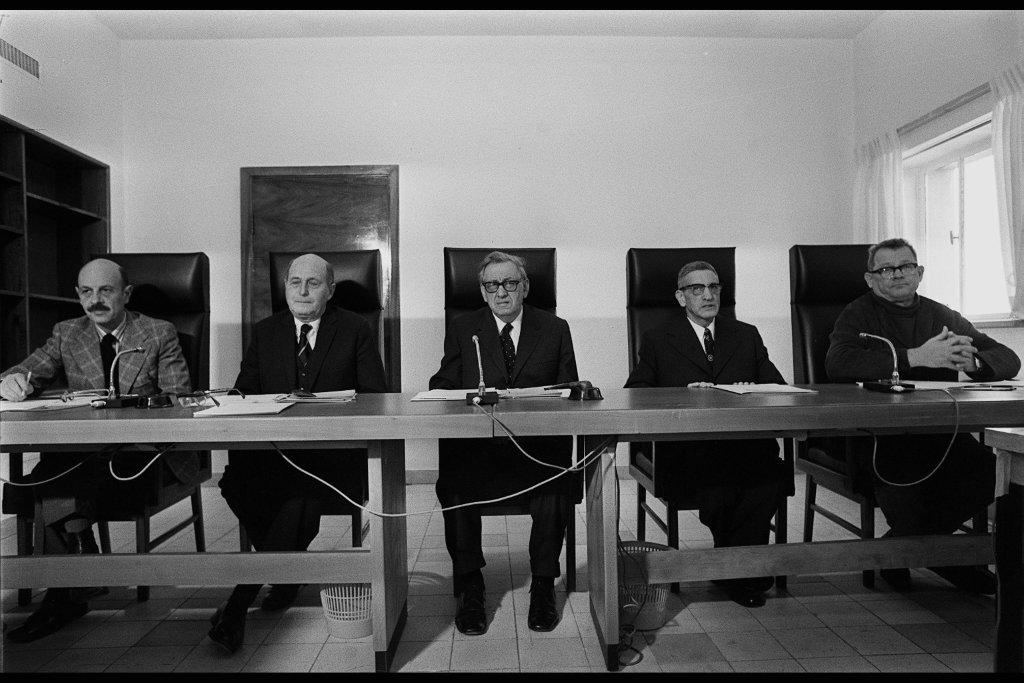
The Agranat Commission consisted of five members whose backgrounds spanned the judicial, oversight, and military fields.
Shimon Agranat (Chairman of the Commission)
Shimon Agranat was born on September 5, 1906, in Louisville, Kentucky, to a Zionist Jewish family of Russian origin. He studied law and philosophy at the University of Chicago, earning a law degree in 1929, before immigrating to Mandatory Palestine in 1930 and settling in Haifa. He began his professional career as a lawyer and was appointed a magistrate in 1940. In 1948, he became president of the Haifa District Court. In 1949, he joined the Israeli Supreme Court, which he went on to preside over from 1965 until his mandatory retirement in 1976. He died on August 10, 1992, at the age of 85.
Moshe Landau
Moshe Landau was born in Germany on April 29, 1912. He studied law at the University of London, graduating in 1933, and immigrated to Palestine that same year. He began his professional career as a lawyer before being appointed a magistrate in Haifa in 1940 and a judge at the District Court in 1948. In 1953, he joined the Israeli Supreme Court and served as its president from 1980 to 1982. He later participated in other commissions of inquiry, including the Landau Commission, which examined interrogation methods used by the Shin Bet (Israel Security Agency). He died on May 1, 2011, at the age of 99.
Yitzhak Ernst Nebenzahl
Yitzhak Ernst Nebenzahl was born on October 24, 1907, in Frankfurt, Germany. He earned a doctorate in law from the University of Frankfurt and worked as a lecturer in civil law before immigrating to Palestine in 1933. He subsequently held several economic and administrative positions, including legal adviser to the Yafit Bank, chairman of the board of directors of Hollander Company, director of the Jerusalem Economic Corporation, chairman of the Postal Bank, and member of the board of directors of Bank Leumi. In 1961, he was appointed Israel’s State Comptroller, a position he held until 1981, becoming the first State Comptroller to also serve as Public Complaints Commissioner. He also served on several official commissions of inquiry. He died on December 19, 1992.
Yigael Yadin
Yigael Yadin, originally named Sukenik, was born in Jerusalem on March 20, 1917, into the family of archaeologist Eleazar Sukenik. In 1949, he was appointed the second Chief of Staff of the Israel Defense Forces, serving until 1952, during which time he worked to reorganize the standing army and reserve forces. After retiring from military service, he devoted himself to archaeology, earning a PhD from the Hebrew University of Jerusalem in 1955. He subsequently became a professor at the university before entering politics, serving as Deputy Prime Minister from 1977 to 1981. He died on June 28, 1984.
Haim Laskov
Haim Laskov was born in 1919 in what is now Belarus and immigrated with his family to Palestine in 1925. He joined the Haganah at an early age and served in the British Army during World War II as a member of the Jewish Brigade, eventually attaining the rank of major. He participated in the Israeli War of Independence and commanded the first armored brigade. He subsequently served as commander of the Israeli Air Force from 1951 to 1953 and as head of the Southern Command. From 1958 to 1961, he served as the fifth Chief of Staff of the Israel Defense Forces. After retiring from military service, he became director general of the Ports Authority and later served as the Soldiers’ Complaints Commissioner. He died on December 8, 1982.
The composition of the Agranat Commission reflected an uneven distribution of roles among its members. Shimon Agranat and Moshe Landau provided the commission’s judicial and legal framework, while Yitzhak Ernst Nebenzahl’s role was confined to the oversight and administrative dimensions. By contrast, Yigael Yadin and Haim Laskov emerged as the commission’s military experts, helping direct a substantial part of its analysis toward the failures of the military establishment and intelligence services.
Although the final report was ostensibly issued with the unanimous agreement of its members, the commission’s military background, particularly Yadin’s influential presence, clearly shaped the course of the investigation. The bulk of the responsibility was attributed to shortcomings within the military and intelligence services, while the political echelon faced a considerably lower degree of accountability. This aspect assumes greater significance in light of revelations by Israeli sources decades later that, only hours before agreeing to join the commission, Yadin had consulted associates of Prime Minister Golda Meir to determine whether she intended to appoint him as a government minister. This adds an important dimension to any assessment of the commission’s independence from political decision-making circles.
The commission’s composition was not the sole factor shaping its findings; the course of the investigation was also influenced by the scope of its mandate, as defined by the Israeli government from the outset.
2. Investigation Methodology and Procedures for Collecting Evidence and Testimony
The Agranat Commission adopted a rigorous judicial investigative methodology pursuant to the Commissions of Inquiry Law of 1968. Under this law, it was granted broad powers to summon witnesses, compel them to testify under oath, and access classified official documents. Over a period of more than a year, the commission held more than 140 hearings and heard testimony directly from approximately 58 senior political, military, and intelligence officials. It also received approximately 188 written statements from various military personnel and examined hundreds of documents preserved in the archives of the military, intelligence agencies, Ministry of Defense, and Prime Minister’s Office. In addition, the commission gathered further testimony and materials through teams of reserve officers assigned to collect evidence, and it maintained detailed transcripts of each hearing. The commission’s proceedings remained strictly confidential throughout the investigation, and most transcripts were not authorized for publication until decades later.
Among the most prominent witnesses heard by the commission was Prime Minister Golda Meir, who defended her decision not to launch a preemptive strike on the morning of October 6, explaining that she had been inclined to do so but was “afraid” of the international reaction. Defense Minister Moshe Dayan also gave extensive testimony, denying that he bore direct responsibility and placing the onus on the Chief of Staff for assessing the situation and deciding whether to mobilize the reserve forces. Chief of Staff David Elazar defended his decisions, maintaining that he had relied on intelligence assessments. Meanwhile, Military Intelligence Chief Eli Zeira acknowledged that an assessment error had occurred but justified his position by citing his adherence to the “Concept” and his confidence in special intelligence-gathering methods. The commission also heard testimony from field commanders, including Shmuel Gonen, commander of the Southern Command, as well as several senior intelligence officers. These testimonies revealed a pattern of mutual recrimination between the political and military echelons, alongside a climate of overconfidence that contributed to the disregard of warning signs preceding the outbreak of war.
3. The Agranat Commission Reports: From the Interim Report to the Final Report
The Agranat Commission issued three major reports in successive stages, reflecting the progress of its investigation and the gradual development of its conclusions regarding the nature of the failures that preceded the October War and accompanied its early days. The interim report, issued in April 1974, represented the first formal and detailed presentation of the investigation’s findings. It was also the shortest and had the greatest impact on Israeli public opinion and the country’s political landscape. Its focus was on the causes of the strategic surprise and the failure of Military Intelligence to interpret the available information and assess its implications, amid continued adherence to the “Concept.” It also identified the responsibility of military and intelligence leaders for various failures during the days preceding the war and its first three days.
In July 1974, the commission issued its supplementary (second) report, which served as an interpretive extension of the interim report. It provided detailed justifications and citations drawn from the testimony and documents on which the commission had relied in formulating its conclusions. The report introduced no new personal recommendations; rather, its primary purpose was to clarify the grounds on which the commission had based its earlier findings, particularly those relating to the failure of intelligence assessments, the delay in mobilizing reserve forces, and the imbalance in the distribution of powers and responsibilities between the political and military echelons. The supplementary report thus helped clarify the evidentiary framework underpinning the conclusions reached in the first report without altering their substance.
The final report, issued in January 1975, was more comprehensive and detailed, comprising approximately 1,500 pages. Of these, about 746 pages were devoted to the southern front and 311 to the northern front, analyzing the course of combat during the war’s early days, with particular emphasis on the performance of field commanders and the level of coordination among military units. The final report reaffirmed the commission’s earlier conclusions while broadening the analysis to examine operational aspects in greater detail. At the time, only the report’s introduction, comprising approximately 42 pages, was published, while the bulk of the document remained classified for security reasons.
Most of the report remained classified until January 1, 1995, when the majority of its contents were declassified, with the exception of approximately 48 pages. The remaining material was released gradually over the following years, particularly following the decision of the Englard Committee in 2005–2006. Taken together, these reports constituted the foremost official record of Israel’s assessment of its failures in the October War. They provided an institutional framework for analyzing the intelligence and military shortcomings exposed by the war and identifying areas of responsibility within the security and military establishments. In its various parts, the Agranat Commission report remains a key reference for historical and military studies examining the October War and its repercussions within Israel.
Second: Intelligence Failure and the “Concept”
This section examines the failures of Israeli intelligence in the lead-up to the October 1973 War, in light of the findings of the Agranat Commission in its reports on the performance of the intelligence services and the mechanisms used to assess the information available before the outbreak of hostilities. The analysis focuses on how intelligence and military assessments were shaped by the “Concept,” and how this affected the interpretation of indicators and warnings preceding the war, ultimately resulting in a failure to assess the likelihood of war and prepare adequately to confront it.
1. The “Concept” Prevailing Before the War
The term “Concept” refers to the central intelligence hypothesis that dominated the thinking of Israel’s Military Intelligence Directorate (Aman) in the years preceding the October 1973 War. This hypothesis rested on two fundamental assumptions. First, Egypt would not launch an all-out war against Israel until it had acquired sufficient offensive airpower to strike deep into Israeli territory, particularly its main air bases, with the aim of neutralizing the Israeli Air Force. Second, Syria would not launch an independent attack on the Golan Heights but would instead await a simultaneous Egyptian offensive on the Sinai front.
Over time, this hypothesis evolved from a flexible intelligence assessment into a rigid doctrine resistant to revision, profoundly influencing the interpretation of all incoming information. Any Egyptian or Syrian troop buildup, or any indication of preparations for an offensive, was automatically interpreted as “training,” “defensive maneuvers,” or a “show of force,” rather than as genuine preparations for war.
In its interim report, the Agranat Commission emphasized that blind adherence to this Concept was the root cause of the failure to provide an adequate early warning. It led to the disregard or underestimation of increasingly numerous warning indicators in the weeks and days preceding the war. The report described how this intellectual rigidity left intelligence officers unwilling to abandon their assumptions, even at critical moments, directly contributing to the surprise that confronted the Israeli military on the morning of October 6, 1973.
2. Military Intelligence’s Assessment of the Available Information
Before the October 1973 War, the Military Intelligence Directorate (Aman) was the only body authorized to assess intelligence at the national level. This resulted in an almost complete monopoly over the assessment process and a lack of institutional plurality in intelligence analysis. The Agranat Commission’s interim report confirmed that Aman’s Research Department was “the only body in the country engaged in intelligence research and assessment,” giving its judgments decisive weight with both the military and political leadership. This monopoly meant that any assessment error directly affected decisions on mobilizing reserve forces and raising the level of alert, in the absence of independent counterassessments or corrective mechanisms.
Despite a growing body of indicators pointing to Egyptian and Syrian offensive preparations in the weeks and days before the war — including an unprecedented concentration of forces along both fronts, the movement of heavy equipment, the removal of camouflage nets from tanks, and the evacuation of Soviet families from Egypt and Syria — the Research Department, headed by Brigadier General Aryeh Shalev and Lieutenant Colonel Yona Bandman, head of the Egypt desk, continued to interpret these indicators in strict accordance with the “Concept.” The Egyptian buildup was interpreted as a “combined-arms exercise” similar to previous drills, while the Syrian buildup was viewed as a defensive deployment. Even on October 5, 1973, Aman’s official assessments continued to describe the likelihood of war as “low” or even “lower than low.”
The commission identified three main reasons for this assessment failure:
- Rigid doctrinal adherence to the “Concept,” which had become outdated and no longer reflected changing realities;
- The Military Intelligence chief’s assurance that he could provide sufficient advance warning to allow for the orderly mobilization of reserve forces, a commitment that lacked an objective basis;
- The Research Department’s refusal to interpret the numerous warning reports it received in the days preceding the war according to their actual significance, preferring instead to explain them as training activities or defensive deployments.
The report explicitly noted that the military buildup on both fronts was “unprecedented in terms of the size of the forces and their movement toward the fronts.” Nevertheless, this did not prompt a reassessment or revision of the intelligence judgment. This intellectual rigidity, combined with excessive confidence in existing assessments, contributed to delays in mobilizing reserve forces and raising the alert level to the degree required, leaving the standing forces in a vulnerable position when hostilities began. The commission placed primary responsibility for this faulty assessment on the head of Aman and his deputy in charge of research, as they were the sole source of national-level intelligence assessments, which had a decisive influence on the decisions taken by the military and political leadership.
3. Failure of Early Warning
According to the findings of the Agranat Commission’s interim report, the final, explicit warning of the likelihood of war was not issued until the early hours of Yom Kippur itself. At approximately 4:30 a.m., the head of Military Intelligence informed the senior leadership, based on newly received intelligence, that the enemy would launch a simultaneous attack on both fronts at 6:00 p.m.
The report described this warning as “far too short,” as it did not allow sufficient time for the orderly mobilization of reserve forces in accordance with established schedules and procedures. Instead, it necessitated the hasty mobilization of ground forces. More importantly, the additional error in estimating the start of the war — placing it at 6:00 p.m. rather than its actual start at 2:00 p.m., a difference of four hours — further reduced the time available between the mobilization of reserve forces and the beginning of enemy fire. This second error caused additional disruption to the readiness and proper deployment of the standing forces on the fronts, particularly along the Suez Canal.
The report also noted that neither the senior military leadership nor the political echelon had anticipated, even in the early hours of that morning, that an all-out war was imminent. Even after it became clear that war would break out, both continued to operate under the mistaken assumption that hostilities would not begin until 6:00 p.m. Thus, even after the earlier assessment had been abandoned and the imminent outbreak of war was finally acknowledged, the warning came too late and was inaccurate in its timing. This substantially diminished its operational value, leaving Israeli forces insufficient time to mobilize and deploy with the speed and organization required to confront the impending attack.
Third: The Failure of the Israeli Military Establishment During the War
The Israeli military’s performance during the first days of the October War was one of the principal areas examined by the Agranat Commission in its investigation, as this was where the intelligence failure translated into an immediate military reality on the battlefield. Accordingly, this section focuses on the serious shortcomings identified in the Commission’s report concerning the army’s state of readiness, its speed of response to the attack, the effectiveness of its command and control systems, and the performance of field commanders and units during the initial phase of fighting on the Egyptian and Syrian fronts. It also examines the confusion and deficiencies that accompanied the conduct of operations in response to the surprise attack, and the resulting inability to counter it with the required effectiveness. These shortcomings demonstrate that the element of surprise was not confined to intelligence but also affected military performance itself, confronting the Israeli army with a genuine operational crisis during the war.
1. Readiness on the Southern Front: Sinai and the Bar-Lev Line
According to the findings of both the interim and final reports of the Agranat Commission, the state of readiness on the southern front on the day the war broke out was marked by fundamental deficiencies that directly contributed to the success of the Egyptian crossing and the loss of control over large sections of the Bar-Lev Line. The interim report noted that absolute reliance on the Military Intelligence Directorate’s commitment to provide sufficient advance warning to enable the orderly mobilization of reserve forces had resulted in the failure to prepare a detailed defensive plan that could be implemented using regular forces alone in the event of a sudden, full-scale attack on both fronts simultaneously. Consequently, the regular forces deployed along the Canal front found themselves unprepared to deal with a large-scale crossing operation, in the absence of rapid support from reserve forces.
The report also emphasized that, even after the warning had been received, the regular armored forces on the Canal front were not deployed in the most effective manner or at the appropriate time, in accordance with the defensive plan for the regular forces. Moreover, no clear instructions were issued that morning to Southern Command chief Shmuel Gonen, or by him to lower-level commanders, regarding how to prepare for the anticipated attack. This created uncertainty in the issuance of operational orders and in ensuring their implementation.
The delay in achieving optimal deployment, combined with the absence of clear orders, further undermined the readiness of regular forces on the southern front, particularly along the Canal. Together, these factors enabled Egyptian forces to cross the Canal and capture most of the Bar-Lev Line strongpoints during the first hours of fighting, before Israeli forces could organize an effective defense or receive the necessary reserve reinforcements.
The final report examined the details of readiness and deployment on the southern front in greater depth, linking the forces’ poor state of preparedness on October 6 to the failure of the counterattack on October 8. It noted that deficiencies in preparations and coordination at the Southern Command level had adversely affected the course of combat operations duri ng the first days of the war.
2. The Failure of the Counterattack on October 8
The final report of the Agranat Commission devoted a substantial part of its analysis of the southern front to the battle of October 8, 1973. This battle marked Israel’s first organized attempt to launch a large-scale counterattack against Egyptian forces following their successful crossing of the Suez Canal and the establishment of bridgeheads on its eastern bank. The Commission concluded that the attack ended in a clear operational failure, exposing the Israeli command’s inability to turn its remaining forces into a coordinated offensive force capable of regaining the initiative.
The failure was not attributable solely to the difficulties of the battlefield situation; rather, it exposed deep-rooted deficiencies in planning, preparation, command, and control. Israeli forces entered the battle with an inadequately organized offensive effort, insufficient clarity in the allocation of tasks, and a lack of effective coordination among the participating formations. Orders and plans were not translated into a unified, coherent operation, resulting in fragmented troop movements, a dispersal of effort among divisions, and failure to achieve the objectives set for the attack.
These deficiencies were all the more serious given the circumstances confronting the Israeli forces. Egyptian troops had already consolidated their positions east of the Canal, while the Israeli command was attempting to regain the initiative before all reserve forces could arrive and its defenses could be better organized. Consequently, the counterattack, rather than providing an opportunity to regain the initiative, became a severe test that exposed the fragility of Israel’s operational command during the war.
The significance of the October 8 battle lies in its demonstration that Israel’s failure extended beyond intelligence surprise and inadequate readiness into the operational arena itself. When Israel shifted from defense to offense, problems of planning, coordination, and control became more apparent. The battle demonstrated that the military superiority associated with the Israeli army since the 1967 war was insufficient to compensate for the confusion that had afflicted its command system at the outset of the war.
3. Responsibility of Chief of Staff David Elazar and the Front Commanders
In its interim report, the Agranat Commission moved beyond diagnosing battlefield failures to identifying the personal responsibility of senior commanders who held decision-making authority on the eve of the war and during its first days. Chief among them was Lieutenant General David Elazar, Chief of Staff, whom the Commission held directly responsible for the assessment of the situation and the army’s state of readiness. Its judgment was unequivocal: it concluded that he bore “personal responsibility” for what had occurred on the eve of the war and recommended that his appointment as Chief of Staff be terminated.
The Commission based its attribution of responsibility to Elazar on a series of decisions that, in its assessment, reflected a flawed appraisal of the situation and excessive confidence in the existing level of preparedness. He relied heavily on Military Intelligence’s assessment, which was based on the assumption that sufficient advance warning would be provided. This contributed to the failure to prepare a detailed defensive plan that would enable regular forces to cope with a surprise attack before the arrival of the reserves. The Commission also found that he had delayed recommending the mobilization of reserve forces despite the availability of indicators that, in its judgment, could have justified a partial mobilization at the beginning of the week preceding the war or a large-scale mobilization on the morning of October 5. In addition, his decisions reflected excessive confidence in the ability of the regular forces alone to withstand a simultaneous Egyptian-Syrian attack on two fronts — a judgment whose inadequacy and risks became apparent in the first hours of the war.
At the level of front commanders, the criticism was more pronounced in the case of the Southern Command, particularly Major General Shmuel Gonen, whose performance was directly associated with the operational failures that emerged during the first days of the war, especially in the October 8 battle. The Commission considered the problem to be more than an unfavorable outcome in a single battle; it reflected deficiencies in Gonen’s performance of his fundamental duties as a front commander, including operational preparation, supervision of his subordinates’ plans, coordination among formations, the issuance of orders, and oversight of their implementation. Accordingly, the Commission recommended in its interim report that he be temporarily suspended from service. The final report subsequently examined his performance in greater detail and concluded that he had failed to meet the standards expected of a front commander.
The Commission thus established a clear hierarchy of military responsibility: the Chief of Staff was responsible for the overall assessment, the army’s readiness, and strategic decision-making, while the Southern Command chief was responsible for failing to translate those decisions into effective operational preparation and leadership. The Commission’s assessment of the Northern Command, by contrast, was more balanced. In its view, therefore, the failure was no longer simply a case of intelligence surprise or a battlefield setback, but a chain of interconnected errors in assessment, readiness, and command that extended from the highest levels of the military establishment to the battlefield.
Fourth: The Challenge of Allocating Responsibility Between the Political and Military Echelons
The allocation of responsibility between the political and military echelons was one of the most prominent issues addressed by the Agranat Commission in its interim report, issued on April 1, 1974. The Commission was careful to distinguish clearly between two types of responsibility: direct personal responsibility, which could be attributed to both military and civilian officials, and parliamentary or ministerial responsibility, which it regarded as an exclusively political matter beyond the scope of its authority.
1. The Commission’s Position on Prime Minister Golda Meir
In its first report, issued in April 1974, the Agranat Commission devoted a separate section to examining the personal responsibility of Prime Minister Golda Meir. From the outset, the Commission emphasized that its findings were limited to direct personal responsibility and that it did not consider itself authorized to express an opinion on parliamentary or ministerial responsibility. Whether the prime minister or a minister should resign, it maintained, remained an exclusively political matter falling within the jurisdiction of political institutions, foremost among them the Knesset, the government, and the political parties.
On the basis of this legal and political distinction, the Commission concluded in Section 32 of its report that the prime minister bore no personal responsibility for her actions at the outbreak of the Yom Kippur War or in its aftermath. Indeed, the Commission commended her conduct during the critical days preceding the war. It described her position as “reflecting an attitude commensurate with the heavy responsibility she bore.” It also singled out for praise her decision on the morning of October 6, 1973, to call up reserve forces on a large scale, characterizing it as “an important act for the defense of the state.” Through this finding, the Commission fully absolved Golda Meir of any direct personal blame, while placing primary responsibility for the failures preceding and accompanying the first days of the war on the military echelon.
2. The Agranat Commission’s Position on Defense Minister Moshe Dayan
In its interim report, issued on April 1, 1974, the Agranat Commission devoted Section 31 to examining the direct personal responsibility of Defense Minister Moshe Dayan. The Commission concluded that Dayan did not bear direct personal responsibility for the failures preceding the outbreak of the war. The report stated:
“According to the standard of reasonable conduct required of a person holding the office of Minister of Defense, the Minister was not obliged to issue orders additional to or different from those proposed to him by the General Staff, on the basis of its collective assessment and the advice of the Chief of Military Intelligence and the Chief of Staff.”
The Commission explained that the office of defense minister had never been equivalent to that of a “super-chief of staff,” requiring its holder to direct the chief of staff on operational matters. Nor did the defense minister, by virtue of his office, occupy the position of supreme commander of the army. Accordingly, the Commission considered Dayan’s reliance on the assessments and recommendations submitted by the competent military authorities to have constituted reasonable conduct. It found no grounds for holding him directly personally responsible for the failures. This conclusion fully absolved Dayan of direct personal blame, while assigning primary responsibility for the failures preceding the war to the military echelon, represented by the chief of staff and senior intelligence officials.
By contrast, the interim report adopted a more decisive position toward the military and intelligence establishments. It maintained that the failure did not stem from a lack of information or warning indicators, but rather from their misinterpretation, rigid adherence to the “Concept,” inadequate readiness, and deficiencies in decision-making and coordination. The Commission held Chief of Staff David Elazar directly personally responsible for the flawed assessment of the situation, the army’s state of readiness, and delays in mobilization procedures. It also held Military Intelligence chief Eli Zeira and several senior intelligence officers responsible for entrenching the erroneous assessment and rejecting indicators that contradicted it. In addition, it sharply criticized Southern Command chief Shmuel Gonen for his failures in preparation, coordination, and operational management, particularly during the October 8 battle, while its assessment of the Northern Command was less severe.
Through this allocation of responsibility, the Commission placed the principal burden of the failure on the military and intelligence leadership without assigning direct personal responsibility to the political leadership. It considered the core problem to have been the transformation of available information into an erroneous assessment, which then informed inadequate preparations and operational decisions. The intellectual rigidity associated with the “Concept” prevented the warning indicators from being interpreted correctly, while command failures further compounded deficiencies in readiness and response. Together, these factors affected military performance during the war. The report thus presented the failure as an interconnected chain of intelligence shortcomings, inadequate readiness, and command errors, while keeping political responsibility outside the scope of direct personal accountability.
Fifth: The Agranat Commission’s Recommendations and Their Major Impacts
The Agranat Commission did not limit itself to identifying those responsible for the failures preceding the October War and during its first days. It also put forward a series of recommendations aimed at addressing the deficiencies exposed by the war within the intelligence system, military command structure, and decision-making mechanisms. The impact of these recommendations, however, was uneven: some had direct political and institutional consequences, while others focused on internal organizational and military reforms.
Recommendations with Direct Political and Military Implications
- Terminating Lieutenant General David Elazar’s appointment as Chief of Staff, holding him personally responsible for the failure to assess the situation correctly and for the army’s state of readiness on the eve of the war. This was one of the Commission’s most consequential recommendations at the military level.
- Dismissing Major General Eli Zeira, Chief of Military Intelligence, on the grounds of his responsibility for the intelligence assessment failure and his adherence to the “Concept” despite the availability of contradictory indicators.
- Removing several senior intelligence officers from their posts, foremost among them Brigadier General Aryeh Shalev, Lieutenant Colonel Yona Bandman, and Lieutenant Colonel David Gadalia, whom the Commission considered directly responsible for entrenching the erroneous intelligence assessment.
- Suspending Major General Shmuel Gonen, commander of Southern Command, from service in light of his failures in directing operations during the first days of the war. The final report subsequently revised this recommendation, allowing him to remain in service but not to serve above divisional command or an equivalent level.
Restructuring the Intelligence Assessment System
One of the most consequential aspects of the Commission’s recommendations concerned Military Intelligence’s monopoly over national intelligence assessment. The war exposed the dangers of political and military leaders relying on a single intelligence assessment. Accordingly, the recommendations sought to:
- End Military Intelligence’s monopoly over national-level intelligence assessment, introducing a plurality of assessment sources to allow for independent and dissenting views.
- Strengthen the roles of the Mossad and the Ministry of Foreign Affairs in the assessment process, enabling political leaders to draw on more than one intelligence assessment.
- Provide the prime minister with an independent intelligence adviser, ensuring that the assessment presented to the political leadership would not be entirely dependent on the military establishment.
Sixth: The Political and Security Implications of the Agranat Report
The release of the Agranat Commission’s interim report on April 1, 1974, triggered widespread public anger in Israel, despite the Commission’s decision to absolve the political echelon of any direct personal responsibility. Large segments of the public, the military, and the press viewed the report as having placed responsibility for the failure on the military leadership and turned the generals into scapegoats, while fully absolving Prime Minister Golda Meir and Defense Minister Moshe Dayan of personal responsibility. Large demonstrations called for the government’s resignation, with demands directed particularly at Dayan. The Commission itself was accused of complicity and of being too lenient in holding the political echelon accountable.
The day after the report was released, Chief of Staff David Elazar submitted his resignation, rejecting the Commission’s conclusions concerning his responsibility, although his resignation was ultimately accepted. In this respect, the report represented an official Israeli acknowledgment of the scale of the failure exposed by the October War within the military and intelligence establishments, even as interpretations of responsibility and the mechanisms for assigning it differed.
Political pressure soon escalated into an open political crisis. Just nine days after the report was published, on April 11, 1974, Golda Meir announced her government’s resignation amid public anger and growing awareness of the scale of the failure. A new government headed by Yitzhak Rabin was formed in June 1974, while Shimon Peres replaced Dayan as defense minister. Dayan left the government, and his political and military reputation suffered a severe blow that largely ended his standing as one of the heroes of the 1967 war. Within the military, Eli Zeira and several senior intelligence officers were dismissed, while Mordechai Gur succeeded David Elazar as Chief of Staff.
The report’s consequences extended well beyond changes in leadership and personnel. It exposed the depth of the deficiencies affecting intelligence, military readiness, and decision-making, and helped shatter the image of the “invincible army” that had taken hold after 1967. At the same time, however, the report left a protracted political crisis in its wake, as accountability focused on military and intelligence officers while the political echelon largely escaped direct personal responsibility. The Agranat Report therefore did not resolve the crisis of failure; rather, it exposed the limits of Israel’s ability to hold itself accountable when responsibility extends beyond what can be assigned to the military establishment alone. The report has consequently remained a point of reference whenever Israel faces a major security or military failure.
This legacy returned to the forefront in a striking way following the October 7, 2023, attack. The Agranat Commission was repeatedly invoked in Israeli public, media, military, and political debates as a historical precedent for addressing intelligence surprise and operational failure. Comparisons were drawn between the “Concept” that dominated Israeli intelligence assessments before the 1973 war and the assessments that ruled out Hamas’s ability to carry out a large-scale attack in 2023. The question of political responsibility also resurfaced amid calls for an independent official commission of inquiry that would examine not only the accountability of military and security leaders but also that of all levels of decision-making, without distinction.
The Agranat Report has thus evolved from a historical document into a benchmark against which Israel’s more recent failures are assessed, and a reminder that the lessons of 1973 had not been fully absorbed even after more than half a century. Israel’s acknowledgment of its failure in 1973 remains one of the most prominent precedents invoked in evaluating subsequent Israeli security failures.
Conclusion
A close reading of the Agranat Report reveals that the October War was not merely a military confrontation that ended when the fighting ceased, but a severe test of Israel’s security model itself. It demonstrated that the superiority that had appeared firmly established after 1967 was insufficient to prevent strategic surprise and Egyptian military success; that an abundance of intelligence did not prevent error when the institution failed to interpret it correctly; and that the strength of the army could not prevent confusion when decision-making and command broke down. From this perspective, the report’s significance lay in transforming military failure from a battlefield shock into an issue affecting the very foundations of security thinking and decision-making.
More than half a century later, the question raised by Agranat is no longer simply who made mistakes in October 1973, but whether the institution has genuinely overcome the mindset that produced those mistakes. The surprise of October 7, 2023, has made this question more pressing, suggesting that the lessons exposed by Agranat did not translate into institutional change sufficient to prevent the recurrence of Israeli security failures.
References
- Manal Radwan, “Agranat Commission Reports: The October Victory Through the Lens of Israeli Documents,” Al-Masry Al-Youm, September 18, 2024. https://www.almasryalyoum.com/news/details/3262084
- “Agranat Commission Transcripts,” Al-Ahram, November 7, 2016. https://gate.ahram.org.eg/daily/News/192077/139/559922/قضايا-عسكرية/محاضر-لجنة-أجرانات.aspx
- “When Israel Actually Probed Its Mistakes, but Didn’t Dig Deep Enough,” Haaretz, September 29, 2022. https://www.haaretz.com/israel-news/2022-09-29/ty-article/.highlight/when-israel-actually-probed-its-mistakes-but-didnt-dig-deep-enough/00000183-8ab3-d4a7-afb7-afff23bb0000
- “The Agranat Commission,” Israeli Ministry of Defense, 50th Anniversary of the Yom Kippur War website, 2023. https://yomkipurwar.mod.gov.il/events/Pages/agrant.aspx
- Jewish Telegraphic Agency (JTA), “Shimon Agranat, Dead at 86, Was Prominent Israeli Jurist,” August 12, 1992. https://www.jta.org/archive/shimon-agranat-dead-at-86-was-prominent-israeli-jurist
- Supreme Court of Israel, “Retired Presidents,” official website. https://supreme.court.gov.il/Pages/RetiredPresidents.aspx
- The New York Times, “Moshe Landau, Israeli Judge in Eichmann Trial, Dies at 99,” May 2, 2011. https://www.nytimes.com/2011/05/03/world/middleeast/03landau.html
- Office of the State Comptroller and Ombudsman of Israel, “Yitzhak Ernst Nebenzahl.” https://www.mevaker.gov.il/ar/about/state-comptrollers/yitzhak-ernst-nebenzahl
- Jewish Virtual Library, “Yitzhak Ernst Nebenzahl.” https://jewishvirtuallibrary.org/jsource/judaica/ejud_0002_0015_0_14641.html
- The Knesset, “Yigael Yadin – Personal Details,” official website. https://main.knesset.gov.il/en/mk/Apps/mk/mk-personal-details/184
- Jewish Virtual Library, “Yigael Yadin: Biography.” https://jewishvirtuallibrary.org/jsource/biography/yadin.html
- The Haganah was a Jewish paramilitary organization established in Mandatory Palestine in 1920 to protect Jewish communities. It was one of the principal Zionist military organizations and was incorporated into the Israel Defense Forces in 1948, becoming one of the foundations upon which the IDF was built.
- The New York Times, “Gen. Haim Laskov of Israel, Former Chief of Staff (1958–61),” December 9, 1982. https://www.nytimes.com/1982/12/09/obituaries/gen-haim-laskov-of-israel-former-chief-of-staff-1958-61.html
- The Agranat Commission, documentary, Al Qahera News, December 29, 2023. https://www.youtube.com/watch?v=-RCijaiMRz4
- Amir Oren, “A Revisionist View of the Intelligence Failure of the Yom Kippur War,” Jerusalem Strategic Tribune, December 2022. https://www.youtube.com/watch?v=-RCijaiMRz4
- “A Look Back: The Agranat Commission,” Movement for Freedom of Information in Israel. https://www.meida.org.il/war2023/historical-view
- The Knesset, “The Agranat Commission,” Lexicon of Terms, 2008, archived by the Internet Archive. https://web.archive.org/web/20101229175926/http://knesset.gov.il/lexicon/eng/agranat_eng.htm
- Egyptian Center for Strategic Studies, Encyclopedia of the October War, Vol. 2: The Epic of Crossing… The Military Victory, 2024, p. 778.
- “New Yom Kippur War Testimony Details the Failures,” The Times of Israel, November 1, 2013. https://www.timesofisrael.com/new-yom-kippur-war-testimony-details-the-failures/
- “Israel Publishes Agranat Commission Hearing Transcripts on the October War Defeat for the First Time,” Al-Shorouk, September 21, 2012. https://www.shorouknews.com/news/view.aspx?cdate=21092012&id=15e98524-b2e8-483e-8eb5-583b30e67e05
- Interim Report of the Agranat Commission of Inquiry, Israel Education Center, April 1974. https://israeled.org/wp-content/uploads/2015/06/1974.4-Agranat-Commission-of-Inquiry-Interim-Report.pdf
- Israel Defense Forces Archives, “Selected Documents,” Israeli Ministry of Defense. https://archives.mod.gov.il/docs/Pages/collections.aspx
- Israel Defense Forces and Defense Establishment Archives, Agranat Commission Report, Volume IV. https://archivesdocs.mod.gov.il/Agranat/6/album/index.html
- In 2005, the Israeli government established a public committee chaired by retired Supreme Court Justice Yitzhak Englard, with Moshe Vardi and Benjamin Amidor as members, to examine the possibility of declassifying materials held in the archives of the military and security establishment. The committee reviewed the classified sections of the final report and approved its publication in full, except for limited passages whose disclosure was considered potentially harmful to state security or foreign relations. The report was made available to the public in 2006. The committee’s work extended beyond the report itself to include consideration of the possible release of the commission’s hearing transcripts and witness testimonies, making declassification a gradual process that enabled researchers and the public to access an increasing body of original documents.
- “The Agranat Commission Report,” official website of the Israel Defense Forces and Defense Establishment Archives. https://archives.mod.gov.il/sites/English/docs/agranat/Pages/AgranatReport.aspx
- Israel Defense Forces and Defense Establishment Archives, Agranat Commission Report, Volume I. https://archivesdocs.mod.gov.il/Agranat/1/album/index.html
- Israeli Ministry of Defense, “The Agranat Commission,” 50th Anniversary of the Yom Kippur War website, 2023. https://yomkipurwar.mod.gov.il/events/Pages/agrant.aspx?query=ועדת+אגרנט&type=papers,pictures,movies,maps,tapes,files
- Agranat Commission, Interim Report of the Agranat Commission of Inquiry, Israel Education Center, April 1, 1974. https://israeled.org/wp-content/uploads/2015/06/1974.4-Agranat-Commission-of-Inquiry-Interim-Report.pdf
- “From Agranat to October 7: Why Israel Needs an Independent National Intelligence Oversight Body,” Jerusalem Institute for Strategy and Security, March 26, 2026. https://jiss.org.il/en/roll-from-agranat-to-october-7/
- Agranat Commission, Interim Report of the Agranat Commission of Inquiry, Israel Education Center, April 1, 1974. https://israeled.org/wp-content/uploads/2015/06/1974.4-Agranat-Commission-of-Inquiry-Interim-Report.pdf
- “Israeli Errors on Eve of War Emerging,” The New York Times, December 10, 1973. https://www.nytimes.com/1973/12/10/archives/israeli-errors-on-eve-of-war-emerging-israeli-errors-on-eve-of-war.html
- Israel Defense Forces and Defense Establishment Archives, “The Agranat Commission,” official website. https://archives.mod.gov.il/sites/English/docs/agranat/Pages/default.aspx
- John J. McGrath, Sinai 1973: Israeli Maneuver Organization and the Battle of the Chinese Farm, in An Army at War: Change in the Midst of Conflict, Combat Studies Institute, Combined Arms Center, U.S. Army, 2005. https://www.armyupress.army.mil/Portals/7/combat-studies-institute/csi-books/AnArmyAtWar_ChangeInTheMidstOfConflict.pdf
- Amiram Azov, The Check: Fighting on the Southern Front in the Yom Kippur War, History Department, Israel Defense Forces, September 10, 2023. https://www.idf.il/אתרי-יחידות/המחלקה-להיסטוריה/מלחמות-ישראל/מלחמת-יום-הכיפורים-1/מלחמת-יום-הכיפורים-50-שנה/בלימה/
- Agranat Commission, Interim Report of the Agranat Commission of Inquiry, Israel Education Center, April 1, 1974. https://israeled.org/wp-content/uploads/2015/06/1974.4-Agranat-Commission-of-Inquiry-Interim-Report.pdf
- IDF and Defense Establishment Archives, Agranat Commission Report. https://archives.mod.gov.il/sites/English/docs/agranat/Pages/AgranatReport.aspx
- Richard L. Owen, Operation VALIANT: Turning the Tide of the War in Sinai, The 1973 Arab-Israeli War, Marine Corps Command and Staff College, Quantico, April 1, 1984. https://www.globalsecurity.org/military/library/report/1984/ORL.htm
- Final Report of the Commission of Inquiry into the Yom Kippur War, IDF and Defense Establishment Archives, 1975. https://archives.mod.gov.il/sites/English/docs/agranat/Pages/AgranatReport.aspx
- “Segment of Agranat Committee Report Released; No Bombshells; Gonen’s Shortcomings Highlighted,” Jewish Telegraphic Agency. https://www.jta.org/archive/segment-of-agranat-committee-report-released-no-bombshells-gonens-shortcomings-highlighted
- Israeli Ministry of Defense, “The Agranat Commission,” 50th Anniversary of the Yom Kippur War website, 2023. https://yomkipurwar.mod.gov.il/events/Pages/agrant.aspx
- “Golda Meir: ‘My Heart Was Drawn to a Preemptive Strike, but I Was Scared,’” The Times of Israel, September 12, 2013. https://www.timesofisrael.com/golda-meir-my-heart-was-drawn-to-a-preemptive-strike-but-i-was-scared/
- Israeli Ministry of Defense, “The Agranat Commission,” 50th Anniversary of the Yom Kippur War website.
- Agranat Commission, Interim Report of the Agranat Commission of Inquiry, Israel Education Center, April 1, 1974. https://israeled.org/wp-content/uploads/2015/06/1974.4-Agranat-Commission-of-Inquiry-Interim-Report.pdf
- “Agranat Recommendations Released,” Jewish Telegraphic Agency. https://www.jta.org/archive/agranat-recommendations-released
- IDF and Defense Establishment Archives, Interim Report, April 1, 1974, and Final Report, January 30, 1975. https://archives.mod.gov.il/sites/English/docs/agranat/Pages/AgranatReport.aspx
- “From Agranat to October 7: Why Israel Needs an Independent National Intelligence Oversight Body,” Jerusalem Institute for Strategy and Security, March 26, 2026. https://jiss.org.il/en/roll-from-agranat-to-october-7/
- “We Felt We Had Been Deceived”: They Returned from the Front Angry, Sparking a Protest That Cost Golda Her Position, Haaretz, September 24, 2023. https://www.haaretz.co.il/news/education/2023-09-24/ty-article-magazine/.highlight/0000018a-b7c8-d13d-a98f-fffd531a0000
- “Chief of Military Resigns in Israel; Blamed in Inquiry,” The New York Times, April 3, 1974. https://www.nytimes.com/1974/04/03/archives/chief-of-military-resigns-in-israel-blamed-in-inquiry-special-to.html
- Israel State Archives, “Golda Meir’s Government, the Agranat Report, and the Fall of a Government, November 1973–April 1974.” https://catalog.archives.gov.il/site/en/chapter/golda-meirs-government-agranat-report-april-1974
- “‘I Cannot Bear This Burden’: 50 Years Since Golda Meir Resigned After the War,” Ynet, November 4, 2024. https://www.ynet.co.il/news/article/bjw51axe0#google_vignette
- Amr Youssef, “Cassandra’s Shadows: Analyzing the Intelligence Failures of October 7th,” Future for Advanced Research and Studies, May 28, 2025. https://futureuae.com/en-US/Mainpage/Item/10237/cassandras-shadows-analyzing-the-intelligence-failures-of-october-7th
- “The Accountable Leader: From Golda to Bibi,” The Times of Israel, April 2, 2024. https://blogs.timesofisrael.com/the-accountable-leader-from-golda-to-bibi/