







The Syrian arena has undergone a significant shift since November 27, marked by the announcement from armed militias led by Hay’at Tahrir al-Sham (HTS) of a large-scale military campaign, Operation Deterrence of Aggression. This offensive has successfully seized control of Aleppo and Idlib over the past week and is now pushing forward towards Hama, targeting Syrian army forces and Iranian-backed militias.
Despite the differing interpretations of the reasons behind this escalation, some attribute it to the distraction of Syrian President Bashar al-Assad’s allies—Russia and Iran—by other pressing matters, such as the war in Ukraine and the situation in Lebanon. Others suggest that the attack is a preemptive measure to thwart potential strikes by the Syrian army. A third perspective views this move as part of the broader realignments and developments the Middle East has been experiencing for over a year.
However, an important dimension warrants attention: the role of the Daesh in this escalation. This role can be understood by examining two key factors, namely the characteristics of its operations in Syria and its relationship with HTS. These factors collectively provide a framework for understanding and interpreting its impact on this highly intricate and interconnected scenario.
The Defining Traits of Daesh Activity in Syria
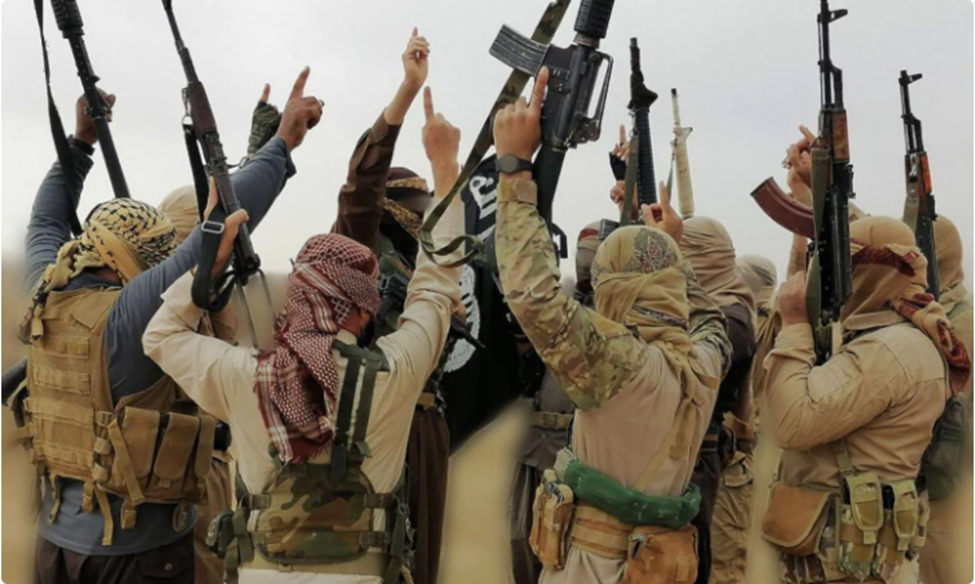
Following its territorial defeat in Syria, Daesh managed to preserve several active cells, bolstering its networks in the Syrian desert. Since 2023, it has intensified its attacks across the country, leveraging regional conflicts and the reduction in counter-terrorism efforts. On July 16, the US Central Command revealed that Daesh is on track to double the number of attacks it conducted in Syria and Iraq in 2023, emphasizing that “The increase in attacks indicates Daesh is attempting to reconstitute following several years of decreased capability.” The attacks observed in Syria, however, have largely been straightforward and limited in complexity, primarily targeting Syrian government military positions. This aligns with the organization’s strategy of “effective selection,” which focuses on conducting operations that maximize impact while minimizing losses.
Notably, the Syrian arena’s strategic importance to Daesh is underscored by two main factors. The first is its symbolic significance, as the former stronghold of its proclaimed caliphate, with continued operations in the region signaling its retained capabilities and influence. The second is its geographic proximity to Iraq, offering a crucial corridor for logistical support and financial resources.
The Daesh-HTS Relationship
The Syrian civil war, which began in 2011, provided a significant opportunity for Daesh in Iraq under Abu Bakr al-Baghdadi to extend its reach. Seeking to create an al-Qaeda affiliate in Syria, Baghdadi sent Abu Mohammad al-Julani to establish Jabhat al-Nusra [al-Nusra Front], which declared itself on January 24, 2012, and quickly solidifid its foothold in the Syrian arena.
Al-Baghdadi grew concerned that Jabhat al-Nusra might slip from his grasp due to its swift successes against Syrian forces. This prompted him to announce its merger with the Daesh of Iraq into a single entity, Daesh in Iraq and the Levant, in April 2013, with Jabhat al-Nusra ultimately falling under his leadership. However, al-Julani chose to pledge allegiance to Ayman al-Zawahiri, the former al-Qaeda leader.
By the end of 2013, conflict broke out between Daesh and Jabhat al-Nusra due to the former’s efforts to expand its influence in regions of Syria controlled by armed militias allied with the latter. In response, Jabhat al-Nusra aligned itself with its allies, leading to violent clashes between the two factions that persisted until 2017.
Following its transformation from Jabhat al-Nusra into HTS in July 2017, in an effort to distance itself from al-Qaeda and establish itself as a political force, the HTS adopted a legal approach in dealing with Daesh cells. Positioning itself as a local governing entity with a focus on counterterrorism, HTS announced 59 operations aimed at arresting Daesh members in Idlib from July 2017 to January 2023.
Daesh and the Escalation in Syria
Based on the foregoing, Daesh is poised to take advantage of the unfolding developments in the Syrian arena to expand its influence, which can be analyzed through the following aspects:
Intensification of Attacks: Daesh is likely to escalate its operations in Syria, capitalizing on the strain faced by Syrian regime forces, shifting security agendas of global and regional actors, and the international community’s preoccupation with urgent crises such as the Gaza war and the conflict in Ukraine. The group has maintained its operational momentum amidst the ongoing escalation in Syria. According to the Syrian Observatory for Human Rights, Daesh cells conducted 27 operations in November, targeting areas under the control of the Syrian Democratic Forces (SDF) and the Syrian Army, resulting in 14 fatalities, including five civilians.
Targeting Prisons and Camps: Daesh is likely to leverage the current escalation in the Syrian arena to revive its strategy of “breaking the walls”, which focuses on freeing its imprisoned members. The cities governed by the Autonomous Administration of North and East Syria under the SDF contain nine prisons housing thousands of Daesh detainees, alongside camps for Daesh families, most notably the al-Hawl camp, which hosts approximately 43,477 individuals, according to March 2024 data from the UNHCR. Attacking such prisons and camps could enable Daesh to rebuild its ranks and rejuvenate its operational capabilities. Simultaneously, targeting prisons could have far-reaching implications, posing threats to both regional and global security, including the escalating danger of returning Daesh affiliates.
Strengthening Human Resources: Daesh is anticipated to prioritize reinforcing its manpower, especially as the potential influx of foreign fighters into Syria grows. These fighters are frequently linked to regional and global players aiming to achieve political goals through their utilization, reminiscent of the post-2011 Syrian civil war period. The threat posed by these fighters stems from three key factors, namely the enhanced ability of terrorist groups to endure security pressures, the refinement of their combat tactics and strategies, based on the knowledge they have acquired from different conflict areas, and their tendency to inflict severe violence on civilian populations.
Temporary Operational Coordination: There is a possibility that Daesh may temporarily coordinate operations, either with the HTS to apply pressure on Iranian militias and the Syrian regime, or with the Guardians of the Religion organization, an al-Qaeda affiliate in Syria, to exert pressure on HTS. The decision of which faction to align with will be driven by Daesh’s current strategic interests.
Although certain analyses dismiss the prospect of operational coordination between Daesh and the HTS due to ideological rifts and organizational disputes, observing the recent patterns of terrorist groups’ activities reveals an emerging trend of prioritizing practical interests over ideological concerns. This indicates that Daesh might show a willingness to adjust to shifting circumstances in pursuit of their fundamental goals.
In short, although Daesh’s role in the ongoing tensions in the Syrian arena, amidst the escalating conflict between armed militias and the Syrian regime, is not yet clearly defined, it is highly likely that if this escalation persists, Daesh will play a significant role, driven by its strategy of “exploiting crises,” by leveraging conflicts to boost its influence. This highlights the need for the international community to reassess its security priorities and recognize terrorist organizations as enduring, long-term threats.