





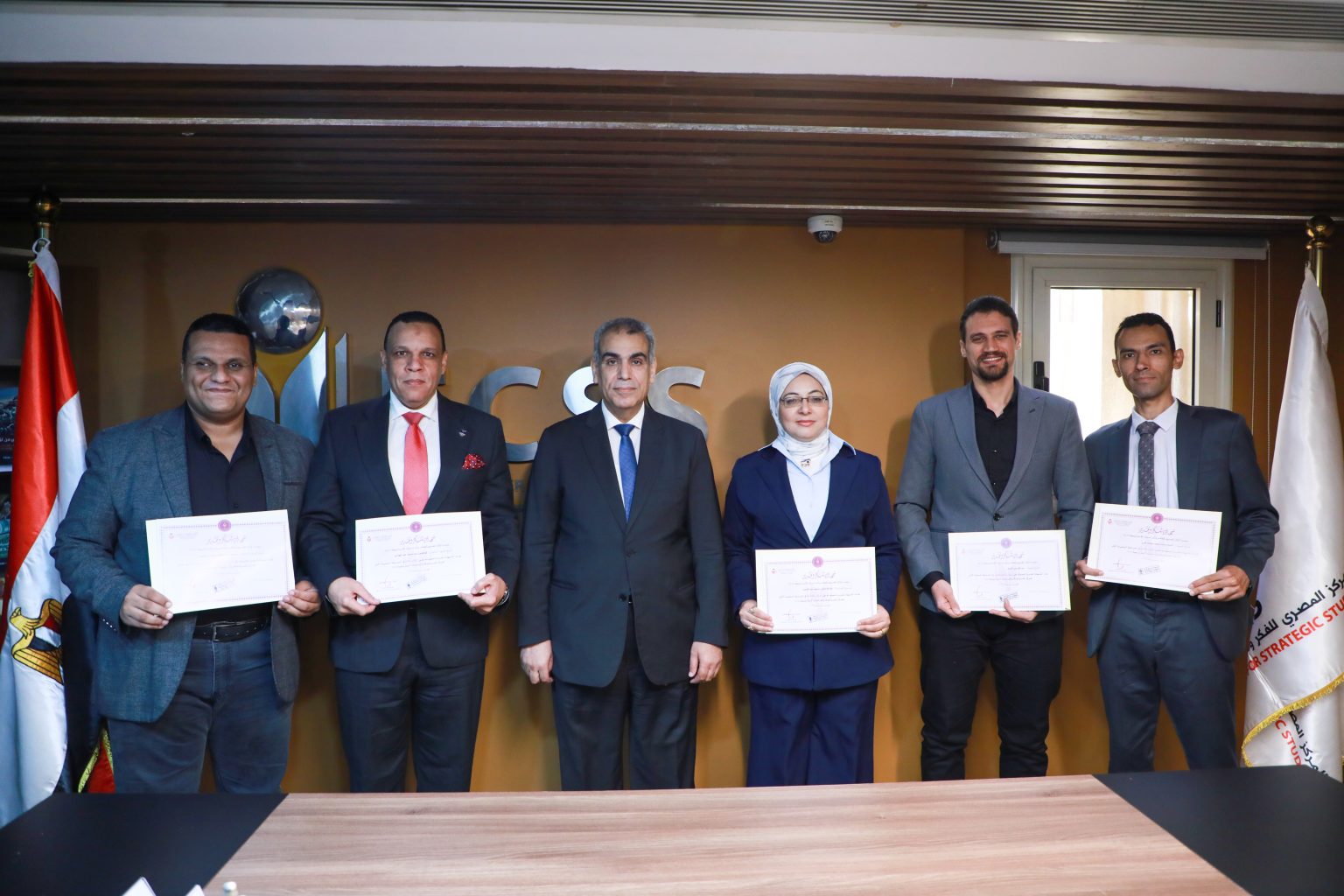
The Egyptian Center for Strategic Studies (ECSS) welcomed on Saturday, September 26, the winners of the top three places in its first research competition, titled “Challenges Facing Egyptian National Identity Amid Contemporary International and Regional Shifts.” The winners are:
- First place: Dr. Ibrahim Ahmed Mohamed Abdel-Hady, for his paper titled “Challenges Facing Egyptian National Identity Amid International Competition and Regional Polarization: An Analytical Study and Strategic Vision for Building Cultural Resilience and Strengthening National Cohesion among Youth.”
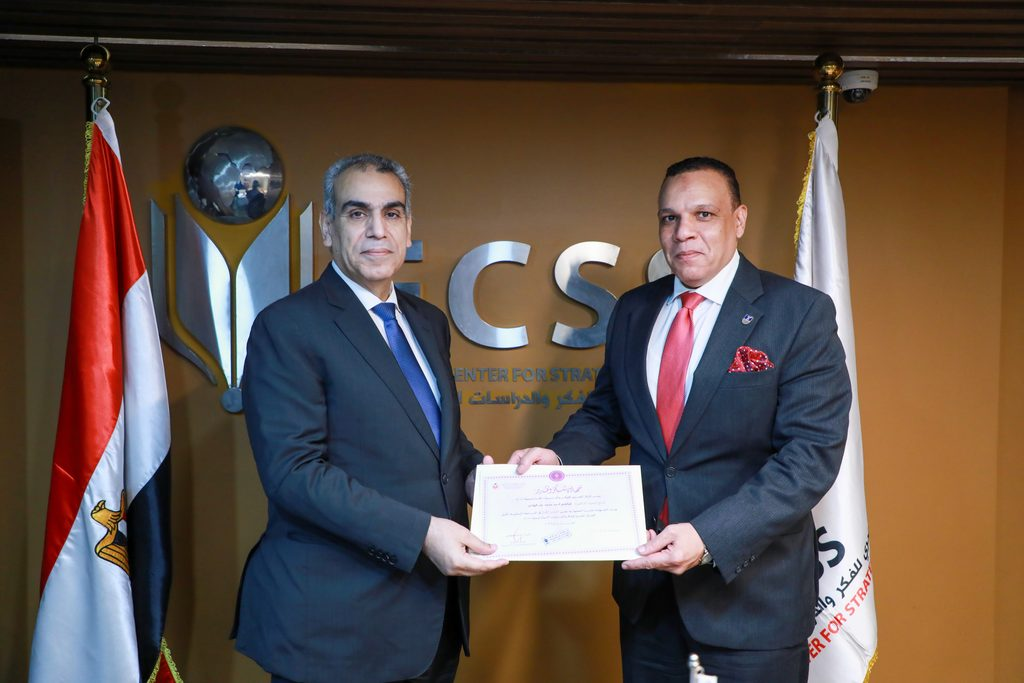
- Second place: Ahmed Mohamed Said Mohamed Ali, for his paper titled “Challenges Facing Egyptian National Identity Amid Contemporary International and Regional Shifts.”
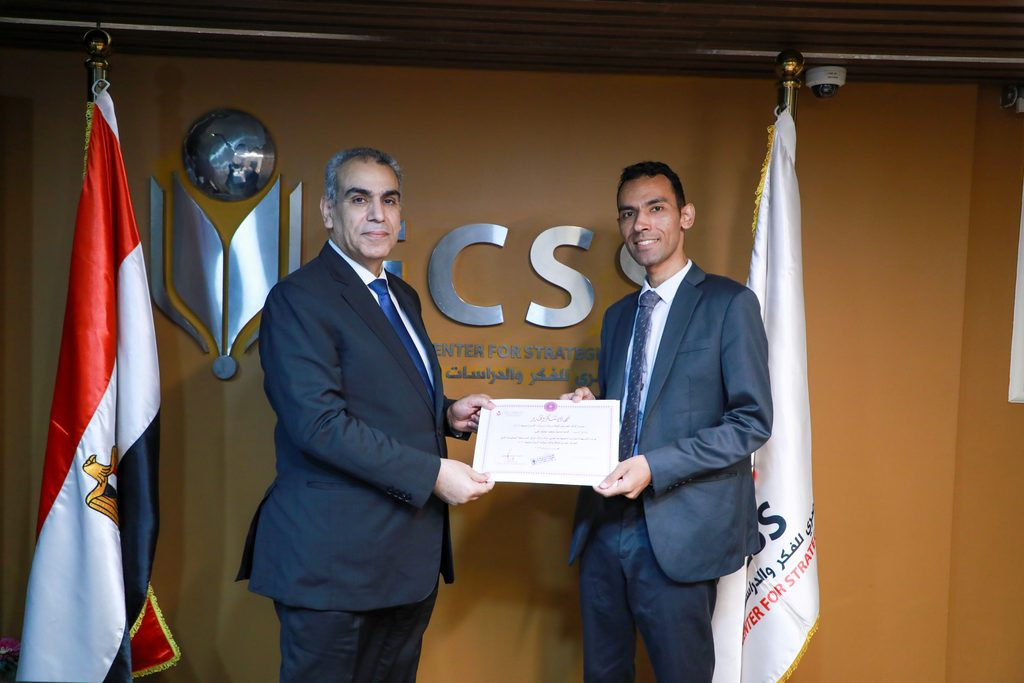
- Joint second place: Abdel-Rahman El-Gamal, for his paper titled “Challenges Facing Egyptian National Identity Amid Contemporary International and Regional Changes: A Societal Security Approach.”
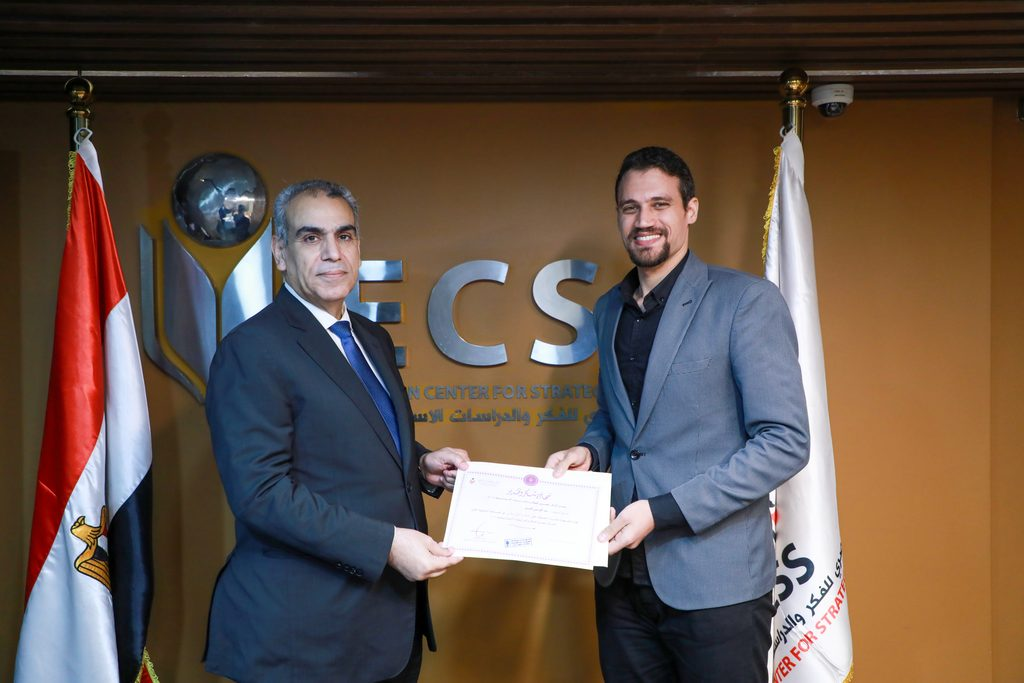
- Third place: Aisha Nagah Mahmoud Abdel-Meguid, for her paper titled “Challenges Facing Egyptian National Identity Amid Contemporary International and Regional Shifts.”
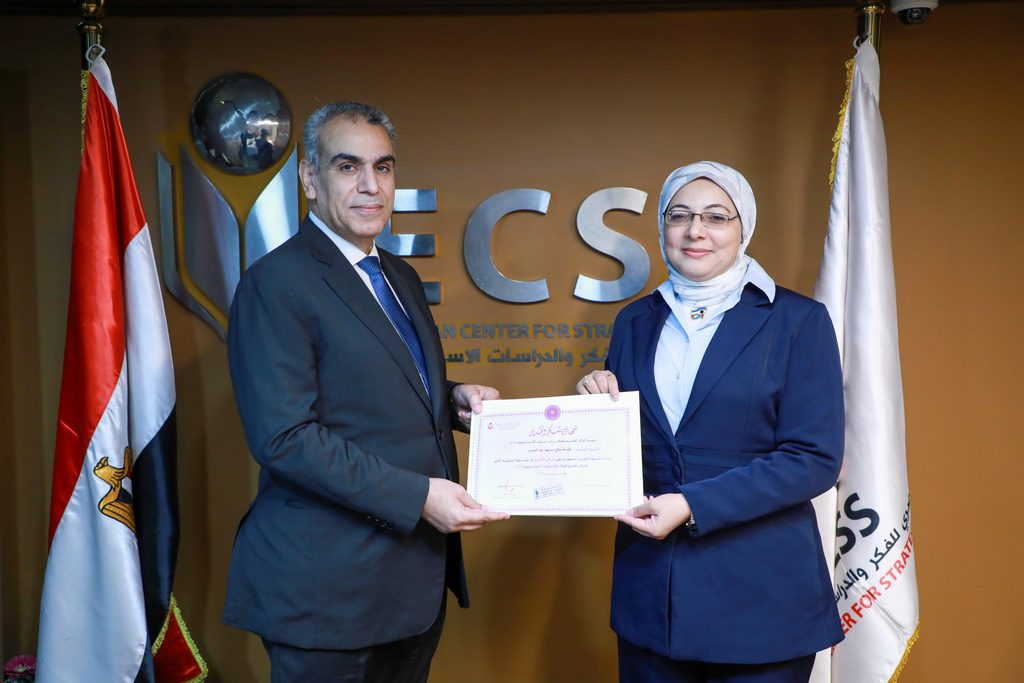
- Joint third place: Dr. Mohamed Abdel-Azim Mohamed Ibrahim, for his paper titled “Challenges Facing Egyptian National Identity Amid Contemporary International and Regional Shifts: An Analytical and Applied Approach to Promoting Awareness and Belonging within the Framework of the Nation-State.”
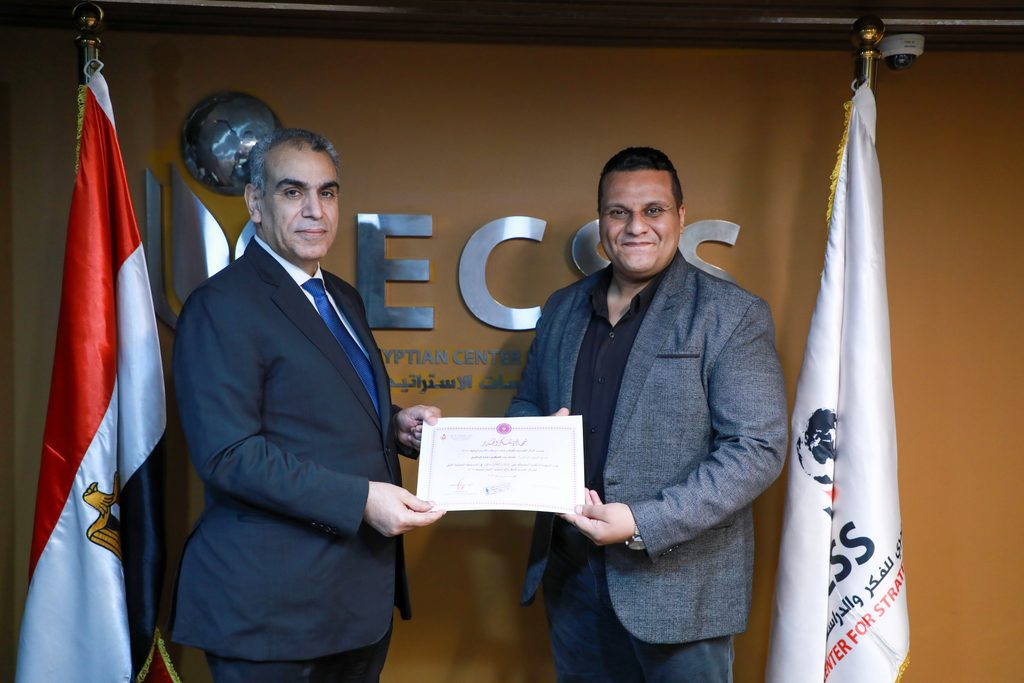
ECSS Director Major General Hossam Mostafa met with the winners during the awards ceremony, which was attended by Dr. Abdel-Wahed El-Nabawy, Head of the Center’s Historical Studies Program and Chair of the research competition’s judging panel.
Major General Mostafa welcomed the attendees and thanked them for their valuable research contributions to the competition. He also thanked Dr. Abdel-Wahed El-Nabawy for his efforts in evaluating the research papers submitted to the competition, noting that the number of submissions exceeded expectations, which led to a delay in announcing the results. He affirmed that the ECSS had objectively and scientifically evaluated and reviewed all the submitted research papers, resulting in the selection of the competition’s five winners, and reiterated his appreciation to all of them.
Major General Mostafa stated that the ECSS would welcome further research contributions from the winners in the future on a range of topics, noting that the Center’s primary criterion across different issues is to provide useful national knowledge.
He explained that the Center’s research priorities revolve around various Egyptian national security issues, which accounts for the diverse composition of its researchers.
The ECSS Director said that the competition topic, “Challenges Facing Egyptian National Identity Amid Contemporary International and Regional Shifts,” was selected primarily because of its importance to Egyptian national security. He added that everything related to national identity has come under threat from both within and outside the country, making its preservation a key challenge to the advancement of the Egyptian state.
He noted that there are certain complexities surrounding the study of national identity, stressing that addressing this issue requires a high degree of precision, particularly with regard to concepts and analytical approaches. At the conclusion of his remarks, Major General Mostafa reiterated his appreciation to the competition’s winners and invited them to take the initiative in undertaking further research to be published by the ECSS.
Dr. Abdel-Wahed El-Nabawy thanked the participants and winners, noting that the launch of the competition was consistent with the Center’s work plan, which is grounded in national interests. He also affirmed that the competition aimed to stimulate researchers’ engagement with the issue, encourage them to exert greater effort in examining it, and identify a new pool of specialists and those interested in the subject of national identity.
He noted the large number and diversity of contributions submitted to the ECSS as part of the competition, as well as the diverse ages and backgrounds of the participants.
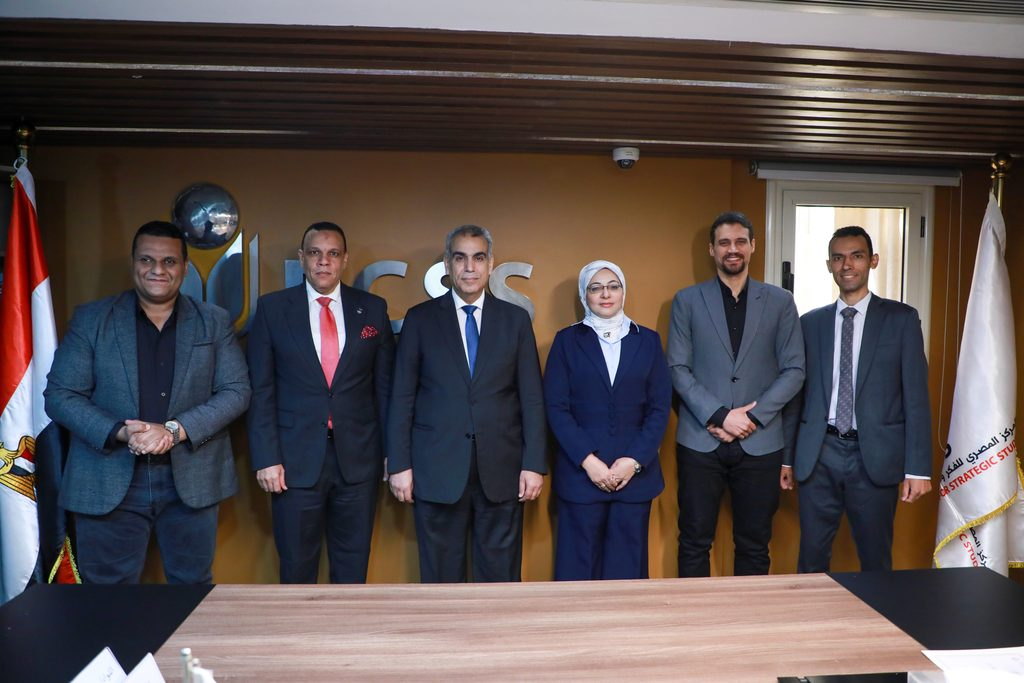
Dr. El-Nabawy explained that the competition was governed by clear criteria, foremost among them that the titles proposed by researchers directly address the issue of identity; the internal and external challenges related to national identity; the quality of the research material; and the inclusion of measurable and actionable recommendations and findings. He noted that Egyptian national identity is clearly being targeted, adding that the most serious aspect of the issue is being aware of our identity without knowing the proper way to define it, which makes it easier to undermine it from abroad or through infiltrators from within.
At the conclusion of his remarks, Dr. El-Nabawy stated that the research papers were evaluated by the competition’s judging committee, which included two senior members of the Center’s Advisory Board: Dr. Khaled Hanafy, an Advisory Board member and the Center’s Editorial Advisor; and Dr. Dalal Mahmoud, an Advisory Board member and Head of the Center’s Security and Defense Program. He affirmed the rigor of the evaluation process applied to the submitted papers.
He also thanked the competition’s winners, praising their writing and research efforts and inviting them to engage more actively with the ECSS through their research contributions.
In his remarks, Ahmed Mohamed Said, the competition’s second-place winner, said he learned about the competition through the Center’s page on social media platforms. He subsequently began gathering preliminary information, identifying and studying the elements of the topic, assessing the challenges related to identity, and developing a vision for addressing those challenges.
He said he was keen to put forward recommendations that could be implemented by the relevant state authorities. Among the most important was giving greater attention to content related to Egyptian identity in the digital space, in addition to leveraging identity as a tool of public diplomacy and measuring its impact on international perceptions of Egypt.
Dr. Aisha Nagah, the competition’s third-place winner, said that her doctoral dissertation focused on the impact of technology on psychological identity, drawing on her previous work related to identity. She welcomed future cooperation with the ECSS.
Abdel-Rahman El-Gamal, the competition’s joint second-place winner, said that Egyptian identity is a composite identity and that Egypt has a highly diverse culture. He noted that more important than defining identity is first having a clear understanding of it, given the internal and external challenges it faces.
He stressed the need to address the issue from a broader perspective that goes beyond defending identity to promoting it and extending influence through it.
Dr. Mohamed Abdel-Azim, the competition’s joint third-place winner, said he learned about the competition through the Center’s Facebook page, after which he began gathering information related to the competition’s topic.
Regarding the impact of the competition’s topic, he said he had organized a number of workshops at Assiut University addressing national identity, driven by his belief in the importance of the issue and its impact on national belonging and loyalty to the country.
He noted that one of the key recommendations put forward in his winning paper was the “National Identity Ambassadors” initiative at Egyptian universities. He expressed hope that the ECSS would play a role in supporting the initiative, in addition to another proposal to establish an Egyptian digital platform dedicated to national identity, given the influence of the digital space on younger generations.
He thanked the Center’s management and the organizers of the competition, noting that he closely follows the studies and research papers produced by the ECSS. He expressed hope for future cooperation between the Center and Egyptian universities, particularly Assiut University.
At the conclusion of the meeting, ECSS Director Major General Hossam Mostafa affirmed that the Center’s doors remain open to receiving high-quality research contributions in the future and thanked the competition’s winners.