






The October 1973 war was not merely a military confrontation that exposed Israel’s lack of preparedness for a coordinated Egyptian-Syrian attack, but a comprehensive test of the military system it had developed after the June 1967 war.
Israel entered the war relying on a set of assumptions that, in light of the results of 1967, appeared highly coherent: that deterrence would prevent Arab states from resorting to war; that Israeli qualitative superiority would ensure a decisive outcome if confrontation erupted; that the geographical depth provided by the occupied territories would allow sufficient time for warning and mobilisation; and that regular forces could absorb the initial blow until reserve forces were called up.
However, the October War put all these assumptions to the test simultaneously, revealing that possessing military power does not necessarily mean being able to translate it into effective combat superiority under conditions of surprise and war on multiple fronts.
Israeli Military Policy Before the October 1973 War:

After the June 1967 War, Israel consolidated the view that the military superiority demonstrated by its army had established sufficient deterrence against the Arab states. Deterrence meant not only preventing war, but was also linked to convincing the adversary that any renewed confrontation would end in a clear military defeat. At the same time, the occupation of Sinai, the Golan Heights and the West Bank gave Israel geographical depth it had not previously possessed, creating a belief that this depth would provide additional time for warning and preparation and keep its vital centres away from immediate danger.
The strategic depth provided by the territories occupied after 1967 was an essential part of this conception. Sinai and the Golan were viewed not only as territories separating Arab forces from Israeli centres, but also as space that was supposed to give the leadership more time to detect an attack and organise the defence.
Geography thus became part of the warning and mobilisation system. Yet this assumption overlooked the fact that Egyptian and Syrian forces were already positioned along the new confrontation lines and no longer needed to cover the distances that had separated them from the battlefield before 1967. Thus, geographical depth, regarded as a source of reassurance, became an element whose value could only be realised when combined with an accurate assessment of the threat and an early decision to mobilise.
This was linked to reliance on a relatively small standing army, supported by a large reserve force that could be called up when needed.
The success of this formula depended on an interconnected sequence: early warning enabling a rapid decision, followed by the mobilisation of reserves and their movement to the fronts, and then the transition from defence to counterattack.
Air power also occupied a central position in this conception, as a principal instrument for rapidly achieving operational superiority, supporting ground forces and helping to carry the war into the adversary’s territory.

The results of 1967 also helped consolidate confidence in air power, which, in the Israeli conception, appeared capable of compensating for numerical disparity, supporting ground forces and creating the conditions for a rapid transition to the offensive. However, the October 1973 War demonstrated that air superiority is not a fixed reality independent of the operational environment.
Egypt’s construction of a dense surface-to-air missile network, alongside its extensive use of anti-armour weapons, showed that it had developed means of temporarily neutralising Israeli strengths, and that qualitative superiority is measured not by the quality of systems alone, but by the ability to operate them against countermeasures specifically designed to constrain them.
But this model contained a fundamental weakness: every element depended on the others. If warning failed, the time available for mobilisation diminished; if mobilisation was delayed, regular forces had to fight the initial battles alone; and if air power lost its freedom of action, the ability to regain the initiative quickly declined.
This was precisely the structural flaw in that system exposed by the October War.
Israel’s Strategic Shock … When Assumptions Collapsed:

The Egyptian-Syrian attack on 6 October 1973 struck the most sensitive link in the Israeli system: early warning. The problem was not a complete absence of information, but the way it was interpreted.
What later became known as “the concept” or “the preconception” governed the interpretation of the available indicators.
The Israeli establishment assumed that Egypt would not begin a war before acquiring certain capabilities that would enable it to confront Israeli air superiority, and that Syria would not wage a large-scale war alone. Consequently, indicators of Arab preparations were interpreted in accordance with prior assumptions, rather than as evidence that war was approaching.
This failure rapidly moved from the level of intelligence assessment to military readiness. Israel relied heavily on reserve forces, but large-scale mobilisation was delayed, leaving the forces already deployed on the two fronts to confront a major offensive before the build-up was complete.
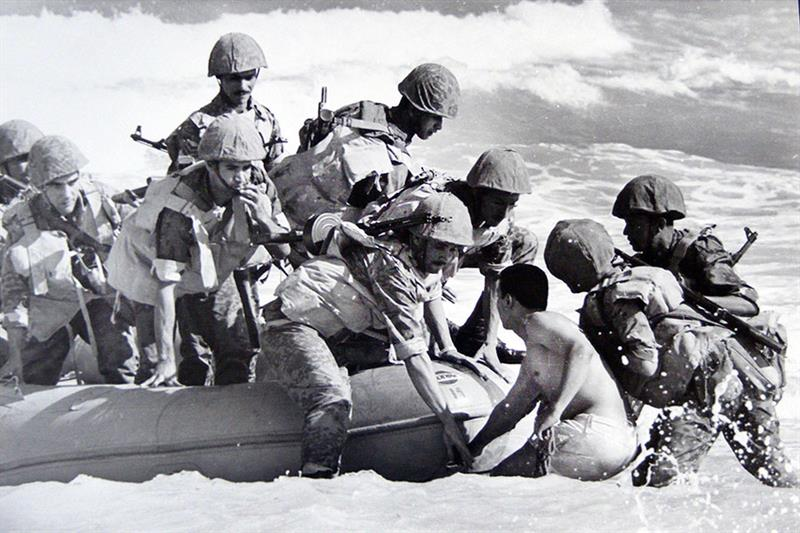
In the Golan, the scale of the numerical disparity became apparent in the first hours, while Egyptian forces succeeded in crossing the Suez Canal and establishing bridgeheads on its eastern bank. This forced Israeli forces into a defensive position that their military policy had not been designed to confront.
The concept of qualitative superiority also faced a severe test. On the Egyptian front, Israeli aircraft encountered a dense, multilayered air defence network that restricted their freedom of action. Israel had prepared a plan to destroy Egyptian air defences and achieve air superiority, but developments in the war, the need to support ground forces, and then the gravity of the situation in the Golan prevented the plan from being implemented as intended.
Possessing an advanced air force was therefore no longer sufficient on its own to secure a rapid, decisive outcome.
More importantly, the war exposed a problem in the relationship between the components of military power, rather than in each component individually.
Deterrence had not prevented war; warning had not provided time; the reserves were not available at full effectiveness when required; air power could not operate as freely as expected; and regaining the initiative required more time and effort than earlier Israeli assessments had assumed.
The October crisis was therefore less a crisis of insufficient weapons or personnel than a crisis in the employment of military power under conditions for which the military establishment was unprepared.
From Strategic Shock to a Review of Israeli Military Policy:

Israel’s response after the war was not confined to identifying those responsible for the failure, but expanded to encompass a broader review of military policy, force development, readiness, warning, and command and control mechanisms. This review followed two overlapping tracks: an official and legal track represented by the Agranat Commission, and a military and intellectual track pursued within the military establishment and research and political circles.
The Agranat Commission did not offer a simple explanation based on the error of a single individual. It examined problems concerning equipment and reserves, shortcomings in planning and command and control, intelligence failure, the issue of surprise, and the performance of commanders on the fronts.
It ultimately held a number of military and intelligence leaders directly responsible. More importantly, however, it revealed that the problem extended beyond individual responsibility: there was a gap between the military power Israel possessed and its ability to translate that power into organised, coherent performance under the pressure of surprise.
The Agranat Commission is particularly significant in this context because it embodied the transition from battlefield shock to institutional review. Its recommendations did include measures against a number of senior military and intelligence officials, foremost among them Chief of Staff David Elazar and the head of military intelligence. However, the most important value of its report lay in the breadth of what it subjected to examination.

The review covered the equipping of reserve forces, planning, command and control, intelligence, doctrine, and performance on the fronts. The war thus shifted from a question of who was responsible for the surprise to a broader question: why had a system possessing substantial military capabilities been unable to employ them efficiently in the first hours and days? This shift took the review beyond holding individuals accountable to examining the structure of military operations itself.
At this point, the October War became a starting point for a process of institutional learning.
The issue was no longer simply how to prevent a recurrence of the intelligence error, but how to build a system capable of functioning even if a failure occurred or war came at an unexpected time. It therefore became necessary to strengthen the army’s ability to absorb surprise, accelerate mobilisation, improve deployment, raise readiness, develop command and control systems, and expand its capacity to deal with war on multiple fronts.
The Impact of the Review Process on Israeli Military and Defence Policy After the October 1973 War:

The post-October review did not produce an entirely new Israeli military policy, but it led to a reordering of priorities and adjustments to the means of implementation. The first of these trends was to reinforce the offensive character of the implementation of defensive strategy. From the Israeli perspective, the war had demonstrated that waiting for the initial blow could carry severe risks.
Attention therefore returned to taking the initiative, the ability to carry operations into the adversary’s territory, and restoring the option of launching a pre-emptive strike if the leadership considered that circumstances warranted it. Restoring deterrence also became more closely linked to demonstrating the ability to use force, rather than merely possessing it.
The war had shown that an adversary might decide to fight even while recognising Israeli superiority if it believed it could achieve limited political or military objectives. Israel therefore moved to strengthen its offensive capability, raise the readiness of its forces and ensure its ability to respond rapidly.
In force development, the change was clear in quantitative terms. The size of regular and reserve forces increased in the years following the war, and the reserve call-up system was reviewed to reduce the time required for reserves to reach the battlefield.
The immediate lesson was that having a large reserve force was insufficient unless it was ready, could be called up quickly, and had the equipment and training necessary for an immediate return to combat.
Rebuilding readiness was also not confined to increasing numbers. Israel moved to reduce its reliance on the assumption that warning would always provide sufficient time to assemble its forces. The speed of call-up, improving the readiness of existing units, and improving the distribution of forces between fronts therefore acquired greater importance.
One of the lessons of October was that a force existing on paper becomes an actual military force only when it is in the right place, at the right time, and under a command capable of employing it rapidly. This lesson explains why the quantitative expansion of forces was accompanied by investment in command and control, reconnaissance and warning systems, rather than numerical expansion alone.
Efforts also expanded to modernise weapons, develop warning, reconnaissance, and command and control systems, increase military expenditure, and strengthen military cooperation with the United States.
The aim was to rebuild Israeli military superiority against the possibility that Arab states might again use numerical concentration, air defence, anti-armour missiles or operational surprise to reduce the impact of Israeli qualitative superiority.
However, one of the most important lessons involved reconsidering the relationship between technology and combat effectiveness.
The war demonstrated that possessing advanced systems does not, on its own, ensure superiority unless these systems are part of an integrated system encompassing accurate information, effective warning, appropriate preparation, and a command capable of making timely decisions. Readiness and integration between the elements of military power therefore became a more explicit part of the review process that followed the war.
The Limits of the Review and the Continuity of the Foundations of Israeli Military Policy:

Despite the extensive review of Israel’s poor military performance in the October 1973 War, describing what occurred after 1973 as a complete change in Israeli military policy would be an exaggeration. Israel retained many of the traditional foundations that had governed its military thinking since its establishment: deterrence, military and qualitative superiority, taking the initiative, reliance on its own strength, keeping the war away from its vital centres, and seeking a military outcome that would prevent the adversary from imposing its objectives by force.
This highlights the importance of distinguishing between changing military policy and developing its instruments and the conditions for its implementation. Some of what changed after October can be viewed as a return to principles that had been more prominent before 1967, after the war demonstrated the limits of the adjustments introduced in the aftermath of that year.
Heavy reliance on geographical depth, the belief that the initial blow could be absorbed, and excessive confidence in deterrence’s ability to prevent war were all subjected to review. But Israel did not abandon deterrence, superiority or taking the initiative; it sought to rebuild the conditions that would make these principles more effective.
For this reason, the change in defence policy was, in many respects, greater than the change in the substance of military policy.
Forces expanded, the pace of armament increased, warning and control systems were developed, and military relations with the United States were strengthened, while the fundamental objectives remained largely stable.
In other words, the means changed substantially, while the core strategic objectives remained more constant.
In Conclusion:

Studying the impact of the October 1973 War on the review of Israeli military policy reveals that the war did not produce a break with the fundamental foundations of that policy so much as expose the gap between possessing military power and being able to translate it into effective combat capability under actual wartime conditions.
This highlights a fundamental paradox in the course of Israeli military policy after the October 1973 War: the expansion of investment in military power was not necessarily accompanied by a comparable transformation in the way war was conducted.
Israel was quicker to increase the size of its forces, modernise its weapons, and develop warning, reconnaissance, and command and control systems than to reformulate some of the operational assumptions governing the employment of these capabilities.
The review undertaken after the October War was therefore a cumulative process through which Israel re-examined the relationship between doctrine, force development, readiness and operational employment.
The true value of the post-1973 review therefore lay not in its production of fundamental changes in Israeli military policy, but in its exposure of the gap between possessing military power and being able to translate it into an effective combat force.

The October 1973 War can thus be viewed as a turning point in the conditions under which military policy was implemented more than a turning point in its purposes and fundamental foundations.
The instruments changed substantially, resources and capabilities expanded, and response mechanisms developed, while the central objective endured: maintaining military superiority and the ability to deter, and preventing adversaries from imposing strategic outcomes by force.
Published in cooperation between the Egyptian Center for Strategic Studies, Al-Ahram Weekly, and the English-language portal Ahram Online