





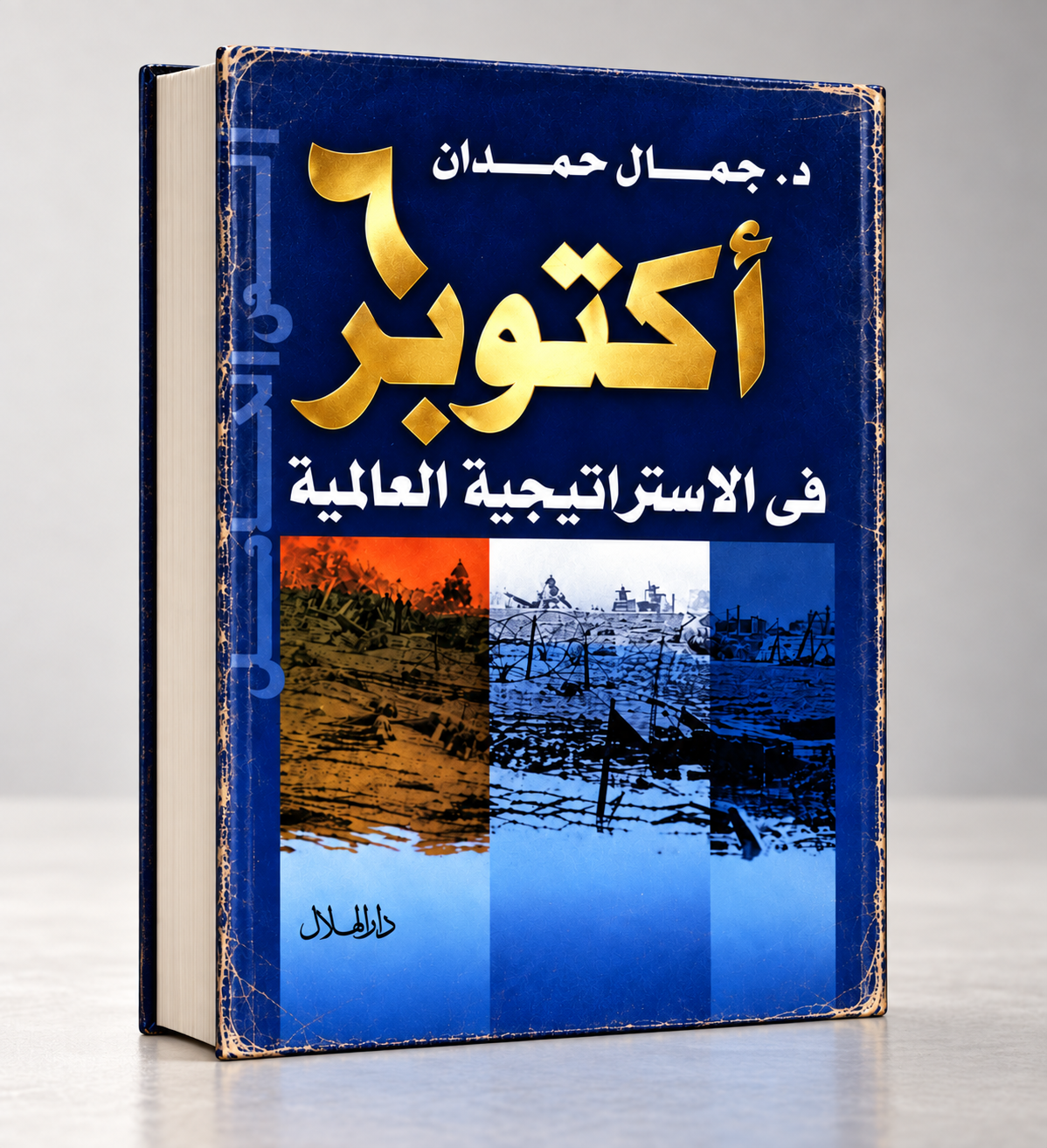
Dr. Gamal Mahmoud Saleh Hamdan (1928-1993) is regarded as one of the most profound geographical and strategic thinkers Egypt produced in the 20th century, and the founder of a distinctive school of thought in political and strategic geography. He earned a Ph.D. in the philosophy of geography from the University of Reading in in the UK 1953. Over the course of his academic career, he produced 29 books and 79 research papers and articles, foremost among them his renowned encyclopedic work, The Personality of Egypt: A Study of the Genius of Place, which is considered one of the most important works written on the interpretive and civilizational geography of Egypt.
Dr. Hamdan’s 11-chapter book is firmly rooted in the geographical-strategic approach that shaped all his works: viewing a political or military event as the product of interconnected geographical, human, and historical factors, rather than as an isolated occurrence detached from its broader spatial and temporal context. This explains why the book begins with an extended geographical chapter on Sinai before delving into the details of the military and political battle.
Hamdan explains that his objective in the book is to provide a systematic scholarly account of the October battle, one that does not examine it in isolation from its broader context, but places it within the framework of the entire existential conflict. Hamdan strongly rejects reducing the significance of the October War to merely the objective opposite of the setback of June 1967, describing it instead as a great war of liberation. He emphasizes the need to view it through a broader global perspective extending beyond the local and regional framework, describing it as — not merely a local military event, but — one of the most consequential turning points in global strategy.
In the introduction, Hamdan opens his book by emphasizing the October War’s defining historical significance, stressing that the battle cannot be separated from the broader Arab-Israeli conflict or from the wider international balance of power.
“Egypt’s Holy of Holies”: Hamdan opens his book with an extensive geographical and strategic study of the Sinai Peninsula, describing it as Egypt’s “Holy of Holies” and the principal theater of the battle. He then outlines the broad features of Sinai’s human and military geography, its resources and population, as well as its strategic significance and history, concluding with a discussion of the meaning of the Egyptian presence in Sinai and the future of that presence. This underscores Hamdan’s view that geography is not merely a descriptive backdrop to a military event, but a key to understanding it.
Under the title “The Great Battle of Liberation,” Hamdan explains how the enemy waged a fierce psychological warfare campaign that had been carefully planned, seeking to undermine Arab self-confidence through the myth of an invincible defense army and absolute technological and air superiority. The chapter then moves to the details of planning the crossing operation and its various stages: its preparations and plans, followed by its major military phases, beginning with the historic crossing and the storming of the Bar Lev Line, the liberation of the broad land bridge in western Sinai, and finally the Israeli infiltration operation known as the “Gap” in the Deversoir area and its repercussions.
Hamdan discusses “the Strategy of the Battle” through a detailed examination of its tactical and strategic dimensions, employing a rigorous military analytical approach. He describes H-Hour and the launch of the major Egyptian air strike. The chapter also documents the simultaneous firing of more than 2,000 artillery pieces in a comprehensive barrage against the positions of the Bar Lev Line, as well as artillery and reserve concentrations, paving the way for the major crossing operation and the securing of bridgeheads. The chapter further examines the elements of initiative and surprise in Egyptian strategic doctrine, including the assembly of forces four months before the battle and the deployment of the main forces during the three weeks preceding the war. It also examines the extremely careful selection of the timing of the war, taking into consideration the most favorable political circumstances, the most suitable day of the week, and the optimal hour for the crossing.
The author also presents the concept of “Total War,” explaining that it is a form of warfare in which all the resources and capabilities of the state — political, diplomatic, economic, and social — are mobilized, alongside all branches of its land, naval, and air forces, in support of the military operation and its success.
Hamdan devotes an entire chapter to “The Great Syrian Battle,” in which he analyzes the Syrian front, emphasizing Syria’s distinctive and prominent strategic and political position among the Arab states. He describes Syria as one of the pioneers of Arab nationalism since the Islamic era, and its front in the Arab-Israeli conflict as geographically significant and militarily formidable — one that consistently maintained a balance with the enemy and imposed countervailing strategic pressures that divided its attention. He further emphasizes that the full coordination between the Syrian and Egyptian fronts in terms of timing, planning, and escalation together formed a strategic pincer that, for the first time, effectively confronted the enemy with the dilemma of fighting a war on two fronts simultaneously.
Under the heading “Victory for Whom?” Hamdan raises a question that remained the subject of debate for some time: Was October truly a war of liberation, or merely a war of maneuver that fell short of achieving complete victory? He opens the chapter by examining the enemy’s position, emphasizing the established fact that the enemy had lost the military battle before the political battle even began. At the same time, however, it waged a skillful and vociferous propaganda campaign on the global stage, through which it sought to obscure the truth and distort the picture of the situation.
Given the significance of the October War, Hamdan assigns an important chapter the title “October 6 and Military and Regional Strategy.” In this chapter, he asserts that the October War represented a radical strategic revolution that overturned many of the established concepts of both conventional and unconventional warfare and profoundly influenced the principles of military geography. Its impact was so significant that military circles and academies devoted themselves to studying its outcomes and implications. He then draws regional comparisons between the October War and the local wars that most closely resembled it in military and political terms.
Hamdan was fully aware of the role of the Arabs in the war, which is why he titled the seventh chapter “The Arabs and October 6.” He explains the Arabs’ position in the battle, where they stood before it, and the impact of the June defeat on them, before examining the transformation brought about by October in the Arab world. The chapter also links the battlefield confrontation to the oil battle, which represented the other face of the October War and its complementary instrument, describing the oil war primarily as a battle with global dimensions.
In the eighth chapter, “October 6 and the Israeli Enemy,” Hamdan expands his analysis of the arrogant and overconfident enemy before October, examining its plans, projects, intentions, statements, provocations, and acts of aggression before turning to the image reflected in the Israeli mirror after the war: psychological collapse, strategic disequilibrium, the collapse of the regional strategy, and, ultimately, the fracturing of the Israeli security doctrine.
When Hamdan titled a chapter “The World and the Battle,” he was keen to highlight the global significance of the October War. The author begins by discussing the view that the October battle represented a decisive turning point in modern Arab history, or a historical dividing line in the Arab-Israeli conflict. He goes further, however, arguing that, in his assessment, it also constituted a turning point in the history of the contemporary world and in global politics. He analyzes, in succession, the battle’s impact on détente between the two superpowers, Western Europe, Africa, and, finally, the United States itself and its relationship with the Israeli enemy.
Hamdan did not overlook future prospects. He devoted a chapter of this distinguished book to the subject and drew a precise methodological distinction between two fundamental objectives of the conflict after October. The short-term objective was the removal of the consequences of aggression, meaning a return to the situation before June 1967 — directly, without postponement, bargaining, or partial solutions. The long-term objective was the fundamental question of Palestine in all its historical dimensions: the historical right, the usurped homeland, the displaced people, and the right of return. This necessarily also entailed the question of the Israeli presence and the Zionist usurpation of occupied Palestinian land. He further addressed the “Future of the Conflict” in a final chapter, in which he examined the nature and future of the Arab-Israeli conflict, describing it as complex and multifaceted, with multiple levels and objectives. It is simultaneously a struggle for survival and destiny — a struggle over existence, not borders; a struggle between right and hatred, rather than between two competing rights, as the Zionists falsely claim. It is also a clash of civilizations, a struggle between nationalisms, and a conflict of religions. Geographically, its arena extends from the local sphere to virtually every corner of the world; historically, its reach encompasses the past, present, and distant future. Hamdan also points to the multiplicity of parties to the conflict: the Palestinians and Arabs on one side, and the Zionist front and global imperialism — particularly the Israel-United States axis — on the other.
In conclusion, the book is distinguished by the depth of its author’s scholarly background as a strategic geographer, which lends his analyses a degree of precision and academic rigor rarely found in the rapid journalistic or propagandistic writings that appeared in the immediate aftermath of the October War. He does not limit himself to a military account of events on the battlefield, but extends his analysis to the political, economic, psychological, and global strategic dimensions of the war, in a serious attempt to place the October War within its broader global context.
The book also represents a model of intellectual courage and critical inquiry, as the author does not hesitate to confront contentious and skeptical questions regarding the scale of the Arab achievement, rather than simply adopting a one-sided celebratory narrative. The book’s early date and its close proximity to the events themselves — having been written in the months immediately following the war — also enhance its documentary value as a contemporary analytical testimony by a distinguished strategic thinker who witnessed the details of the event firsthand, rather than writing about it decades later through the lens of selective recollection.
The book stands as one of the most important foundational Arab references for analyzing the 1973 October War from a comprehensive geographic-strategic perspective, as well as one of the most significant examples of an immediate, contemporaneous reading of a major military and political event, before subsequent layers of interpretation and political instrumentalization accumulated around it. It remains a valuable scholarly reference for students of military geography and the history of the October War, owing to its analytical precision, methodological rigor, and enduring intellectual value in distinguishing systematically between the short- and long-term dimensions of the Arab-Israeli conflict — a distinction that, despite the decades that have passed since the book was written, remains highly relevant to understanding the complexities of the Palestinian question today.


