






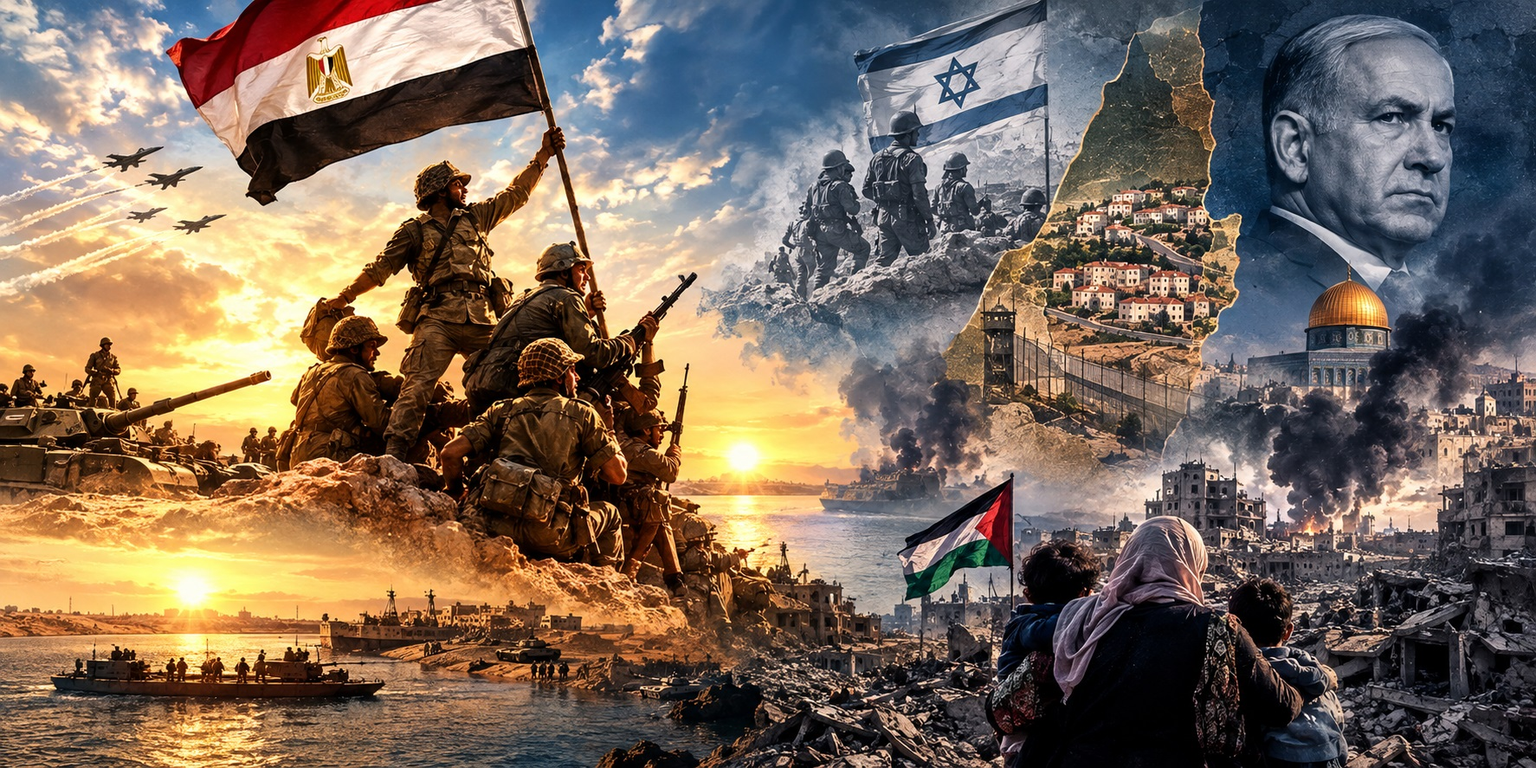
On the anniversary of the Egyptian Army’s victory in the October 1973 War, revisiting the memories of that war is not only an exercise in recalling a military event that took place more than half a century ago. Rather, it offers an opportunity to reexamine the Israeli project itself: how its doctrine toward land, population, and power took shape, and why security in the Israeli consciousness has remained so closely intertwined with expansion, settlement, and the use of force.
More than half a century after the October War, in light of the extensive destruction witnessed in the Gaza Strip, the accelerating expansion of settlements in the West Bank, and the realities established by the Israeli occupation of the Syrian Golan Heights, it has become difficult to understand the current landscape if it is treated as a series of separate crises.
Gaza does not stand alone, the West Bank is not an isolated issue, and the Golan Heights is not only territory that has been occupied since 1967. Rather, there are different links in a long trajectory in which Zionist ideology, military power, settlement, and the reshaping of geography intersect.
Perhaps the most important point to consider is that the roots of this trajectory do not begin on October 7, 2023, or even with the June 1967 War. Rather, they go back to a period predating the establishment of Israel, when the Zionist project was still in the process of building its presence in Palestine and clandestine military organizations had emerged before the establishment of the state.
Indeed, the organization of armed force was itself part of the process of establishing the Zionist presence.
This is where the significance of a phrase that may appear harsh, yet captures a dimension of history that cannot be ignored, comes into focus: “the doctrine of blood and fire.” It is not intended as a religious doctrine, nor as a characterization of Jews as a group. Rather, it describes a political and military trajectory that emerged within the armed Zionist movement, in which force became a means of establishing settlements, settlement became a means of consolidating a presence, and the protection of that presence subsequently became a pretext for expanding the scope of force and control.
If the October War demonstrated that this project is not an immutable destiny that cannot be challenged, what is unfolding today in Palestine, Syria, and other countries of the region raises another question: What remains of that thinking more than fifty years later? Has the doctrine changed, or has only the language in which it presents itself to the world changed?
Accordingly, examining the underlying thought will take precedence over adhering to a chronological sequence, so that moving between dates and events remains consistent with the thinking and narrative that we are being asked to view the world through.
When the Gun Came Before the State
Perhaps the greatest mistake in reading Israel’s history is to begin with the declaration of statehood in 1948, as though the military establishment emerged only after the state was founded to defend an already existing state. Yet the evidence documented in the research literature on which this paper draws points to a different picture: clandestine military organizations predated the establishment of the state, and armed force was part of the process of building the Zionist presence in Palestine.
Here, the emergence of Hashomer, followed by the Haganah, is particularly significant, with the latter eventually becoming the Israeli military after the declaration of statehood. This sequence reveals something important: the military was not simply an institution created by the state; rather, the military establishment itself was one of the instruments that contributed to creating the state and establishing its presence on the ground.
This is not only a formal observation. When David Ben-Gurion argued that relying on others to protect settlements and settlers could not ensure security and freedom, he was offering an early interpretation of the relationship between settlement and armed force. And when the establishment of Hashomer was linked to the armed guarding of settlements, and that experience subsequently became one of the sources from which the Haganah emerged, we are presented with a model that does not separate the settler from the fighter, or the establishment of a settlement from the building of the force capable of protecting it.
Even more revealing is the slogan attributed by the research to Ben-Gurion: “By blood and fire Judaism fell, and by blood and fire it will return.” Regardless of the full historical context of the statement, its significance in this reading lies in the extent to which it reflects the centrality of force and violence in the conception held by that generation of Zionist leaders regarding the establishment of a presence on the ground.
This is where a particularly important point deserves attention: the language changed, but the political function of the terminology remained.
At an early stage, the discourse centered on “guarding,” “defense,” and the protection of lives. It then shifted to “security,” and after the establishment of Israel, the focus became “secure borders.” In recent decades, the term “the right to self-defense” has become widely present in Israeli and international discourse.
This does not mean that every use of the concept of Israeli security is necessarily a cover for expansion, nor that Israeli security concerns are entirely imaginary or fabricated. The problem arises, however, when security becomes an open-ended concept with no clearly defined geographical limits, transforming it from a means of protecting the state into a justification for retaining territory, preventing the establishment of a Palestinian state — or even recognition of one — expanding settlements, and controlling resources, movement, and populations.
This brings into focus one of the central original arguments of this analysis: that settlement in the Zionist experience was not simply a civilian housing project separate from security, but was linked from its beginnings to the building of armed force and to creating the geographic and demographic environment that served the Zionist project.
As for 1948, it was not merely the moment when a state was declared; it was also associated with a war during which large areas of Palestine were occupied, vast numbers of Palestinians were displaced, and massacres were committed by armed Zionist militias. Accordingly, viewing this period simply as the “Israeli War of Independence” removes from the picture the other side that paid an enormous human and geographic price, turning the military outcome into a self-contained narrative.
The Founding Myths of the Zionist Narrative: From “Defense” to “Blood and Fire”
For greater depth and a broader exploration of the subject, there are numerous serious Arab studies that have examined this Zionist military thinking. Among the most prominent is Zionist Militarism, the first major publication of Al-Ahram Center for Political and Strategic Studies in 1972. Without setting out to do so, the study revealed a complete distortion in the way political, media, and journalistic circles have approached conflicts and crises involving the Israeli occupying state, as compared with this legacy. This has contributed to the dominance, strength, and perhaps even overwhelming influence of Israeli narratives, terminology, interpretations, and justifications.
Perhaps the most important lesson from this legacy is the need to focus on the misconception that the colonies — “settlements” — enjoy immunity, and that settlers are civilians entitled to protection. This misconception grants the occupying state a right to self-defense that it does not possess. It also raises the question of how colonies — “settlements” — function as security and military entities consistent with Zionist thinking, and how armed resistance against such entities is imposed by challenges, necessity, and strategic interest, despite the sacrifices borne by the resisting population and the crises this may cause for neighboring states. By strategic standards, however, these may be regarded as a lower price to pay than allowing such colonies — “settlements” — to remain directly on their borders.
Military thinking played the initial and decisive role in shaping Zionist policy aimed at establishing and developing the Zionist presence in Palestine, leaving its clear imprint from the outset on all the plans and approaches devised to establish the “Jewish state.” As a result, armed force assumed a central position in realizing this project, and military organizations had a decisive voice from the beginning. This helps explain, to a considerable extent, a phenomenon that accompanied the establishment of the state: the creation and organization of the military establishment were preceded by the establishment of the state itself. When the establishment of the state was declared and the formation of a regular army became necessary, all that was required was to change the name of the clandestine military organization Haganah from the “Defense Organization” to the “Israel Defense Forces,” or Tzahal, an acronym formed from the Hebrew words Tzva Haganah LeYisrael, meaning “Israel Defense Forces.”
The phrase “defense and guarding,” used in the year when the Zionist Organization decided, in 1907, to begin pursuing Zionist colonization in Palestine on a wider scale, did not, in reality, mean anything other than “violence and dispossession.”
David Ben-Gurion’s ideas, in which he was known to them as the “armed prophet,” help explain the reasons for establishing a military force linked to the construction and expansion of settlements in Palestine during the early stages of the conflict preceding 1948. At the time, these efforts were cloaked in deceptive terms and expressions such as “defense,” “security and guarding,” and “protection of lives,” eventually culminating in the present-day term “the right to self-defense.” None of these terms and expressions, however, reflects the reality or provides a basis or justification for the Zionist presence in the first place, as that presence was founded on dispossession and coercion.
In discussing the establishment of Hashomer, Ben-Gurion stated:
“It was absurd for the Jewish settlers to rely on others to guard their crops and protect their lives. If this continued, they would never enjoy their freedom or feel secure. If they had to defend themselves, and guards had to be hired for that purpose, those guards should be Jews. Accordingly, Hashomer was established as a guard organization. It was, in fact, the precursor of the Haganah, the secret Jewish defense force formed after the First World War, which played a violent role in continuously defending the Jews until the declaration of independence in 1948.”
Ben-Gurion Looks Back; In Talks with Moshe Pearlman; New York, Simon & Schuster, 1965, p.24.
The settlement of “Al-Shajara” was the first Zionist settlement to establish an armed force as the nucleus of Hashomer. Ben-Gurion and Ben-Zvi continued their efforts to build what they envisioned as an “armed Zionist society” and to extend the system of armed force across the settlements. Hashomer was thus formed from members of the Poale Zion party and former members of guard units in the Diaspora, modeled on self-defense groups in Russia. Its slogan was not “guarding and defense”; rather, the slogan championed by Ben-Gurion, the “armed prophet,” was: “By blood and fire Judaism fell, and by blood and fire it will return.”
The Jewish national project that accompanied the initial infiltration into Palestine, followed by the seizure of land, the institutionalization of the Jewish presence, and subsequent phases of expansion, faced resistance from a competing project and a challenge from the emerging Arab liberation movement, whose high point was the Egyptian Revolution of 1952. This developed into an armed confrontation with everything that Arab nationalism represented, as well as with its extension into the ideas of liberation spreading across the region and the developing world.
The successive rounds began with the 1956 aggression, followed by the development of the concept of expansion in preparation for another offensive, under the pretext of securing “secure borders” and enabling the Israeli armed forces to pursue ambitious objectives on multiple Arab fronts and across various theaters of operation. The third Arab-Israeli round, in the summer of 1967, brought this phase to a dramatic conclusion, ending with the absorption of all of Palestine and the occupation of additional neighboring Arab territories.
This continued until the major obstacle encountered on October 6, 1973, which dealt a severe blow to the project of expansion and secure borders and compelled Tel Aviv to accept a number of peace agreements with the largest state in the region and several neighboring states, with the aim, according to the old, modern, and contemporary Zionist conception and thinking, of neutralizing them and removing them from the sphere of direct military confrontation.
This approach was based on the idea that wars are waged through multiple means and instruments, not all of them military, and that conflict, confrontation, infiltration, and consolidation of control, as well as expansion, have multiple dimensions and instruments — war by other means. These dimensions and instruments include the political, economic, media, cultural, security, and intelligence spheres, in conjunction with alliances and concerted efforts with the active colonial powers of each period, in accordance with its circumstances and the prevailing balance of power.
This means, in tracing the foundations of this thinking and linking its present to its distant past, that the conflict with Israel is existential and represents a civilizational challenge, accompanied by interests, plans, and strategies aimed at fragmenting opposing fronts at the level of surrounding states, institutions, and communities.
From the Nakba to October: When the Egyptian Army Halted the “Secure Borders” Project
As noted above, the project did not stop at the territories controlled by Israel in 1948. The year 1956 came to reveal, at an early stage, that military power was not merely an instrument of defense. The June 1967 War then opened the way for the occupation of the West Bank, East Jerusalem, the Gaza Strip, the Golan Heights, and Sinai.
At that point, Israel appeared to have achieved something beyond a military victory: power had become a means of redrawing geography. It is precisely here that the significance of the 1973 October War emerges within the context of this analysis. The war represented a turning point because it broke, albeit temporarily, the image that Israel had sought to entrench after 1967: that Israeli military superiority made the recovery of Arab territory virtually impossible. When the Egyptian Army crossed the Suez Canal and breached the Bar Lev Line, the issue was not only a water crossing or the breaching of fortifications; rather, it was a direct blow to the concept of Israeli deterrence and to the image of an army that could not be defeated.
More importantly, the outcome of the October War compelled Israel to confront a strategic reality that it had sought to overcome: “Military power alone cannot confer legitimacy on occupation, nor can it transform temporary control into an eternal political reality.” One of the important developments that followed the war can therefore be understood in this context: Israel became more aware of the importance of removing Egypt, the largest and militarily most powerful Arab state, from the circle of direct warfare. This coincided with the course of Egyptian-Israeli negotiations that ultimately led to the peace treaty.
Israel, however, did not abandon the logic of power. Rather, it redistributed its instruments. If all objectives could not be achieved through conventional warfare, some could be pursued through political, economic, media, security, intelligence, settlement, and alliance-building means. In other words, war was no longer necessarily a direct military confrontation between two armies; instead, it became a multidimensional struggle employing multiple instruments. This makes an examination of the Israeli doctrine today more complex than simply considering the size of the Israeli military or the sophistication of its weapons.
This is where the anniversary of October takes on a significance that goes beyond military commemoration: the war demonstrated that a project based on force could be deterred, and that technological and military superiority was not the end of history.
Settlement: When the Civilian Becomes Part of a Project of Control
Perhaps the most consequential development over the following decades was Israel’s success in transforming settlement from a phenomenon associated with the state’s founding period into an integrated system for reshaping the land. In the West Bank, this system is particularly evident: a settlement does not exist in a vacuum. It requires roads, military protection, infrastructure, land confiscation, security zones, civil administration, legal arrangements, and, in many cases, direct or indirect protection by the military.
Accordingly, the assertion that settlers are “civilians” does not, by itself, answer the question of the nature of a settlement within the strategic system in which it was established. There is a distinction between a civilian living in a city within the recognized borders of their state and a settler living in a community established on occupied land as part of a settlement project linked to a network of protection, control, and demographic and geographic transformation.
This does not mean that every settler carries a weapon, that every settler participates in military operations, or that civilians lose their protection merely because of their identity or place of residence. This distinction is essential, particularly in any serious analysis of international law. The distinction between an individual’s civilian status and the strategic function of a settlement, however, is a separate matter.
Israeli settlements in the West Bank are no longer scattered population centers; they constitute a network extending across the land, redistributing populations, severing or constricting areas of Palestinian territorial contiguity, and generating political, economic, and security interests that make reversing the process increasingly difficult over time.
Therefore, the most consequential aspect of settlement is not the number of homes built each year, but the time it takes for a fait accompli to become a reality that appears natural and irreversible. This is what makes developments in the West Bank today an important continuation of an old idea within the Zionist project: control over land does not always have to be achieved through comprehensive military occupation; it can instead be achieved gradually through settlement, infrastructure, law, security, and demographic change. Gaza, meanwhile, has revealed the other side of this system.
If the West Bank provides a model of gradual control and the remaking of the land, Gaza provides a model of the intensive use of force, siege, destruction, and displacement. The issue has also highlighted the importance of the “Gaza envelope” within Israeli security thinking, not merely as a population center, but as an area associated with geographic, security, economic, and military considerations. This reading, naturally, requires distinguishing between the strategic function of the area and the legal status of each individual living there.
More importantly, the war in Gaza has raised the old question in a starker form: Is military force being used to protect an existing reality, or has force itself become a means of reshaping that reality? The scale of destruction and displacement, together with the collapse of broad sectors of the Strip’s civilian infrastructure, makes answering this question an issue that concerns not only military actors, but also the future of Palestinian society itself.
The “Gaza Envelope” Deception and the Immunity of the Settlement and Settler
Consider that the settlement, the settler, and the settlement’s infrastructure are military and security assets. This may explain why the battles and confrontations between the occupation forces and the Palestinian resistance were concentrated in western Gaza rather than in the east, where a conventional attack would traditionally involve advancing armored units and detachments in offensive formations from bases located in eastern Gaza and its northeastern area. An analysis of operations on the ground, however, indicates that they have consistently been launched from positions in the west that were originally occupation-force settlements in the Gaza Strip before the withdrawal in 2005. These included Netzarim, Elei Sinai, and Dugit, where the highest concentration of tanks, armored personnel carriers, and other military vehicles is located near the Gaza coast because of the existing infrastructure and roads, which are well known to the forces and allow for a degree of maneuvering that is not available from the east. The same applies to the Nissanit settlement in the northeast.
This confirms that these settlements had been constructed by the occupation forces in the Strip as military infrastructure, enabling them to serve as anchor points in operational plans for reentering and reoccupying the Strip, supported by naval artillery. This allows the occupation forces to maneuver and deploy some of their units along streets and axes such as Salah al-Din Road before withdrawing again. This explains the failure to establish full control over the Strip and also helps explain the continued air attacks and strikes, which provide an alternative and signify that the territory has not been brought under full control.
We then come to the deception and narrative surrounding the “Gaza envelope” settlements and the particular status of settlements such as Zikim, Sderot, Netivot, Kissufim, and Eshkol. When we speak of the Gaza envelope, we are referring to an area of land extending over 700 square kilometers and encompassing 50 vital and strategically important settlements within Zionist security and military thinking. Some Israeli analysts — and unfortunately not Arab analysts — have gone so far as to argue that the collapse of the envelope in the manner witnessed on October 7, 2023, implicitly meant the collapse of Israel, apart from the intelligence, informational, and psychological failures and the collapse of the security and deterrence doctrine.
The security and military concept underlying the Gaza envelope is based on establishing a human barrier between the West Bank and the Gaza Strip through Jewish immigrants committed to the Zionist idea, thereby preventing geographic contiguity between the territories of the Palestinian state envisaged in United Nations resolutions. More importantly, however, it prevents communication, coordination, and security and military mobilization should the situation escalate as a result of resistance activity in the Strip and the West Bank.
Moreover, the concept of the “Gaza envelope” is intended to ensure that the areas around Beersheba and the Negev remain connected to the Mediterranean coast or, in Zionist terminology, to prevent the desert region from being cut off from the northern green and cultivated areas, thereby linking the Negev and Beersheba to Tel Aviv. In addition, these settlements serve an economic purpose despite their relatively limited population of approximately 40,000, as they supply the Israeli interior and market with 70 percent of the occupying state’s fruit and vegetable needs. From the perspective of food security, this represents a critical vulnerability for the occupying state and gives these settlements strategic value, making them strategic targets when attacked by an adversary or resistance movement.
Accordingly, the disappearance of the “Gaza envelope” settlements as a result of resistance operations and attacks is considered a serious matter for Israeli decision-makers, who faced the displacement of settlers as a result of the panic and fear following the October 7 attack and their decision not to return until the source of the threat inside the Strip had been eliminated. Israeli sources at the time estimated that the various factions in the Strip were capable of mobilizing 150,000 fighters, while Gaza’s population was estimated at 2.3 million, most of them young people and adolescents. This meant that recruitment could continue indefinitely, with replacements being trained and equipped for those who were killed or arrested. The estimated strength of the resistance was therefore a factor behind the concept of the “Gaza envelope” as a countermeasure.
Accordingly, the Zionist security and military plan was to seek a balance between this threat emanating from the Strip and the number of immigrants — “occupiers” — settling in these settlements, while intensifying waves of immigration, expanding the benefits granted to them, and continuing to develop the military infrastructure needed to secure the settlements and their residents, who are trained and armed. Until this process was completed and the necessary infrastructure, balance, training, and advanced armament were in place, the Zionist doctrine called for eliminating any resistance within the Strip, because if matters were left as they were, the next operation would target geographic and security coordination and connectivity between the West Bank and the Gaza Strip.
Campaigns encouraging Jews in the West, particularly in the United States, to immigrate to the “envelope” area and other settlements were based on offering permits to establish special settlements of up to 50 homes, surrounded by open green spaces, water wells, and electronic infrastructure, as well as a special legal arrangement between the government in Tel Aviv and the settlers that granted them broad freedom of movement and various benefits, under the protection of the 12,000-member “Gaza Division” of soldiers and officers, known as the “Fire Foxes.” The division was promoted as comprising some of Israel’s finest athletes in combat sports, bodybuilding, and marksmanship, and as being among the best equipped and trained units of the occupation army. This served the propaganda model encouraging immigration and settlement under the slogan of “welfare, prosperity, and security.”
The October 7 operation, however, dealt a severe blow to this propaganda model and humiliated the division, its soldiers, and the entire security, intelligence, information, combat-readiness, response, and early-warning system within six hours. It involved the overrunning of 25 military and security positions, the division’s headquarters, and the powerful Erez base, while completely paralyzing the leadership and decision-making process through the launching of 5,000 rockets, exceeding the Iron Dome’s capacity to respond. Above all, the operation exposed Netanyahu and his right-wing government and completely shattered his image, and, without U.S. support, it nearly placed him behind bars. This is precisely what Israeli propaganda has attempted, and continues to attempt, to obscure and divert attention from by focusing on allegations of attacks against civilians, the killing of children, the rape of women, and the abduction of civilians, followed by international and Arab statements of condemnation.
Gaza, the West Bank, and the Golan Heights: Has the Doctrine Changed, or Has the Language Changed?
Here we arrive at the present moment. In Gaza, we have witnessed a large-scale war that has once again placed Israeli military power at the center of the scene, resulting in massive destruction, loss of life, displacement, and an unprecedented humanitarian crisis. In the West Bank, settlement activity continues, with the expansion of outposts, roads, and areas of control, while settler violence, military operations, and displacement are escalating. In the Golan Heights, the Israeli occupation has continued since 1967, accompanied by settlement and the consolidation of the status quo despite the international rejection of the annexation of Syrian territory.
These three issues may appear different, but when viewed through the lens of “Zionist militarism,” a clear connection emerges: power is not a single instrument, but a system. In Gaza, power is manifested through bombardment, siege, ground operations, and the reshaping of the urban landscape; in the West Bank, it appears through the military, settlements, roads, land confiscation, restrictions, security protection, and demographic change. In the Golan Heights, it is manifested through occupation, settlement, and the legal and administrative structures that seek to make the status quo permanent.
It would be incorrect, however, to claim that all these policies are the product of a single decision or a single mindset. Within Israel, there are political currents, institutions, and security agencies with their own calculations and differences. Moreover, Israel’s security concerns are real and have historical roots that cannot be denied. Yet the existence of genuine security concerns does not automatically confer political or legal legitimacy on every policy adopted in their name. This is the issue that must not be lost amid the media noise.
When security becomes a justification for settlement, settlement then becomes a reason for greater military protection, and military protection becomes a pretext for greater control, we find ourselves within a cycle that is difficult to break: security produces control, control produces settlement, settlement requires force, and force produces a new reality that itself becomes a justification for greater security and control. Thus, the issue is no longer a military doctrine in the traditional sense; rather, it becomes a political doctrine for managing the land.
Therefore, the question raised by the anniversary of October today is not: Is the Israeli military still powerful? The answer is well known.
The more important question is: What does this military superiority achieve? Is it being used to build security that could lead to a settlement, or is it being used to entrench the occupation, expand settlements, prevent the establishment of a viable Palestinian state, and turn the outcomes of war into permanent realities?
Herein lies the great paradox: more than half a century after October 1973, and after the Egyptian Army demonstrated that Israeli military superiority is not an immutable destiny, the greatest danger no longer appears to lie solely in conventional warfare, but rather in the ability of military power to produce a new political and geographic reality and then present it as an irreversible fait accompli.
Accordingly, genuine peace will not begin simply with a ceasefire, a new security agreement, or the reconstruction of what the war has destroyed. Peace begins when the idea that makes power a prerequisite for existence changes; when security becomes mutual rather than a privilege enjoyed by one side at the expense of the other; and when the transformation of occupied land into a permanent settlement reality comes to an end. The most important lesson of October, meanwhile, is that history does not always move in the direction dictated by the dominant power.
Following the June 1967 War, Israel believed that its military victory had given it a long-term strategic advantage. October came to demonstrate that no matter how great its power, it is not impervious to being breached; that armies that appear victorious can be taken by surprise; and that peoples and states that appear defeated can rebuild their capabilities and regain the initiative.
Accordingly, commemorating the October victory should not become an expression of nostalgia for another war, nor a call to replicate the circumstances of 1973 in a world in which the nature of power and warfare has changed. The more realistic lesson is that possessing power must be accompanied by vision and by the ability to employ it at the right time, in the right place, and for the right purpose.
If the October anniversary has a deeper meaning in confronting what is happening today, it is that military power can open a path to politics, but it cannot by itself create lasting peace. A peace that requires the continued occupation, settlement, and blockade in order to endure is not a stable peace; rather, it is a truce postponing another eruption.
True peace, by contrast, begins when Israel abandons the practice of turning “security” into a permanent cover for control and expansion, and ceases to treat Palestinian and Arab land as an open space in which new realities can be imposed by force.
This is precisely where the lesson of October converges with the lesson of history as a whole: blood can create temporary realities, and fire can destroy cities and homelands, but neither blood nor fire can, by themselves, create lasting legitimacy or erase a people’s right to their land.
Conclusion
More than a century after the beginnings of the Zionist project, more than seven decades after the establishment of Israel, and more than half a century after the October 1973 War, the “doctrine of blood and fire” — in the political and military sense revealed by the historical record — appears to have evolved from a doctrine of armed militias and settlement guards into a state system possessing a sophisticated military, without abandoning the central role of force in managing the conflict over the land. What has changed, however, is that this power no longer operates in isolation; rather, it has become intertwined with settlement, law, administration, the economy, the media, and international alliances, allowing the outcomes of military force to be transformed into political and geographic realities with long-term consequences.
Accordingly, the real struggle is not only over who possesses the most advanced weapons, but over who can prevent power from being transformed into a right, prevent occupation from becoming a permanent reality, and prevent settlement from becoming new borders.
The memory of October 1973 remains important because it provides historical evidence that this trajectory is not inevitable. At a pivotal moment in history, the Egyptian Army succeeded in breaking the deterrence equation that had appeared impossible to challenge and in restoring politics to the heart of the conflict.
Perhaps this is the lesson the region needs to reclaim today: there can be no peace without the power to protect it, but no amount of power can create peace if it continues to be used to entrench occupation and expansion.