







Ukrainian forces made a surprising and unprecedented incursion into Russia’s Kursk Oblast, which is the first operation of its kind since the start of the Russian-Ukrainian war in February 2022. Within two weeks of the August 6 Kursk offensive, Ukraine had seized control of over 1,250 square kilometers, including 92 residential areas, as confirmed by President Volodymyr Zelensky. Zelensky stated that the operation aimed to establish a ‘buffer zone’ to shield Ukrainian territory from cross-border Russian attacks. As the incursion continued, Ukraine expressed its readiness for a ceasefire, but only under Kyiv’s terms.
In response to the Ukrainian incursion, Russia sought to contain the situation by initiating counter-terrorism measures in Kursk, Belgorod, and Bryansk just three days after the assault began, along with evacuating residents from Kursk and declaring a regional state of emergency in Belgorod. President Vladimir Putin appointed Aleksey Dyumin, the governor of Tula Oblast and his former bodyguard, to oversee operations in Kursk, according to the Institute for the Study of War. Meanwhile, Russian forces defied expectations by making significant advances on the Ukrainian front, capturing the town of Niu-York in Donetsk on August 20 and advancing towards Pokrovsk. Amid the escalating conflict, the prospect of negotiations has been dismissed, with Russia also launching a drone strike on Kyiv.
This surge in hostilities sparks significant questions about the underlying motives behind Ukraine’s incursion and whether it might shift the trajectory of a war that has dragged on for over two years without resolution or if it ends up as a brief operation with uncertain results, especially with Russian forces maintaining the upper hand on the Ukrainian front and President Putin unlikely to tolerate Ukrainian troops on Russian soil for long.
Drivers of the Incursion
By extending the conflict into Russian territory, Ukraine aims to counter the series of setbacks it has encountered since the failure of its June 2023 counteroffensive. This strategy may also reflect a broader goal of enhancing its bargaining power by seizing more Russian land and capturing additional prisoners, aligning with Russia’s preference for shaping negotiations around on-the-ground realities. The key motivations behind this incursion likely include the following:
• Regaining the Ability to Strike First: Ukraine’s primary motive for the Kursk incursion might be to showcase its strength and assert its ability to act, especially in front of its Western allies, proving it can stand up to Russia if sustained support continues and restrictions on supplied weapons are eased. Additionally, Ukraine likely seeks to alleviate the relentless pressure on the Donbas front and slow the Russian advance, which aims to erode its defences and exhaust its forces, while Western support is becoming uncertain, particularly following the Gaza war. The incursion also serves to boost the morale of Ukrainian troops, who face numerous challenges, including manpower shortages, a situation that prompted President Zelensky to lower the recruitment age from 27 to 25 in April 2024.
• Shattering Red Lines: Ukraine’s incursion sent a powerful message, signaling that Russia is no longer immune after its invasion of Ukraine and that Kyiv has no reservations about directly challenging the Kremlin. While this isn’t the first strike on Russian soil—preceded by the attack on the Crimean Bridge and the symbolic drone strike on the Kremlin—the difference this time is the direct involvement of regular Ukrainian forces, marking the first foreign military presence on Russian soil since World War II. This move could boost President Zelensky’s domestic popularity and restore confidence among Ukrainians and allies alike, following the setback of the failed counteroffensive.
• Altering the War’s Dynamics: As Ukraine struggles to reclaim its lost territory, with Russia still holding about 18%, Kyiv remains firm on the need for Russia’s commitment to its Peace Formula in any future settlement. This stands in stark contrast to Russia’s demand that any negotiations consider the current realities on the ground, particularly regarding the four regions it annexed, as well as Ukraine’s neutrality and non-membership in NATO. Given these challenges, Ukraine found itself in need of resolving the standoff to shift the situation in its favor. The incursion could push negotiations from a “land for peace” towards a “land for land” scenario, as suggested by Foreign Policy. However, the growing risks from this escalation could pose serious challenges if Ukraine lacks a clear strategy for handling a prolonged incursion and sustaining pressure on both fronts.
• Preparing for the US Elections Outcomes: Ukraine’s incursion might be a strategic response to the evolving dynamics among its Western allies, particularly with the intensifying US presidential race now narrowed down to Republican candidate Donald Trump and Democratic candidate Kamala Harris, following Joe Biden’s announcement to step back from the race. A Trump victory could potentially jeopardize US aid to Kyiv, given his opposition to it, while a Harris win would present her party with the challenge of securing consistent support for Ukraine in Congress. This may explain Ukraine’s attempt to make a decisive impact on the battlefield, aiming to secure more political leverage and avoid being forced into negotiations with Russia under pressure.
Notably, Ukraine’s resilience in sustaining this incursion could be credited to President Joe Biden’s administration, potentially strengthening Kamala Harris’s standing in the upcoming November presidential election, as her campaign may benefit from highlighting this success.
Diverse Implications
The ongoing escalation, which has highlighted Russia’s security struggles in securing its borders with Ukraine amidst a war that has now entered its second year with no resolution in sight, suggests several significant implications, including the following:
• Critical Timing: The Ukrainian incursion follows Russia’s failure to create a “safe zone” along the border, a key objective of its May 2024 offensive on Kharkiv. This setback prompted allies to grant Kyiv the green light to use Western weapons against military targets within Russia near the Kharkiv border, considering that Ukraine “has the right, under international law, to defend itself” against these attacks originating from Russian territory, as noted by German government spokesman.
National Security Advisor to President Biden Jake Sullivan articulated the rationale behind the decision in statements to the Public Broadcasting Service, saying, “It’s not about geography; it’s about common sense. If Russia is attacking or is about to attack Ukraine from its territory, it only makes sense to allow Ukraine to retaliate against forces that are striking it from abroad.” Sullivan also noted that Ukraine would be permitted to use air defense systems to target Russian aircraft in their airspace if those planes were intending to strike Ukrainian targets.
On June 20, Kyiv received approval to use American weapons against Russian forces attacking Ukrainian troops from anywhere across the border, not just in areas near Kharkiv, according to the US Department of Defence, as reported by Reuters.
Moreover, Ukraine has managed to strike Russia on unexpected fronts, as seen in Mali. The incursion’s timing also nearly coincided with the anniversary of Yevgeny Prigozhin’s death, the Wagner Group leader, who died two months after his mutiny against the Kremlin. This Ukrainian incursion now stands as the first significant challenge for President Putin in his fifth term, following his victory in the elections that were held in March 2024.
• Maintaining Secrecy: Ukraine appears to have learnt from the missteps of last year’s counteroffensive against Russia, opting this time to keep its objectives under wraps. There is also a strong possibility that Kyiv employed a strategy of “deception,” signaling its willingness to negotiate ceasefire while simultaneously promoting the idea of holding a second peace summit with Russia’s involvement—following the June 2024 summit in Switzerland where Russia was absent. Additionally, reports circulated suggesting that Ukraine would not be ready to launch a significant counteroffensive or reclaim territory until next year.
Furthermore, the objectives of the attack were initially vague and unfolded gradually, based on Ukraine’s advances within Russia. For instance, about a week after the operation began, the Ukrainian Foreign Ministry stated that Ukraine seeks to protect its people, emphasizing that “unlike Russia, Ukraine does not need (foreign territories), including the territory of the Kursk region.” By the third week of the incursion, President Zelensky affirmed that the operation was a step in a broader strategy to end the war on terms favorable to Ukraine.
Ukraine’s strategy could be interpreted as a means of probing Russia’s response to the surprise attack and assessing its ripple effects, which would dictate subsequent actions. In fact, the Russian response allowed Ukrainian forces to gain ground and assert control, creating a border gap near the frontlines that could disrupt the flow of Russian supplies.
• Demonstrated Support: The swift Ukrainian capture of over 70 towns within a week, coupled with its ability to bypass checkpoints, field fortifications, and sophisticated surveillance and intelligence systems, not only highlighted the competence of Ukrainian forces but also underscored the potency of Western support. This was evident in Ukraine’s use of precision-guided GBU-39 glide bombs, tanks, missiles, and armored vehicles, which provided Ukraine with a critical edge in advancing its previous counteroffensive. On August 21, the Ukrainian military confirmed that Ukrainian forces are utilizing American HIMARS missile systems to destroy floating bridges and engineering equipment in Kursk, disrupting Russian logistical operations, as reported by Reuters.
While the Ukrainian president continues to urge allies to lift further restrictions on weapon usage, Washington has refused to authorize the deployment of long-range ATACMS missiles, according to The Telegraph. It’s important to note that granting Ukraine access to these missiles could significantly expand its range of potential targets. The Institute for the Study of War estimates that “at least 250 military and paramilitary targets in Russia fall within the range of ATACMS, which Ukraine is currently barred from using, left only rely on HIMARS systems, which can hit around 20 targets at most.
Nevertheless, on August 9, Washington unveiled a $125 million military aid package for Kyiv, which included multi-mission radars, air defense interceptor missiles, anti-tank weapons, and ammunition for rocket and artillery systems from US reserves, according to the US Secretary of State. In this context, it is evident that the recent incursion has not faced Western opposition, unlike the previous objections raised against Ukraine’s attacks on critical Russian energy infrastructure.
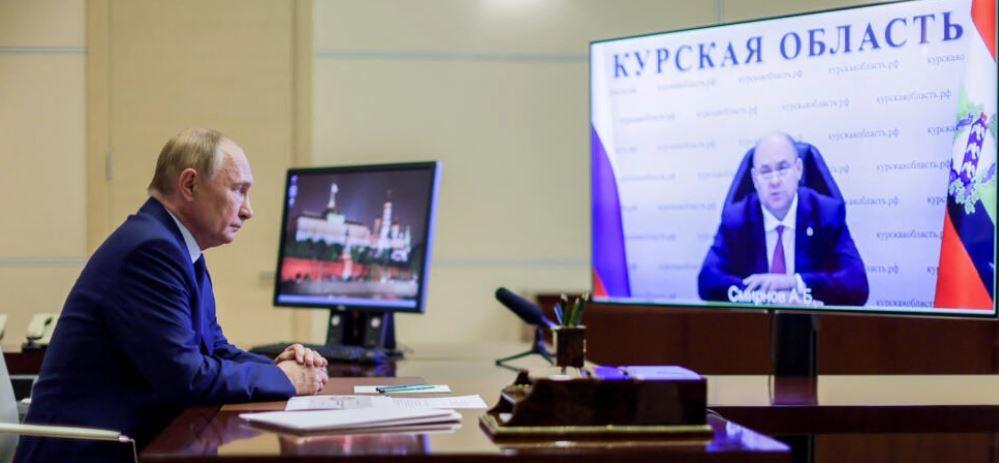
• A Perplexed Response: The Russian reaction displayed a certain level of disarray, possibly due to a failure to foresee the attack and assess its potential fallout. During a televised security briefing, President Putin cut off the Kursk governor as he mentioned the number of missing and the scale of the incursion, The Washington Post reported. Gen. Valery Gerasimov, Chief of the Russian General Staff, claimed that Russian forces had thwarted a Ukrainian advance of up to 1,000 troops in Kursk. Nevertheless, Ukrainian forces encountered little resistance due to weaknesses in Russia’s border defenses. For example, earlier in 2024, Gen. Alexander Lapin dismantled a council that oversaw security in the Kursk province in the months before Ukrainian troops invaded, as highlighted by The Wall Street Journal.
The appointment of Dyumin to oversee counterterrorism operations just ten days into the offensive hints at possible underlying tensions between Putin and Gen. Gerasimov. This incursion marks the second major challenge for the Kremlin following the Wagner commander’s rebellion and the first of its kind Russia faces. It appears the Kremlin is leaning on trusted figures to address the situation. Dyumin, known for his staunch loyalty to the Kremlin, played a key role in evacuating pro-Russian Ukrainian President Viktor Yanukovych in 2014 and in the annexation of Crimea as then deputy head of the Military Intelligence Directorate (GRU), as reported by Le Monde.
In response to the incursion, Russia sought to manage the fallout without declaring a general mobilization, with government propaganda focusing on efforts to assist the displaced. Meanwhile, President Putin continued with his scheduled meetings, including discussions with Palestinian President Mahmoud Abbas in Moscow, followed by a two-day visit to Azerbaijan and a trip to the Chechen Republic. On the battlefield in Ukraine, Russian forces have maintained a relatively rapid advance, contrary to Ukrainian expectations.
In summary, the Ukrainian incursion appears to be an effort to bolster Ukraine’s negotiating leverage, though it is fraught with considerable difficulties if Ukraine cannot withstand the advancing Russian forces, which are likely to intensify their offensive—evoking the “scorched earth” policy employed by Russia in the early months of the war. Russia may also opt to directly target Ukraine’s allies, either within their spheres of influence or through hybrid operations, as the current situation presents a significant dilemma whose fallout needs to be swiftly managed. This could potentially offer the Kremlin a pretext for declaring a general mobilization to manage the ensuing consequences.
Overall, it seems improbable that Russia will pursue negotiations at this stage, especially given that it still has time to shift the war in its favor—particularly if the resolution process is tied to the US elections. This raises the question of which territories Ukraine might prioritize in its demands: Will Kursk be exchanged for Ukraine’s territorial return, whether under the 1991, pre-2014, or pre-2022 lines?