






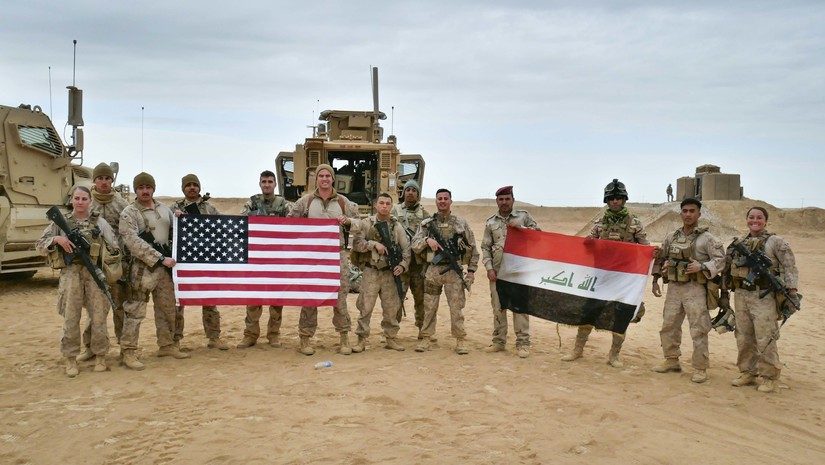
Iraq’s Ministry of Foreign Affairs stated on August 15 that the announcement of a definitive end date for the US-led coalition’s mission in the country has been delayed. The US presence now comprises only military advisors operating under the Global Coalition against Daesh, concerned with the outcomes of the US-Iraqi Supreme Military Committee. Through rounds of US-Iraq Strategic Dialogue, an agreement was reached on the withdrawal arrangements and timeline for these advisors, along with a consensus that Iraq’s engagement with the Coalition forces be distinct from its broader bilateral ties with the United States.
Multiple rounds of discussions were conducted between Iraq and the United States regarding the status of the Coalition’s forces in Iraq and the future of security cooperation between the two countries. The Strategic Dialogue, initiated in June 2020 under the 2008 Strategic Framework Agreement between Baghdad and Washington, has persisted beyond the April 2024 visit of Iraqi Prime Minister al-Sudani to Washington. A key bilateral meeting was held from July 22–23 between the defense departments of both countries, attended by Iraqi Defense Minister Thabit al-Abbasi, US Defense Secretary Lloyd Austin, and representatives from the Defense Security Cooperation Agency, US Central Command, State Department, and National Security Council. Subsequently, al-Abbasi also held a separate meeting with Chairman of the Joint Chiefs of Staff Charles Q. Brown, the Director of the Bureau of Counterterrorism, and the Deputy Commander of Joint Operations Command-Iraq.
The dialogue rounds between the military delegations agreed to create a bilateral Higher Military Commission between Washington and Baghdad to address three primary concerns, namely the threat of Daesh, operational requirements, and strengthening the capabilities of Iraqi security forces. The Commission’s goals include defining the mission of the US-led coalition in Iraq, consulting on expanding Iraqi participation in regional military exercises under US Central Command, reinforcing the Iraqi army’s ties with US Central Command’s service components, enhancing US-Iraq bilateral cooperation, ensuring Daesh’s defeat, bolstering the capabilities of Iraqi and Kurdish security forces, and urgently addressing the return and reintegration of displaced persons and residents of northeastern Syria into Iraqi communities. Additionally, the Iraqi delegation reaffirmed its dedication to safeguarding individuals, advisors, convoys, and diplomatic missions of the United States and other countries within the Global Coalition. In light of this, a pertinent question arises: Why was the conclusion of the Global coalition’s mission in Iraq delayed? What are the broader implications of this postponement at this particular moment?
Significant Implications
The decision to delay the conclusion of the Global Coalition’s mission in Iraq carries several significant implications, which can be outlined as follows:
1. Strategic Delay: The decision to postpone the conclusion of the Global Coalition’s mission in Iraq is intricately linked to escalating regional tensions, especially in the context of the ongoing Gaza conflict and the persistent standoff between Israel and Iran and its proxies. The recent assassinations of key figures, including Ismail Haniyeh, the chairman of the Hamas Political Bureau, and Hezbollah’s military commander, Fouad Shukr, have heightened the situation. This has sparked concerns of a possible Iranian retaliation, either through direct action or via its regional proxies, targeting American or Israeli interests, especially given Iran’s ‘unification of the arenas’ strategy among Iraqi, Lebanese, and Yemeni factions. Iranian rhetoric, stressing the imperative of retaliating for Haniyeh’s killing, and the recent military drills by the Iranian Revolutionary Guard Corps (IRGC) in August 2024 further emphasize the urgency of this strategic delay.
Additionally, the National Guard in Oregon has announced that around 230 of its soldiers are gearing up for deployment as peacekeepers in support of the United States and its allies in Syria and Iraq. This move comes amid growing threats to forces and bases in these regions. Hence, the current regional instability, especially the tension surrounding Gaza, has underscored the need for the Global Coalition forces to remain in Iraq. Their continued presence is crucial for consulting, training, and bolstering the capabilities of Iraqi forces in the face of ongoing attacks by Iranian proxies against foreign forces in the country.
2. Defending US Bases and Troops: Since the launch of Operation al-Aqsa Flood on October 7 and the ongoing conflict in Gaza, US bases in Iraq and Syria have been repeatedly targeted. One notable incident was the drone attack on the American airbase Tower 22 in northeastern Jordan on January 28, which was claimed by the Iraqi Kataib Hezbollah and resulted in the deaths of three US soldiers and injuries of approximately 40 others.
In retaliation, on February 2, the United States launched strikes against 85 targets across Iraq and Syria, conducting airstrikes along a 130-kilometre stretch from Deir ez-Zor to the Syrian-Iraqi border, including al-Mayadin town. These strikes targeted 28 sites associated with Iranian militias, resulting in the deaths of approximately 29 militia members. Additionally, on February 7, the United States targeted and eliminated Abu Baqir al-Saadi, the logistics chief for the Iraqi Kataib Hezbollah, due to his involvement in the attack on the American base, Tower 22.
Additionally, on August 5, the Ain al-Assad air base in Anbar Governorate, which hosts US forces, was targeted by a missile attack, resulting in injuries to five US personnel. According to the Washington Institute, there have been approximately 189 attacks on American forces in Iraq and Syria since the Gaza war began. American bases in Syria were also struck by a drone attack on August 10, specifically at the Rmelan field and Kharab al-Jir base in the al-Hasakah countryside. In this context, the decision to delay the conclusion of the Global Coalition’s mission serves as a strategic measure to address rising tensions, especially given the continued targeting of Coalition forces by resistance factions in Baghdad, Erbil, and Anbar. This extension was underscored by a meeting on August 6 between US Secretary of Defence Lloyd Austin and Secretary of State Antony Blinken, where it was reiterated that “the United States will not tolerate attacks on its forces in the Middle East,” emphasizing the commitment to ensuring the security of both Israel and US soldiers following the attack on Ain al-Assad.
3. Volatile Security Landscape: The choice to extend the Global Coalition’s mission comes at a time of heightened security instability, marked by the resurgence of Daesh in Iraq and Syria, with it claiming responsibility for around 153 attacks in 2024 alone. Thus, the delay is seen as essential, particularly given that a complete withdrawal from Iraq could create a power vacuum in the central and northern regions, potentially leading to a scenario reminiscent of 2014, where the security situation deteriorated in the Diyala Governorate, plagued by drug trafficking shielded by armed groups backed by foreign actors. Similar instability is seen in Anbar, Saladin, and parts of Nineveh Governorate, suggesting that the complete withdrawal of Coalition or US forces could lead to the proliferation of armed factions and a renewed wave of terrorism, particularly given that the persistent ideological grip of Daesh remains a serious concern as the group continues to operate in Saladin, Anbar, and Diyala, with its imprisoned militants showing unwavering loyalty, and its activities ongoing in several regions at varying levels of intensity.
Persistent Challenges
Following the decision to extend the Global Coalition’s mission in Iraq, there has been mounting pressure from the Coordination Framework—part of the ruling coalition—on Iraqi Prime Minister Mohammed Shia al-Sudani to expedite the withdrawal of foreign troops. This push is fueled by concerns that Iraq might become a battleground amid the Gaza conflict and escalating regional tensions. Over the past eleven months, Iraq has experienced persistent unrest, including attacks on US bases by Iranian-aligned militias and over 300 Iranian drones and missiles targeting Israel, which have violated Iraqi airspace and threatened national security. Consequently, al-Sudani’s visit to the United States on April 15 was aimed at discussing enhanced security cooperation and the future of the strategic partnership between Baghdad and Washington.
And amid the ongoing struggle for Iranian influence and power dynamics in Iraq, a deep-seated conviction exists among pro-Iranian factions to strike American interests and forces. This doctrine was evident on July 30, when a US drone strike on a base in Babylon Governorate, south of Baghdad, resulted in the deaths of at least four individuals, reportedly by the Popular Mobilization Forces. Additionally, some political factions and Iran-affiliated militias in Iraq have expressed strong opposition to the American presence, exerting pressure on the government to advance negotiations for a US withdrawal. In this volatile environment, the Iraqi al-Nujaba movement issued a statement on August 20, declaring the end of the truce intended to facilitate negotiations and signaling that targeting US bases has now become a viable option.
Arguably, the potential for targeting US interests and bases in Iraq and Syria has intensified following the Gaza conflict as Washington continues its backing for Israel. In this context, on August 22, Abu Ali al-Askari, the security chief of Kataib Hezbollah, declared their intention to continue attacks on US forces in Iraq, noting that these decisions are influenced by the current power dynamics.
In conclusion, the prospect of targeting US bases and forces in Iraq remains viable, driven by several factors, including the ongoing regional tensions tied to the Gaza conflict, which serve as leverage to pursue various interests, the outcome of upcoming agreements that could determine the success of efforts to end the Gaza war, the power struggle between Washington and Iran, along with the opposition of Iran-aligned militias to the US presence in Iraq, and lastly, the region’s unstable security environment, compounded by the potential resurgence of Daesh. As such, the decision to extend the Global Coalition’s mission will likely intensify the pressure on the Iraqi government, challenging Iraq’s aspirations to evolve from a conflict zone to a sovereign state focused on growth and development.


