






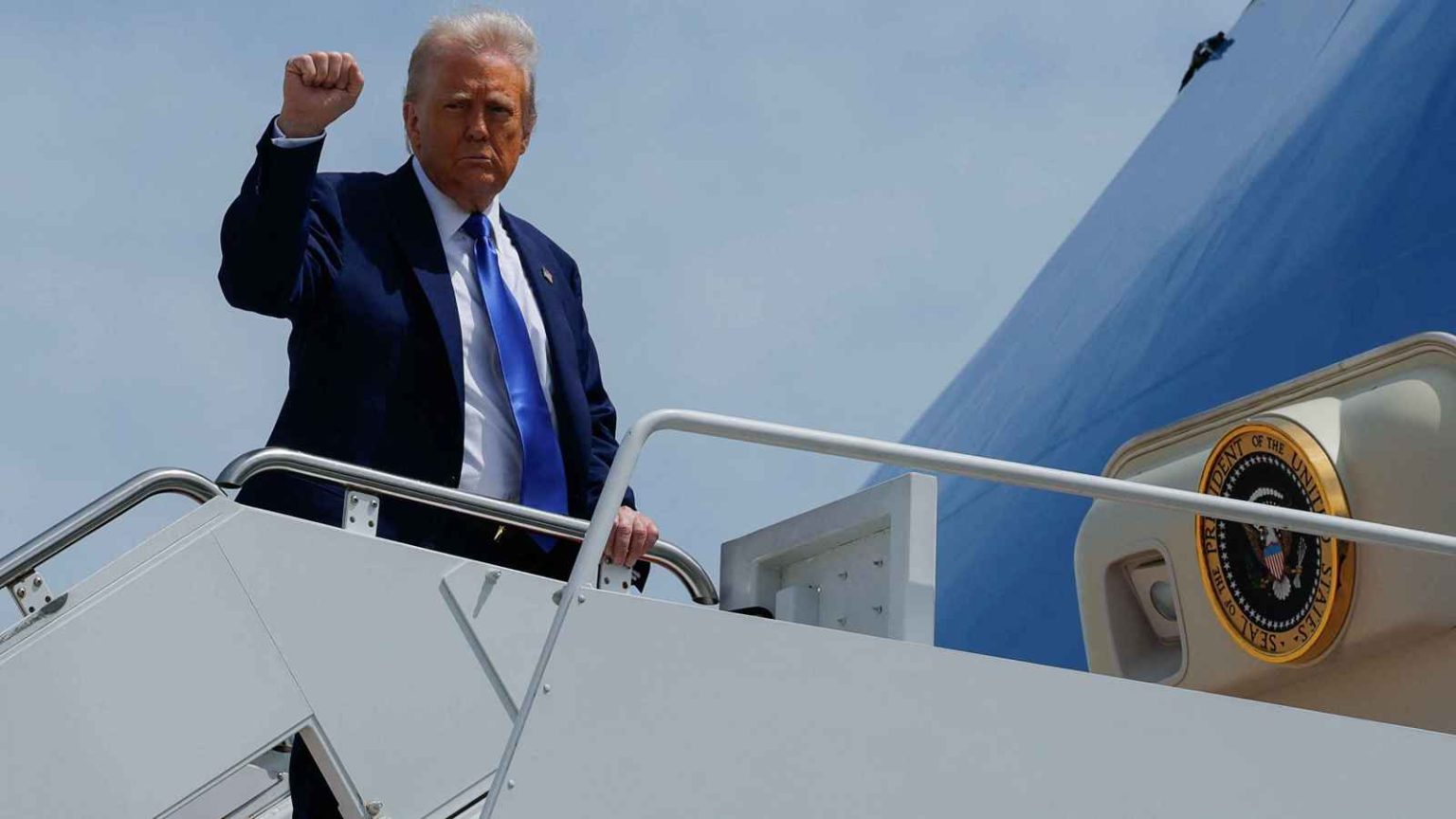
On May 13, US President Donald Trump arrived in Saudi Arabia for his first major international trip of his second, non-consecutive term—excluding a brief Vatican visit—embarking on a tour that extends through May 16, and includes Qatar and the United Arab Emirates. This visit comes as the Middle East grapples with complex crises. Trump has described his Gulf tour as “historic,” while Samuel Werberg, the US Government’s principal Arabic-language spokesperson, told Youm 7 that the visit aims to “strengthen cooperation in security and defense, promote stability in sensitive issues like Yemen and Gaza, and expand economic and investment ties in energy and technology sectors.” This prompts questions about the visit’s top priorities and anticipated outcomes.
A Changed Regional Landscape
Trump’s visit to the three Gulf states comes months after his return to the White House, against a Middle East backdrop starkly different from his first term. The region now faces unrestrained Israeli actions, extending beyond Gaza—where massive destruction has claimed thousands of lives, mostly women and children—to Lebanon and Syria. This has stalled the Abraham Accords, a hallmark of Trump’s first-term diplomacy.
Additionally, is experiencing strategic weakness, triggered by the collapse of its proxies—most notably the swift deterioration of Assad’s regime in Syria at the hands of Hay’at Tahrir al-Sham. Meanwhile, Hezbollah in Lebanon has suffered major setbacks at the hands of Israel, deepening Iran’s regional decline.
Conversely, Iran’s Houthi proxy in Yemen has grown stronger, disrupting Red Sea navigation and launching attacks on Israel, linking its destabilizing actions to Israel’s ongoing aggression in Gaza. This has fueled speculation that Iran may scale back support for the Houthis to pursue rapprochement with the United States, particularly amid ongoing nuclear talks mediated by Oman.
Complex Context of Trump’s Middle East Visit
Despite the strong alignment of the US administration with Israel’s far-right perspective on the Gaza situation and its handling of ongoing critical developments, the revelation of direct US-Hamas contacts leading to an agreement to release Israeli-American dual citizen Edan Alexander may be seen as a blow to Israel. This is particularly significant given other US moves causing concern in Israel, including engaging in nuclear talks with Iran and pursuing an agreement with the Houthis.
These actions have led some analyses to overstate the existence of a major rift between the United States and Israel, especially since Israel was not included in Trump’s travel schedule. US Ambassador to Israel Mike Huckabee, in interviews with Israeli media, justified Trump’s decision not to visit Israel by emphasizing that the trip “was focused on economic issues.” This suggests that Trump’s choice to exclude Israel stems from prioritizing the economic aspects of the visit over political ones, rather than necessarily indicating a dispute.
Consequently, it appears that the primary motivation behind US efforts toward de-escalation is Trump’s desire to achieve quick breakthroughs and pave the way for concluding the deals he intends to sign during his tour. This points to Trump’s strong intent to wrap his regional visits with a series of accomplishments, as evidenced by a statement from US Special Envoy for Hostage Response Adam Boehler, who noted that Trump’s visit spurred the Hamas agreement.
Furthermore, given Trump’s keen focus on trade deals and investments, the Gulf tour follows substantial investment pledges from Gulf states across various sectors. Additionally, Trump’s mention of a potential visit to Turkey during this tour reflects his appreciation for Turkey’s role in Syria, which not only fills the gap left by limited US engagement in the Syrian arena but also serves as a barrier to Russian or Iranian repositioning there.
Top Priorities: Deals vs. Crises
For over a decade, the United States has sought to pivot away from the Middle East toward the Indo-Pacific, yet the Trump administration has prioritized the region in its early months. President Trump’s visit reflects an acknowledgment of opportunities in a region often viewed through the lens of risks and threats.
Axios described Trump’s trip to Saudi Arabia, Qatar, and the UAE as “almost all about money,” quoting an Arab official who said “his regional agenda is business, business, business.” CNN confirmed, citing Trump administration officials, that the president’s primary focus is “procuring economic agreements,” with these Gulf countries driving their investments into the United States. The New York Times noted that the visit’s agenda “conveniently aligns with Mr. Trump’s expanding business plans. His family has six pending deals with a majority Saudi-owned real estate firm, a cryptocurrency deal with an affiliate of the government of the United Arab Emirates.”
Put simply, despite the region’s numerous pressing issues, Trump’s Middle East visit is expected to focus heavily on trade deals and new Gulf investments, particularly in defense, aviation, energy, and artificial intelligence. This aligns with White House Press Secretary Karoline Leavitt‘s statement that Trump “looks forward to embarking on his historic return to the Middle East, visiting Saudi Arabia, Qatar, and the United Arab Emirates next week, where he will focus on strengthening ties between our nations […] President Trump will return to re-emphasize his continued vision for a proud, prosperous and successful Middle East where the United States and Middle Eastern nations are in cooperative relationships and where extremism is defeated in place of commerce and cultural exchanges.”
However, Trump cannot easily sidestep the region’s extensive crises, including the Gaza war, Houthi tensions in Yemen, Syria’s chaotic transition, and Iran’s nuclear ambitions. Thus, the administration’s efforts to de-escalate tensions may serve as a catalyst for securing the trade and investment deals Trump seeks, while reinforcing Washington’s image under his leadership as a strong, central player. The effectiveness of these efforts hinges largely on the pressure Washington can exert on Israel to halt its aggressive actions, thereby reviving the Abraham Accords to facilitate Saudi-Israeli normalization.
On regional crises, little is known about potential discussions between Trump and Lebanese President Joseph Aoun, though Lebanon is urging the United States to press Israel to fully withdraw from its territory. In Syria, the Trump administration seems poised to relax or lift sanctions, with Reuters reporting that transitional president Ahmed al-Sharaa will pitch a strategic plan to Trump, potentially involving an Israel deal and US access to Syrian oil and gas. Issues like Sudan, Libya, or Yemen’s state crisis are unlikely to receive significant attention.
Regarding Iran, Gulf states will likely seek clarity on the US approach to Iran and the Houthis, as they bear the risks of any miscalculations, particularly amid ongoing US-Iran nuclear talks. This issue is intricately linked to the security arrangements Gulf states aim to establish with the United States.
When it comes to the Israeli assault on Gaza and the broader question of Palestinian statehood, the Trump administration finds itself in a clear bind. On one hand, Trump’s unwavering support for Israel, bolstered by the growing influence of the Christian right in the United States, is unlikely to waver. In March, prominent American evangelical figures, including Ralph Reed, Tony Perkins, and Mario Bramnick, visited Israel, declaring support for its sovereignty over the West Bank. Trump echoed this stance in February 2025, during a press conference with the Israeli Prime Minister, stating that “people do like the idea of annexation and we’ll be making an announcement over the next four weeks.”
On the other hand, reviving the Abraham Accords is a top priority for Trump in the region, aligning with a US vision that views their continuation as essential for creating a shared security, economic, and political framework. This framework aims to ease the burden on Washington while countering the influence of regional adversaries like China, Russia, and Iran. However, Israel’s ongoing brutal aggression in Gaza and its heavy reliance on military force in regional interactions pose significant obstacles to advancing the Abraham Accords.
Given the unlikelihood of a major shift in Trump’s stance on Gaza and the Palestinian cause, he may focus on strengthening humanitarian efforts in Gaza as a positive gesture to reinvigorate the Abraham Accords. Prior to his visit, a US plan to distribute humanitarian aid was revealed, which Israel approved despite refusing to participate in its implementation.
On Trump’s regional vision, there are opportunities to leverage his transactional approach to build a new regional framework. James Jay Carafano, in an analysis published by the Italian Institute for International Political Studies, suggested that Trump could revive the India-Middle East-Europe Economic Corridor (IMEC) by integrating it with his first-term economic peace vision. This would position the Middle East as “a hub of free and open spaces,” fostering stability and economic growth. Carafano emphasized that this vision relies not only on an economic framework but also on a security structure ensuring regional cohesion, which necessitates activating Saudi-Israeli normalization.
In short, Trump’s visit holds vast potential for securing deals across multiple sectors. It also offers Trump a chance to achieve a “major breakthrough” by adopting a more balanced approach that moves beyond Israel’s extreme positions, grounded in realities like achieving a permanent Gaza ceasefire, delivering substantial humanitarian aid, and starting a process for Palestinian statehood. However, such an outcome appears challenging given the Trump administration’s preference for a power-centric, deal-driven approach over one based on partnership or legitimacy.


