








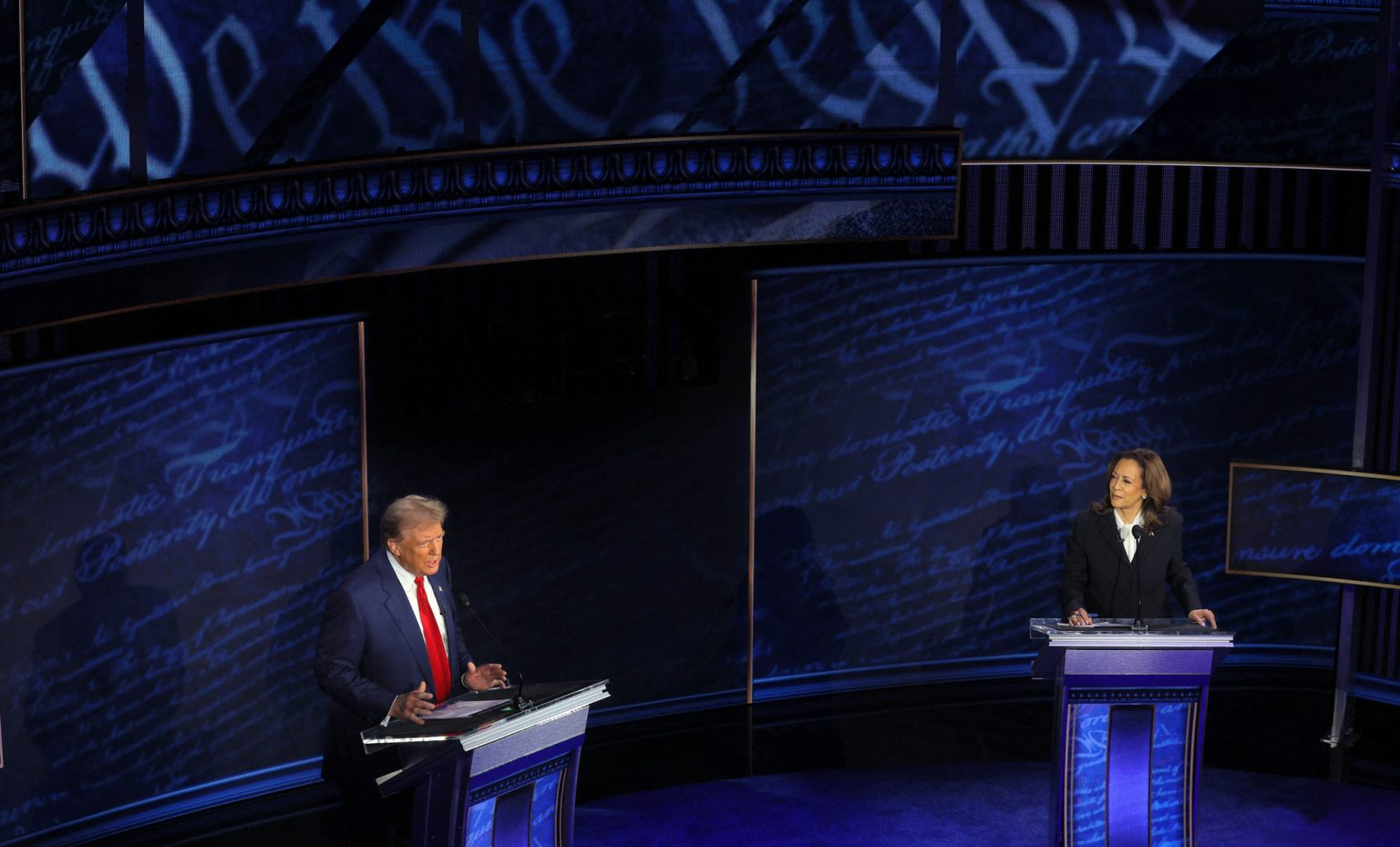
Given the considerable influence of the June 27 presidential debate, where Democratic President Joe Biden faced off against Republican rival Donald Trump, which ultimately led Biden to step aside for his vice president, Kamala Harris, the significance of the September 10 debate between Trump and Harris at the National Constitution Center in Philadelphia, aired live for 90 minutes on ABC, stands out clearly.
This significance stems from the debate’s anticipated role in shaping the trajectory of the presidential race, as it has the potential to bolster one candidate’s chances while diminishing the other’s. Although the debate devolved into a verbal duel marked by mutual accusations, it revealed deeper signs of widespread contradictions that extend beyond the election and permeate the entire American political landscape.
The Growing Significance of the Debate
While some commentators downplay the impact of debates on the trajectory of the presidential race, others argue that they can strongly influence voter behavior, particularly among swing voters, by enhancing or tarnishing a candidate’s image and affecting their chances of winning. A joint poll by the Marist Institute for Public Opinion, National Public Radio (NPR), and the Public Broadcasting Service (PBS) shows that 30% of registered voters say the debate will help them to a great deal or good amount in making their selection for president. This underscores the growing importance of the Trump-Harris debate amid a fierce presidential contest and a political landscape fraught with complex issues, which led the Washington Examiner to label the debate as one of “the most consequential presidential campaign events in decades.” This can be distilled into the following key factors:
The Impact of the First Debate on Biden’s Downfall: The initial debate between Biden and Trump played a crucial role in undermining Biden’s image and prompting the Democratic Party to reassess their support for him. According to the Wall Street Journal, Biden appeared unsteady in his first direct encounter with Trump, while the New York Times noted that his “stumbling left Trump on top.” Politico further reported that “Democrats are so panicked over President Joe Biden’s faltering debate performance and some are actively discussing what was once unspeakable: replacing him on the ticket.” This illustrates how the debate’s influence was powerful enough to potentially end a candidate’s campaign.
A Chance for Harris to Make Her Mark: Harris didn’t begin the presidential race as the Democratic frontrunner but was chosen following Biden’s lackluster performance, making it vital for her to introduce herself to the American public. The debate presents a crucial opportunity for her to win over voters who remain unfamiliar with her policies, especially in light of the Democratic Party’s earlier confusion—first backing Biden, then urging him to step aside for Harris. The Washington Post noted that Harris “needs to tell voters who she is and define herself as something new, not more of the same.”
The Narrowing of Poll Results between the Candidates: After Trump initially gained a lead in the polls during his contest against Biden, Harris’s entry into the race has shifted the dynamics, restoring balance and intensifying the competition. Polls now show a convergence in support for both candidates, indicating that Harris, in just a few weeks, has quickly gained momentum, significantly closing the gap between Republican and Democratic contenders. According to the New York Times, the polls, taken together, reveal “a tight race that remains either candidate’s to win or lose.” This has led both candidates to see the debate as a key opportunity to sway undecided voters, potentially improving their standing in the election.
Verbal Duel and Accusation Exchange
Election debates are crucial for highlighting the opposing platforms of candidates and informing the US public about the policies that will shape their presidency, but the exchange between Trump and Harris turned into an aggressive verbal sparring match dominated by accusations. Prior to the debate, Harris’s campaign had warned on the X platform that Trump will lie a lot and that they will fact-check his claims live. As the debate unfolded, Trump labelled Harris as a ‘Marxist,’ while Harris countered, “We had to clean up the mess left by Trump.” The exchange covered a broad spectrum of allegations across the debate topics, including:
Economy: Trump claimed credit for creating one of the greatest economies in US history and vowed to replicate that success. In response, Harris warned that Trump’s proposals would likely drive up inflation and trigger a recession. She presented her vision of an ‘opportunity economy,’ featuring tax cuts for the middle class and plans to tackle housing costs while supporting families and small businesses. Trump countered by dismissing Harris’s plan as merely a reiteration of Biden’s economic policies. Harris also criticized Trump’s Project 2025, labelling it a “detailed and dangerous plan” that he would pursue if he were re-elected.
Abortion: Trump labelled Democrats as ‘true radicals’ on abortion issues, criticizing Tim Walz, Harris’s vice presidential pick, for allegedly advocating abortion up to the ninth month. Harris countered by condemning Trump for his role in the Supreme Court’s 2022 decision to overturn Roe v. Wade, which ended the federal right to abortion. Harris accused Trump of “insulting American women” with his abortion policies and of spreading a pack of lies about abortion policy.
Immigration and Border Security: Harris held Trump accountable for the ongoing border issues, blaming him for blocking a bipartisan bill to address them. Trump countered by accusing Democrats of permitting millions of immigrants into the country, arguing that this has reduced global crime rates while increasing crime in the United States. Harris responded by attacking Trump’s credibility, pointing out his own past criminal charges in reaction to his claims about immigrant crime.
Russian-Ukrainian War: Harris criticized Trump for his past praise of Vladimir Putin, suggesting that “if Trump had been president during the invasion, then Putin would be sitting in Kyiv.” She argued that dictators around the world are rooting for Trump to be president again because they know they can manipulate him. Trump fired back, accusing Harris and Biden of recklessly managing relations with Russia, a “nuclear state,” and reiterated his commitment to ending the war, claiming he could broker a ceasefire. Notably, Harris did not outline any concrete future policy on Ukraine, nor did she address the contentious issue of providing Ukraine with long-range American missiles for strikes deep inside Russia.
The Gaza War: Harris voiced her support for a two-state solution, emphasizing the need to protect Israel’s security while also ensuring safety for Palestinians. Trump sidestepped the question, instead accusing Harris and the Democrats of hating Israel, and claimed that such conflicts wouldn’t occur under his leadership. He further suggested that Israel would be destroyed within two years if Harris assumed office as president. However, neither candidate offered a concrete plan to end the Gaza war or secure the release of hostages held by Hamas.
Withdrawal from Afghanistan: When asked about her role in the US withdrawal from Afghansitan, the Vice President defended the administration’s decision to end America’s longest war while criticizing Trump for his handling of the initial withdrawal agreement, which sidelined the Afghan government. Trump, in turn, defended his approach, stating that his aim was to protect American troops while accusing the Biden-Harris administration of leaving behind $85 billion in US military equipment, calling the withdrawal “the most embarrassing moment in US history.”
Conflicting Stances Revealed in the Debate
The first debate between Harris and Trump unfolds in a complex landscape, marked by numerous intertwined crises. As such, the debate cannot be viewed in isolation—not only from the heated presidential race but also from the extraordinary state of the American political system. This is particularly true as polarization deepens, political divisions widen, and the moderate center shrinks in favor of both more conservative and progressive extremes. This dynamic can be outlined as follows:
Traditional America vs. the American Dream: The presidential debate brought together two fundamentally opposing American models. Republican candidate and former President Trump represents a ‘conservative ideology’ that emphasizes traditional values and white supremacy as foundational to the United States, while Vice President Harris embodies a ‘largely progressive’ discourse, reflecting a victory for the immigrant community and the embodiment of the American Dream. Harris’s diverse heritage—Indian and Jamaican—represents the ideal of the United States as a melting pot where differences are transcended and opportunities are available to all. This was evident in the debate, where Harris pledged to be a “president for all Americans.” In contrast, Trump criticised the Democrats for supposedly destroying the fabric of American society,” blaming their immigration policies for rising crime rates and warning of an “America in decline.” He dismissed Harris’s policies as ineffective, highlighting that she had been in power with Biden but accomplished nothing.
Trump’s Conservatism vs. Harris’s Progressivism: The debate underscored the stark contrast between Trump’s conservative stance and Harris’s progressive vision. During the debate, Trump pledged to implement tax cuts, denounced the Affordable Care Act, and promised to work on its replacement. He took a hardline stance on immigration while attempting to present a moderate approach to abortion. In contrast, Harris strongly advocated for abortion rights, promoted her ‘opportunity economy’ plan with tax cuts for the middle class, and pledged to address housing costs and support families and small businesses. In her closing remarks, Harris emphasized the stark contrast between her forward-looking vision and Trump’s focus on past issues, declaring, “We will not go back. We can chart a new way forward.”
A Convicted Candidate vs. a Legal Expert: The presidential debate featured a rare and unprecedented scenario in American politics: a Republican candidate facing numerous criminal charges and a Democratic contender with a distinguished legal career, including roles as District Attorney of San Francisco and California Attorney General. During the debate, Harris labelled Trump a ‘convicted criminal’ and held him accountable for the January 6 United States Capitol attack of 2020 and the 2017 protest events in Virginia. In response, Trump denounced these legal cases as politically motivated, asserting they were “fake” and attributing the assassination attempt to “Democrats’ rhetoric.”
In conclusion, the Harris-Trump debate has taken on significant importance in the presidential race, with both campaigns highlighting the strength of their respective performances. The Trump campaign hailed the debate as “the best ever,” while the Harris campaign touted her ability to “dominate the stage on every key issue.” A CNN/SSRS poll indicated that Harris not only surpassed Trump but also exceeded watchers’ expectations for her performance. However, establishing a direct correlation between the debate’s impact and the final voting outcomes remains challenging.


