
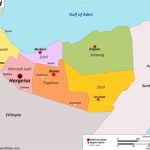



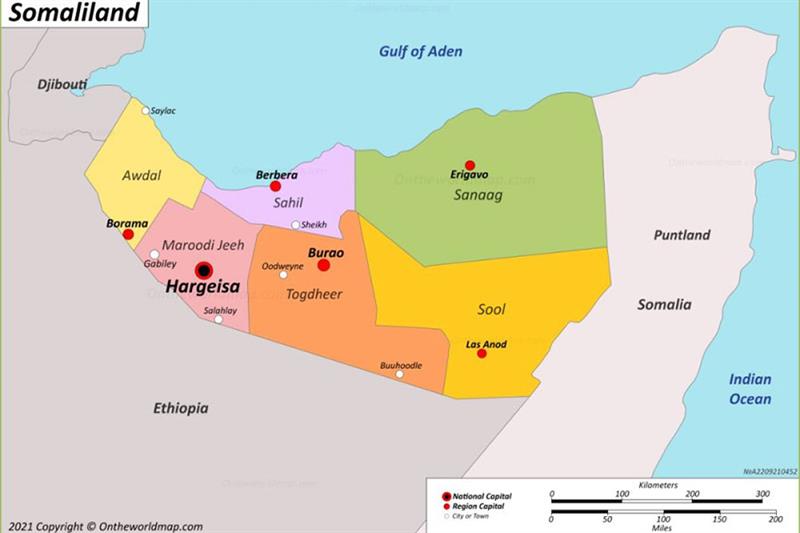
Protests in Borama and Saylac have exposed the fragility of long-standing accommodations and the declining capacity of the authorities in Hargeisa to manage peripheral disputes. In this respect, Awdal increasingly echoes the trajectory of SSC-Khaatumo in eastern Somalia, a locally constituted administration that recently obtained formal recognition from Somalia’s federal government in Mogadishu, thereby establishing a precedent for challenging Somaliland’s de facto territorial claims.
This fragility is compounded by Awdal’s growing strategic significance as a potential corridor for Ethiopia’s maritime-access projects, as well as by its location within the traditional social domain of the Issa clan. These dynamics intersect with Djibouti’s efforts to balance influence through its own Issa clan networks. The convergence of these factors became starkly visible during the “Xeer Ciise” crisis in December 2025, when a symbolic cultural dispute escalated into armed clan mobilization in Saylac and Borama. The episode demonstrated that the conflict in Awdal transcends a localized cultural disagreement and instead represents a nexus where internal legitimacy deficits, competition over the Gulf of Aden–Red Sea littoral, and broader geopolitical transformations in the Horn of Africa collide.
The Trajectory of the Crisis
The immediate trigger for escalation was the decision by Somaliland’s authorities to cancel a cultural celebration linked to Xeer Ciise—scheduled to take place in Saylac on December 14, 2025. The decision unleashed an unprecedented wave of social and security unrest across Awdal. Demonstrations in Saylac and Borama rapidly deteriorated into violent clashes between the Issa and Gadabuursi (Samaroon) clans, reviving a long-standing dispute over cultural rights, symbolic recognition, historical narratives of ownership, and local sovereignty over Saylac.
Tensions intensified after the paramount chief of the Issa clan called for mass mobilization to defend the city, accusing the authorities in Hargeisa of siding with the Gadabuursi. Fighters subsequently arrived from Ethiopia’s Somali Region and from Djibouti, raising fears of cross-border spillover. Confrontations with security forces resulted in fatalities and injuries, prompting the leadership in Hargeisa to cancel the festival under pressure from Gadabuursi elders. Yet the move failed to defuse the crisis: the Issa viewed the cancellation as an assault on an entrenched cultural right, shifting the dispute from civic protest to open clan mobilization.
The crisis was further inflamed by the inclusion of Xeer Ciise on UNESCO’s Representative List of the Intangible Cultural Heritage of Humanity in December 2024. Gadabuursi leaders objected to accompanying documentation that they regarded as exclusionary. The violence left at least 18 people dead and more than 100 wounded, alongside widespread arson and looting of public property. Elders and parliamentarians from Awdal sharply criticized the use of force and hinted at “self-defense” options, while Somaliland’s minister of information resigned in protest over the handling of the situation.
Structural Roots of Conflict in Western Somaliland
The roots of conflict in western Somaliland—particularly in Awdal—lie in a historically strained relationship between the political center in Hargeisa and the western periphery, shaped by unresolved historical, clan, and political grievances since 1991. The unaddressed legacy of the Borama massacre and the absence of a formal process of historical reconciliation have entrenched a collective sense of marginalization, periodically crystallizing into demands for a separate Awdal administration.
These tensions are reinforced by structural imbalances in Somaliland’s internal power distribution. The Isaaq clan family, owing to its demographic weight and central role in the Somali National Movement (SNM) and in post-1991 governance structures, has dominated political and economic decision-making. By contrast, the Gadabuursi and Issa—despite their cross-border reach and stabilizing roles—have remained underrepresented in central governing arrangements, deepening perceptions of inequity.
Although the Borama Conference of 1993 sought to broaden governance and recalibrate clan balances by integrating Gadabuursi elites into senior executive positions, the resulting equilibrium proved fragile. The leadership of the Somaliland administration has remained concentrated within particular Isaaq sub-clans, perpetuating feelings of exclusion among non-Isaaq groups and even within Isaaq itself.
From this perspective, the recent unrest reflects a deeper structural crisis in center–periphery relations. The authorities’ contradictory containment strategy—initially approving the Xeer Ciise celebration to accommodate the Issa, then reversing course to placate the Gadabuursi—illustrates the limits of managing western Somaliland’s clan politics through ad hoc balancing rather than through an institutionalized political settlement.
The Evolution of Somaliland’s Political Order
Since 1991, Somaliland’s governing elites have presented their project as a locally grounded experiment in order-building within a collapsed state environment, emphasizing relative security, periodic elections, and functioning local institutions. Yet this order has remained fundamentally hybrid, combining procedural democratic mechanisms with deeply entrenched clan logic—a form of consociational governance rooted in pastoral social structures.
Somaliland’s modern political trajectory traces back to the establishment of the British Somaliland Protectorate in 1884, when colonial authorities governed indirectly through treaties with major clans, including Isaaq, Gadabuursi, and Issa. This approach entrenched clan institutions as primary political units and limited the development of centralized state structures.
After independence in June 1960 and subsequent union with Italian-administered Somalia, the northwestern regions became marginalized within a southern-dominated state. Grievances intensified under the military regime of Mohamed Siad Barre, particularly after the Ogaden War, catalyzing the rise of the SNM in 1981.
With the collapse of Somalia’s central government in 1991, local elites in the northwest declared Somaliland’s separation as a means of avoiding the descent into generalized civil war. The SNM confronted a devastated region lacking institutions and resources and adopted a strategy centered on clan conferences and negotiated reconciliation. A provisional charter granted the movement transitional authority, with limited inclusion of non-Isaaq clans.
Internal conflict in 1992 was halted through elder mediation, paving the way for the Borama Conference of 1993, which produced a more stable power-sharing arrangement and installed Mohamed Haji Ibrahim Egal as head of the administration. A hybrid system blending modern institutions with clan representation facilitated disarmament and modest institutional consolidation. Subsequent conferences in Hargeisa (1996–1997) recalibrated internal balances.
The adoption of a constitution in 2001 and a three-party system sought to curb overt clanization of politics, and subsequent elections reinforced procedural legitimacy. Nevertheless, clan-based power-sharing has remained decisive in practice, underscoring the structural limits of Somaliland’s governance model.
Conclusion
The Awdal crisis encapsulates the fragility of Somaliland’s social and political equilibrium and exposes the limited capacity of its authorities to manage clan disputes through institutional political means rather than coercive security responses. In Awdal, questions of clan identity, cultural sovereignty, and local authority intersect with regional rivalries and maritime geopolitics, transforming the region into a critical test case for the durability of Somaliland’s governing project.
The conflict therefore cannot be reduced to a localized cultural disagreement over Xeer Ciise. It is a manifestation of a deeper internal legitimacy crisis and the absence of a comprehensive political settlement capable of rebuilding social consensus between center and periphery. Without such a settlement, western Somaliland—particularly Awdal—will remain vulnerable to becoming an open arena for overlapping and potentially escalating conflicts with far-reaching consequences.
Published in cooperation between the Egyptian Center for Strategic Studies, Al-Ahram Weekly, and the English-language portal Ahram Online