




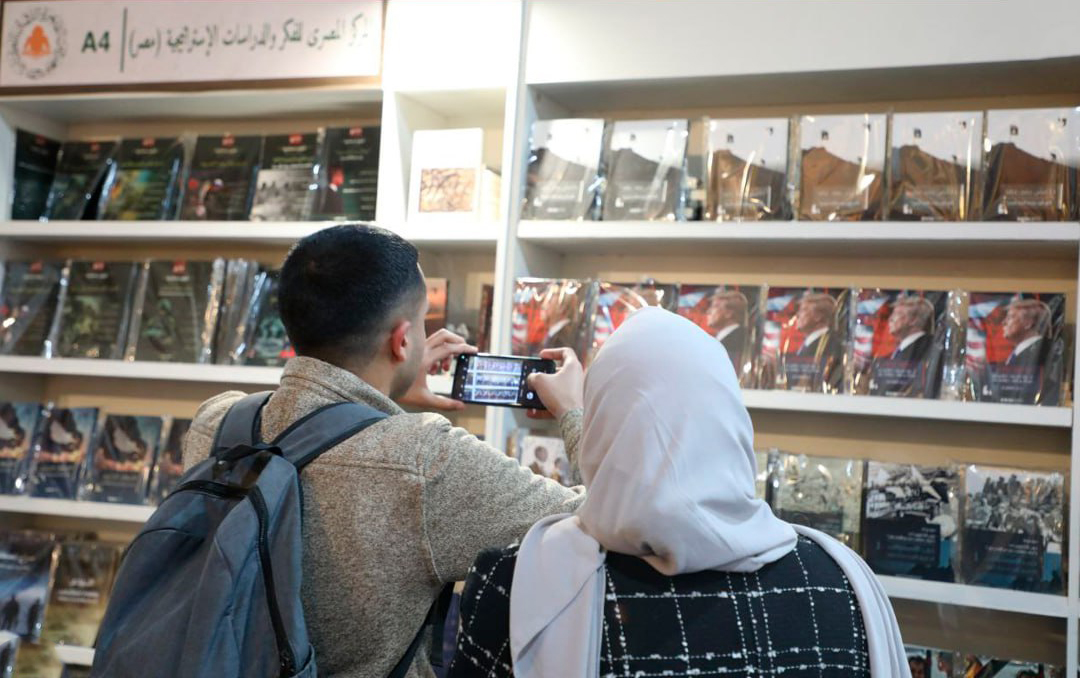
For the sixth consecutive year, the Egyptian Center for Strategic Studies (ECSS) is taking part in the 57th Cairo International Book Fair, held from 21 January to 3 February at the Egypt International Exhibition and Convention Center.
At its pavilion (A2 – Hall 3), the ECSS is presenting a carefully curated selection of books and new publications addressing regional and international issues that have become a central concern not only for specialists and students of political, military, and strategic studies, but also for a broad audience interested in public affairs. The publications span a wide and diverse thematic and geographic spectrum, covering interactions across the Middle East, Asia, and the United States. They draw on the work of a large number of experts and specialists whose varied perspectives, analytical approaches, interpretive frameworks, and in-depth studies and assessments make these works a substantial contribution for scholars, professionals, and readers concerned with political, security, military, strategic, and economic affairs. These scholarly contributions add to an extensive body of more than 200 prior research products, including books in both Arabic and English, periodicals, and special publications.
Among the ECSS’ most notable releases this year is the book “Displacement from Gaza: Deconstructing the Idea, Approach, and Plan,” edited by Dr. Khaled Hanafy Ali, a member of the ECSS Advisory Board. The volume presents the conclusions of discussions and research papers delivered at the conference “Gaza and the Future of Peace and Stability in the Middle East,” organized by the Center in February 2025. The conference undertook a rigorous scientific and historical deconstruction of the “displacement project,” refuted the arguments and claims advanced to promote or justify it from multiple angles, and addressed the overarching and fundamental questions surrounding the issue. It concluded with an unequivocal rejection of plans to displace the population of the Gaza Strip, describing them as acts of ethnic cleansing and crimes against humanity that must be opposed and for which those responsible should be held accountable, as they form part of a broader context aimed at liquidating the Palestinian cause, following numerous phases over the past eight decades. The conference further affirmed that historical experiences in conflict resolution and reconstruction have rested on returning residents and displaced persons to their original homes, and that reconstruction efforts have not been associated with population displacement, nor are they inherently incompatible with the presence of the inhabitants.
Edited by Professor Maher Al-Sharif, Director of the Economic Studies and Energy Issues Program, and prepared by the ECSS experts and researchers, the book “The Struggle for Economic Sovereignty: Who Controls the Instruments of Influence” examines the future of great-power competition over economic sovereignty in its vital domains, including rival strategies, the management of technological superiority, the attraction of investment and manufacturing hubs, the role of defense industries in this contest, competition over energy flows, and the future of the multilateral trading system. It also explores how these dynamics shape the U.S. political landscape and their implications for projecting the future of global trade and the reconfiguration of the world’s emerging economic map.
During its current participation in the Book Fair, the ECSS is also introducing a new research product titled “Research Papers,” a series of non-periodic booklets devoted to the study and analysis of selected issues related to current regional and international developments. The series seeks to unpack these issues, discuss their various dimensions, track their rapid evolution, and anticipate their potential trajectories, thereby contributing to a deeper, objective understanding of these transformations and offering rigorous analytical readings for researchers and those interested in political and strategic affairs. Among these contributions is a paper by Maryam Salah, a researcher at the ECSS, supervised by Professor Dr. Alaa Taysir Ahmed Mahdi, entitled “The 39th World Zionist Congress: The Impact of Right-Wing Dominance on the Future of Global Zionist Policies.” The paper examines the 39th World Zionist Congress, held in Jerusalem from 28 to 30 October 2025, reviewing its principal outcomes and the future directions they signal for Zionist policy worldwide, while also discussing the congress’s role within the Zionist Organization and the reciprocal influence between the organization and Israel.
Dr. Alaa Barania, a Senior Researcher at the ECSS, under the supervision of Professor Mohamed Marai, Head of the Media and Public Opinion Studies Unit, has prepared a paper entitled “The Battle for Awareness: Combating Rumors from the Perspective of Egyptian National Security.” The study examines rumors as a form of nontraditional threat to national security, identifies their types and determinants, analyzes the mechanisms through which they spread, and explores their multiple repercussions for the stability of the Egyptian state. It also reviews a number of international experiences in countering such phenomena, particularly in light of the growing use of social media as a fertile environment for rumors in the absence of adequate digital awareness among different segments of society.
Meanwhile, Amal Ismail, a Senior Researcher at the ECSS, under the supervision of Professor Maher Al-Sharif, Director of the Economic Studies and Energy Issues Program, presents a paper entitled “Renewable Energy and the Enhancement of Egypt’s Energy Security.” The paper addresses how Egypt’s energy mix can be reshaped by increasing the share of renewable sources in a manner consistent with achieving security and independence in the energy sector, through national objectives and plans for the transition to renewable energy and by bridging the gaps between planning and aspirations on the one hand and the realities of implementation on the other.
Ezzat Ibrahim, Director of the Americas Studies Unit, contributes a paper entitled “Eastern Churches in the Face of Christian Zionism: How Palestinian Liberation Theology Confronts the False Political-Religious Narrative” The paper explores how Christian Zionism has evolved into a global political narrative seeking to redefine Palestine in Western consciousness by conflating history with prophecy, politics with religion, and maps with the sacred. It traces the formation of this discourse from the period of the mandate over Palestinian territories and beyond, through to its expansion within U.S. and European foreign policy. It also examines how Eastern Churches have responded through official statements and initiatives within Western societies and churches, and by constructing a counter-discourse that exposes the politicization of religious texts and their transformation into a cover for uprooting people from their land.
Moreover, the ECSS presents a number of papers under diverse titles, including: “Turkey Without Terrorism: Assessing the Trajectory of Turkish-Kurdish Reconciliation,” “The Eighth Front: Israel’s Strategies to Counter the Erosion of Its Narrative in Western Public Opinion,” “Hydrogen: A Strategic Option for Enhancing Egypt’s Energy Security,” among others.
Visitors to the ECSS pavilion will find a wide array of books addressing varied issues, including, but not limited to, “The Middle East: A Region at a Crossroads,” “Major Transformations: Redrawing the Global Map,” “The Islamic State a Decade Later: Where Is the Organization Headed?,” “The Trump Era: Economic Nationalism versus Globalization,” “The Rise of Trump: Transformations in U.S. Politics in the Twenty-First Century,” “Asia: Internal and External Transformations,” “Cyber Warfare in the Middle East and the World,” “The Militarization of Interactions: Shifts in Wars and Weaponry,” and “The Sudanese State Crisis: Between a Faltering Political Transition and Armed Conflicts.”
In addition to titles such as “Transformations in the Horn of Africa: Redrawing the Region,” “Terrorism in the African Sahel: Ten Years of Intractable Confrontations,” “The Conflict in Ethiopia: A Troubled Project and Its Regional Repercussions,” “Israel from Within,” “Transnational Actors: Dynamic Networks,” “Artificial Intelligence Technology and Shifts in Global Power,” “Military Technology: An Arms Race or Strategic Deterrence Parity?,” “Restructuring the Balance-of-Power Equation in the Middle East,” “The Geopolitics of Terrorism, Vol. 1: Networks and Pathways,” “The Geopolitics of Terrorism, Vol. 2: Understanding Danger Zones Between Human Geography and Terrorism,” “Private Military Companies: A New Challenge in International Relations,” “NATO’s Strategic Concept,” “The Iran We Have Yet to Know,” “The Brotherhood’s Secret Weapon: Penetrating Civil Society,” “Russia and China: Partnership for a New Era—Drivers and Constraints,” and “The October 1973 War Encyclopedia” (three volumes), among many other works.
This is in addition to all issues of the monthly, quarterly, and annual periodicals published by the ECSS, including Egyptian Assessments, Military Affairs, and the Egyptian Journal of Strategic Studies, as well as a number of specialized publications such as “Security of Maritime Passages in the Middle East: Escalating Challenges,” “Deterrence as a Strategic Concept in Confronting Contemporary Challenges,” “Unmanned Aerial Vehicles: Evolution Between Past and Future,” and “Leading from Behind: U.S. Military Redeployment,” among others.
The 57th edition is the largest in the history of the Cairo International Book Fair in terms of the scale of participation, the diversity of events, and the richness of its cultural and intellectual content. This edition is witnessing unprecedented participation, with 1,457 publishing houses from 83 countries and a total of 6,637 exhibitors, marking the broadest international presence to date.