








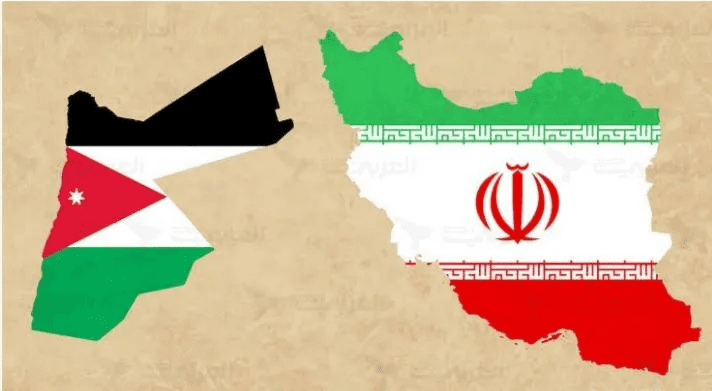
Jordan is strategically positioned at the center of geopolitical dynamics in the Middle East, making it vulnerable to political and security risks arising from regional instability. Consequently, the resurgence of conflict cycles in the region, associated with the recent Palestinian-Israeli conflict, whose spheres began to expand culminating in the Iran-Israel reciprocal attacks, posed a significant stability threat to Jordan, brought back the issue of regional security to the top of the agenda for foreign diplomatic movements, and forced Amman to tread carefully both inside and outside, trying to strike a balance between upholding the rights of the Palestinian people, calming the street, and preserving strategic ties with the United States and Israel.
Infiltration Attempts
Being well-aware of the scope and perils of Iran’s regional project, Amman is understandably wary of Tehran’s efforts to rally internal components and leverage its geopolitical position to expand it into Jordanian territory. It was King Abdullah II who coined the term “Shiite crescent” to refer to the Iranian regional expansionist project that impacted neighboring countries, with the exception of Jordan. The most significant Iranian infiltration attempts into Jordan can be examined as follows:
Contagion of Armed Militias: Tehran aims to achieve militia integration along the logistical supply route that stretches from Iran to the Mediterranean coast, passing through Iraq, Syria, and Lebanon, excluding Jordan. Despite the fact that the Shiites in Jordan make up less than 2% of the population and have no ties to Iran either ideologically or organizationally, and that there are no organizations in the country that claim to be part of the axis of resistance, the Jordanian government is worried that Iran’s militias could use Brotherhood members or dormant cells linked to Hamas and the Islamic Jihad movement as a springboard for armed ideological organizations to launch attacks outside of Jordan. These concerns were reinforced by the remarks made by Abu Ali al-Askari, a security official with the Iraqi Hezbollah militia, regarding the Islamic Resistance’s readiness to train 12,000 fighters in Jordan and provide them with tactical missiles, light and medium weapons, anti-armor launchers, ammunition, and explosives under the banner of the Islamic Resistance in Jordan. Notwithstanding the critical need for addressing security threats, irrespective of their magnitude or origin, it is premature to assert that they represent an official Iranian strategic trajectory. The statement in question was made by a field commander of an Iraqi militia and was not endorsed by Iranian officials or prominent commanders of the Islamic Revolutionary Guard Corps. As such, its applicability is limited to individual evaluations regarding the characteristics of field operations undertaken by Iranian militias.
Incursion into Jordanian Airspace: Numerous instances exist where Iran and its militias have used Jordanian airspace to conduct hostile military operations against the forces, interests, and territories of regional or international parties that they deem hostile. One noteworthy example is the use of Iranian drones by Iraqi militias to carry out an assault on US Tower 22 base in the northeastern region of Jordan. This attack resulted in the fatalities of three American soldiers and caused approximately 40 injuries in January 2024. Additionally, the militias have employed Jordanian airspace to launch drone attacks on Israel. Additionally, Jordan was recently traversed by Iranian drones that targeted Israel in retaliation for the targeting of the Iranian consulate in Damascus at the start of April, which entailed the incursion of Jordanian soil and its transformation into a battlefield where regional factions maneuver their pawns and a chessboard where scores are settled, which undermines the state’s sovereignty, jeopardizes its security, makes it vulnerable to the spread of armed elements, and puts it in the crosshairs of regional fire. This explains the security measures implemented by the Jordanian Armed Forces, including closing airspace and repelling Iranian drones.
Encircling Jordan with Militia Hotspots: The militias are gradually advancing towards the Syria-Jordan-Iraq border triangle. As they move, they are shifting the focus of the American-Israeli military conflict with Iranian groups to the eastern borders of Jordan. This means encircling Jordan with volatile hotspots, often accompanied by insecure border security that aids in the spread of cross-border security risks, most notably the utilization of sophisticated techniques and strategies by smugglers to transport drugs and weapons, including the deployment of drones, and the coordination of simultaneous and coordinated operations spanning an expanse exceeding 100 kilometers. In addition, there is the potential for the movement of terrorist elements due to the ongoing operations of Daesh in the region, which poses a threat to the security of Jordan.
Getting the Jordanian Street Moving: Jordanian protests against Israeli aggression on the Gaza Strip are intermittent. While the protesters adhere to a “safe distance” policy, refraining from discussing internal political issues and focusing solely on supporting the Palestinians, Hamas leaders’ recent appeals for Jordanians to sustain their protests coincides with a Hamas delegation’s visit to Tehran, led by the Political Bureau’s head Ismail Haniyeh, and their meeting with the supreme leader and several Iranian officials suggest that Iran is in favor of the Jordanians’ actions. This causes concern in Amman because Tehran may take advantage of the brewing public unrest to undermine Jordan’s stable political system by changing the focus of the protests from supporting the Palestinians to condemning the government’s policies and escalating them from peaceful to violent.
Jordan’s concerns are compounded when considering other significant factors, foremost of which is the tribal and clan-based backing of the protests, including their planning and organization, as well as the endorsement of Hamas, especially with the main Jordanian tribes acting as a crucial force for stability within the political system and being integral to the political and security apparatus. Second, there is a noticeable change in the demographic composition, with the Jordanian population of Palestinian descent now comprising over half of the total population. Third, the ongoing unrest in the streets of Jordan could have significant consequences for the already struggling economy, which is plagued by structural crises and heavily reliant on foreign aid. This turmoil could lead to the depletion of resources and efforts by the security services at a time when Jordan faces threats from multiple strategic fronts, except the southern one, including the potential risks of militia outposts and porous borders. Consequently, there is a pressing need for heightened security measures to effectively counter these challenges. Fourth, there is the political power of the Brotherhood and its political wing, the Islamic Action Front party, in Jordan and the potential for political gains in the run-up to the parliamentary elections stemming from the growing pro-Hamas sentiment in return for charges that the Jordanian government is soft on Israel.
Driving Factors
Iran’s propensity to exert pressure on the Jordanian arena is associated with targets pertaining to its bilateral relationship with Jordan and its regional policy against perceived adversaries:
Further Encircling Israel: By means of its militias, Iran has effectively encircled Israel with hostile regimes that present security risks along Israel’s southern (the Houthis in Yemen), northern, and northeastern (Lebanese Hezbollah and the Shiite militias in southern Syria and near the Golan) strategic fronts, in addition to the resistance threat along the southern front of Gaza. Through the expansion of its sphere of influence within Jordan and the deployment of devoted armed militias, Tehran has fortified its encirclement by incorporating the entire eastern front. This has rendered Israel vulnerable to Iranian groups’ fire, with the exception of its western border sector. Indeed, Iran’s increased efforts to open the Jordanian front at this time are aimed at mitigation on the Gaza and Lebanon fronts, disrupting the Israeli war effort, and taking advantage of the opponent’s military vulnerabilities to achieve a significant military advancement. Tel Aviv directed its sensors and radars towards the north and northeast regions, as it assessed that the Jordanian border area poses a lower level of risk compared to other areas. Detection of drones along the Jordan-Eilat border is complicated by the rugged terrain that provides cover for long-range, high-altitude approaches of such devices.
Challenges to the Gulf Region’s Northern Flank: Jordan’s strategic geographical location on the borders of Saudi Arabia positions it as the primary entry point to the Gulf region. This means that Jordan plays a crucial role in the Gulf’s overall security given its close connection to both regional dynamics and national security. Hence, if Jordan were to experience political instability or security disorder, it would jeopardize the overall regional security situation, particularly the security of Gulf states. This could potentially lead to cross-border threats, including the facilitation of weapon and drug smuggling, as well as the infiltration of armed and terrorist groups.
Undermining a Significant Arab Ally of the United States: Tehran has long regarded Jordan as a close ally of Washington in the region, threatening its militias in Syria and Iraq, as well as a forward base for US and allied forces, including British forces. Jordan effectively accommodates approximately 3,000 American soldiers, and the two countries engage in a collaborative effort to share intelligence pertaining to Iranian agents and terrorist organizations. The Jordanian ally’s significance augments as a cornerstone of the United States’ regional presence, particularly in view of the ongoing deliberations concerning the redefinition of the objectives and characteristics of American troop deployments within Iraq and potentially Syria in the future. As a consequence, undermining Jordan, inundating it with internal challenges, and transforming it into a battleground for regional retaliation disrupts the established equilibrium in the Levant region, deprives the United States of a regional card, impairs its capacity to exert control over the regional conflict, and fortifies an atmosphere that is antithetical to US presence in the Middle East.
Influencing Jordan’s Political Choices: Jordan maintains strategic relations with the United States and Israel, but has strained ones with Iran. Iran aims to change this dynamic by exerting pressure on the Jordanian government. Its goal is to influence Jordan to take specific actions, such as improving relations with Tehran and allowing the implementation of religious and cultural projects that are proposed by the Iranian government and opposed by Jordan and have the potential to create sectarian tensions, including the construction of Husayniyyas for Shiites and opening the door to religious tourism. Furthermore, Iran’s strategic objectives include exerting pressure on Israel through the obstruction of its supply chain of goods traversing Jordanian territory, undermining US influence in Jordan, and neutralizing any potential threat that Israel may pose to Iranian interests by ensuring that the Shiite militia activities in the region are not targeted through intelligence and information cooperation between Jordan and the United States.
Alleviating Strain on Iran’s Conventional Militia Network: After shifting their strategy from fighting the “head of the octopus’ to its “arms,” the United States and Israel began directly targeting traditional Iranian militias in Syria, Iraq, Yemen, and Lebanon, killing hundreds of Iranians and their militia leaders and advisors and destroying ammunition stores, shipments of weapons and equipment, warehouses, and command and control centers. As a result, shifting conflicts to less traditional arenas will relieve strain on those arenas while also distracting regional and global confrontation efforts.
In short, regional pressures are putting a strain on Jordan’s security and political stability. The country has to strike a balance between calming the streets, keeping strategic relations with the US and Israel, and increasing security cooperation and coordination with other Arab parties that share its views, all while enduring the weight of these pressures.


