

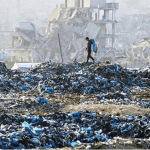



Pakistani Defence Minister Khawaja Asif announced the outbreak of war between his country and Afghanistan on 27 February. Reports in Pakistani media confirmed that Pakistan had carried out strikes against Taliban military facilities and positions in the Afghan capital, Kabul, and the Paktia and Kandahar provinces. According to Pakistani officials cited in the reports, the targets included Taliban military centres and the Bagram Air Base north of Kabul. Shortly afterwards, Afghanistan announced that it had launched attacks on Pakistani forces along their shared border.
These open hostilities followed a week of escalating tensions. On 22 February, Pakistan conducted several airstrikes against seven terrorist camps and hideouts belonging to the Islamic State Khorasan Province (ISKP) and Tehrik-i-Taliban Pakistan (TTP). Both jihadist organisations operate from Afghan territory, which they use as a safe base for staging terrorist attacks inside Pakistan. The Pakistani Ministry of Information stated that the strikes were in retaliation for suicide bombings carried out by these groups, including the bombing of a Shiite mosque in Islamabad and attacks on military and security targets in Khyber Pakhtunkhwa. In response, the Taliban government vowed to retaliate for the strikes, which it claimed had targeted civilian sites.
Two days later, Pakistani and Afghan forces traded fire along the border, with each side accusing the other of initiating the clash. On the evening of 26 February, Afghan forces attacked Pakistani border military facilities. This prompted Pakistan to declare war and launch an operation dubbed “Ghazab lil-Haq” (Righteous Fury). The current military confrontation is a continuation of intermittent clashes in recent months. In October 2025, fierce exchanges erupted along the Pakistan-Afghanistan border, lasting more than seven days before Qatar and Turkey managed to mediate an “immediate ceasefire”. Under the agreement, the Taliban pledged not to support groups launching attacks against the Pakistani government, and each side agreed to refrain from targeting the other’s security forces, civilians or critical infrastructure.
However, the truce did not last. A new round of cross-border clashes erupted on 6 December after Pakistan accused Afghanistan of refusing to cease its support for the TTP. The flareup coincided with a surge in terrorist attacks targeting Pakistani security personnel. Pakistan had maintained close relations with the Taliban, having helped establish the movement in the early 1990s. However, after the Taliban returned to power in 2021, Islamabad began to regard the movement as a threat to Pakistan’s national security. The Afghan Taliban has close ethnic, religious, and cultural ties with the TTP and many TTP fighters have previously fought alongside the Afghan Taliban in combat operations. It is therefore unlikely that the Taliban leadership will turn against the group, as doing so could fuel dissent within Taliban ranks or push TTP fighters towards the ISKP – the Taliban regime’s principal rival in Afghanistan. The ISKP consists largely of former Afghan Taliban and TTP members who believe the Taliban is not radical enough.
The TTP, for its part, benefited significantly from the Afghan Taliban’s return to power in Kabul. The group’s operational freedom through cross-border safe havens has enabled it to intensify attacks against Pakistan launched from Afghan territory. In August 2022, during the tenure of former prime minister Imran Khan, Pakistan entered negotiations with the TTP; however, the talks collapsed because of the group’s unacceptable demands. They insisted, for example, on the imposition of Sharia Law across the country and the withdrawal of Pakistani forces from border areas, which would effectively cede territory to the group.
The 35th report of the UN Analytical Support and Sanctions Monitoring Team, tasked with monitoring terrorist groups such as IS and Al-Qaeda and evaluating sanctions implementation, revealed an increase in support by the Afghan Taliban for the TTP during the period from 21 June to 13 December, 2024. According to the report, which was released in early February 2025, the Afghan Taliban provided logistical, operational and financial support. This included payments of an estimated $43,000 per month to the family of TTP leader Noor Wali Mehsud. In addition to such cross-border support, the TTP established new training bases in the Afghan provinces of Kunar, Nangarhar, Khost, and Paktika, and used increasing numbers of Afghan Taliban fighters in its operations. Such growing support enabled the group to carry out more than 600 attacks on Pakistani territory during the aforementioned period.
The threats to Pakistan from Afghanistan are not limited to the TTP. Islamabad also accuses Kabul of failing to act against Baloch separatist groups that use Afghanistan as a safe haven. Pakistan’s government also believes that the Taliban government in Afghanistan serves as a proxy for India in the context of Indian-Pakistani rivalry. During the UN Security Council session on 9 March to discuss developments in Afghanistan, Pakistan’s permanent representative to the UN, Asim Iftikhar Ahmad, accused India of supporting and sponsoring terrorist groups operating from Afghan territory, such as the TTP and the Balochistan Liberation Army. He added that India’s failure to acknowledge the “terrorist threat emanating from Afghanistan” was an indication of its complicity and that Pakistan had provided the UNSC with “irrefutable evidence of India’s collusion with terrorist groups that are engaged in orchestrating violent attacks against Pakistan”.
Given the collapse of the ceasefire and the growing mutual distrust between Islamabad and Kabul, the intensive cross-border skirmishes are likely to persist. In addition, Pakistan will probably continue its airstrikes against Afghan military sites and TTP hideouts as part of Operation Righteous Fury until the government in Kabul provides verifiable guarantees that it will stop aiding terrorist groups operating out of Afghanistan to target Pakistan. Whether the hostilities remain confined to border regions or expand to include major urban targets – including renewed strikes on Kabul – depends on how willing the two sides are to prolong the conflict. Afghanistan lacks an air force that can help it endure a drawn-out war, while Pakistan must determine whether it is politically, economically and militarily prepared to sustain a multi-front security strategy. Beyond the Afghan front, it faces mounting tensions with India and the uncertainty surrounding the spiralling war that the US and Israel launched against Iran.
Published in cooperation between the Egyptian Center for Strategic Studies, Al-Ahram Weekly, and the English-language portal Ahram Online


