






US foreign policy toward Africa, particularly the African Sahel, is undergoing a phase of strategic reassessment that reflects deeper shifts in the structure of the international system and in global balances of power. After years of diplomatic coolness and a reduced military presence, Washington has begun reopening channels of communication with Sahelian states, signaling a shift from an approach centered on isolation and political pressure toward a more pragmatic framework grounded in security and economic interests.
This reassessment is unfolding within a highly complex regional environment in which transnational terrorist threats intersect with great-power competition over strategic resources, alongside the rise of military-led regimes that have redefined notions of sovereignty and rejected traditional Western frameworks. The central question is no longer whether the United States will return to the Sahel, but rather how it will reposition itself in a region that no longer operates according to the patterns of influence that prevailed for decades.
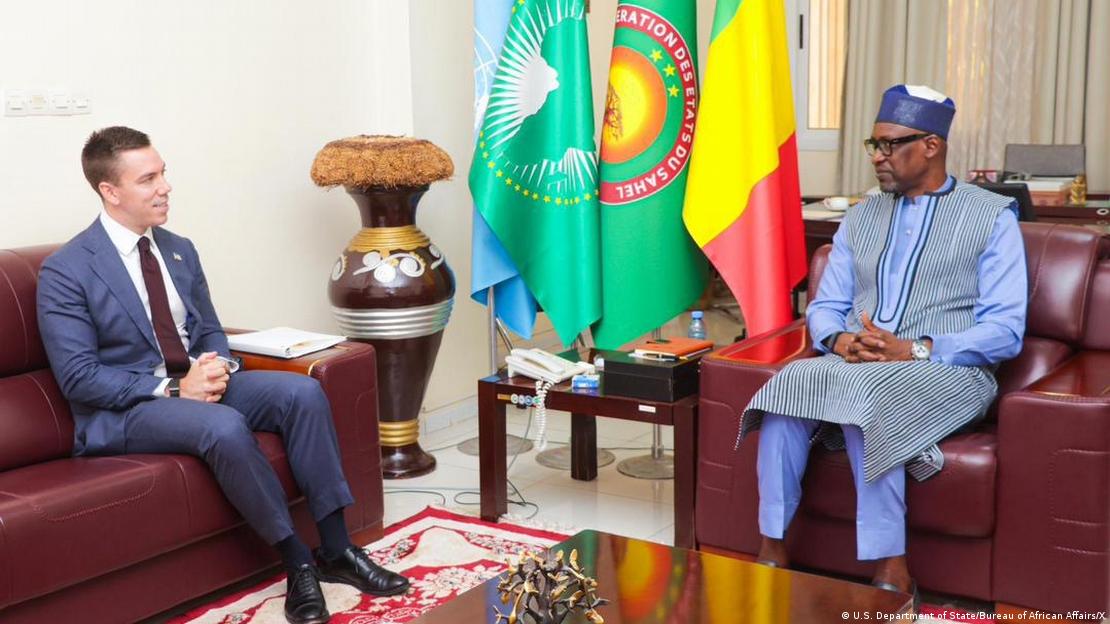
In this context, the recent visit by the senior official in the Bureau of African Affairs at the US Department of State, Nick Chicker, to Bamako on February 2, 2026, reflects this emerging shift. The significance of the visit extends beyond routine diplomacy, signaling an attempt to recalibrate relations with governments that until recently had been subject to political isolation. Washington appears to have recognized that continued retrenchment risks eroding its influence in one of the world’s most sensitive regions in terms of global security and the supply chains of critical minerals. Within this framework, the present report seeks to analyze the contours of the emerging US policy in the Sahel, explore its strategic drivers, assess its instruments, and examine its interaction with the regional and international environment, with a view to anticipating potential scenarios for the future of US influence in the region.
First: Transformations in US Strategy in the Sahel
The US approach toward Africa has undergone a gradual transformation, shifting from a normative discourse emphasizing democracy and governance toward a more realist framework shaped by considerations of security and geoeconomic competition. Earlier strategies sought to combine diplomacy, development, and defense, whereas the current approach increasingly aims to reduce reliance on aid in favor of expanding trade and investment.
This shift represents more than a tactical adjustment; it reflects a redefinition of the concept of partnership itself. Washington now appears to prefer engagement with “capable and reliable” states rather than adopting a comprehensive continental approach. In this sense, the relationship is evolving from a long-term developmental model toward selective partnerships based on mutual interests. Yet this orientation also reveals a clear paradox. While the United States advocates what it terms “commercial diplomacy,” it has simultaneously adopted measures such as tightening visa restrictions and imposing higher financial guarantees—policies that could undermine the objectives of economic engagement and constrain human and commercial exchange with African countries, including those of the Sahel.
Perhaps most notably, the absence of explicit references to democratic transition demands suggests a growing US willingness to engage with the new political reality shaped by military councils in Sahelian states. This indicates that stability—rather than democratic transformation—has increasingly become the primary criterion for engagement, particularly in regions experiencing severe security vacuums.
Second: Strategic Drivers of Washington’s Reengagement in the Sahel
Washington’s emerging approach toward reengagement in the Sahel reflects a comprehensive reassessment of its strategic priorities. This shift extends beyond security cooperation to encompass economic and political dimensions aimed at restoring US influence amid the growing presence of major powers and escalating terrorist threats. The key drivers of this reengagement can be outlined as follows:
- Containing the advances of competing major powers: One of the principal motivations behind the US return to the region is mounting concern over the expansion of Russian influence and the deepening of China’s economic and security presence. Western retrenchment created an opportunity for these powers to fill the vacuum through defense agreements, arms sales, and partnerships in the mining sector. The challenge extends beyond the loss of access to resources; it also involves the risk of diminishing strategic relevance in a region that has increasingly become a theater for the reconfiguration of international power balances.
- Competition over critical minerals: Sahelian states possess vast mineral wealth, ranging from gold and uranium to lithium, cobalt, and copper—resources that are indispensable to the global energy transition and advanced technological industries. As military-led governments in these countries move toward nationalizing these resources, a rare negotiating opportunity has emerged that major powers are seeking to leverage. Consequently, US engagement is closely linked to efforts to secure global supply chains and prevent their monopolization by strategic competitors.
- Escalating terrorist threats: The Sahel has become one of the most active hubs of terrorism worldwide, with militant groups—particularly Jama’at Nusrat al-Islam wal-Muslimin, affiliated with Al-Qaeda, and the Islamic State’s Sahel Province—expanding their operations toward urban centers and extending their reach toward the Gulf of Guinea in West Africa. This reality has heightened concerns about the emergence of safe havens that could threaten Western interests and exacerbate migration crises. The collapse of previous security frameworks, following a series of military coups between 2020 and 2023 and the subsequent withdrawal of French and UN forces, has intensified the need for new security arrangements. This helps explain Washington’s willingness to provide intelligence support—and potentially limited military assistance—without imposing stringent political conditions.
- Mitigating the negative consequences of withdrawal from the African Sahel: US policymakers have come to recognize that the suspension of communication and cooperation with transitional authorities in Sahelian states created space for other powers to expand their influence. Moscow strengthened its security and military ties with the governments of Mali, Niger, and Burkina Faso, while China deepened its presence through extensive economic investments and partnerships largely free of political conditions. Together, these developments paved the way for a level of Russian-Chinese influence that surpassed the traditional diplomatic role previously maintained by the United States in the region.
Third: Instruments of the New US Approach
The current US strategy relies on a combination of hard and soft instruments, though with a clear tilt toward pragmatic approaches. This can be understood through the following dimensions:
- Security as the central pillar: Washington is seeking to rebuild intelligence cooperation networks and monitor the movements of armed groups, particularly after losing key military facilities such as Air Base 101 in Niamey. It has also raised the idea of establishing joint command structures and strengthening regional coordination in an effort to prevent the Sahel from evolving into a global hub for terrorist activity. At the same time, US engagement appears carefully calibrated. Washington is attempting to avoid the model of extensive military deployment that provoked popular backlash against France, instead favoring a limited military footprint based on partnerships and regional coordination.
The US military strike in northwestern Nigeria on December 25, 2025, offers a practical example of this emerging security approach. Washington employed its strike capabilities from outside the immediate theater of operations by launching Tomahawk missiles from a naval vessel in the Gulf of Guinea, avoiding direct ground deployment. This pattern reflects the US reliance on high-precision military tools with relatively low political costs, consistent with its broader strategy of reducing direct military presence while retaining the capacity for rapid intervention when necessary.
- Trade diplomacy: The new approach seeks to move from a relationship based on “aid” to one centered on “investment.” This framework goes beyond the provision of financial resources and instead requires a comprehensive vision for generating added value for recipient countries, with particular emphasis on extractive industries, infrastructure, and health sectors. Washington is betting that shared economic interests can provide a more sustainable foundation for engagement than political conditionality. However, the success of this strategy will depend on the United States’ ability to present competitive offers in the face of the flexible financing and low-cost arms supplies provided by China.
- Sovereignty-centered political discourse: Washington has repeatedly emphasized respect for national sovereignty, noninterference in internal affairs, and the rejection of coercive measures. This narrative intersects with the discourse adopted by the military-led governments in Sahelian states. The objective is to rebuild trust and avoid accusations of external tutelage, though this stance may simultaneously limit the United States’ capacity to influence governance trajectories within these countries.
Fourth: Dilemmas of US Policy Between Values and Interests
Washington faces a strategic test in balancing counterterrorism priorities with its longstanding discourse of support for democracy. Engagement with governments that came to power through military coups may weaken the standards the United States has long defended, yet such engagement may also be necessary to prevent a broader deterioration in regional security.
At the same time, US influence may remain limited as Sahelian states increasingly diversify their partnerships and pursue agreements grounded in a “win-win” framework of mutual benefit. This suggests that Washington is no longer the dominant actor, but rather one participant in a crowded arena of international players. Moreover, an excessive focus on security and resource competition may come at the expense of development and governance issues, potentially reproducing the underlying causes of instability over the long term.
In addition, the establishment of the Alliance of Sahel States (AES) by Mali, Niger, and Burkina Faso has reshaped the geopolitical landscape of West Africa. The alliance presents itself as a project aimed at overcoming post-colonial constraints while seeking to unify its members’ security and political positions. As a result, it reduces the ability of external powers to deal with each state individually and imposes a more complex regional framework for engagement.
France’s withdrawal has also disrupted arrangements that endured for decades, creating a vacuum that several powers are attempting to fill. While Russia has expanded its defense cooperation with Sahelian governments, China has focused on arms transfers and military training while largely avoiding direct operational involvement. Arms trade data indicate a growing Chinese role as a major supplier to West Africa, benefiting from lower costs and the absence of political conditions. This suggests that competition in the Sahel is no longer confined to economic domains but increasingly extends to the restructuring of national security architectures.
In sum, renewed US engagement in the Sahel reflects a deeper transformation in how Washington understands its role in Africa. The promotion of democracy is no longer the sole driver; rather, geopolitical realism has become the dominant framework. Although international competition and mounting security threats are pushing the United States to return to the region, the evolving regional environment requires it to operate under conditions markedly different from those of the past. Sahelian states are no longer passive arenas of influence but negotiating actors seeking to maximize their gains through diversified partnerships. Accordingly, the future of US policy in the region will depend largely on its ability to adapt to this new regional reality and to offer partnerships that move beyond containment toward the construction of shared interests. Ultimately, Washington’s return does not simply reflect an attempt to reclaim lost ground; it also signals a growing recognition that the Sahel is no longer a peripheral space in international politics, but one of its emerging strategic gateways.