








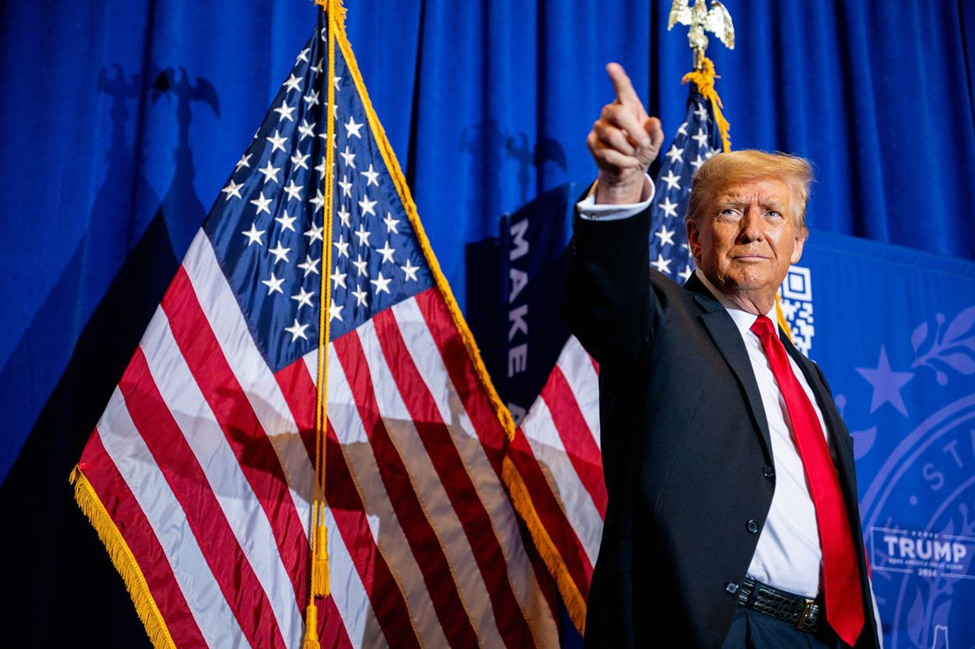
Donald Trump has once again been elected President of the United States, returning to the White House amidst intense political divisions, domestic economic and social turmoil, and significant global geopolitical shifts. His second-term campaign was defined by rhetoric centered on “restoring America to greatness” and prioritizing economic and security concerns. The election outcome triggered diverse reactions, with his supporters hailing his return while detractors voiced concerns about the potential consequences of his policies on democracy and human rights. Globally, attention is fixed on how Trump’s return might shape foreign relations, particularly with China, Russia, and the Middle East, as well as the potential ramifications of his domestic policies he plans to pursue in his second term.
In this article, we will examine Trump’s potential economic strategy for his second term in the context of the current global transformations.
During his previous term from 2017 to 2021, Trump’s economic policies were defined by a strong focus on boosting domestic growth and reinforcing US competitiveness in the global market. His strategy revolved around tax reduction, investment stimulation, and easing regulatory constraints. A centerpiece of his economic agenda was the Tax Cuts and Jobs Act (TCJA) of 2017, enacted in December of that year. This legislation marked one of the most significant overhauls of the US tax code in over 30 years, aiming to invigorate the economy through substantial tax cuts, particularly benefiting corporations and high-income individuals. The law notably lowered the corporate tax rate from 35% to 21%, its lowest point in decades, enhancing the United States’ appeal to multinational corporations.
Moreover, the law introduced temporary tax reductions for individuals, with high-income families receiving larger benefits compared to other groups. However, it imposed new limits on deductions for estate and local income taxes, particularly affecting taxpayers in high-tax states. On the corporate front, the law eliminated or adjusted several provisions to motivate companies to channel their profits back into the US economy. It further reduced taxes on foreign earnings, aiming to deter businesses from shifting their operations abroad. Although these changes led to higher corporate earnings and surging stock prices, the law drew significant criticism for its perceived contribution to widening income inequality.
Regarding international trade, the Trump administration pursued a protectionist approach, imposing significant tariffs on steel and aluminum imports in March 2018—25% on steel and 10% on aluminum. These measures were part of the America First policy, designed to shield domestic industries from what the administration viewed as unfairly subsidized foreign imports, particularly from China. The tariffs were framed as essential for safeguarding US national security, given the strategic importance of the steel and aluminum industries for defense and infrastructure. Simultaneously, the administration renegotiated key trade agreements, withdrawing from the Trans-Pacific Partnership (TPP) and replacing the North American Free Trade Agreement (NAFTA) with the US-Mexico-Canada Agreement (USMCA) in 2020. Trump also initiated a trade war with China, aiming to reduce the US trade deficit and boost domestic manufacturing. This involved imposing tariffs on Chinese goods worth hundreds of billions of dollars, which heightened global economic tensions and raised production costs for US manufacturers.
On the energy front, Trump prioritized loosening regulatory constraints on businesses, rolling back numerous environmental and health restrictions, and encouraging fossil fuel and oil extraction. His administration offered robust support to the domestic energy sector, including coal, oil, and natural gas, with the goal of minimizing reliance on energy imports and achieving energy self-sufficiency. Among his most controversial actions was the withdrawal from the Paris Climate Agreement, arguing that it imposed an unfair economic burden on the United States compared to developing countries.
The Impact of Trump’s Economic Policies
At the outset of his presidency, Trump’s economic policies delivered notable successes, including robust economic growth and historically low unemployment rates. However, these policies faced significant criticism. Many argued that the tax cuts disproportionately favored the wealthy and large corporations over the middle and working classes. Additionally, the trade war with China was blamed for driving up costs for American consumers and businesses, while also adversely impacting key sectors such as agriculture and the automotive industry.
Figure 1: US Soybean Exports to China

Source: United States Department of Agriculture
For instance, US soybean exports to China were heavily impacted by China’s retaliation to US protectionist measures. Prior to the imposition of tariffs, China accounted for approximately 60% of US soybean exports, making it an essential market for US farmers. However, when China ceased purchasing soybeans in response to the tariffs, farmers faced substantial financial losses and were left with unsold crops due to the lack of buyers. To address these challenges, the Trump administration introduced a multibillion-dollar relief package to help farmers recover from the economic impact of the trade war.
However, this aid fell short of fully compensating for the damage, with many farmers deeming the amounts inadequate and accusing the distribution process of disproportionately benefiting large agricultural companies at the expense of small and medium-sized farms. Export-reliant agricultural sectors also suffered from increased costs of imported production materials, such as fertilizers and agricultural machinery, due to tariffs on steel and aluminum imports. These factors directly drove up agricultural production costs, diminishing farmers’ competitiveness and inflating prices for domestic products.
Tariffs on steel and aluminum imports directly increased raw material costs for the US automotive sector, driving up production expenses and car prices for consumers. This adversely affected the competitiveness of American automakers, particularly against imported cars from countries with cheaper production processes. The added expenses also pushed some companies to contemplate relocating their production operations overseas to mitigate the impact of tariffs, contradicting the trade policy’s objective of promoting domestic manufacturing. For instance, in 2018, General Motors (GM), a leading American automaker, announced the closure of several factories in the United States, including facilities in Ohio, Michigan, and Maryland, as part of a restructuring plan to cut costs and enhance profitability in response to rising production expenses.
Although these decisions were not solely driven by tariffs, the rising costs of steel and aluminum added significant pressure on companies like GM. While GM has not fully relocated its operations to China, it has expanded investments and production there to cater to the vast Chinese market. Similarly, Tesla, the leading electric vehicle manufacturer, established a massive gigafactory in Shanghai, China, to bypass tariffs on cars imported into the Chinese market. This move was aimed at minimizing the effects of reciprocal tariffs between the United States and China, enabling Tesla to offer its vehicles at competitive prices in China. Ford, on the other hand, opted to manufacture certain models abroad to avoid high tariff costs. For instance, the Ford Focus Active was produced in China to cut expenses, but the company ultimately canceled plans to import the model to the United States due to the financial strain imposed by tariffs.
Tools at Trump’s Disposal
Trump’s proposed economic strategy for the United States over the next four years will likely prioritize tax cuts, deregulation, higher tariffs, and an expansion of energy production. Central to his plan is the extension and expansion of the 2017 TCJA, which would include keeping individual income tax rates low, preserving the higher standard deduction, and cutting the corporate tax rate from 21% to 15%. Trump also aims to eliminate taxes on Social Security benefits, a move that could significantly aid older Americans living on fixed incomes, though it would likely increase the federal deficit in the long run.
In terms of trade, Trump is concentrating on imposing high tariffs on imports from countries such as China, claiming these tariffs will strengthen domestic industries like steel and automobile manufacturing. His economic agenda also seeks to cut federal spending, including redirecting funds from clean energy projects under the Inflation Reduction Act in favor of expanding conventional energy production. This includes increasing access to federal lands for oil exploration and drilling and facilitating the construction of additional refineries and power plants to ramp up domestic energy production.
On housing, Trump has proposed unlocking federal lands for development to address the housing crisis, particularly in high-demand areas. He argues that this initiative will create jobs, expand the housing supply, and potentially lower housing prices.
Overall, Trump’s broader economic agenda combines protectionist trade measures, tax incentives, and deregulation, with the overarching goal of boosting domestic production, curbing inflation, and enhancing US self-sufficiency in critical industries. However, these policies are expected to substantially raise the federal deficit, with projections suggesting an increase of $5.8 trillion over the next decade due to tax cuts and spending adjustments.