







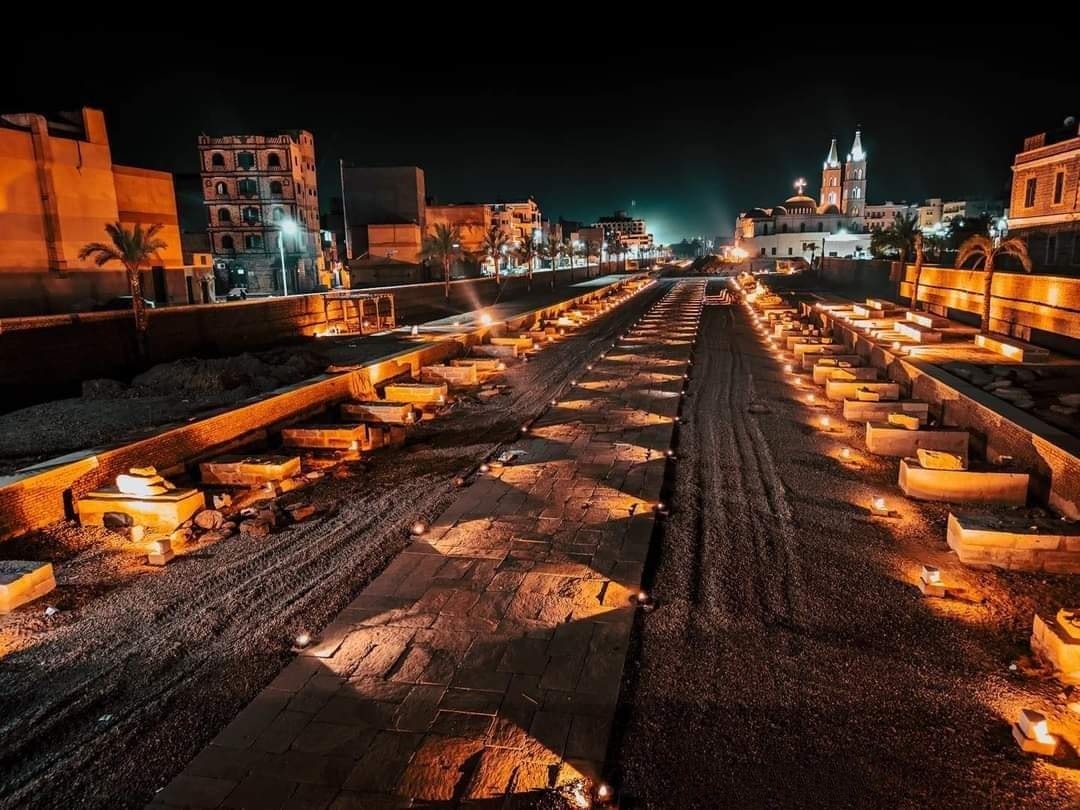
On 25 November, the world witnessed a remarkable cultural and touristic event, with Egypt reopening the King’s Festivities Road, known as Al-Kibash Venue or the Avenue of the Sphinxes, following assiduous intermittent efforts over the past decades to excavate, restore, and develop the avenue, bringing life back to the oldest road in human history that was enshrouded for centuries.
This event is the second of its kind following the Pharaohs’ Golden Parade of April 2021, in which 22 mummies of Egyptian kings and queens of the New Kingdom era were relocated from their old location at the Egyptian Museum in Tahrir to their new resting place in the Museum of Egyptian Civilization in Fustat, along with the opening of the Museum of Egyptian Civilization itself, the first of its kind among archaeological museums in Egypt.
Reopening Al-Kibash Venue is aimed at accentuating the archeological, touristic, and folklore elements of Luxor, stressing its standing as a global tourist destination emulating several major historic cities such as Athens, Rome, and Paris, bringing about a rebound in cultural tourism in the city, which, in turn, would increase the volume of annual incoming tourism and contribute to increasing the country’s tourism revenues.
A City with a Rich History
Luxor is one of the oldest historical cities in Egypt. Over the past decades, archaeological missions to the city revealed robust evidence of buildings and temples dating back to the predynastic and Old Kingdom eras. Engravings on temples and tombs tell the story of the development of Luxor city, known then as Thebes. By the end of the First Intermediate Period (dark period) and the beginning of the Middle Kingdom under King Mentuhotep I, Luxor was chosen to be the capital of a united Egypt, which brought unprecedented prosperity to the city that continued to be the capital of the Egyptian state until the end of the New Kingdom era.
Inscriptions on the walls of temples have shown us signs of the commercial and military expeditions undertaken by several kings of the Middle and New Kingdoms including Mentuhotep II, Thutmose I, Thutmose III, Amenhotep III, and Hatshepsut to kingdoms of Kush, Punt, Phoenicia, and Canaan, and how these journeys contributed to strengthening the city at the political and economic levels. Historical inscriptions etched on Luxor temples narrate the role of Thebes in fighting aggressor forces against Egypt, including attacks of the Hyksos, Kushites, Libu tribes, and Sea Peoples.
The prosperity that Thebes experienced during the Middle and Modern Kingdoms served as a driving force for Egyptian kings to construct several religious and funeral edifices, which are still admired by historians, travelers, and tourists. Official estimates indicate that there are over 800 archeological shrines that survived in the ancient city of Thebes. Prominent examples of these attractions include Karnak and Luxor Temples on the eastern bank of the Nile, Ramesseum Temple, Deir Al-Bahari Temple, and the tombs of the Valley of the Kings on the western bank of the Nile, which prompted UNESCO in 1979 to recognize ancient Thebes as one of the World Heritage sites in Egypt.
Historic Egyptian Parade
The Avenue of the Sphinxes ceremony on 25 November featured several shows including fireworks that illuminated Luxor’s sky, decorated horse and Victoria carriages’ long parades, sailing of dozens of sailing boats in the Nile, and a display of flying balloons. Yet the ceremony essentially recreated the spirit of the ancient Opet Festival known in the New Kingdom era devoted to celebrate the Nile’s annual flooding.
In the New Kingdom, the procession would start with Amun’s priests moving from the Karnak Temple, northern Thebes, carrying on their shoulders three ceremonial boats, each of which has a sarcophagus with one statue of the Theban Triad gods, i.e. Amun, symbol of the sun, his consort Mut, symbol of the heavens, and their son Khonsu, symbol of the moon disk. The destination of the procession was the Luxor Temple in Southern Thebes where, according to ancient Egyptian mythology, a marriage ceremony between the Pharaoh and Amun and his consort Mut took place, which was believed to bring fertility and prosperity with the inundation of the Nile, promoting abundance and fertility of the harvest.
This sacred annual journey between the Temples of Karnak and Luxor either travelled overland or sailed on the river parallel to the bank. The land journey would extend over 2.7 km from the Luxor Temple and the Karnak Temple with 1,200 statues of sphinxes and rams on the sides of the road. As for the river road, it extended at a distance similar to that of the land road, where riverine barges, propelled by wind sails or dragged with ropes overland, were used.
The procession of the three deities was generally accompanied by groups of soldiers, chariots, and standard-bearers as a kind of honor, and was often preceded by a full band of musicians, dancers, acrobatic performers, stick-fighters, and hymns’ citers. Leading statesmen used to queue up at the Luxor Temple waiting for the holy procession paying homage to Egypt’s deities that bring good and prosperity. Tables of food and drink were prepared nearby the temple to celebrate this huge annual ceremony. As for the common people, they could only participate in this annual feast by witnessing the celebration.
The pharaoh was one of the key participants in the procession. Before the procession begins, the pharaoh would head to the Karnak Temple to renew his vows to the three deities to renew the religious and earthly life in the new year. Incense-burning and pouring wine were of the practices followed for the pharaoh to get the divine right to rule for another year. As the procession arrives at Luxor Temple, the pharaoh would wait for the procession with incense sticks, signaling the start of deities’ marriage ceremony involving the pharaoh who according to old mythology is the son of gods and the intermediary between them and Egyptian society.

Figure 1. A scene of the Theban Triad procession recorded on the walls of the Red Chapel in the Karnak Temples area (Source: UCLA Encyclopedia of Egyptology, the Opet Festival, John Coleman Darnell, 2010)
Adequate Preparations
Since the beginning of 2020, Egypt has adopted a development approach aimed at making qualitative development leaps in heritage sites where major tourist events take place. The beginning was with the Pharaohs’ Golden Parade where the government accelerated the development agenda for squares and roads where the parade made its way, including primarily the Tahrir Square that was fully developed with a pharaonic obelisk and four rams placed in it. Further, building facades were renovated to be aesthetically consistent with the tourist and heritage character of the place. Additionally, the road network surrounding the Museum of Civilization was developed and expanded to be commensurate with the volume of tourism after the opening.
However, this development trend wasn’t restricted to Cairo. Luxor, too, witnessed several development projects particularly in areas close to the archaeological and tourist sites. The beginning was with infrastructure projects where the executive authorities worked on developing the 1.7 km eastern Corniche area facing the Luxor Temple. Further, the river barges dock has been transferred to a new location where a parking for taxis and microbuses is situated, which helped maintain the civilized look of the area. Outdoor courtyards and tour bus stops at Karnak and Luxor temples were also developed.
Besides, over 2.000 buildings right across the archaeological sites were painted in the same color commensurate with the visual identity of the city, several tourist routes in the city were paved and beautified, including the Airport Road and the Corniche, and the largest artistic mural in Egypt was implemented, with a length of 25 meters and a height of 6 meters, intended to be one of the city’s most distinctive attractions.
Additionally, the antiquities dossier has received a great deal of interest from the government. After archaeological projects were disrupted in the early 2000s, competent authorities resumed most of these projects over the past five years. Excavating remnants of the Avenue of Sphinxes is a prominent example of these projects, where Egyptian archaeologists managed to carry out excavations in most parts of the road that is now being beautified to serve its new role as an archaeological and tourist walkway connecting Karnak and Luxor Temples.
During their 30-minute tour between the two temples, visitors would see on both sides of Al-Kibash Venue a number of archaeological remains, including workshops, wine presses, plantings that were used by ancient Egyptians to decorate the road, as well as a number of facilities that visitors may use during their short visit to Al-Kibash Venue.
Archaeological monuments, like Al-Kibash Venue, also received particular attention from the competent authorities. Over recent months, archaeological restorers have worked to restore all the temples on the east coast as well as the columns and sculptures contained therein. The Great Hypostyle Hall is a case in point, where restoration teams managed to restore the original colors of the columns after getting rid of the dust accumulated on their surface.
In conclusion, the reopening ceremony of Al-Kibash Venue represented a landmark event in Egypt’s record of cultural and touristic events. Never in the history of Modern Egypt has an Egyptian city held a cultural and tourist carnival of this magnitude. The success of this event shall be capitalized, thereby contributing to attracting more tourists.
The government should consider organizing a series of successive cultural events, following the example of major international cultural carnivals such as the Rio Carnival and the Venice Carnival, opening the eyes of the world on a new tourist destination one at a time.