








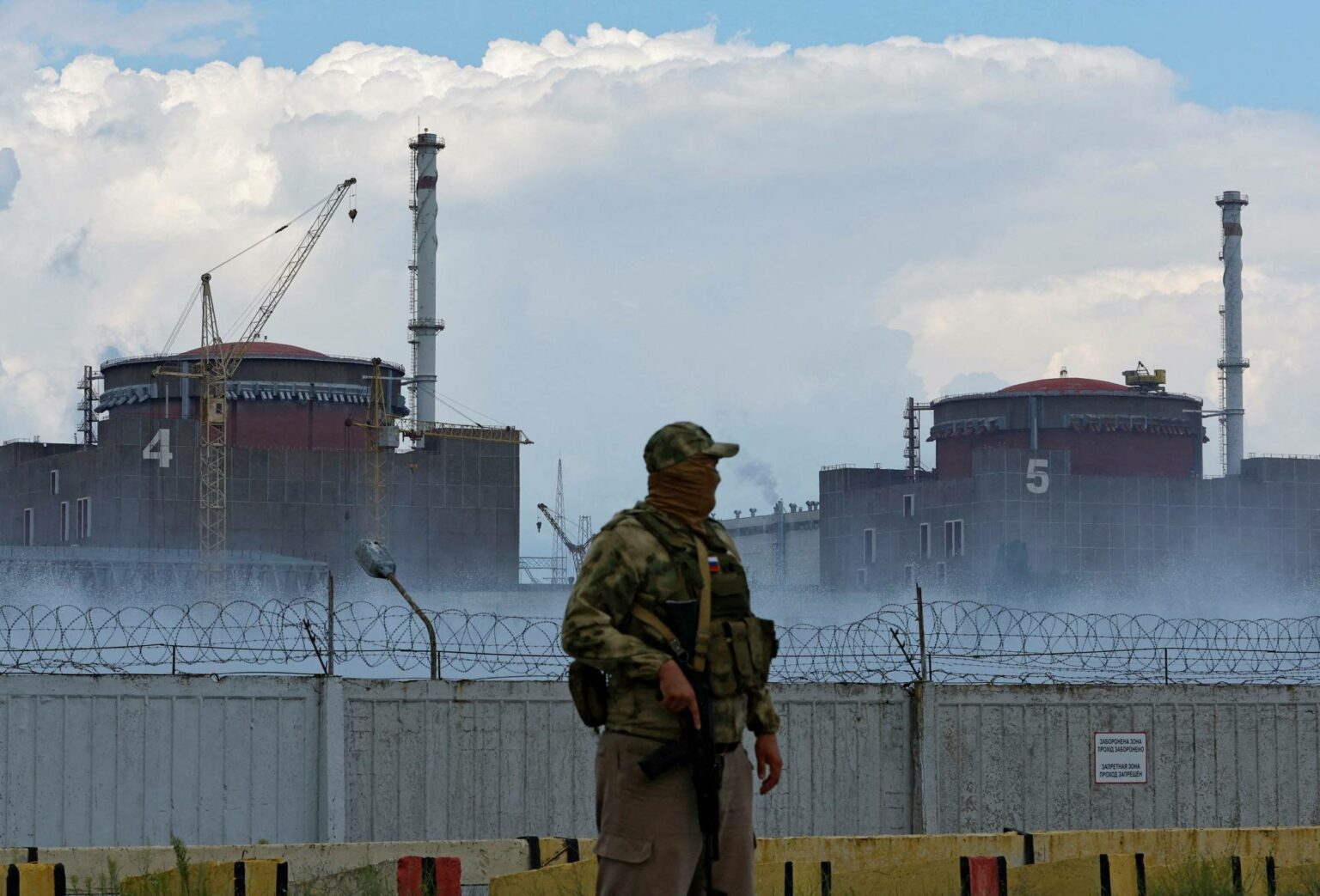
The world’s attention turned to Zaporizhzhia nuclear station with the visit of the IAEA inspectors on 1 September. The visit came amid the ongoing shelling of the station and mutual accusations between Moscow and Kiev, in addition to the resonating talk about nuclear terrorism and the failure of international efforts to contain existing tensions.
There are fears of a nuclear or hydrogen explosion, or perhaps nuclear leak that produces nuclear radiations that extend beyond the Ukrainian borders, especially that the Zaporizhzhia station is the largest in Europe, containing six reactors, and was capable of producing one-fifth of Ukraine’s electricity needs prior to the Russian-Ukrainian war.
First: Dimensions and Outcomes
The most important dimensions, purposes and outcomes of the IAEA’s visit to Zaporizhzhia station can be concluded as follows:
1- Purpose of the visit: The IAEA mission to the station aimed at observing the current situation as a result of the bombing, and checking some technical documents presented by the Ukrainian Ministry of Energy related to operating the station, in addition to checking the existence of Russian military equipment in its surroundings. That –in general- helps in containing the fears of occurrence of a nuclear accident or a radiation leak. Those fears became global while Ukraine already got ready for, through some virtual drills, in addition to its continuous calls on Moscow to stop bombing the roads that lead to station.
2- Mission of the Delegation: The visit of the IAEA delegation (included 14 inspectors) lasted for 5 hours. Rafael Grossi, the IAEA director general confirmed that he has been able to see the entire location, the reactors, the emergency systems as well as the control and radiation level monitoring rooms. He could also evaluate the damages that occurred over the past weeks. He praised the hard work of the Ukrainian workers who continued operating the station after the Russian forces seized it last March; he described them as “very professional”.
3 – Logistic Difficulties: The delegation members faced a variety of challenges that caused them to be late due to bombing the avenue they were supposed to use to reach the station. Dmytro Orlov, the mayor of Energodar city posted on Telegram app that the Russians are bombing the road which the IAEA should take to reach Zaporizhzhia station. He said that there have been excessive military actions until very short time ahead of the visit.
He had been informed by the local military commander about the potential mission risks especially in the grey area that separates the Russian forces from the Ukrainian forces. However, those potential risks did not deter the delegation from completing their mission, besides; the risks were much less compared the benefits gained from the visit.
4 –Outcomes: Following his visit to the station, Grossi confirmed that the station and its safety systems have been violated several times as a result of being bombed, and that he did not have the proper means to assess the situation which is not supposed to resume the way it is. This means that numerous technical issues are still under investigation, and that assessing the damages requires more experts, time as well as technical capabilities, in addition, technical inspection cannot be conducted in such a militarily turbulent context.
5 – Prospective Action: The IAEA’s mission aims to achieving permanent observation on the nuclear station. This had been said by Grossi: “I hope our delegation can remain permanently”. Consequently, members of the IAEA expert team were scheduled to stay at the station until 4 or 5 September to resume their assessment of the situation, however, it is not known how many of them remained. It is worth noting that the IAEA delegation arrived to the station boarding 9 vehicles, but only 4 vehicles left. Two experts are planned to stay until military aggression stops.
Second: The Most Notable Indications
The IAEA’s mission to Zaporizhzhia nuclear station raises a number of indications, which are as follows:
1- Delayed Mission: For the first time, the world sees severe military clashes in the surroundings of an active nuclear station, which obliged Ukrainian workers to run it under unstable circumstances amid fears of losing control over it, as well as mass migration of nearby residents. Despite the risky situation, the IAEA mission took place following months of negotiations between the Russians and Ukrainians over the root to be used by the team, as Ukraine refused to receive them in case they arrive through Russian-occupied lands. In turn, Russia does not guarantee their safety in case they move through Ukraine-controlled lands.
2- Endangering Nuclear Safety: For the first time in history, Ukrainian nuclear power stations get trapped in a conventional war in the way that endangers nuclear safety regulations. Russia has exploited the station as a military base, taking advantage of its protection provided by walls and permanent surveillance. As a result, many have called for negotiating the interaction between military war and nuclear safety, as previous concerns had been focusing on nuclear terrorism and human error.
In order to protect its nuclear safety, Ukraine has –over the past 3 months, without achieving any success– called on the IAEA to bind its members to respect a safe zone of 5 Km around nuclear facilities. Military forces are not allowed to break in this safe zone.
3 – Critical Timing: The IAEA mission comes following the announcement of Energoatom –the Ukrainian state-owned company that operates the nuclear power station– that it has completely disconnected the station from the main grid due to cutting the power lines that connects them –for the first time in its history– as a result of targeting it with a mortar shell. This was followed by activating the emergency system, and turning off the 5 reactors. President Volodymyr Zelensky demanded a quick reaction from the IAEA.
4 – Effectiveness of the Mission: It can be said to have achieved one of its goals, which is the existence of a number of its experts there. However, it is too early to assess the IAEA mission’s effectiveness as the utmost objective called for by the UN, which is banning any kind of military action within the Zaporizhzhia station surroundings and establishing a demilitarized zone around it to guarantee its safety, this objective is still far from materializing.
Also it can be said that Zelensky’s pre-assessment of the mission indicated its lack of effectiveness. In his daily afternoon address, he said that the IAEA should have done more, and should have insisted on demilitarizing that nuclear zone. He also condemned preventing international media members from accompanying the delegation by the Russian forces. He also held the Russians accountable for failing to protect the independent media representatives.
5 – Potential Complications: Russia possesses a good experience in nuclear energy as it is running 38 nuclear power stations around the country. Relying on that experience, it can keep its occupation of the Zaporizhzhia station despite the increased potential dangers as fighting resumes. In addition, the Ukrainian authorities’ unawareness of what is going on inside the station is somehow dangerous, despite the existence of IAEA experts, which means that it (Ukraine) needs more international support.
6 – Another Field for Exchanging Accusations: Ukraine accuses Russia of using the station as a shield, and a garrison for launching attacks, while Russia accuses Ukraine of recklessly targeting it. Repeatedly, President Zelensky accuses Russia of bombing the city of Energodar where the station exists. The Ukrainian army announced that there has been extensive shelling around Kharkiv and Zaporizhzhia, in addition to other places.
Russian Foreign Minister Sergey Lavrov said that Russia is doing its best to keep Zaporizhzhia nuclear station working safely, while the Russian Ministry of Defense accused the Ukrainian army of shelling the assembly point of the IAEA delegation, near the nuclear station. It has also announced the abortion of a provocative operation planned by Ukraine on the IAEA delegation arrival day, that operation aimed to use the IAEA experts as human shield.
Finally: The Importance of the IAEA Report That Will Be Issued Next Week is increasing:
Consequently, the importance of actual measures for protecting the station from military operations is also increasing.
There is an increasing danger of disconnecting the station from the main Ukraine grid, as it means the possibility of a nuclear disaster similar to Chernobyl (only 500 Km from Zaporizhzhia) that happened in 1986. Thus, the prevention of a new nuclear disaster became a global goal that requires exerting efforts by all governments as well as international agencies, in addition to demanding on countries to boost the safety of their nuclear facilities.