


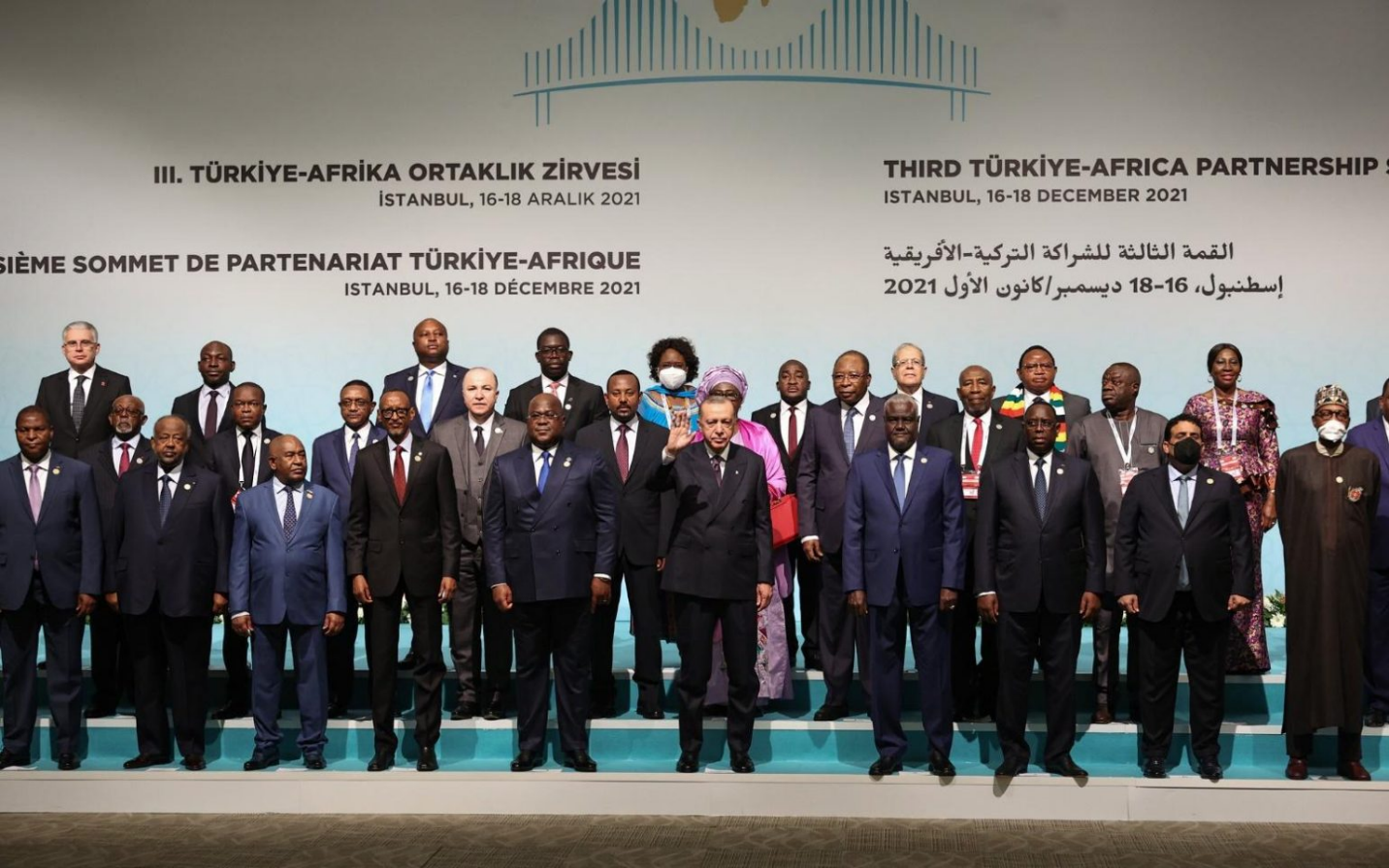
Africa has long been a focal point of Turkish foreign policy, but a significant transformation began with the rise of the Justice and Development Party in the early 2000s. Turkish-African relations advanced notably, starting with Ankara’s designation of 2005 as the Year of Africa, following its attainment of observer status in the African Union (AU) that same year. By 2008, it had become a strategic partner of the AU, following the first Turkish-African Summit in Istanbul.
Initially, Turkish influence on the continent was driven by soft power, but over time, security, military, and strategic dimensions took the lead. In recent years, Turkey has refined its foreign policy instruments to expand its presence in Africa, aligning with its broader global and regional ambitions of safeguarding its core strategic interests. This article explores Turkey’s strategies for expanding its influence in Africa and how these efforts align with its broader strategic objectives.
Evolving Engagement Strategies
Ankara has long employed conventional economic and humanitarian tools to establish its influence across the African continent, including establishing a broad diplomatic presence, including 44 embassies, hosting joint Turkish-African summits, having Erdogan and his cabinet embarking on visits to numerous African capitals, and spearheading development projects via the Turkish Cooperation and Coordination Agency (TIKA). Such projects range from building schools, hospitals, and wells, to providing both humanitarian and developmental aid. Turkey has also drawn on shared religious affiliations to initiate faith-based projects, while also injecting investments to stimulate sectors like construction, textiles, and energy, promoting job creation and economic growth. Moreover, it has facilitated scholarships and training for African youth, expanded air routes between Istanbul and dozens of African cities, strengthened trade relations, and inked defense agreements involving arms transfers, military training, and anti-terrorism efforts. Recently, however, Ankara has devised new strategies to further extend its reach into Africa. These strategies include the following:
Recruiting Syrian Mercenaries: Mercenaries have become a key element in Turkey’s strategy for extending its influence, with fighters being rotated across various conflict zones. Africa has seen its share of this tactic, with SADAT International Defense Consultancy enlisting around 1,000 Syrians from the Turkey-aligned Sultan Murad Division. These fighters were dispatched to Niger under contracts lasting six months to a year, with salaries of $1,500 per month, performing security duties for Turkish-operated companies, factories, and mines, and occasionally engaging in combat against Daesh. Some of these mercenaries have also crossed into other West African countries, such as Nigeria and Burkina Faso. This policy aligns with Ankara’s broader strategy of gaining a foothold in one country to serve as a hub for expanding influence across a wider regional scope, similar to how Somalia became a springboard for Turkish operations in the Horn of Africa, with Niger playing a similar role in West Africa.
Drone Diplomacy: The rapid advancement of Turkey’s drone industry has transformed it into a key instrument of foreign policy, amplifying Turkish influence and boosting its international standing. In just a few years, Turkish drones have become the flagship of the country’s defense exports, particularly in Africa. As many African countries face a range of security threats such as terrorism, civil unrest, border disputes, and smuggling, the demand for affordable, technologically advanced drones has surged. Turkish drones, used for surveillance, reconnaissance, and airstrikes, have fulfilled this need. To date, Ankara has supplied drones to roughly 13 African countries, in addition to countries in North Africa. Countries like Togo, Burkina Faso, Mali, Niger, Somalia, Ethiopia, Djibouti, Rwanda, and Senegal have procured Baykar TB2 drones from Baykar Defense, a company run by Erdogan’s son-in-law Selcuk Bayraktar. Kenya may soon join the list of Baykar TB2 drones’ buyers. Furthermore, Chad and Kenya have purchased TAI Anka drones from Turkish Aerospace Industries, while Nigeria and Uganda have received TOGAN drones from STM Defense. Burkina Faso, meanwhile, utilizes mine-clearing drones from Turkish ASFAT Inc..
Leading Mediation Efforts between African Countries: Ankara has long demonstrated a skill for mediating conflicts, a hallmark of its foreign policy, though traditionally focused on Western, Asian, and Middle Eastern partners. Now, for the first time, Turkey is extending its mediation efforts to Africa. In recent months, Ankara hosted three rounds of negotiations between Ethiopia and Somalia, in July, August, and September, positioning itself as a ‘peacemaker’ in Africa, one that avoids entanglement in local conflicts and instead seeks to create win-win partnerships with African countries, contributing to its growing acceptance. While the talks have yet to yield significant breakthroughs, their relative success sets a precedent for future mediation efforts among African parties, particularly in West Africa, where Turkey enjoys favorable relations.
Advancing Strategic Interests
Turkey’s engagement in Africa has expanded beyond merely focusing on bilateral relations or continent-specific interests to becoming a key component of its broader strategic moves on the global stage. This shift reflects Turkey’s pursuit of a new role that aligns with its vision of its standing within the international and regional power structure. The following are the key factors driving Turkey’s strategic ambitions in Africa:
Boosting NATO’s Reach and Advancing Western Interests: Although Ankara has its own distinct interests in Africa; its initiatives are closely tied to the reality of its NATO membership. Turkey’s growing presence in strategically critical regions like the Horn of Africa and West Africa provides NATO with a gateway into new territories, potentially offsetting the diminishing Western influence in certain areas due to political shifts. The United States may also perceive Turkey’s role as a strategic counterbalance to growing Russian and Chinese influence, paving the way for Turkish-American collaboration in Africa. Washington might increasingly view Ankara as a dependable partner in the region, especially in the face of competing interests from Moscow and Beijing.
Niger and Somalia exemplify Turkey’s strategic positioning in Africa. Niger, once a stronghold of Western influence in sub-Saharan Africa, experienced a shift after the military coup in July 2023, leading to strained relations with France and the withdrawal of French forces. The United States is also expected to complete its withdrawal from the country by mid-September, while Russia, China, and Iran have emerged as Niger’s new allies. Additionally, Turkey’s military partnership with Somalia has allowed it to establish a permanent political and military presence in the Horn of Africa, positioning itself as a central player in the region’s security and global trade routes. This opens doors for US-Turkish cooperation, especially as Washington remains intent on controlling maritime routes and safeguarding global trade as part of its endeavors to maintain its global dominance.
Establishing a Foothold in the Indian Ocean Basin: The Indian Ocean has emerged as a key area for Turkey’s growing influence, driven by the global shift of geopolitical rivalry toward the Indo-Pacific region. Turkey’s 2023 foreign policy vision, “The Century of Türkiye” underscores the strategic significance of the Indian Ocean, particularly in relation to energy security and supply chains. This vision builds on the 2015 Turkish Naval Forces Strategy, which identified the Indian Ocean as a vital strategic region and highlighted Turkey’s goal of enhancing interoperability capabilities by securing local logistical bases and port access. Both the vision and the strategy are practical interpretations of Erdogan’s 2011 statement during a military event, in which he characterized Turkey’s national interest as extending from the Suez Canal and its surrounding seas to the Indian Ocean.
Hence, Ankara has thus taken steps to fortify its ties and enhance its footprint in the Indian Ocean region, collaborating with countries such as Japan, Southeast Asian countries, and those in Central Asia. It has also strengthened security and defense alliances with Malaysia, Bangladesh, South Korea, the Philippines, and Pakistan. Additionally, Turkey’s involvement in the Horn of Africa—located on the northwestern edge of the Indian Ocean—should be viewed through this lens. By fostering political, military, economic, and humanitarian partnerships with countries like Somalia, Ethiopia, Djibouti, and Sudan, Turkey positions itself as a significant power in the western Indian Ocean.
Becoming a Key Player in the Global Trade Landscape: The Horn of Africa boasts a strategic position overlooking critical shipping routes, namely the Red Sea and the Gulf of Aden. In light of rising tensions in the Red Sea and escalating geopolitical competition among global, regional, and domestic actors in this vital waterway, Turkey has navigated a complex military and political environment to secure a foothold by strengthening its presence in the Horn of Africa. This transforms Turkey into a significant security player in the Gulf of Aden, positioning it as a crucial factor in the global trade equation, particularly since control over international trade routes has emerged as a pivotal strategy for major powers seeking to reshape global power dynamics, as evident by China’s Belt and Road Initiative and the United States’ proposed “India-Middle East-Europe” corridor. Thus, having ports or military bases along the routes of these corridors, including the Red Sea, the Bab al-Mandab Strait, and the Gulf of Aden, enhances the state’s geostrategic significance.
Bolstering Turkey’s Status as a Global Power: Ankara is firmly of the view that its strategic presence in areas where the United States, China, Russia, several European countries—including France—and various Arab and regional actors that are vying for influence, coupled with its success in facilitating effective mediation efforts, enhances its standing on both regional and global stages, showcasing how a country with moderate economic and political capabilities can assert itself in a geographically distant area and revealing not only Ankara’s capacity to influence events but also emphasizing its proactive role in managing and resolving conflicts. Such engagement fosters confidence in Turkey within the international community and provides opportunities to reassess the diverse applications of its foreign policy tools across different arenas. Furthermore, Turkey’s presence in the southern Red Sea enhances its role in regional dynamics, positioning it as a key player in the Bab al-Mandab and Gulf of Aden, areas that are crucial battlegrounds for regional competition between Iran and its adversaries and leaving it with a strategic card to apply pressure on Tehran and its proxy, the Houthi group.
Promoting Turkish Investments and Securing Energy Resources and Strategic Assets: The economic dimension of Turkish-African relations has evolved beyond mere financial goals, now incorporating a strategic dimension that illustrates the intricate connections among political, economic, and military elements in Africa. Ankara aims to unlock new markets for its businesses, particularly those that flourished during the Justice and Development Party’s tenure and have gained significant influence in Turkish policymaking, especially military firms closely aligned with the ruling elite. Furthermore, Turkey’s ambitions to enter the peaceful nuclear arena necessitate access to uranium for reactors. As such, collaborating with Niger—currently the world’s seventh-largest uranium producer—presents Turkey with a vital opportunity to secure long-term supplies of uranium for future nuclear energy production.
In addition, Ankara aims to diversify its energy sources. Exploring onshore and offshore oil and gas rights in Somalia (with a focus on offshore fields) and Niger (particularly in the Agadem Basin in the southeast) is perhaps instrumental in Turkey’s diversification strategy. Turkey’s interest extends beyond oil resources; it also encompasses strategic assets like gold, which is viewed as a hedge against economic instability marked by high inflation and the depreciation of the Turkish lira. In this context, Niger, Burkina Faso, Zimbabwe, and Ivory Coast emerge as key partners for Turkish mining companies. Additionally, extraction of iron ore and other minerals by Turkish companies is crucial for expanding Turkey’s industrial base.
Aligning with Global Actors Sharing a Common Vision for the World Order: In his book “A Fairer World is Possible,” Erdogan outlines his vision for a more just international system. He argues that the corrupt and inequitable structure of the global system is the root cause of humanitarian crises across the world, suggesting that in the future, the world will inevitably question the legitimacy of an international order that fails to end global injustices, political disputes, and socioeconomic crises. According to Erdogan, the current global system, shaped by US leadership after the Cold War, has failed to deliver stability and has instead triggered crises in various regions. To rectify these imbalances, Erdogan proposes the ‘reconstruction of global governance,’ encompassing everything from security and politics to economics and health. Indeed, Erdogan’s perspective resonates with many African leaders who have similarly called for reform of global governance institutions, such as Bretton Woods Institutions (the International Monetary Fund and World Bank), which they view as disproportionately empowering Western countries at the expense of the Global South. This alignment strengthens Turkey’s influence by gaining African support for its vision of global reform, allowing Ankara to build alliances and secure backing in international forums, particularly as Africa holds significant voting power in the United Nations and other global institutions.
While not comprehensive, the outlined Turkish tools and motivations highlight the evolving nature of Turkey’s engagement with Africa. These developments are in line with Erdogan’s broader vision of positioning Turkey as an Afro-Eurasian state, leveraging multiple arenas to reinforce its standing as a middle power within the intricate dynamics of the international system.