


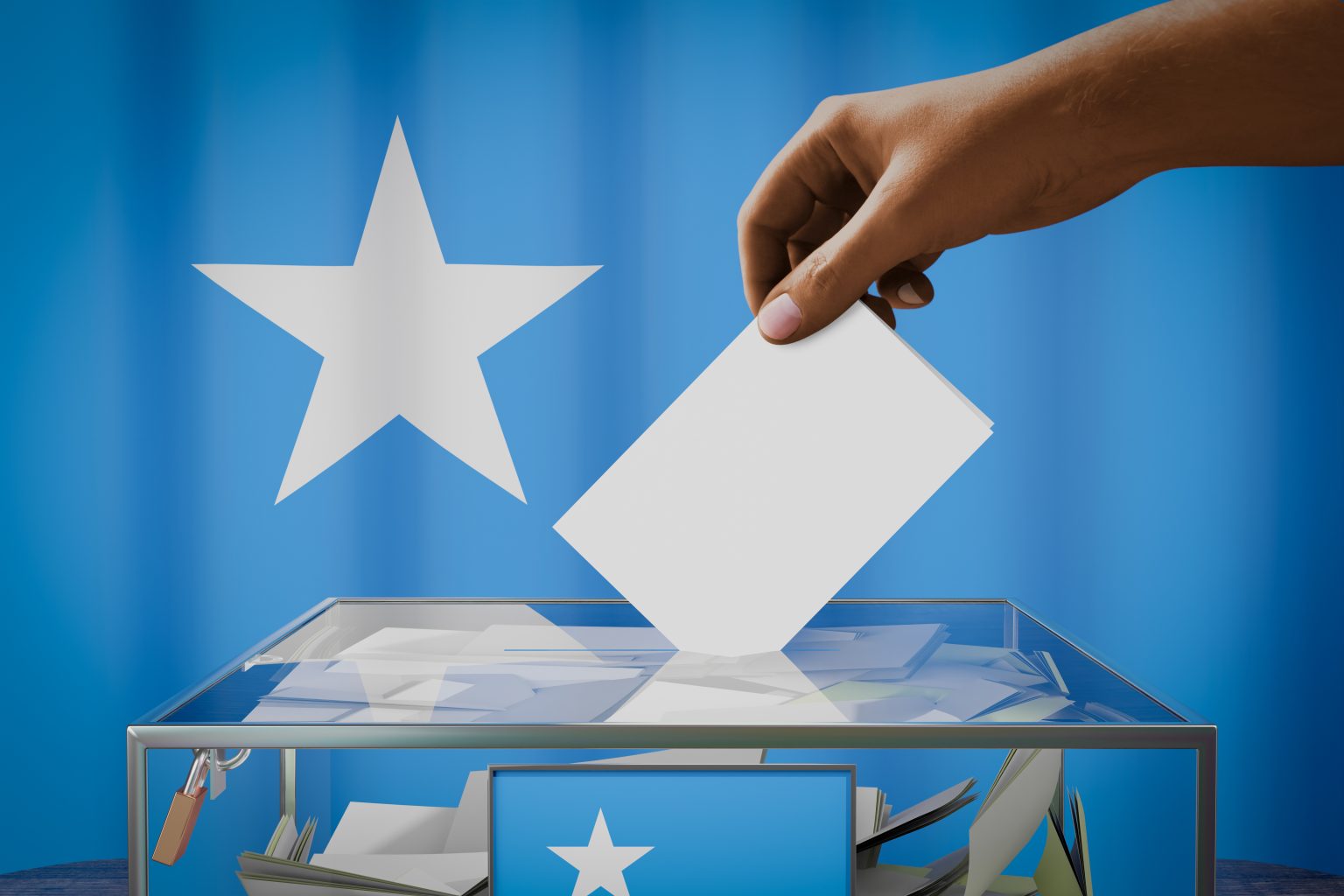
The Somali Federal Government continues to try to organize the country’s first direct elections in decades, viewing this step as fundamental to transitioning from the clan-based power-sharing formula toward a representative system grounded in direct suffrage. This trajectory, however, has encountered strong objections from influential opposition forces, alongside official warnings regarding funding shortfalls that could result in potential postponement. Consequently, the future of the electoral process remains contingent upon broader political consensus or external support capable of ensuring the completion of technical and logistical preparations. Despite these challenges, the government remains committed to this path, considering direct elections a gateway to strengthening state legitimacy and building institutions capable of transcending traditional clan structures. Nonetheless, profound disagreements over the provisional constitution and the overall political process continue to constitute a structural impediment to democratic progress, particularly with regard to advancing the legislative track needed to consolidate the constitutional framework and electoral system.
First: Procedural Complexities as Reflected in Municipal Elections
On 15 April 2025, Somalia’s National Independent Electoral and Boundaries Commission (NIEBC) launched the first phase of voter registration for municipal council elections, marking the first such initiative in nearly six decades. Registration commenced in Mogadishu as the inaugural station of the process, where the Shangani district witnessed notable citizen turnout, reflecting public readiness to shift from clan-based quota arrangements toward a more representative model of direct voting. The Commission’s Chairperson, Abdikarim Ahmed Hassan, confirmed that participation exceeded expectations, noting that all technical requirements had been met, including the adoption of biometric registration systems to ensure transparency and prevent duplication or manipulation. The Commission estimated that approximately 1.5 million citizens would be registered during the first phase, with projections rising to two million voters as the process expands to cover 16 of Somalia’s 18 regions, excluding Jubaland and Puntland, which had recently conducted municipal elections under their own systems. According to the electoral timetable, the first phase of registration extended over thirty days across four federal states, constituting an important test of the state’s capacity to entrench a more democratic local governance structure.
In August 2025, the Commission announced the completion of voter registration in Mogadishu (Benadir Region), with nearly one million citizens registered in preparation for the capital’s first municipal elections in decades—an outcome that reinforces decentralization efforts and broadens participation in local governance. Although 30 June 2025 had initially been set as the date for municipal elections, mounting technical and logistical pressures, along with tensions between the Federal Government and certain federal member states—particularly Puntland and Jubaland—led to postponement to 30 October 2025 as a preliminary date. Subsequently, municipal elections in Mogadishu were again delayed to 25 December 2025 instead of the previously scheduled 30 November, in response to the sharp increase in registered voters and the need to complete technical and administrative preparations. However, the elections were not held on the revised date, revealing persistent technical challenges and ongoing disputes between the Federal Government and the states over the electoral model and timing, in addition to pressures from political forces demanding a review of voter rolls and assurances regarding polling station readiness.
These developments highlight the fragility of the preparatory phase of the electoral process, which requires a higher degree of political consensus and enhanced organizational capacity to ensure the conduct of credible and inclusive local elections. A key challenge in this context remains the absence of an accurate national voter registry, given that the majority of citizens lack official identification documents and that no centralized database exists, rendering registration vulnerable to manipulation. Although the Electoral Commission has adopted modern digital systems, the initiative remains constrained by limited funding and technical support. Furthermore, the restructuring of the National Electoral Commission has exacerbated tensions, as opposition actors have perceived it as an attempt to strengthen executive influence in the absence of a clear legal framework governing the Commission’s mandate.
Within the framework of accelerated preparations for local elections in Mogadishu, Prime Minister Hamza Abdi Barre paid an official visit to the headquarters of the National Independent Electoral and Boundaries Commission on 16 November 2025, coinciding with the launch of voter card distribution for the capital’s first municipal elections in decades. The visit conveyed clear political backing for the electoral track, as the Prime Minister urged registered citizens to collect their voter cards and participate in voting as a constitutional right, while commending the organizational and security arrangements that had created a conducive environment for credible elections despite Mogadishu’s longstanding challenges. On 18 November, he chaired a high-level government meeting to review final preparations, reaffirming the government’s commitment to implementing the “one person, one vote” model, while the Commission renewed its call for urgent financial support to avert any further postponements.
According to Commission data, voter card distribution commenced in several districts, including Hamar Jabjab, Abdi Aziz, Shangani, Hamar Weyne, Bondhere, and Shibis, with 25 November 2025 designated as the deadline for submitting candidate lists. Commission Chairperson Abdikarim Ahmed Hassan confirmed the readiness of electoral materials and the completion of staff training and security protocols. Local elections are expected to take place between January and May 2026, beginning with Mogadishu and the Benadir Region, paving the way for the first direct presidential elections in more than fifty years, scheduled for May 2026. This trajectory represents a critical test of Somalia’s ability to manage an inclusive electoral process that institutionalizes transparency and supports the transition from clan-based power sharing to a political system grounded in direct popular participation.
Second: The Reconfiguration of Political Alliances
The political framework surrounding direct elections in Somalia constitutes a complex environment in which interests and alliances intersect. Within this context, President Hassan Sheikh Mohamud has revived the “one person, one vote” project that stalled under former President Mohamed Abdullahi “Farmaajo,” despite persistent security and political concerns linked to federal member states, clan structures, and deficiencies in institutional and logistical capacity. The political arena is witnessing the reconfiguration of alliances ahead of the parliamentary elections scheduled for May 2026, amid disputes with Puntland, Jubaland, and the Opposition Forum over constitutional amendments and the proposed shift toward a presidential system. In an effort to contain these tensions, the President launched the National Dialogue Forum (16–19 June 2025), aimed at strengthening national unity, supporting security, completing the constitution, and preparing for direct elections based on universal suffrage. Although several states and opposition alliances boycotted the forum, plans were made for a subsequent round in July 2025 with opposition participation through mediation efforts, reflecting attempts to rebuild trust and enhance political inclusivity. Nevertheless, the success of this track remains dependent on genuine political will and the government’s capacity to move beyond exclusionary practices and prioritize national interests over narrow considerations. Against this backdrop, multiple political alliances have emerged, divided over competing visions for the future of the electoral process, most notably the following:
1. The National Salvation Forum
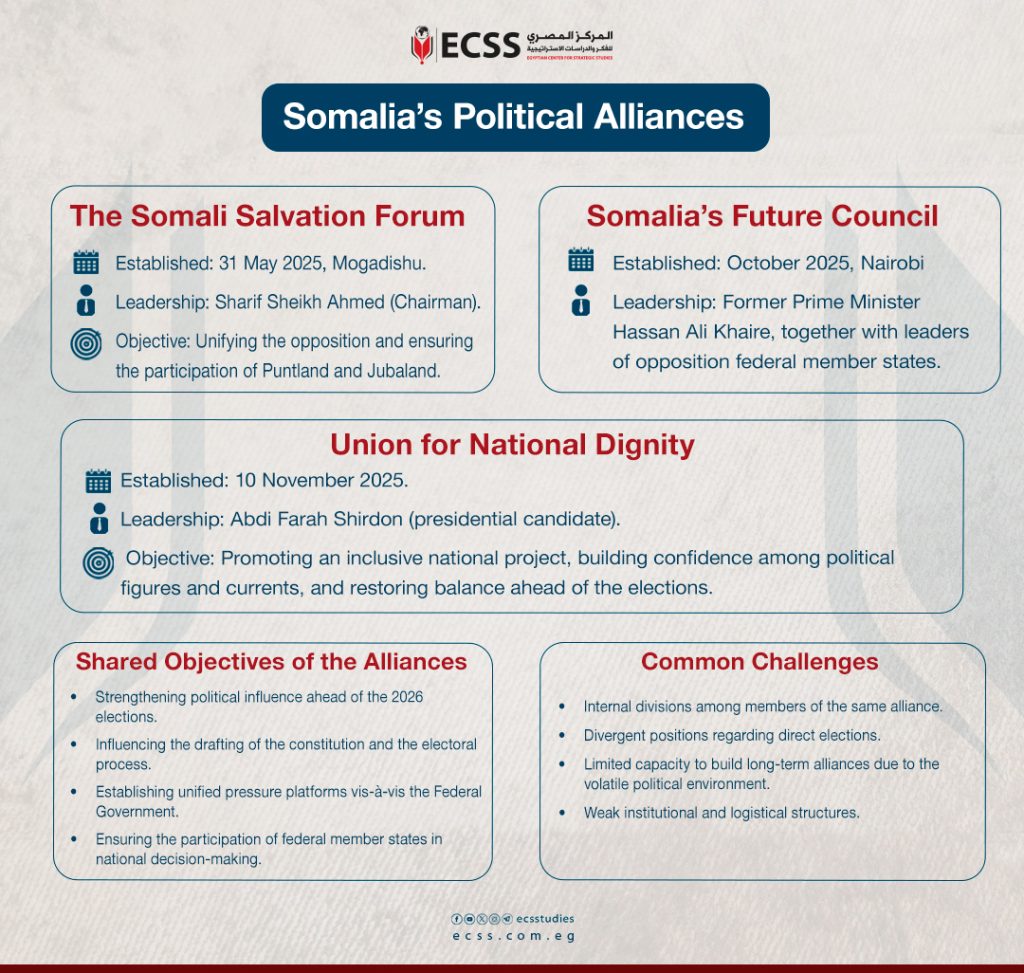
The Somali political landscape witnessed significant transformations with the establishment of the “Somali National Salvation Forum” on 31 May 2025, during a four-day expanded opposition conference held in Mogadishu. The Forum sought to bring together political, civil, clan, and youth leaders opposed to President Hassan Sheikh Mohamud and his newly established Justice and Solidarity Party. Former President Sharif Sheikh Ahmed was selected to lead the Forum, which aimed to form a unified front capable of counterbalancing the influence of the Federal Government and ensuring the participation of the Puntland and Jubaland states in any future political arrangements.
Despite attempts to build consensus, the Forum issued a statement on 23 July 2025 condemning the escalating violence in the town of Beled Hawo in Gedo Region, Jubaland, and called on the government to return to a path of reconciliation and state-building.
The National Salvation Forum, however, faced structural challenges that led to a decline in its influence. On 24 August 2025, several of its most prominent founders—including former Prime Minister Omar Abdirashid Ali Sharmarke, former parliamentary speakers Sharif Hassan Sheikh Aden and Mohamed Mursal Sheikh Abdirahman, and former Minister of Information Taher Mahmoud Gelle—announced their withdrawal in order to establish political parties in preparation for the elections. This move resulted in a significant internal split.
Subsequently, the Forum convened a series of sporadic meetings, including one on 31 August and another on 22 September 2025. During these sessions, the hardline faction renewed its criticism of the government and called for national consultations involving Puntland and Jubaland, as well as a review of constitutional reforms. In contrast, another faction signed an agreement with the government on 25 August to support the electoral process in exchange for oversight guarantees.
This internal fragmentation and the decline in coordination weakened the Forum’s ability to form a cohesive opposition, thereby strengthening the influence of the federal member states and enabling the Federal Government to advance parts of its reform agenda without organized resistance. Individual opposition positions continued intermittently until September 2025.
During that month, Puntland and Jubaland proposed resuming dialogue with the government, while the National Salvation Forum opted for escalation by calling for protests in Mogadishu. The government responded with warnings and accusations of “sabotage.” Despite several meetings—including one held in October 2025 between President Hassan Sheikh Mohamud and Jubaland President Ahmed Mohamed Islam “Madobe”—no breakthrough was achieved. This was largely due to ongoing disputes over the legitimacy of the 2024 Jubaland elections and Madobe’s demands to withdraw an arrest warrant and open a new chapter of federal cooperation. Parallel consultations were also held in Nairobi between Madobe and a Forum delegation in preparation for political dialogue.
2. The Somalia Future Council
In October 2025, Somali opposition leaders—including former Prime Minister Hassan Ali Khaire, Puntland President Said Abdullahi Deni, and Jubaland President Ahmed Mohamed Islam “Madobe”—announced the establishment of the “Somalia Future Council” during an expanded meeting held in Nairobi, Kenya. This announcement followed a series of intensive discussions addressing various pressing political issues in Somalia amid profound transformations in the country’s political landscape.
The Council aims to serve as a comprehensive platform for redrawing power balances in Somalia and forming a strong pressure bloc to push the Federal Government toward inclusive national dialogue, despite the potential of such a coalition to deepen political polarization between the central government and regional administrations.
In addition to former Prime Minister Hassan Ali Khaire, the meeting that led to the Council’s formation included former Prime Minister Saad Shirdon and MP Abdirahman Abdishakur from the opposition National Salvation Forum—an alliance comprising prominent political forces, some of which had defected from the National Salvation Forum—alongside the presidents of Puntland and Jubaland.
According to the founding statement, the Somalia Future Council is conceived as an inclusive body aimed at integrating opposition efforts with those of Puntland and Jubaland in shaping the contours of Somalia’s political transition. This reflects an attempt to unify opposition ranks, contribute to regulating constitutional and political transformations, and enhance joint representation in decision-making on critical national issues.
The Council’s principal outcomes focused on completing its organizational structure and defining its authorities, as well as calling for the convening of a comprehensive national conference inside Somalia to discuss the political transition process. The initiative seeks to exert pressure on the Federal Government to respond to the alliance’s demands and to encourage all Somalis to strengthen national unity and safeguard stability, while commending Kenya’s regional role in supporting peace efforts.
3. The Union for National Dignity
The Somali political scene witnessed a notable development with the establishment of the Union for National Dignity on 10 November 2025, as a new political bloc aimed at reshaping the balance of power ahead of the 2026 general elections. Former Prime Minister Abdi Farah Shirdon assumed the leadership of the alliance and emerged as a candidate for the upcoming presidential elections. The bloc brought together a group of prominent political figures, including former Minister of National Security and former President of the Galmudug Federal State Abdirakman Hussein Guled, former Minister of Public Works Abdi Adam Hoso, former intelligence chief Fahad Yasin, in addition to ministers and members of parliament representing a broad and balanced clan spectrum.
The alliance’s formation reflects a departure from traditional short-lived coalitions, as its founders announced their resignation from previous parties to engage in a comprehensive national project aimed at restoring confidence in state institutions and addressing internal divisions that have negatively affected economic performance and public services. Observers note that the alliance’s composition, with its broad influence in Mogadishu, may grant it the ability to assert a meaningful political presence, although the extent of its impact remains uncertain in an environment characterized by rapid shifts and fragile alliances.
The alliance’s leadership—particularly Abdirakman Hussein Guled—has emphasized that its objective is to build bridges of trust among political figures and currents participating in the electoral process, in contrast to previous alliances that were temporary and formed and dissolved during election cycles. Nevertheless, the alliance’s position on the direct election model scheduled for mid-2026 raises questions, as its leaders argue that the current framework lacks the necessary legal guarantees and does not enjoy comprehensive political consensus. This positions the alliance more as a pressure instrument on the Federal Government than as a coalition founded on a unified vision, particularly given the government’s adherence to the “one person, one vote” principle in contrast to opposition calls for a return to the indirect electoral system.
Despite the organizational and political capabilities of the National Prestige Alliance, its presidential candidate Shirdon remains in need of strengthening his popular and clan-based support to ensure genuine competitiveness. The emergence of the alliance nonetheless reflects the vitality of Somalia’s political landscape and the intensification of efforts to recalibrate power balances ahead of the 2026 elections, amid rising polarization and the growing involvement of Puntland and Jubaland in shaping forthcoming political transition pathways.