


By using ECSS site, you agree to the Privacy Policy and Terms of Use.
Accept
ECSS - Egyptian Center for Strategic StudiesECSS - Egyptian Center for Strategic Studies
  • Home
  • International Relations
    International Relations
    Show More
    Top News
    Egyptian-Greek Trade Relations to Prepare for the Next Step
    September 1, 2020
    Iran’s nuclear program: New contexts and possible scenarios
    April 17, 2021
    The Sino-Australian Rising Rivalry in the Indo-Pacific
    October 16, 2021
    Latest News
    Israel’s security and economic conundrum:How does Israel confront the challenges of a protracted war with Iran?
    May 2, 2026
    Reshaping the US position toward Israel: From the erosion of the old consensus to a new conflict across parties, state, and society
    April 23, 2026
    Israel’s African gambit
    March 6, 2026
    Geopolitical realism: What does Washington’s return to the African Sahel mean?
    March 5, 2026
  • Defense & Security
    Defense & Security
    Show More
    Top News
    Israel’s Cyber ​​Dome: Hallmarks and Motives
    Israel’s Cyber ​​Dome: Hallmarks and Motives
    August 15, 2022
    Water Disputes: Regulating Iran-Afghanistan Escalation over Helmand River
    June 13, 2023
    A Multi-dimensional Affair: Women and Terrorism in Africa
    June 14, 2020
    Latest News
    Between two camps: Reading into ISIS discourse on the US-Israeli war on Iran
    April 15, 2026
    Encrypted messages “Roaring Lion”: The hidden messages behind the name of the operation against Iran
    March 11, 2026
    Iran war developments
    March 9, 2026
    Manufacturing the enemy : Reframing terrorism in contemporary Western discourse
    March 7, 2026
  • Public Policy
    Public Policy
    Show More
    Top News
    Trade between Egypt and Nile Basin Countries
    April 22, 2021
    Volunteering in Egypt: Towards a Paradigm Shift
    March 15, 2022
    The domino effect: Global chip shortage crisis hits the Egyptian market
    June 5, 2021
    Latest News
    From global shock to Egypt’s economy: Analyzing the impact of the Iran war on energy security
    May 3, 2026
    Egypt as a balancing power: Why Cairo rejects the logic of wars in the Middle East
    April 30, 2026
    Militarizing water in Middle East wars A strategic analysis of the Iran-US-Israel war
    April 18, 2026
    Reading into attacks on maritime navigation in the Arabian Gulf
    March 17, 2026
  • Analysis
    • Opinion
    • Analysis
    • Situation Assessment
    • Readings
  • Activities
    • Conferences
    • ECSS Agenda
    • Panel Discussion
    • Seminar
    • Workshops
  • ECSS Shop
  • العربية
  • Defense & Security
  • International Relations
  • Public Policy
All Rights Reserved to ECSS © 2022,
Reading: Challenges to World Development in 2022
Share
Notification Show More
Latest News
From global shock to Egypt’s economy: Analyzing the impact of the Iran war on energy security
Economic & Energy Studies
Israel’s security and economic conundrum:How does Israel confront the challenges of a protracted war with Iran?
Palestinian & Israeli Studies Research Programs
Egypt as a balancing power: Why Cairo rejects the logic of wars in the Middle East
Media Studies
Reshaping the US position toward Israel: From the erosion of the old consensus to a new conflict across parties, state, and society
American Studies
Militarizing water in Middle East wars A strategic analysis of the Iran-US-Israel war
Economic & Energy Studies
Aa
ECSS - Egyptian Center for Strategic StudiesECSS - Egyptian Center for Strategic Studies
Aa
  • اللغة العربية
  • International Relations
  • Defense & Security
  • Special Edition
  • Public Policy
  • Analysis
  • Activities & Events
  • Home
  • اللغة العربية
  • Categories
    • International Relations
    • Defense & Security
    • Public Policy
    • Analysis
    • Special Edition
    • Activities & Events
    • Opinions Articles
  • Bookmarks
Follow US
  • Advertise
All Rights Reserved to ECSS © 2022, Powered by EgyptYo Business Services.
Public Policy

Challenges to World Development in 2022

Sally Ashour
Last updated: 2022/11/02 at 10:10 PM
Sally Ashour
Share
7 Min Read
SHARE

The World Bank has released its latest report on world development entitled “World Development Report 2022: Finance for an Equitable Recovery”, which looks into the central role of financing in the economic recovery from the Covid-19 pandemic which gave rise to the greatest economic crisis the world has witnessed in over a century. 

Contents
Figure 1: Loss of income by country income groupFigure 2: Changes in non-performing loan ratios, by country income group, 2020-2021Figure 3: Quarterly trends in credit conditions, by country income group, 2018-2021Figure 4: Change in general government gross debt, by country income group, 2010-2020

In 2020, about 90 percent of countries recorded a contraction in economic activity by about three percent, the global poverty rate soared, and governments adopted policies that would mitigate the economic consequences of the pandemic. However, governments’ responses brought about several economic vulnerabilities. The development report sheds light on four of the pressing risks arising from the pandemic, including the mounting non-performing loans, the delayed settlement of critical loans, credit crunch, and higher sovereign debt. 

I- Covid-19 and Emerging Economic Risks to Recovery

The Covid-19 pandemic has had knock-on effects on all economies, which prompted governments to launch economic programs that have proved effective in the short term. Nevertheless, this emergency response by governments gave rise to new risks, including the public and private over-indebtedness and a global rise in poverty and inequality rates, with greater income losses among youth, women, and the self-employed and seasonal employment of low-educated workers. Women were particularly affected by the loss of income and employment because they were more likely to be employed in sectors that were more affected by lockdown and social distancing measures.

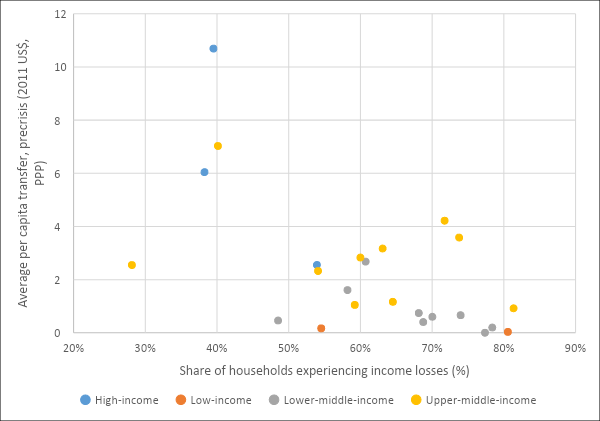
Data indicates that more than 50 percent of households in emerging and advanced economies have not been able to sustain basic consumption for more than three months in the event of income losses. Figure 1 shows income losses during the pandemic by country income group.

Figure 1: Loss of income by country income group
Similar patterns of income loss exist among businesses. Smaller businesses, informal businesses, and businesses with limited access to the formal credit market have been severely affected by income losses caused by the pandemic. Larger firms, though, have weathered the crisis as they had the ability to cover their expenses for up to 65 days, compared to 59, 53, and 50 days for medium-sized, small, microenterprises businesses, respectively.

II- Covid-19 and Risks Facing Bank Balance Sheets

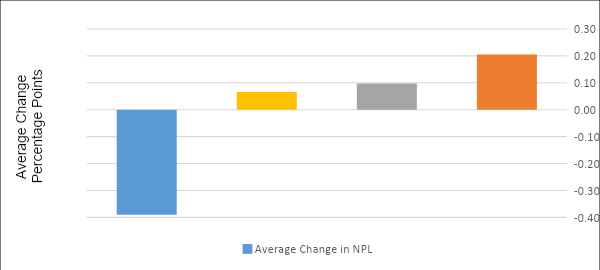
The pandemic affected debt repayment rates, with banks recording the highest rates of repayment deferrals as part of the measures introduced to alleviate the direct economic pressure that households and firms have come under during the pandemic. The following figure shows the changes in non-performing loan ratios, by country income group, over the years 2020-2021.

Figure 2: Changes in non-performing loan ratios, by country income group, 2020-2021
III- Restructuring Firm and Household Debt

According to the World Bank data, in countries with a normal bankruptcy system, it takes an average of more than two years to resolve a company’s bankruptcy case. Complex liquidations may take longer in case of an increase in over-indebtedness, even with efficient judiciary. Amid absence of effective legal mechanisms to declare bankruptcy or resolve creditor-debtor disputes, political interference in the credit market may be required. As such, improving the institutional capacity to manage insolvency becomes critical for equitable economic recovery for several reasons pertaining to the increased access to credit, faster creditor recovery, stronger job preservation, higher productivity, and lower failure rates for small businesses.

IV- Lending during Recovery and Beyond

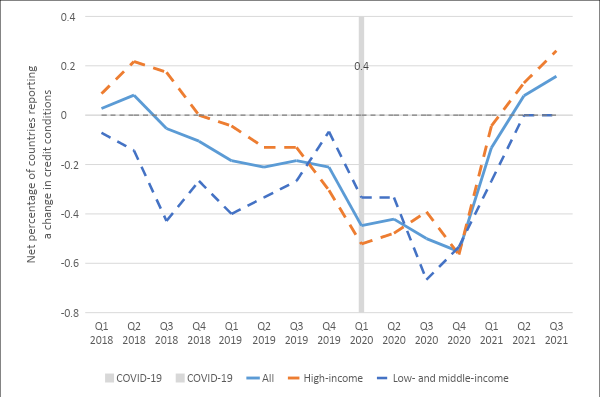
The ongoing impact of the Covid-19 on business performance and household incomes could inhibit new lending because of the increased credit risk. However, credit can be kept flowing by better visibility into borrower viability and improved recourse in the event of default, along with innovations in digital finance and reassessment of credit models to take into account the “new post-pandemic normal”. Additionally, regulatory frameworks that enable innovation can support credit in the recovery period while ensuring consumer and market protections.

Figure 3: Quarterly trends in credit conditions, by country income group, 2018-2021
V- Managing Sovereign Debt 

Covid-19 forced emerging and developing economies to expand their sovereign debt to record highs in an effort to mitigate the economic consequences of the crisis on households and their local economies. This contributed to an increase in the average total debt burdens among low- and middle-income countries by about nine percent of GDP during 2020, relative to an annual increase of 1.9 percent of GDP per year over the previous decade as is shown in figure 4.

Figure 4: Change in general government gross debt, by country income group, 2010-2020
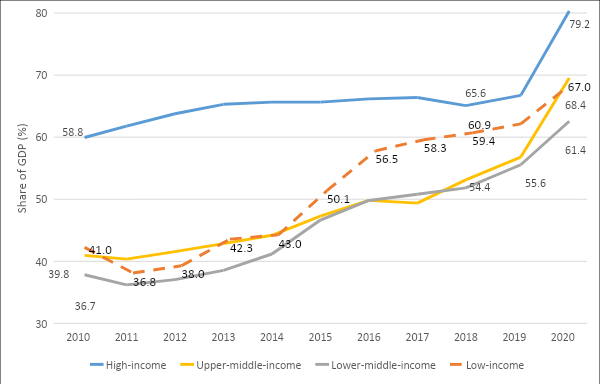
The accumulation of sovereign debt poses significant risks to the global economic recovery, as debt-ridden governments fail to spend on public utilities, such as education and health care services, which would aggravate inequality and the human development outcomes. Further, countries in debt distress have limited capacities to deal with future shocks and may be unable to become the lender of last resort to private sector firms in need of public assistance.

In short, the Covid-19 crisis has exacerbated the economic risks facing countries. However, it offers a great opportunity to accelerate the shift towards a more efficient and sustainable global economy. In addition to the pandemic, there is climate change, a global phenomenon that has more severe impacts on low-income countries by exacerbating the existing vulnerabilities in these countries, such as the lack of access to clean water, low crop yields, food insecurity, and unsafe housing.

Related Posts

From global shock to Egypt’s economy: Analyzing the impact of the Iran war on energy security

Egypt as a balancing power: Why Cairo rejects the logic of wars in the Middle East

Militarizing water in Middle East wars A strategic analysis of the Iran-US-Israel war

Reading into attacks on maritime navigation in the Arabian Gulf

TAGGED: COVID-19, Development, Featured, risks, World
Sally Ashour April 5, 2022
Share this Article
Facebook Twitter Whatsapp Whatsapp LinkedIn Telegram Email Copy Link Print

Stay Connected

Facebook Like
Twitter Follow
Instagram Follow
Youtube Subscribe

Latest Articles

Observations before the Launch of the National Dialogue
Opinions Articles June 26, 2022
Shadow War: How Will the Iran-Israel Conflict Unfold Next?
Opinion August 15, 2024
Dimensions and Implications of the Tunisian-Moroccan Diplomatic Crisis
International Relations October 5, 2022
Parliamentary elections 2020: Boosting stability and a launching point
Public Policy May 27, 2021

Latest Tweets

//

The Egyptian Center for Strategic Studies is an independent non-profit think tank providing decision-makers by Policy alternatives, the center was established in 2018 and comprises a group of experts and researchers from different generations and scientific disciplines.

International Relations

  • African Studies
  • American Studies
  • Arab & Regional Studies
  • Asian Studies
  • European Studies
  • Palestinian & Israeli Studies

Defence & Security

  • Armament
  • Cyber Security
  • Extremism
  • Terrorism & Armed Conflict

Public Policies

  • Development & Society
  • Economic & Energy Studies
  • Egypt & World Stats
  • Media Studies
  • Public Opinion
  • Women & Family Studies

Who we are

The Egyptian Center for Strategic Studies (ECSS) is an independent Egyptian think tank established in 2018. The Center adopts a national, scientific perspective in examining strategic issues and challenges at the local, regional, and international levels, particularly those related to Egypt’s national security and core national interests.

The Center’s output is geared toward addressing national priorities, offering anticipatory visions for policy and decision alternatives, and enhancing awareness of various transformations through diverse forms of scientific production and research activities.

All Rights Reserved to Egyptian Center for Strategic Studies - ECSS © 2023

Removed from reading list

Undo
Welcome Back!

Sign in to your account

Lost your password?