


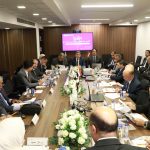


The Libya Stabilisation Initiative Conference that Tripoli hosted last week added little substance to the outputs of the first and second Berlin conferences on Libya.
The focus was primarily on questions of national sovereignty, the forthcoming elections, removing foreign mercenaries from the country and other matters critical to the success of the current interim period. However, there is no denying that the conference was of symbolic importance. It was the first international conference on the Libya crisis to be held in Libya and it drew a high level of regional and international attendance.
A noticeable exception to this were Russia and Turkey, whose presence was weak to non-existent. Perhaps this was to be expected, as these two countries were mainly responsible for introducing the foreign mercenaries in question and have since ignored their responsibilities in this regard. In the Berlin-2 Conference on Libya, in June 2021, Ankara lodged a reservation on the fifth point of the conference’s conclusions which stated, “All foreign forces and mercenaries need to be withdrawn from Libya without delay, and the security sector reformed and placed firmly under unified, civilian authority and oversight.” Moscow at the time voiced no objections in principle but it was concerned that the withdrawal of foreign forces should be coordinated to ensure reciprocal reductions. The Russian and Turkish presidents met subsequently in Sochi, on 29 September 2021, to discuss coordinating on Libya, where they support opposing sides.
Nevertheless, Turkey and Russia have made little if any practical progress on this matter, although pressure is building up on them. Evidence of this can be found in the strongly worded point of the conference’s final communiqué rejecting foreign interference in Libya and attempts to violate the arms embargo and foment chaos. In addition, Under-Secretary-General for Political and Peacebuilding Affairs Rosemary Dicarlo told conference participants that the first group of the UN team to support the Libyan ceasefire monitoring mechanism had arrived. The team is also there to help support 5+5 Joint Military Commission (JMC) in implementing the plan for the withdrawal of foreign fighters. In her speech, Dicarlo alluded to the JMC’s “Action Plan for the gradual, balanced, sequenced and synchronised withdrawal of all mercenaries, foreign fighters, and foreign forces.” The actual processes and mechanisms have yet to be finalised. The JMC met in Geneva on 6-7 October and then met with the Chairman of the Presidency Council Mohammed Al-Manfi and Prime Minister Abdel-Hamid Dbeibah on the fringe of last week’s conference.
Some of Libya’s neighbours have voiced reservations regarding the removal of foreign fighters and mercenaries from Libya. Chad, in particular, is worried because Chadian rebels have been operating on Libyan territory and N’Djamena does not want them back in Chad. Chad’s as well as Niger’s concerns draw attention to other dimensions of the question of foreign fighters in Libya. Perhaps one such concern that has more directly to do with the east versus west aspect of the Libyan crisis is the relationship of this question to the Libyan militias which most foreign fighters were introduced to support.
Given the need to support stabilisation and security ahead of the elections, it is surprising that the 5+5 commission has focused so exclusively on foreign fighters and mercenaries, opting to defer the question of the local militias until after elections in the framework of “reform of the military and security apparatus”. Apart from the choice of terminology “reform”, which seems an attempt to tiptoe around the actual Libyan need to unify the military establishment, there are genuine concerns over how the militias might try to influence the elections. Some observers have argued that the militias could pose more of a threat to the electoral process than the foreign fighters. After all, the militias are governed by domestic political and economic factors and considerations of the domestic balance of power. In some scenarios, they could serve as a potential powder keg for factions fearful that the elections would not work in their favour.
The Libya Stabilisation Initiative Conference met with some scepticism among politicians in eastern Libya. Many saw the event as a propaganda tool for Prime Minister Dbeibah who is a possible contender in the forthcoming presidential elections. Others remarked on the absence of prominent representatives from Cyrenaica while yet others worried that political forces in western Tripolitania were scheming to side-line the eastern based House of Representatives on crucial issues, like the foreign fighters and mercenaries.
Interestingly, the day before the conference convened, there were reports of a dispute among organisers over whether or not to mention the date of elections which the interim roadmap has scheduled for 24 December. Critics of the conference cited this as the sign of an attempt to postpone the polls. In the end, the communiqué stressed “the importance of taking the necessary measures to build confidence and create an appropriate environment for holding the Libyan national elections in a fair, transparent and inclusive manner on 24 December.” Some believe that the rubric on confidence building measures and an appropriate environment were added as a kind of compromise solution. Others suggest that the date was included in the final draft of the communiqué under pressure of conference participants. It is believed that Al-Manfi played a central role in resolving the dispute after having met with the High National Election Commission (HNEC) and discussed various technical aspects with it. Al-Manfi has been described as the weight that keeps the scales balanced at this crucial juncture.
It should be noted in this regard that the controversy over the constitutional basis for the elections and the debate over whether or not to hold a referendum on the constitution before the elections have now been overshadowed by the High Council of State’s opposition to the electoral law adopted by the House of Representatives. For months, the Libyan Political Dialogue Forum (LPDF) had been deadlocked on the question of the constitutional basis of the elections, despite the attempts of the bridging committee to promote a compromise solution. Eventually, the House of Representatives acted resolutely and passed the necessary legislation so that the HNEC could proceed with preparations for the polls. The UN Support Mission in Libya (UNSMIL) breathed a sigh of relief at the House’s resolve and was disinclined to indulge more cycles of controversy when the Tripoli based High Council of State (HCS) and its representatives on the LPDF raised objections to the law on assorted procedural grounds. Like most other international and regional stakeholders, UNSMIL is determined that the elections should proceed on schedule. While it has been the first to foster dialogue, it is also aware there must come a time when debate needs to give way to action.
French Foreign Minister Jean-Yves Le Drian took advantage of the Libyan conference to promote the Paris Conference in November. It is unclear what difference the conference is intended to make, apart from building up further momentum behind the aims of Berlin 1 and 2 and, now, the Stabilisation Initiative Conference. Perhaps it will focus on problems that might hamper the successful completion of the interim phase, such as lack of substantial progress in the withdrawal of mercenaries and foreign fighters. Or perhaps it will work on staging: smoothing over certain problems and ensure elections proceed on schedule so as to produce a new governmental authority and formally end the interim phase, even if the hope for stability remains elusive.
Ultimately, the Libya Stabilisation Initiative Conference was probably given a title bigger than it could live up to. In all events, the test will start soon, when registration for presidential and parliamentary elections opens next month.


