







Tensions between Russia and Ukraine escalated in recent months upon Russia’s mobilization of thousands of troops on the Ukrainian border, which gave rise to an international crisis and fears of a possible Russian invasion of Ukraine.
Even as situated thousands of kilometers away from Ukraine with no geographical boundaries dividing between them, Egypt isn’t in isolation from these tensions and may, directly or indirectly, be affected by the existing disputes, being the world’s largest importer of wheat and an importer of oil, let alone its surplus of natural gas that plays a pivotal role in the Ukraine crisis. Against this, this analytical article tackles the repercussions of the Ukraine crisis on the Egyptian economy.
Impacts of Disruption of Energy Supply
The geopolitical crisis between Moscow and Kiev has cast a pall over the already high-energy prices due to growing concerns over the possibility that Russia’s potential invasion of Ukraine could result in imposing sanctions on Russia by the United States and Europe and disruption of energy supplies by the world’s second largest energy producer. This comes in tandem with global supply-demand imbalances due to easing of Covid-19 precautionary measures and the return of life to normalcy, after periods of limited supply and disruption of supply chains during the pandemic, which led to an increase in the prices of Brent and WTI crude oil as is shown in figure 1.
Figure 1: Weekly prices of Brent and WTI crude oil

As is indicated in figure 1, during the week ending 11 February, WTI crude prices rose hitting $90.61 a barrel, i.e. a 1.12 percent rise on a weekly basis. On the other hand, prices of Brent crude jumped by about 3.9 percent recoding $96.43 a barrel, both rises are the highest levels recorded weekly over the review period. This surge in oil prices may have the following consequences for the Egyptian economy:
- Widening Deficit of Oil Trade Balance: Despite Egypt’s successive oil discoveries, it still depends on abroad to meet its oil needs due to the widening gap between domestic supply and demand, which makes it a net importer of oil. Figure 2 shows the gap between oil production and consumption in a decade (2010-2020).
Figure 2: Oil production and consumption gap

The previous figure reveals the persistent gap in oil consumption, amounting to about 43,000 barrels per day in 2020, up from 24,000 barrels per day in 2010, i.e. an increase of 79.1 percent within 10 years. Accordingly, Egypt’s oil trade balance suffers a serious deficit as shown in figure 3.
Figure 3: Egypt’s Oil Exports and Imports

Figure 3 shows that, by the end of the fiscal year 2020-2021, petroleum imports exceeded petroleum exports with a difference of about $6.7 million, compared to a surplus in oil balance of about $2.87 billion in the fiscal year 2010-2011 .
Given the oil production-consumption gap and Egypt’s reliance on oil imports, the oil trade balance deficit is projected to grow in the coming period affected by the rise in oil prices, which may have a bearing on Egypt’s cash reserve and the value of the Egyptian pound against the US dollar.
- Pressuring the Budget: In the 2021-2022 draft budget, Egypt allocated EGP 18.41 billion for petroleum products subsidies, down from EGP 28.1 billion the previous year. Petroleum subsidies were calculated on the basis of average barrel price of $62. Thus, an increase of $1 in the price of an oil barrel over the price set in the budget would result in an increase in allocations of petroleum subsidies by about EGP 3-4 billion.
As such, if, as global forecasts indicate, Brent crude prices rose to about $100 per barrel, this will place new demands on the budget, ranging between EGP 114-152 billion (the price differential between the expected $100 per barrel and the $62 per barrel set in the budget is $38 a barrel, multiplying it by EGP 3-4 billion would make a total of EGP 114-152 billion). As a result, higher oil prices could place pressure on expenditure on this item, giving rise to an increase of the budget cash deficit.
- High Revenues of the Suez Canal: Over the last year, the Suez Canal achieved phenomenal performance, hitting its highest annual revenue and largest net tonnage. During the fourth quarter of the 2020-2021 fiscal year, Suez Canal transit fees increased to record $1.56 billion, up from $1.45 billion over the previous quarter and $1.34 billion in the fourth quarter of the 2019-2020 fiscal year, as is shown in the below figure.
Figure 4: The change in Suez Canal transit fees (billion dollars)

The solid performance of the Suez Canal over the past year can be partially attributed to the rise in oil prices, which contributes to enhancing the competitive advantage of the Canal and prompted vessels to leave aside other alternative routes that are more costly and fuel consuming, such as the Cape of Good Hope. As such, a further rise in oil prices will indirectly bring about an increase in the revenues of the Suez Canal, which would help compensate for the drawdown of cash reserves that may deplete due to the increase in the fuel import bill as mentioned earlier.
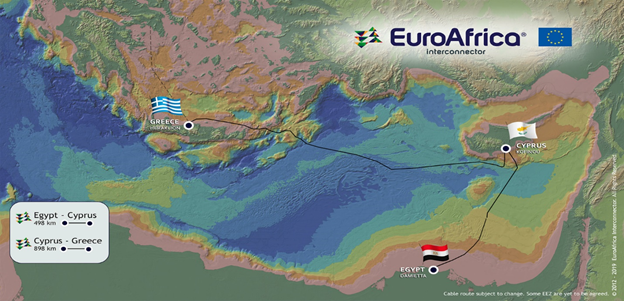
- Strengthening Egypt’s Position as a Regional Energy Hub: This could be one of the positive repercussions of the current crisis, with Egypt standing out as a reliable strategic partner for Europe. In this vein, Cairo broke off negotiations with European countries to sell electricity in excess of its strategic reserve, estimated at about 25 percent of its total electricity production and signed two agreements last October for electricity interconnection, the first was with Greece and the second with Cyprus, as part of the EuroAfrica project, connecting the national electricity grids of Egypt, Cyprus and Greece, with investments of $4 billion, to generate 2,000MW of electricity for Europe, that could be increased to 3000 MW. The following map shows the route of the EuroAfrica Interconnector Project:
EuroAfrica Interconnector Project path
Food Crisis Reverberations
Russia, Ukraine, and Romania are among the largest exporters of grain, especially wheat. They export grains to all countries of the world, including Egypt through the Black Sea ports that may suffer disruptions in supply chains as a result of any military action or economic sanctions. This will have a negative impact on the local economy due to the diminishing supply of goods and the price increases. Negative repercussions of the global food crisis on the Egyptian economy can be identified as follows:
- Rising Food Import Bill: Egypt relies on Russian and Ukrainian imports to secure its food needs, particularly wheat, given the widening gap between demand and local production. Data of the World Bank indicates that Egypt’s food imports account for 20.7 percent of total merchandise imports. Therefore, the rise in food prices may increase the non-oil trade balance deficit amounting to $42.1 billion the last fiscal year. The increase in the import bill will weigh heavily on Egypt’s cash reserve.
- Missing the Budget Reduction Targets: In the 2021-2022 draft budget, the price for imported wheat was valued at $255 per ton, relative to $193.8 per ton during the previous fiscal year 2020-2021, i.e. an increase of $61.2, as shown in the figure 6.
Figure 5: World wheat price estimates in the general budget

The difference between the increase in the actual price of wheat and its estimated price in the draft budget is expected to translate into an increase in the fiscal deficit, amid difficulties of bringing the total deficit to 6.6 percent of GDP as targeted, as the government targets purchasing 8.61 million tons of wheat, 5.11 million of which will be imported.
- High Inflation Rates: Food and beverages accounts for 35.87 percent of Egypt’s consumer price index (CPI). Therefore, a global rise in food prices will likely affect local food prices, based on the principle of “imported inflation” that arises due to the country’s dependence on imported goods and services. The following figure shows the development of the food and beverage index over the past year in Egypt.
Figure 6: Monthly change in food and beverage index, 2021

The above figure shows an increase in the prices of food and beverage by 11.15 percent over 12 months, rising from 97.7 points in January to 108.6 points in December.
Proactively, the Egyptian government endeavoured to overcome the rise in global market prices –a crisis that loomed in the horizon even before the outbreak of the Ukraine crisis– by diversifying sources of supply, encouraging farmers to increase the wheat-cultivated area, and setting the price of the local wheat supply before planting. Additionally, the government engaged in talks with Citigroup towards reaching a deal on hedging against global wheat-price increases. Furthermore, the national agricultural projects such as the New Delta and the Silos project contributed to providing Egypt with stockpile of wheat sufficient for five months to come.
In sum, the energy and food crises arising from the political events may reflect on the Egyptian economy in two ways, namely increasing the trade balance deficit and the state’s general budget deficit, noting that the trade balance deficit may give rise to two positive outcomes, i.e. strengthening the Suez Canal position and optimizing Egypt’s plan towards becoming a regional energy hub.