



Introduction
Egyptian intellectual production surrounding the 1973 October War was not limited to political articles, military analyses, and literary writings. It also included satirical works that expressed prevailing attitudes toward the war and its developments. Satire assumed particular significance during this period because it was closely linked to the daily events of the battle, engaging with news reports, statements, and political and military positions as they unfolded. These were transformed into texts and images whose significance extended beyond the humorous dimension to convey the psychological and political attitudes of Egyptian society, portraying a realistic picture of what stirred within it and lay deep in its consciousness. Such works also constituted an important source for documenting significant aspects of the war.
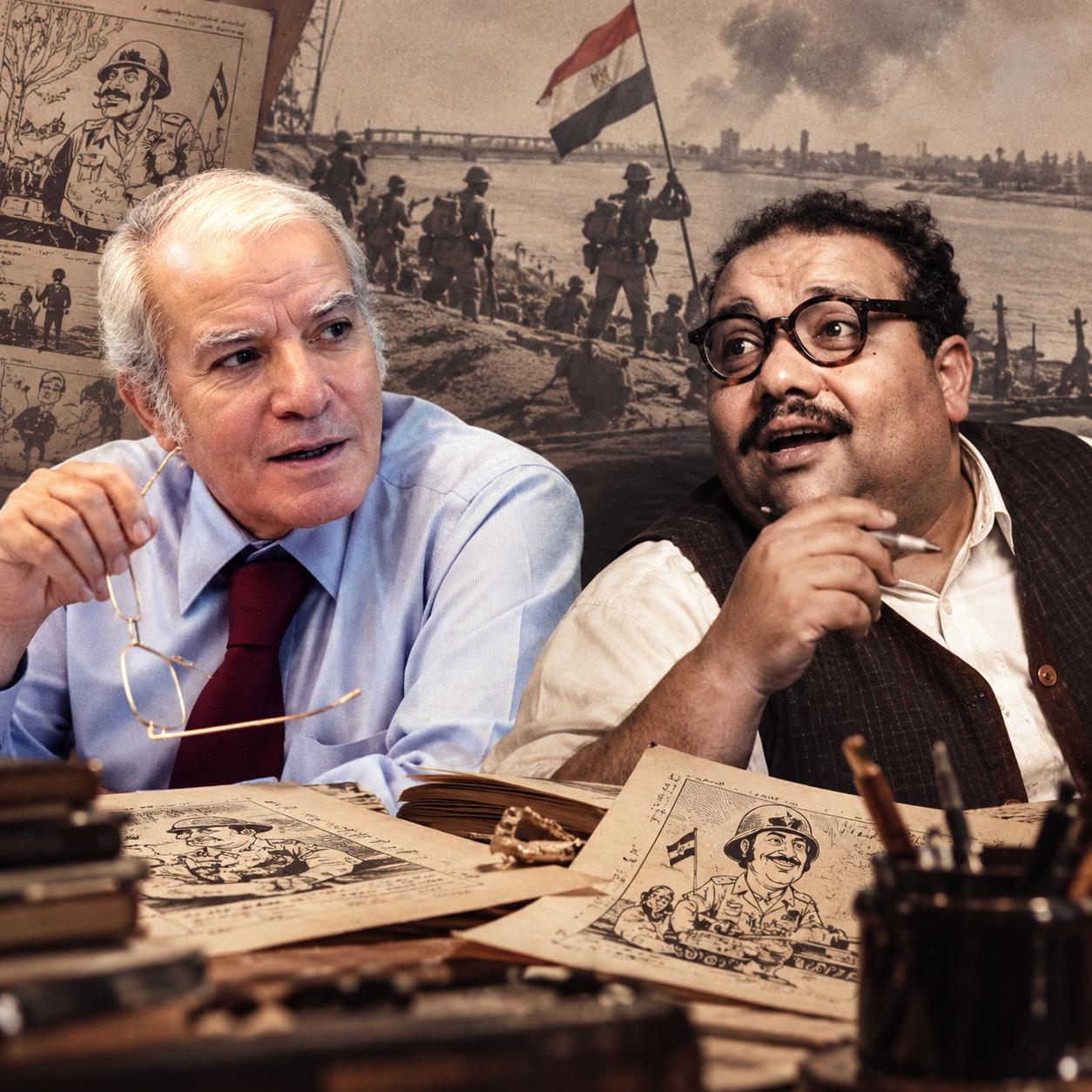
The works produced by Ahmed Ragab in Al-Akhbar, and the cartoons created by Salah Jahin in Al-Ahram during the days of the war, reveal two approaches that differed in medium but were similar in function. Ragab relied on words, linguistic irony, and political jokes, while Jahin relied on caricature and visual irony. Both, however, shared a tendency to mock the Israeli army and its leaders, express the growing Egyptian confidence that emerged as the war developed, and criticize certain international positions related to the conflict.
First: Satirical Journalism and Its Role in Psychological Warfare
The Concept of Satirical Journalism
Satirical journalism is a form of journalistic writing that relies on satire, irony, and humor to address various issues in a manner that combines entertainment with usefulness. Satirical journalism is distinguished by its ability to reach a broad segment of readers, given its connection to the emotional and human dimensions. It takes various forms, including satirical articles, caricature, colloquial poetry, short stories, and other forms of expression that convey critical and awareness-raising messages. A number of Egyptian writers and artists have excelled in this field throughout modern history.
The Role of Satirical Journalism in Psychological Warfare
Satirical journalism plays a vital role in psychological warfare through several functions:
- Boosting morale: Satirical works help alleviate the tension and fear associated with wars, instill a sense of optimism and strength among the public, and affirm the nation’s ability to confront challenges.
- Providing constructive criticism: Satirical journalism creates space for criticizing negative conditions or shortcomings, where they exist, through an indirect approach characterized by flexibility and wit, making such criticism more acceptable to officials and the public alike.
- Exposing the enemy: Satire is used as a tool to expose the enemy’s weaknesses and depict its defeat, portraying it in a caricatured manner that diminishes its prestige and reveals its true nature, thereby contributing to strengthening the resolve of soldiers and the public.
- Documenting events: Satirical works constitute an important historical record that reflects people’s sentiments and attitudes toward momentous events. They also convey human and social dimensions that go beyond those presented in conventional news reports.
Historical Context of Satirical Journalism before the October War
The period preceding the 1973 October War was marked by difficult psychological conditions in Egypt and the Arab world following the 1967 setback. During this period, the position of the satirical press fluctuated between frustration and despair on the one hand, and hope and optimism on the other. With President Anwar Sadat assuming office, however, signs began to emerge of a shift in the strategy for dealing with the conflict. Optimistic tones began to appear in the press, calling for patience and preparedness. In this context, the works of Ahmed Ragab and Salah Jahin played a prominent role in transforming the state of despair that followed the setback into one of hope and determination to restore dignity.
Second: Ahmed Ragab’s Half a Word: Recording Egyptians’ Joy and Schadenfreude toward Israel
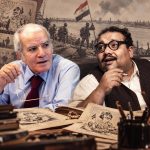
Ahmed Ragab was distinguished by a unique satirical style and an exceptional ability to address readers in simple language close to their hearts, infused with a generous dose of humor and biting satire. Ragab became renowned for his daily column, Half a Word, in the Egyptian newspaper Al-Akhbar. During the October War, the column evolved from a platform for satirical social and political criticism into a source of moral support and a fervent expression of national sentiment in support of soldiers on the front. Through the column, Ragab successfully conveyed powerful patriotic messages, bolstered the morale of the soldiers, and directed scathing messages at the enemy.
Ahmed Ragab relied on a range of satirical terms and expressions that became tools for articulating Egyptian patriotic sentiments and directing criticism at Israel and its military and political leadership. Foremost among these was the expression “My Brother on the Battlefield,” which conveyed the unity of the people and the army and the solidarity between the home front and the combatants. He also repeatedly used the word “Confidence” and the chant “Allahu Akbar” as symbols of confidence in victory and moral support.
In confronting the enemy, Ragab used satirical expressions such as “a bloody gang” and “mangy wolves.” He also described Moshe Dayan as “the last Israeli currency struck in Sinai,” turning him into a satirical symbol of defeat. He likewise employed wordplay in expressions such as “prisoners” and “Isra-eel,” as well as “Egypt exports cotton and imports prisoners,” transforming Israeli captivity and defeats into material for popular humor.
Among his other prominent techniques was the manipulation of names and terms, such as “Aharon / Ah… Qaharona” (“Oh… they have defeated us”), “Sam / Sam 6,” and “Santos / Sam-tos.” He also turned “Deversoir” into a satirical symbol of Israeli losses, used the expression “a fake wedding procession” to describe the propaganda surrounding the gap, and referred to Israeli radio as the “Israeli Rumor-Mongering House.”
Taken together, these expressions reveal Ragab’s reliance on irony, wordplay, the satirical reversal of meaning, and popular language to transform symbols of Israeli power into objects of ridicule, while simultaneously reinforcing Egyptian national self-confidence and consolidating the image of the Egyptian soldier as a symbol of strength, heroism, and victory. The following section examines Ahmed Ragab’s contributions to Half a Word during the 1973 October War.
1. October 7, 1973: A Message of Moral Support
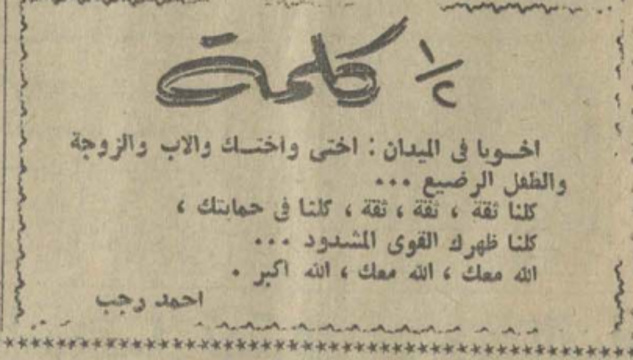
On October 7, Ahmed Ragab wrote under the title “My Brother on the Battlefield,” addressing the Egyptian soldier in a style that reflected the profound bond between the people and the army. He wrote:
“My brother on the battlefield: My sister and your sister, the father and the wife, the infant child… We are all confident, confident, confident. We are all under your protection; we are all your strong, steadfast support… God is with you. God is with you. Allahu Akbar.”
This text carries several profound psychological and patriotic connotations. It expresses the solidarity between the people and the army by portraying the entire population — men, women, and children — as standing behind the soldier and representing his strong support. The repetition of the word “confident” three times underscores certainty of victory and reinforces the soldier’s morale. Concluding the article with “God is with you. Allahu Akbar” lends it a spiritual and religious dimension that strengthens faith in God and confidence in victory.
2. October 8, 1973: Secrecy and National Security
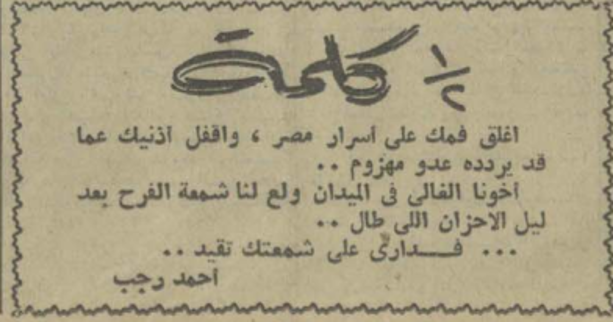
In this article, Ragab called for maintaining secrecy and refraining from discussing the secrets of the war. He wrote: “Keep your mouth shut about Egypt’s secrets, and close your ears to whatever a defeated enemy may repeat… Our dear brother on the battlefield has lit for us the candle of joy after a long night of sorrow… So guard your candle and keep it burning.” The article combines a warning against the dangers of information leaks, a call to maintain secrecy, and an expression of joy at the army’s victories. The metaphor of the “candle of joy” signifies the beginning of victory after long years of sorrow and bitterness, while the exhortation to “guard your candle” suggests the need to preserve this victory until it is fully achieved.
3. October 9, 1973: A Mawwal for My Brother on the Battlefield
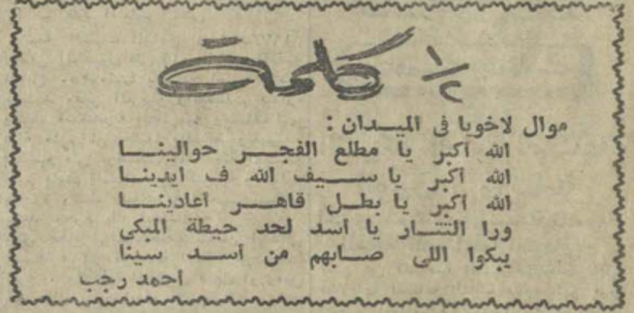
Ragab wrote an impassioned mawwal, in which he said: “Allahu Akbar, O dawn rising all around us; Allahu Akbar, O sword of God in our hands; Allahu Akbar, O conquering hero who has vanquished our enemies. Drive the Tatars before you, O lion, all the way to the Wailing Wall; let them weep over what the lion of Sinai has inflicted upon them.” This mawwal makes powerful use of rhetorical and religious imagery, invoking “Allahu Akbar” as a refrain that recalls reliance on God and His power, while portraying the Egyptian soldier as the “sword of God,” the “conquering hero,” and the “lion of Sinai.” These images evoke strength, heroism, and inevitable victory, while generating a sense of enthusiasm and pride among soldiers and civilians alike.
4. October 10, 1973: Exposing the Enemy
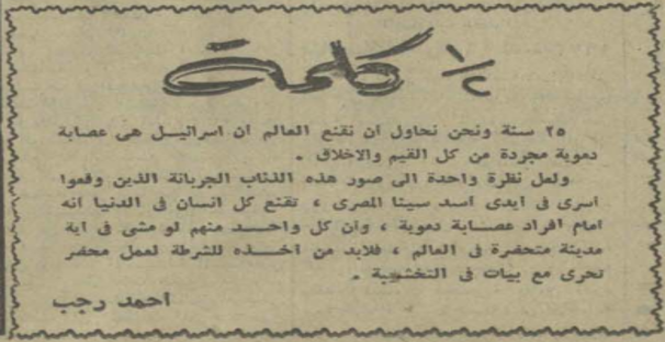
Ragab turns to exposing the Israeli enemy and revealing its true nature. He wrote: “For 25 years, we have tried to convince the world that Israel is nothing more than a bloodthirsty gang devoid of all values and morals… Perhaps one look at the pictures of these mangy wolves who have fallen captive into the hands of the Egyptian lion of Sinai would convince everyone in the world that they are looking at members of a bloodthirsty gang,” adding, “Any one of them, if he were to walk through any civilized city in the world, would be arrested, have a report filed against him, and spend the night in the lockup.” Here, the writer employs a caricatural style in depicting the enemy, portraying it as a “bloodthirsty gang” and “mangy wolves” — descriptions that undermine the enemy’s prestige and present it in a humiliating light. He also presents the Israeli prisoners as tangible evidence of defeat, thereby reinforcing confidence in the capabilities of the Egyptian army.
5. October 11, 1973: Satirizing Israeli Leaders
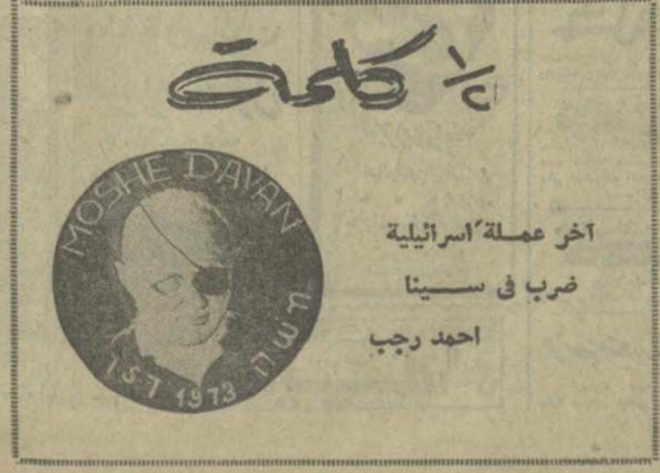
Ragab mocked the image of Moshe Dayan, the Israeli defense minister, describing him as “the last Israeli coin minted in Sinai.” This satirical expression alludes to Israel’s defeat in Sinai, portraying the Israelis’ presence there as nothing more than an obsolete coin.
6. October 12, 1973: Satirizing Israeli Military Leaders
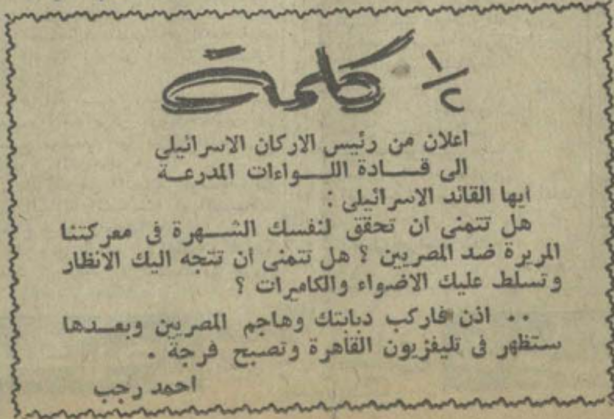
Ragab presents a satirical advertisement attributed to the Israeli Chief of Staff, which reads: “Do you wish to make a name for yourself in our bitter battle against the Egyptians? Do you wish to attract attention and have the spotlight and cameras focused on you? Then climb into your tank and attack the Egyptians, and afterward you will appear on Cairo Television and become a spectacle.” Here, Ragab mocks Israeli military leaders who seek fame, implying that their ultimate fate will be defeat and capture, and that their appearance on Egyptian television will be as a “spectacle” rather than a triumph. This satire undermines the enemy’s morale and reinforces the Egyptians’ sense of confidence.
7. October 14, 1973: Linguistic Satire
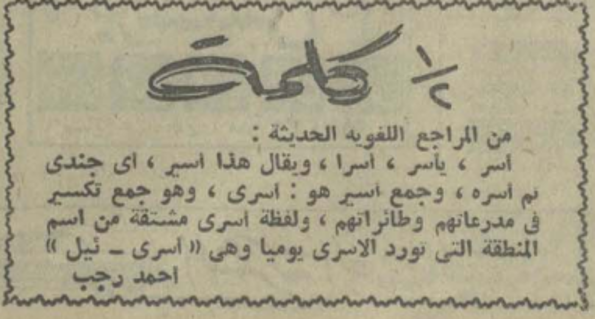
Ragab devised a clever form of linguistic satire, writing: “Asara, ya’siru, asran, and asir refers to a soldier who has been captured. The plural of asir is asra, which is a broken plural in their armored vehicles and aircraft, and the word asra is derived from the name of the region that supplies prisoners every day, namely, ‘Isra…el.’” Ragab combines satire with linguistic information, offering a humorous explanation of the word “prisoners” and linking it to the name “Israel” in a clever play on words. This satire reinforces the notion of Israel’s defeat and the superiority of the Egyptian army, while employing language as a weapon in psychological warfare.
8. October 15, 1973: Economic Satire
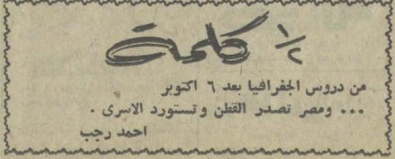
Ragab wrote: “Among the lessons of geography after October 6… Egypt exports cotton and imports prisoners.” Here, he presents a form of biting social and political satire, drawing a humorous contrast between Egypt’s traditional exports, namely cotton, and its “imports” of prisoners as evidence of military victory.
9. October 16, 1973: Satirizing the Death of Avraham Mendler
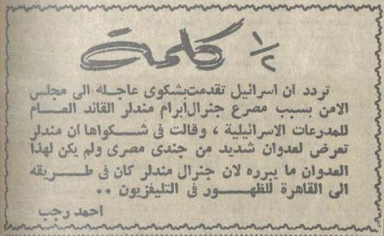
In his article published in Al-Akhbar on October 16, 1973, Ahmed Ragab addressed the death of Israeli General Avraham Mendler, commander of the Israeli armored forces, in a satirical manner. He imagined that Israel had lodged an urgent complaint with the UN Security Council over his death, claiming that his being attacked by an Egyptian soldier was unjustified. He then added that the general had been on his way to Cairo to appear on television. The satire here rests on the juxtaposition of the military event with its media dimension, presenting an Israeli military commander in a situation that contrasts with the conventional image of a commander on the battlefield. Framing the incident as a complaint before the UN Security Council further adds a political dimension to the satirical paradox, reflecting aspects of the Israeli character as portrayed by Ragab — lying, making unfounded claims, distorting facts, and presenting itself as the aggressed, wronged, oppressed, and weak party. Ragab thus went beyond mocking the death of an Israeli commander to deconstructing the image of the Israeli military leadership and portraying it in a position of weakness and confusion.
10. October 17, 1973: Expressing Egyptian Sentiments after the Victories of the First Days
On October 17, 1973, Ahmed Ragab made Egyptian sentiments toward President Anwar Sadat and the developments of the war the subject of his satirical piece. He expressed the inability of the pen to convey these sentiments through a humorous comparison between the writer’s inability to express himself and the Israeli army’s inability to confront the Egyptian leadership. This treatment reveals an important shift in the function of satire: it was no longer directed solely at the enemy, but had also become a means of expressing the Egyptian psychological state accompanying the initial military successes. The exaggeration in describing the pen’s inability to express itself humorously reflects the magnitude of the emotions generated by the war within Egyptian society. The text thus represents a satirical expression of the restoration of confidence after years of the effects of the June 1967 defeat, while remaining true to the writer’s characteristic humorous style.
11. October 18, 1973: Portraying Israeli Losses as an Internal Crisis
On October 18, 1973, Ragab turned to the repercussions of Israeli military losses on Israeli society. He imagined a massive demonstration taking place in Tel Aviv, with protesters chanting in outrage over what had happened to the Israeli army and the money that Israeli citizens had paid, linking this to the army’s losses in Sinai. The paradox in this text is based on transferring the consequences of the war from the battlefield to the Israeli home front. The writer focuses not only on the soldiers who suffered losses, but also imagines the effects of the battle reaching ordinary citizens who bear the burdens of war. Thus, the military losses are transformed in the satirical text into a social and economic crisis, reinforcing among Egyptian readers the perception of the far-reaching effects of the war on Israel.
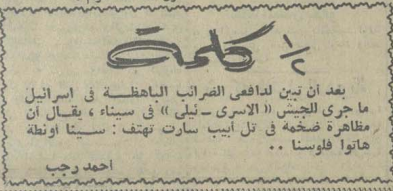
12. October 19, 1973: Satirizing the Confusion of the Israeli Leadership
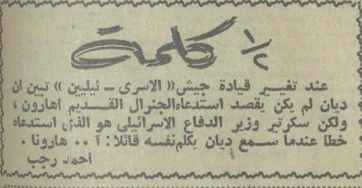
On October 19, 1973, Ahmed Ragab continued to satirize the Israeli military leadership through wordplay involving the names of its commanders and the misunderstanding surrounding the recall of retired General Aharon. The significance of this text lies in its reliance on linguistic irony, whereby names and expressions associated with the Israeli leadership are transformed into material for humor: “Aharon — Ah… Harona = Ah… They have oppressed us.” Ragab thus used the name “Aharona” to express the Israelis’ complaint about the oppression allegedly inflicted upon them by our soldiers. This is consistent with the satirical narrative established during the war, portraying the Israeli army and its commanders as oppressed and depicting the collapse of the image of strength they had sought to convince the world of before October 1973.
13. October 21, 1973: Satirizing Israel’s Association with Uncle Sam and Its Defeat by SAM-6
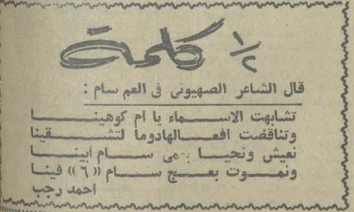
On October 21, 1973, Ragab broadened the scope of his satire by drawing a comparison between the word “Sam,” referring to the United States and its protection of Israel, and the “SAM-6” missiles, referring to the damage they inflicted on Israeli aircraft during the war. He presented this comparison in the form of a satirical poem. The use of poetic form lends a popular and satirical character to the political criticism, making the idea more accessible and easier for readers to circulate.
14. October 22, 1973: “Wrong” in Reading History
On October 22, 1973, Ahmed Ragab used the telephone as a device for satirical irony, imagining Golda Meir calling Cairo to plead for a ceasefire. He then structured the dialogue around the dates of previous wars, with Golda Meir recalling what Israel believed it had achieved in earlier victories, only for Cairo to respond, “Wrong,” and give the date “6-10-73.” The text is built around a historical paradox: the earlier dates associated with the Arab-Israeli wars become, in contrast to October 6, 1973, part of a memory whose significance changed after the crossing. Through this device, Ragab presents the new date as a defining landmark in Egyptian consciousness.
15. October 22, 1973: “Wrong” in Reading History
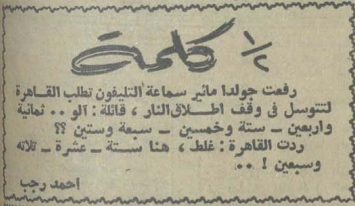
On October 22, 1973, Ahmed Ragab used the telephone as a device for satirical irony, imagining Golda Meir calling Cairo to plead for a ceasefire. He then structured the dialogue around the dates of previous wars, with Golda Meir recalling what Israel believed it had achieved in earlier victories, only for Cairo to respond, “Wrong,” and give the date “6-10-73.” The text is built around a historical paradox: the earlier dates associated with the Arab-Israeli wars become, in contrast to October 6, 1973, part of a memory whose significance changed after the crossing. Through this device, Ragab presents the new date as a defining landmark in Egyptian consciousness.
16. October 24, 1973: The War as a Football Match
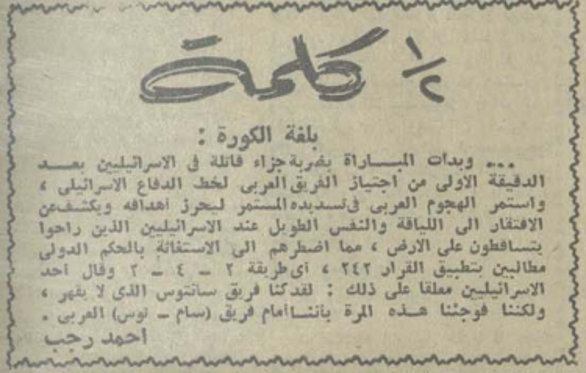
On October 24, 1973, Ragab used the language of football to describe the war, portraying the beginning of the confrontation as though it were a match, with references to a penalty kick, sustained attacks, and goals. He then depicted the Israeli forces retreating and calling for the implementation of Resolution 242. He suggested that they had thought they were the famous Brazilian team Santos, only to find themselves facing the superior Arab team “Sam-tos,” as he called the Arabs. He incorporated the name of the SAM missiles into the name of the Arab team to satirize the impact those missiles had on Israeli aircraft. Ragab thus simplified the military event and recast it in familiar popular language, presenting it as a football match whose score the reader could easily follow: the Egyptian forces appeared as the attacking side scoring goals, while the Israeli forces appeared as a team losing its ability to continue.
17. October 25, 1973: American Weapons and Israeli Scrap
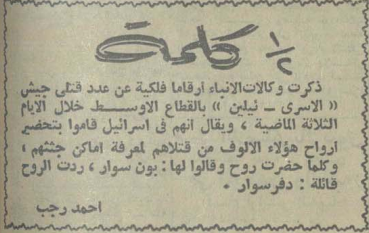
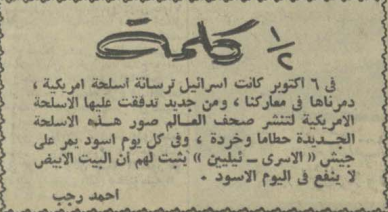
On October 25, 1973, Ragab documented the destruction by Egyptian soldiers of the American weapons arsenal possessed by Israel during the war. When American weapons began flowing to Israel again, the Egyptians destroyed them as well, reducing them to debris and scrap. He mocked the Israelis by suggesting that every passing day was a black day for them, and he satirized American support by saying, “The White House is of no use on a black day.”
18. October 26, 1973: Criticizing the Israeli Narrative of the Infiltration West of the Canal
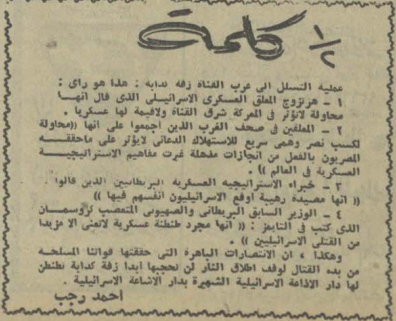
On October 26, 1973, Ahmed Ragab addressed the Deversoir Gap from a different perspective, seeking to undermine Israeli claims by focusing on its actual military significance and the falsehood of Israeli propaganda. Ragab cited the views of several military experts and commentators. He referred to Israeli military commentator Herzog, who argued that the infiltration west of the Canal had no effect on the course of the battle east of the Canal and carried no decisive military significance. He also cited the views of several commentators in the Western press who regarded the operation as an attempt to achieve a quick victory for propaganda purposes, without diminishing the Egyptian achievements attained since the beginning of the war. He further drew on the views of British military strategy experts, who described the Gap as a “terrible trap” into which the Israelis had fallen themselves, as well as the opinion of former British minister and Zionist Trosman, who described it as nothing more than “military bombast” that meant only more Israeli casualties.
Through these views, Ragab sought to emphasize that the Deversoir Gap was merely a “fake wedding procession” trumpeted by the Israeli Broadcasting House, which he mockingly called the “Israeli Rumor-Mongering House.” By referring to the Israeli broadcasting service as the “Rumor-Mongering House,” he alluded to its continued dissemination of what he portrayed as falsehoods. He concluded that the “fake wedding procession” could not obscure the brilliant victories achieved by our armed forces from the beginning of the fighting until the ceasefire.
19. October 28, 1973: Satirizing the Israeli Army and Its Weapons
On October 28, 1973, Ragab presented a satirical text in the form of an excerpt from the “Israeli Archives.” He imagined a song about Israeli aircraft, missiles, and tanks that ultimately portrays the army as having failed and its defeat in Sinai as having been exposed. The satire here rests on reversing the propaganda narrative: rather than presenting weapons as symbols of victory, the satirical text turns them into part of a story of failure. He uses the “Arab SAM-6” missile in a poetic form that highlights its ability to bring down Israeli aircraft of all types, presenting this in a satirical framework. This reveals an attempt to recast the image of Israeli military power in the Egyptian consciousness and transform symbols of military superiority into objects of ridicule.
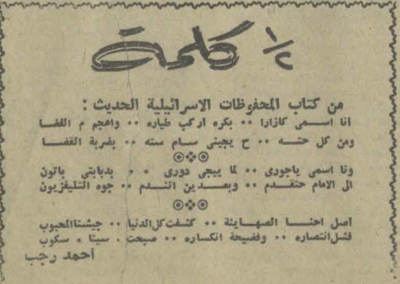
20. October 29, 1973: Deconstructing the Discourse on “Anti-Semitism”
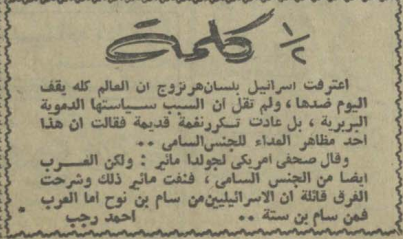
On October 29, 1973, Ragab addressed Israeli discourse on anti-Semitism, building his satirical paradox around the distinction between “Shem, son of Noah” and “Shem of Six,” referring to the missile that inflicted heavy losses on Israel, caused widespread panic, and destroyed most of its aircraft. This treatment reveals the use of satire to deconstruct an ideological discourse, as Ragab turns a political concept into a play on words. The Israeli discourse thus itself becomes the subject of satire, rather than being treated as a discourse promoted by Israel and used to frighten the world. He linked it to the “SAM-6” that Egypt used to terrify those claiming Semitic identity.
Conclusion
The satirical works published by Ahmed Ragab during the 1973 October War reveal how satire was employed as an intellectual and media tool to keep pace with the developments of the battle and express the transformation it brought about in Egyptian and Arab consciousness. By following his articles published successively from the early days of the war, it becomes clear that Ragab did not limit himself to satirizing Israeli military and political leaders or Israeli propaganda. Rather, he sought to deconstruct the image Israel had attempted to establish of its military superiority and its ability to achieve a decisive victory. To this end, he relied on paradox, reversal of situations, imagined dialogue, wordplay, and the transformation of certain military and political events into satirical situations that exposed the contradiction between the Israeli narrative and the reality imposed by the battles. Satire thus became, for him, a means of assimilating rapidly unfolding events and alleviating the tension accompanying the war, while at the same time reinforcing their psychological and moral significance for the Egyptian reader.
These works also reflect the evolution of the public mood during the war. Satire moved from expressing surprise and delight at the Egyptian military successes to refuting the Israeli narrative and portraying the impact of the war on the Israeli military and political establishment. This material is significant for studying the role of Egyptian intellectuals and writers during the war in constructing a popular discourse that confronted hostile propaganda. Ahmed Ragab’s satirical articles may thus be viewed as one form of the moral and cultural mobilization that accompanied the October War and contributed to transforming military victories into material for public consciousness and satirizing the image Israel sought to project of itself and of the outcome of the war.
Third: Salah Jahin’s Brush Documents Egypt’s Victory and Humiliation of Israel
Salah Jahin combined poetry, zajal, and caricature. He documented the daily events of the October War through his caricatures, which were published daily in Al-Ahram throughout the war, using biting satire that defeated Zionist propaganda and placed the October victory in its proper context.
In his caricatures during the 1973 October War, Salah Jahin relied — not only on satire and visual expression through his drawings, but also on a range of popular words and expressions that gave him a remarkable ability to transform military and political events into satirical situations that were easy to understand and circulate. Among the most prominent was the expression “So, what do you think of this natural view?” which he used to satirize the world’s astonishment at the Egyptian forces’ crossing. He also employed patriotic expressions such as “Go on, my son… May God gladden your heart” and “We’re going to liberate our land, which means we’re going to liberate it,” capturing the solidarity of the people with the soldiers and their determination to liberate the land.
A substantial part of his satire focused on Israel and its supporters, using biting popular expressions, most notably “How can you make them braver?!” in criticizing US support for Israel, and “Ride the highest horse you have” in confronting the military superiority backed by the United States. He also satirized the Israeli leadership, particularly Moshe Dayan, through statements attributed to him such as, “Could we please stop the firing for a while?… I need to go to the bathroom!”
Jahin also employed linguistic and visual irony in expressions such as “No comment!” and “Tomorrow, the weapon will reach farther,” as a reference to the importance of Arab oil as a weapon, and “The water is cut off” in criticizing the role of the United Nations. He further transformed “Phantom” into “wreckage” and turned the Bitter Lakes into a symbol of Israeli losses. Thus, these expressions and “gags” formed an integrated satirical language that brought together paradox, wordplay, popular language, and exaggeration, making caricature a means of commenting on the war, resisting Israeli propaganda, and expressing confidence in and pride in Egypt’s victory. The following section presents Salah Jahin’s contributions during the October War:
1. October 7 Cartoon: The New Natural View
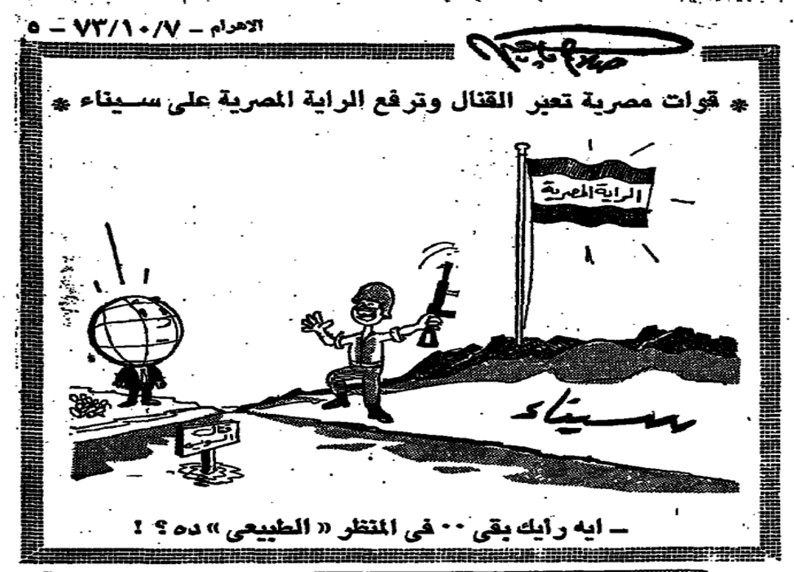
This cartoon carries significant implications for the changing international equation, depicting the world as astonished by the Egyptian army’s sweeping crossing, as though the event had taken everyone by surprise. The satirical question, “So, what do you think of this natural view?” expresses mockery of the world’s shock and astonishment, while also reflecting Egyptian confidence in the achievement that had been accomplished.
2. October 8 Cartoon: Zayyat Speaks at the United Nations
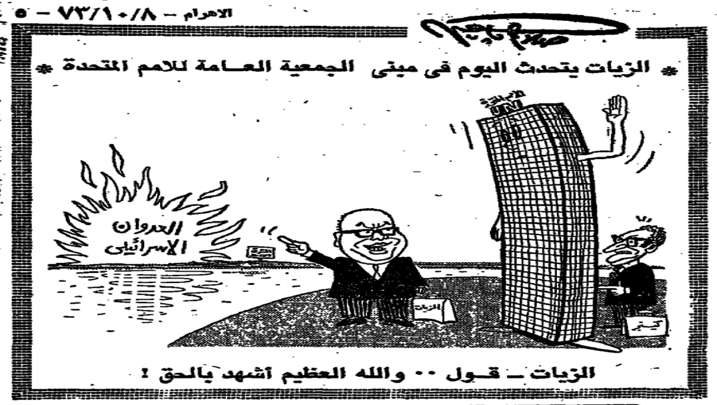
Jahin depicted Minister Mohamed Hassan Zayyat standing before the United Nations building, raising his hand as a sign that he was about to give testimony. Behind the building stands US Secretary of State Henry Kissinger, who was known for his strong bias toward Israel, depicted in a state of fear. In the center of the cartoon, Jahin wrote, “Israeli aggression,” while at the bottom he wrote, “Zayyat — Say it… I swear to God, I testify to the truth!” Zayyat is thus portrayed as calling on the United Nations to testify to the truth and stand with Egypt in defending its right to expel the enemy from its territory.
3. October 9 Cartoon: A Mother’s Prayer
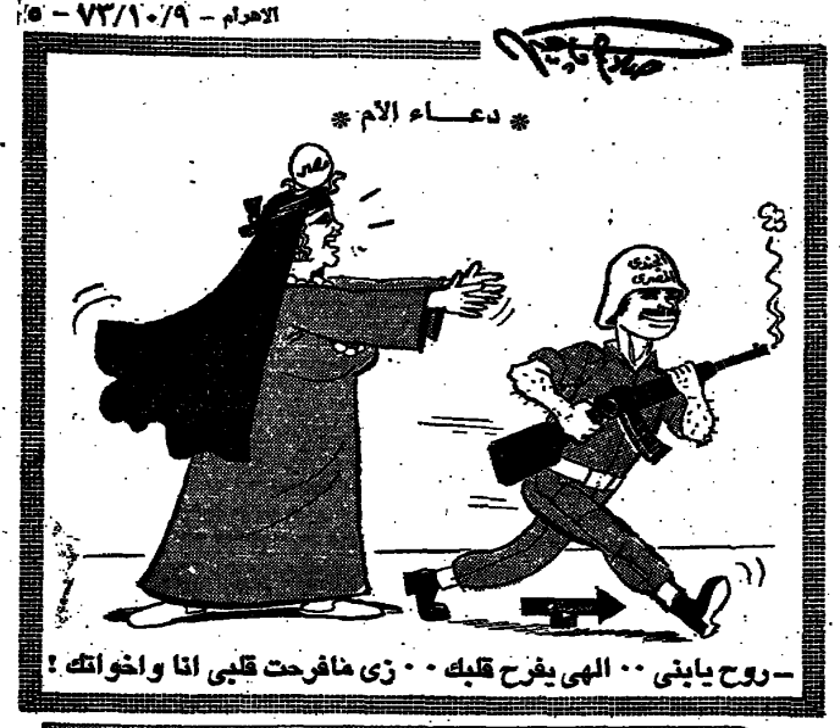
Jahin depicted an Egyptian soldier, with the words “The Egyptian Soldier” written on his helmet, carrying his weapon, with his mother standing behind him, the word “Egypt” written on her head. At the top of the cartoon, he wrote, “A Mother’s Prayer,” and at the bottom, “Go, my son… May God gladden your heart, just as you have gladdened mine and your sisters’!” The cartoon expresses the solidarity between the people and the army and portrays Egypt as a mother rejoicing in victory.
4. October 10 Cartoon: The Heroism of the Soldiers
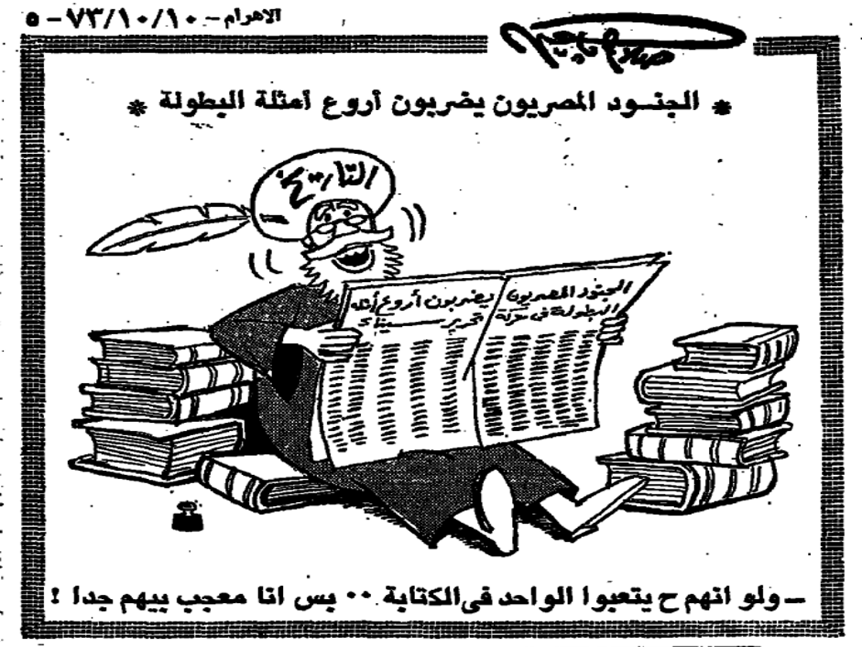
Jahin depicted History as a man following the news of the victory through a newspaper bearing the headline, “Egyptian Soldiers Set the Finest Examples of Heroism in the Liberation of Sinai.” At the top of the cartoon, he wrote, “Egyptian Soldiers Set the Finest Examples of Heroism,” while at the bottom, History says, “Although they’re going to make things tiring for me when it comes to writing… I’m very impressed by them!” The cartoon portrays History’s admiration for the heroism achieved by the Egyptian soldiers and expresses pride in and appreciation for their sacrifices.
5. October 11 Cartoon: Satirizing US Support
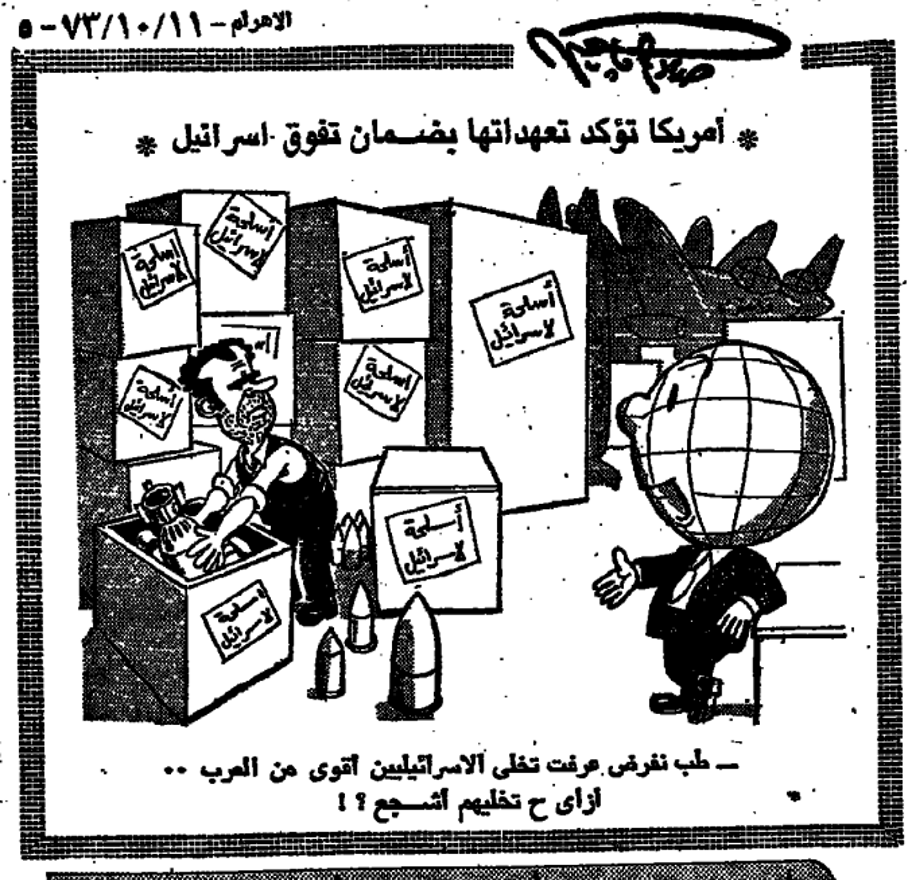
In this cartoon, Jahin depicted US President Richard Nixon supporting Israel with weapons. At the top, he wrote, “America Reaffirms Its Commitments to Ensure Israel’s Military Superiority.” At the bottom, Jahin satirized this on behalf of the world, saying, “Suppose you manage to make Israel stronger than the Arabs… how are you going to make them braver?!” The satirical question suggests that courage cannot be provided by weapons and that, regardless of how much weaponry Israel receives, it remains lacking in genuine courage.
6. October 12, 1973 Cartoon: Satirizing the Israeli Position at the UN Security Council
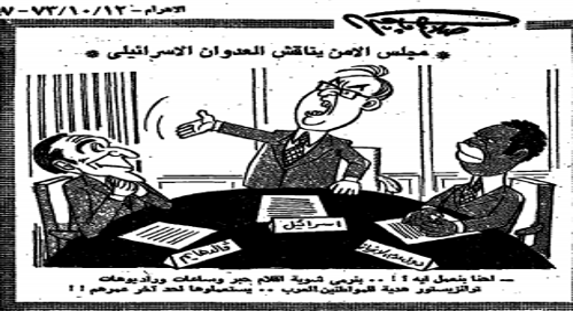
On October 12, 1973, Salah Jahin presented a satirical cartoon depicting a session of the UN Security Council attended by the Israeli representative, Kurt Waldheim, the UN secretary-general, and representatives of the Non-Aligned countries. He portrayed the Israeli representative as proposing items associated with procrastination, justification, and resolutions that remained merely on paper — such as ink pens, watches, and transistor radios — and were never implemented, like all previous Security Council resolutions. He further had the representative call for the adoption of a resolution similar to those that had preceded it, offering a satirical portrayal of what Jahin saw as Israel’s influence over the United Nations.
7. October 13 Cartoon: Moshe Dayan and the Targeting of Civilians
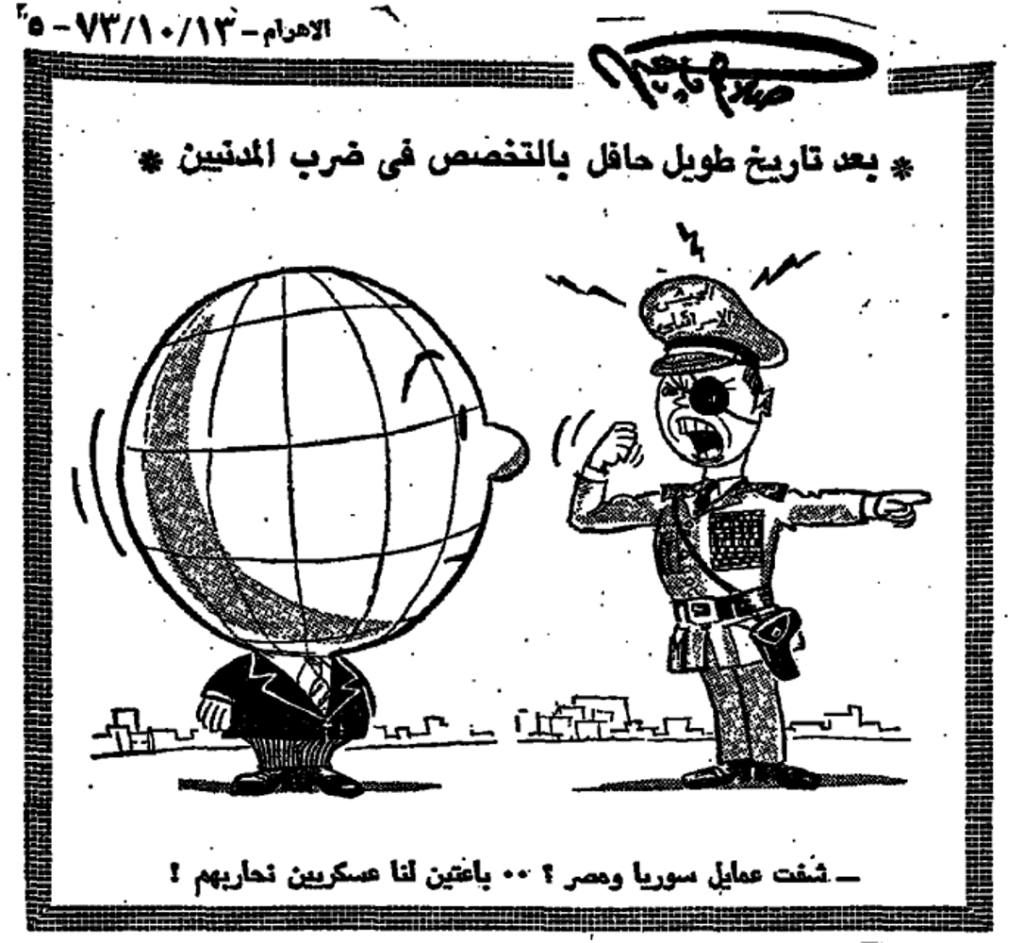
Jahin depicted Moshe Dayan shouting at the world. At the top, he wrote, “After a long history of specializing in attacking civilians,” and at the bottom, “Have you seen what Syria and Egypt have done? They’ve sent soldiers to fight us!” Jahin satirizes Dayan as beginning to cry out after his defeat and the exposure of his forces’ vulnerability in the face of the steadfastness of the Egyptian and Syrian forces.
8. October 14 Cartoon: Egyptian Soldiers and US Supplies
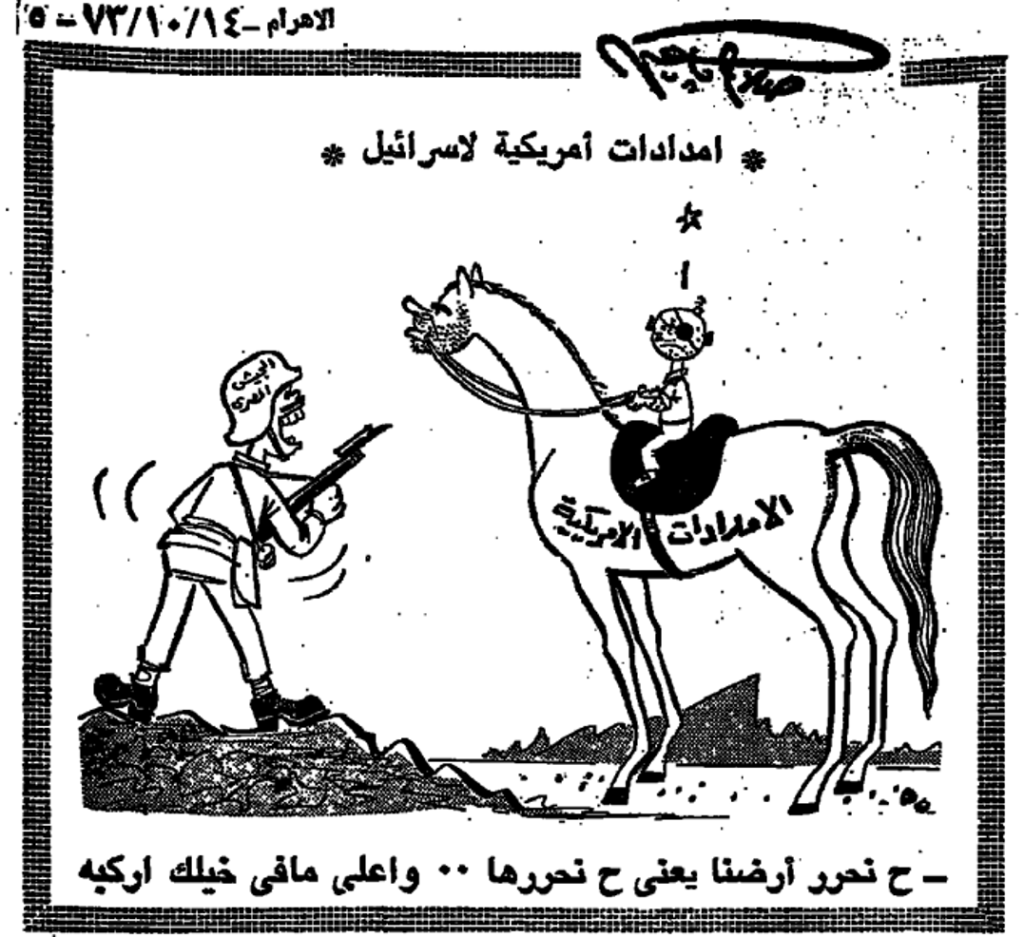
Jahin depicted an Egyptian soldier standing with his rifle, facing a diminutive Moshe Dayan riding a huge horse labeled “American Supplies.” At the top, he wrote, “America’s Supplies to Israel,” while at the bottom, the Egyptian soldier says, “We’re going to liberate our land, which means we’re going to liberate it… Ride the highest horse you have.” The cartoon conveys the steadfastness of the Egyptian soldier, who is not intimidated by weapons, regardless of how formidable they may be.
9. October 15, 1973 Cartoon: “Israel That Cannot Be Broken”
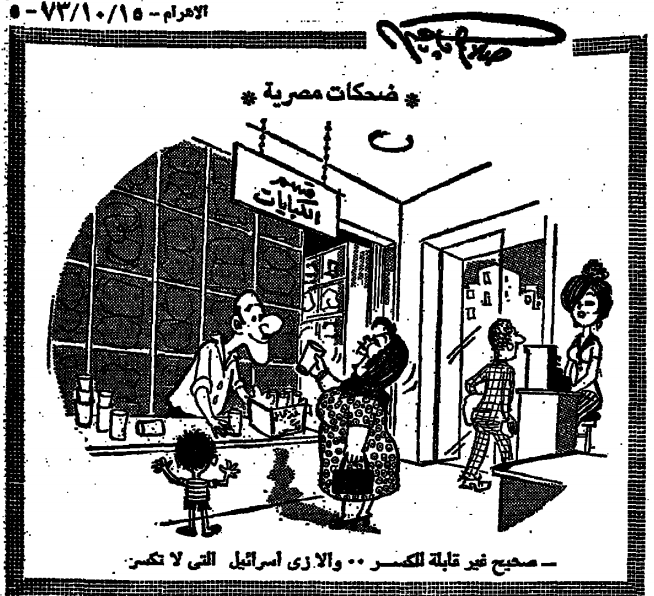
On October 15, 1973, Jahin presented a cartoon depicting an Egyptian woman in a household goods store asking about cups, then drawing a connection between their ability to break and Israel, which had been broken in the war. He placed the cartoon under the title “Egyptian Laughter.” The cartoon carries a clear symbolic significance: Jahin brought the military meaning into the realm of everyday life and turned Israel’s defeat into a subject of humor.
10. October 16 Cartoon: The Fires Do Not Stop
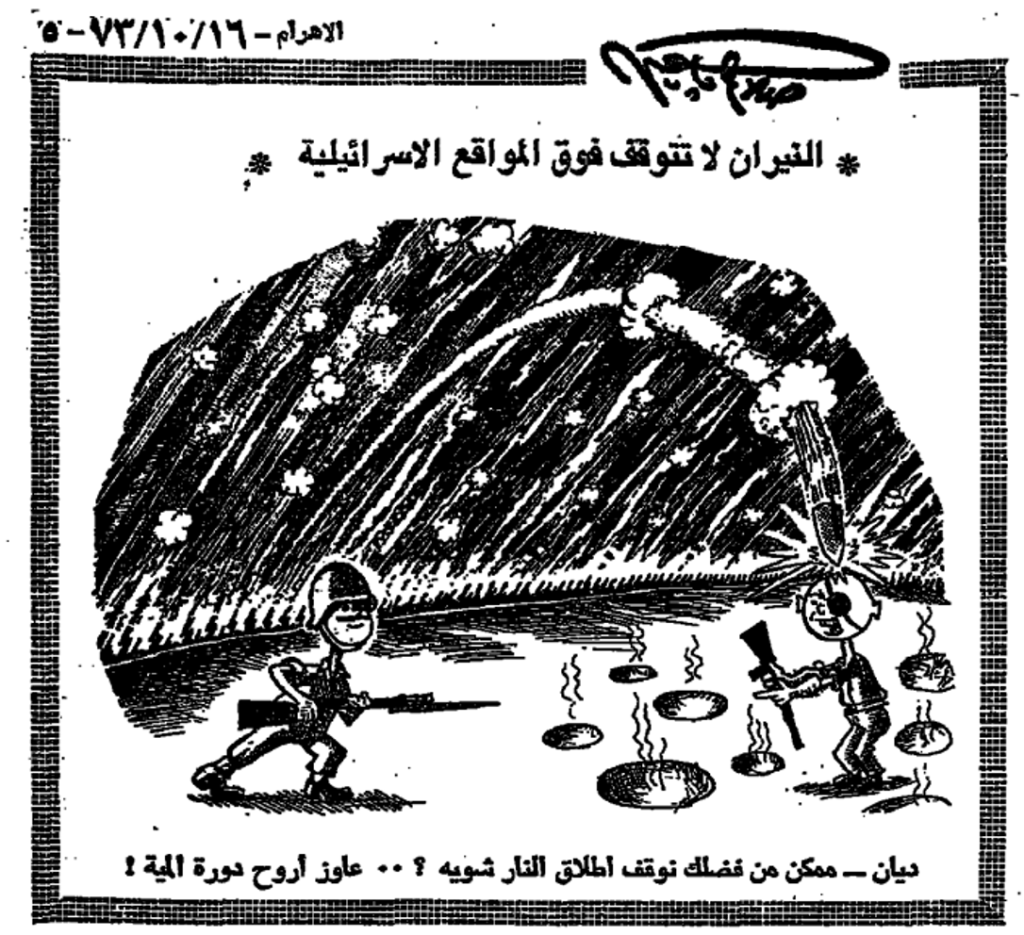
Jahin depicted the battle, with missiles striking Israeli positions, while Moshe Dayan appears frightened and surrendering. At the top, he wrote, “The fires do not stop over the Israeli positions,” and at the bottom, Dayan says, “Could we please stop the firing for a while?… I need to go to the bathroom!” Jahin satirizes Dayan by portraying him in a state of panic and fear, while highlighting the strength of the Egyptian army and the pressure it exerted on the enemy.
11. October 17 Cartoon: The Heart of Egypt
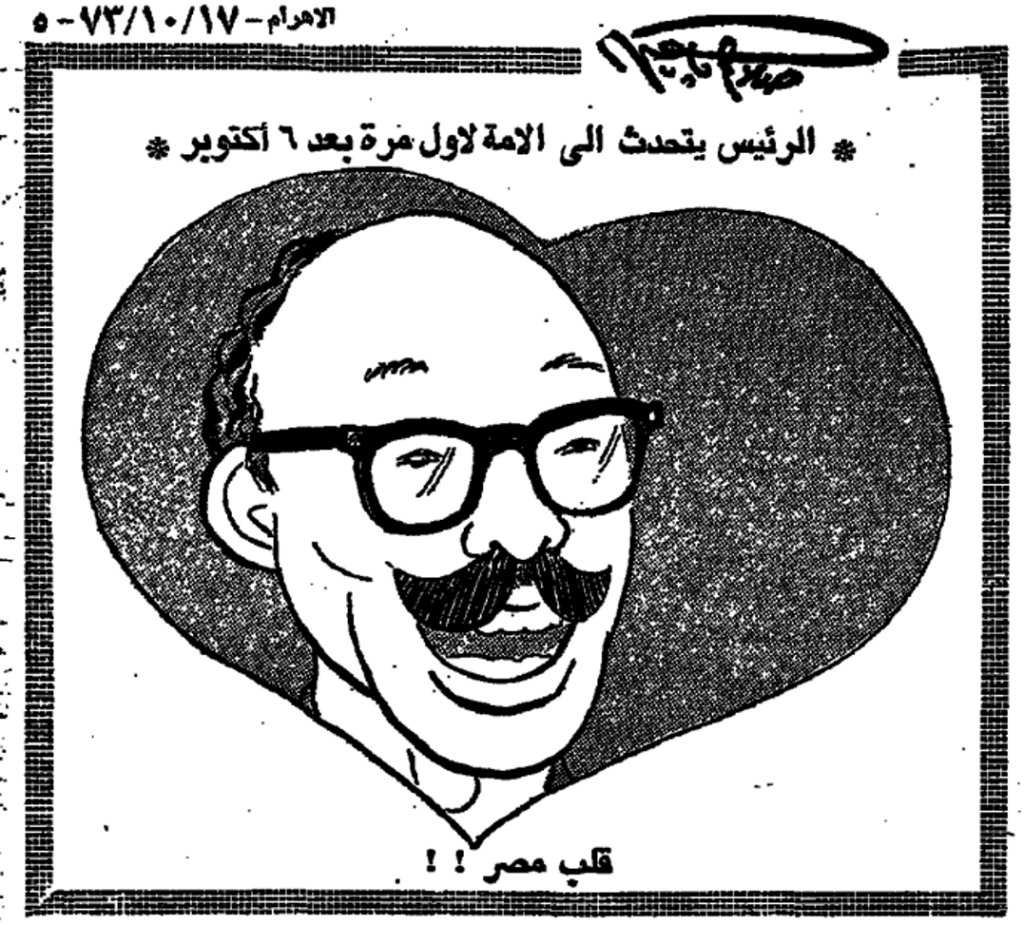
Jahin depicted a heart containing a picture of President Sadat. At the top, he wrote, “The President Addresses the Nation for the First Time since October 6,” referring to the president’s speech before the People’s Assembly on October 16, and at the bottom, “The Heart of Egypt!!” The cartoon expresses the place President Sadat held in the hearts of Egyptians and conveys feelings of pride in and appreciation for the decision to go to war that he had made, as well as his confidence in the armed forces.
12. October 18 Cartoon: Sadat’s Peace Initiative
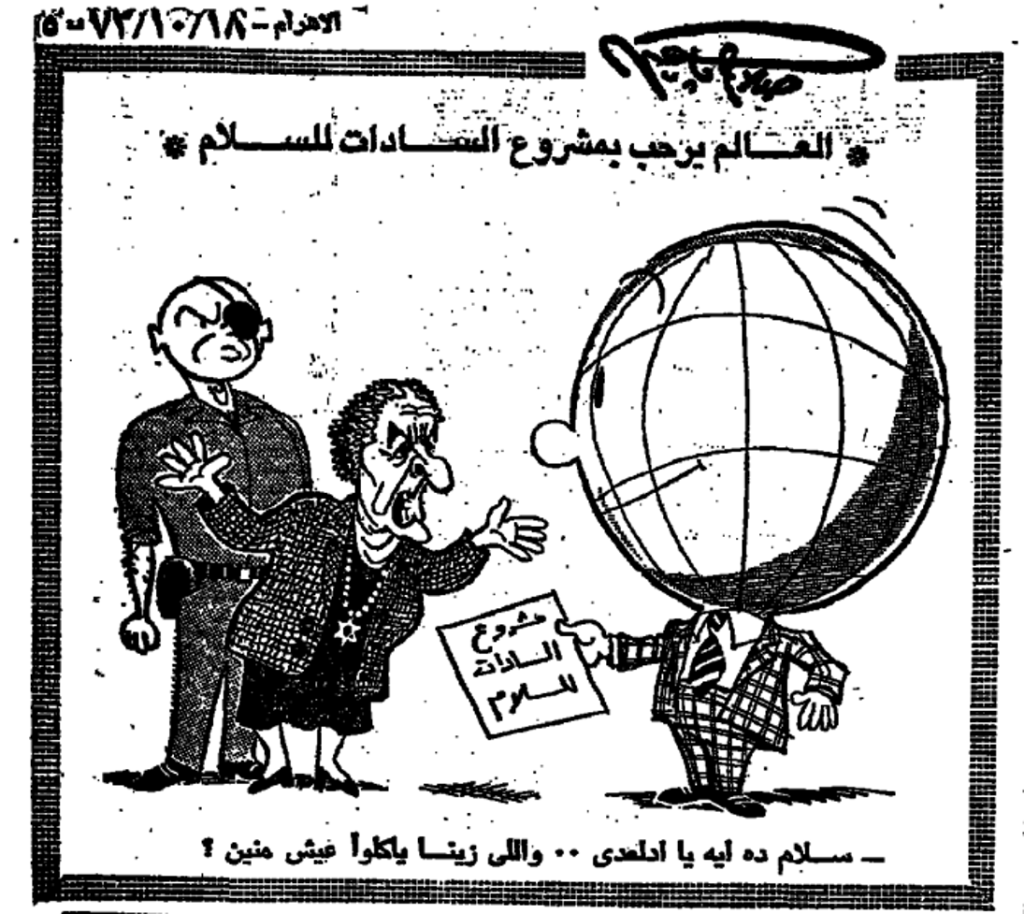
Jahin depicted the world as a man holding a paper bearing the words “Sadat’s Peace Initiative,” while Golda Meir stands before him, pale-faced, with Moshe Dayan behind her. At the top, he wrote, “The World Welcomes Sadat’s Peace Initiative,” while at the bottom, Golda Meir says, “What kind of peace is this, you fool? How are people like us supposed to make a living?” The cartoon expresses the Egyptian position of offering peace from a position of strength, while portraying Israel as rejecting peace because it is a state founded on aggression and war as a means of expansion.
13. October 19 Cartoon: Oil as a Weapon
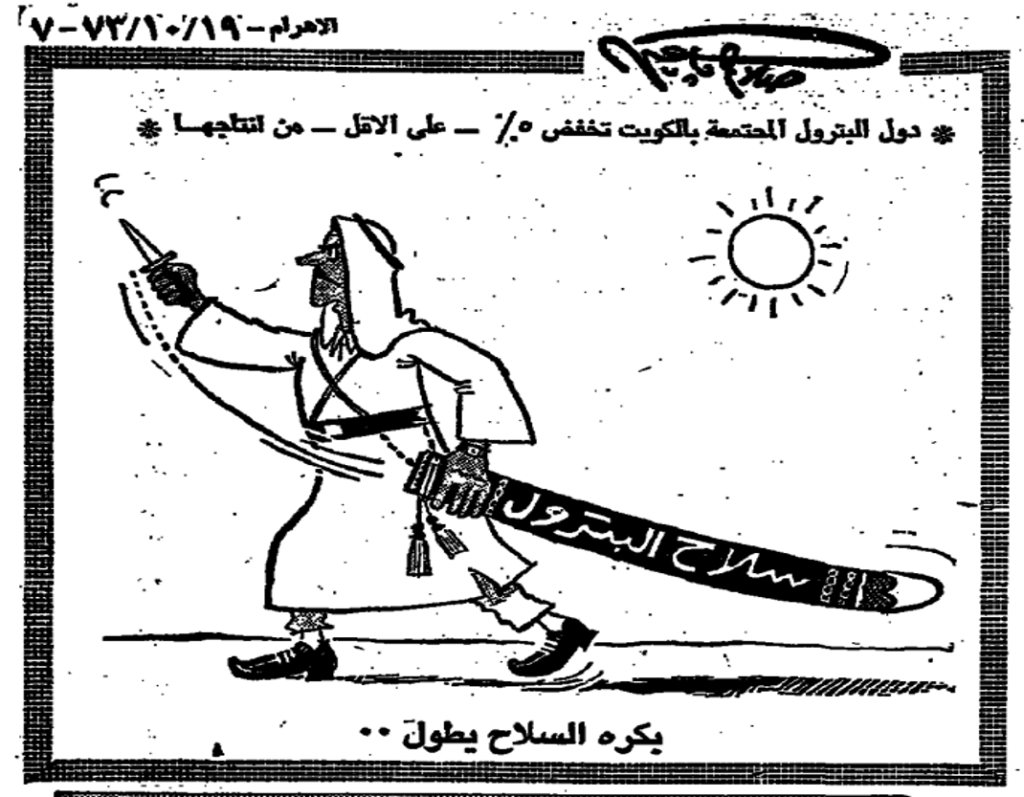
Jahin depicted an Arab man carrying a large sword scabbard, from which he had drawn a small dagger. He wrote, “The Arab oil-producing states meeting in Kuwait cut their production by at least 5%,” and at the bottom, “Tomorrow, the weapon will reach farther…” The cartoon expresses the idea of Arab oil as a weapon, while Jahin portrays the 5 percent reduction agreed upon by the Arab oil ministers as insufficient, humorously suggesting, “Tomorrow, the weapon will reach farther,” reflecting the hopes of ordinary citizens that this weapon would be used more effectively to expel the Israeli occupation from Arab territories.
14. October 20 Cartoon: Kosygin’s Visit to Cairo
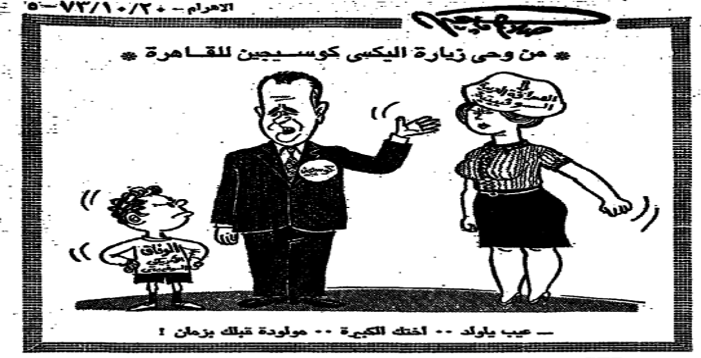
Jahin depicted Kosygin with a mature woman standing to his left, with “Arab-Soviet Friendship” written on her hat, and a mischievous child standing to his right, with “US-Soviet Détente” written on his chest. At the top, he wrote, “Inspired by Alexei Kosygin’s Visit to Cairo,” while at the bottom, Kosygin says to the child, “That’s naughty, boy… Your big sister was born long before you!” Jahin thus portrays the Soviet Union as rejecting the use of US-Soviet détente at the expense of Arab-Soviet relations, which, in his depiction, were more firmly established than the newly emerging détente.
15. October 21 Cartoon: Mercenary Soldiers
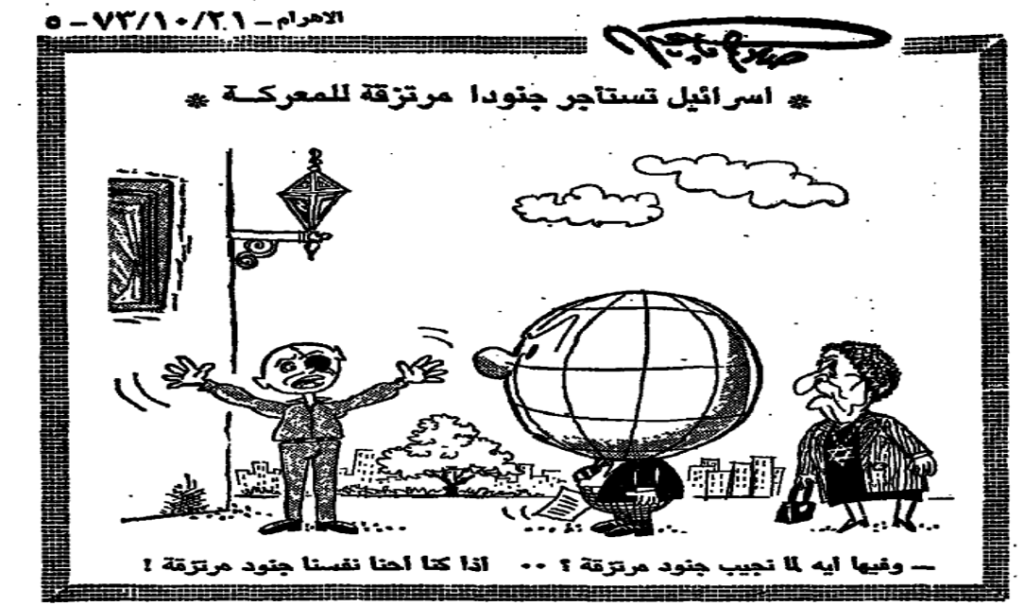
Jahin depicted the world as a man, with Moshe Dayan standing before him and Golda Meir behind him. At the top, he wrote, “Israel Hires Mercenary Soldiers for the Battle,” while at the bottom, Moshe Dayan responds, “What’s wrong with bringing in mercenary soldiers?… We’re mercenary soldiers ourselves!” Jahin satirizes the reliance of the Israeli army on mercenary soldiers, portraying its members as mercenaries themselves, recruited from various countries.
16. October 22 Cartoon: Arab Oil
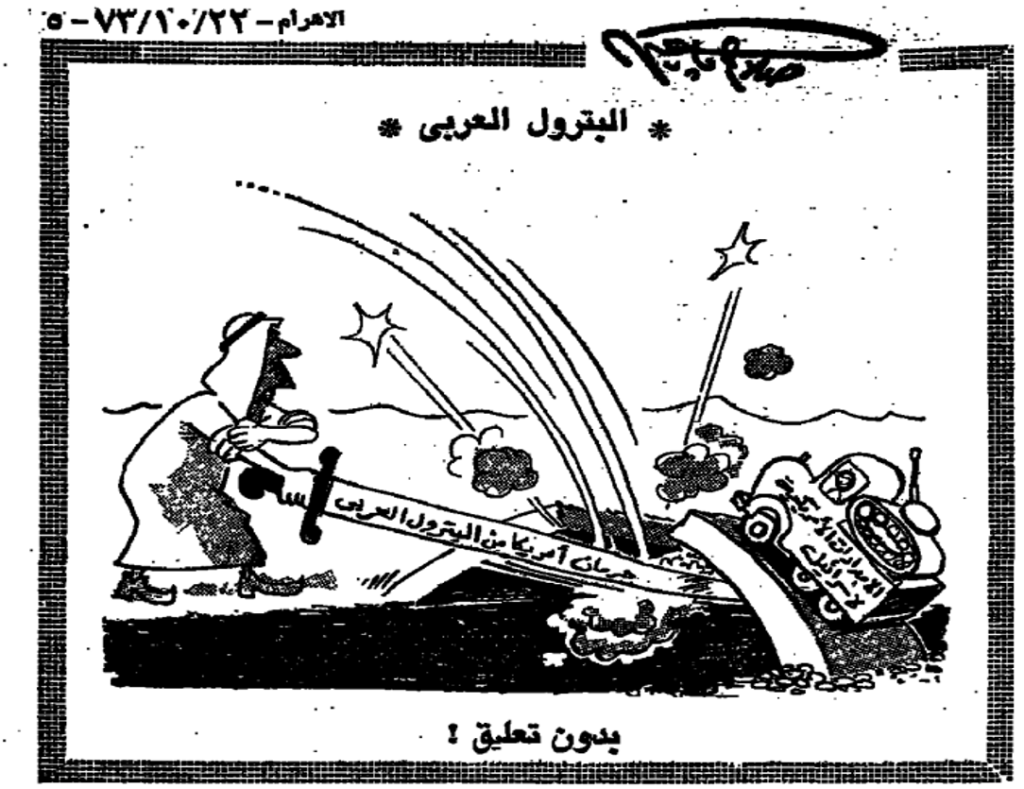
Jahin depicted an Arab man carrying a large sword bearing the words “Depriving America of Arab Oil.” The sword is shown destroying a ship carrying American aid and supplies to Israel. At the top, he wrote, “Arab Oil,” and at the bottom, “No Comment!” The cartoon expresses the power of the Arabs if the oil weapon were used, suggesting that it could cut off American supplies to Israel. Jahin leaves the comment to the reader, implying that Arab oil had not been used as effectively as it could have been, with only 5 percent of oil production having been suspended; hence, he wrote, “No Comment!”
17. October 23 Cartoon: Ceasefire
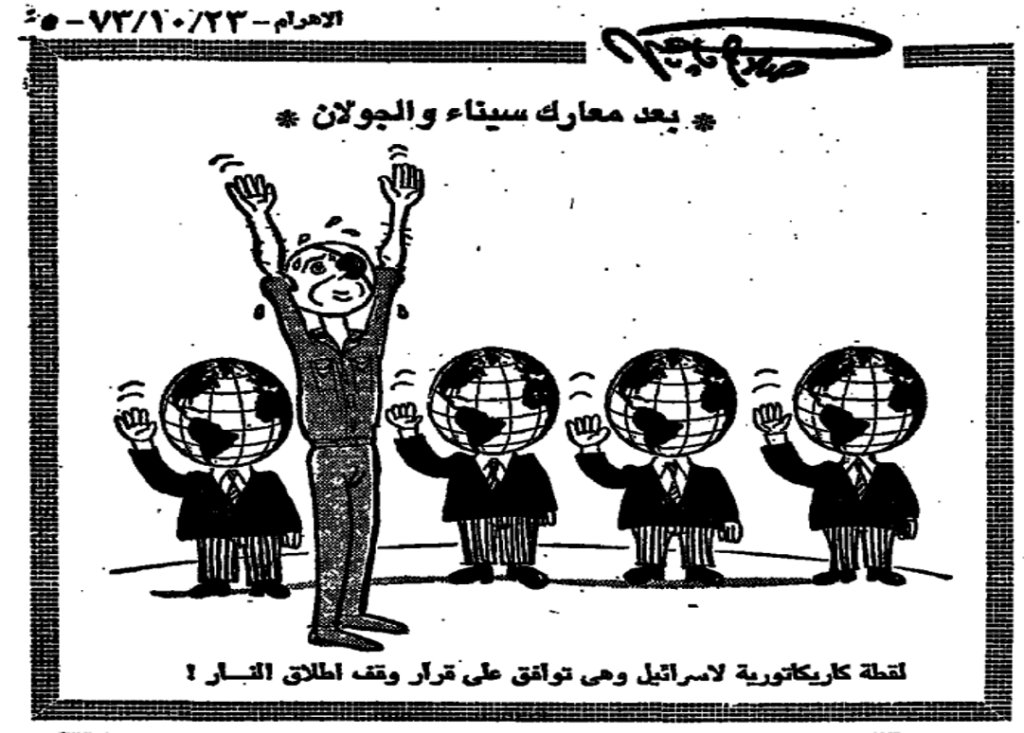
Jahin depicted four representatives of various countries, with their heads shaped like maps of the globe, facing Moshe Dayan, who is raising his hands high. At the top, he wrote, “After the Battles of Sinai and the Golan,” and at the bottom, “A caricature of Israel agreeing to the ceasefire resolution!” The cartoon portrays Israel as being in a position of complete surrender and strongly accepting the ceasefire, as indicated by the raised hands, under the pressure of its military defeats.
18. October 24 Cartoon: Call of the Day
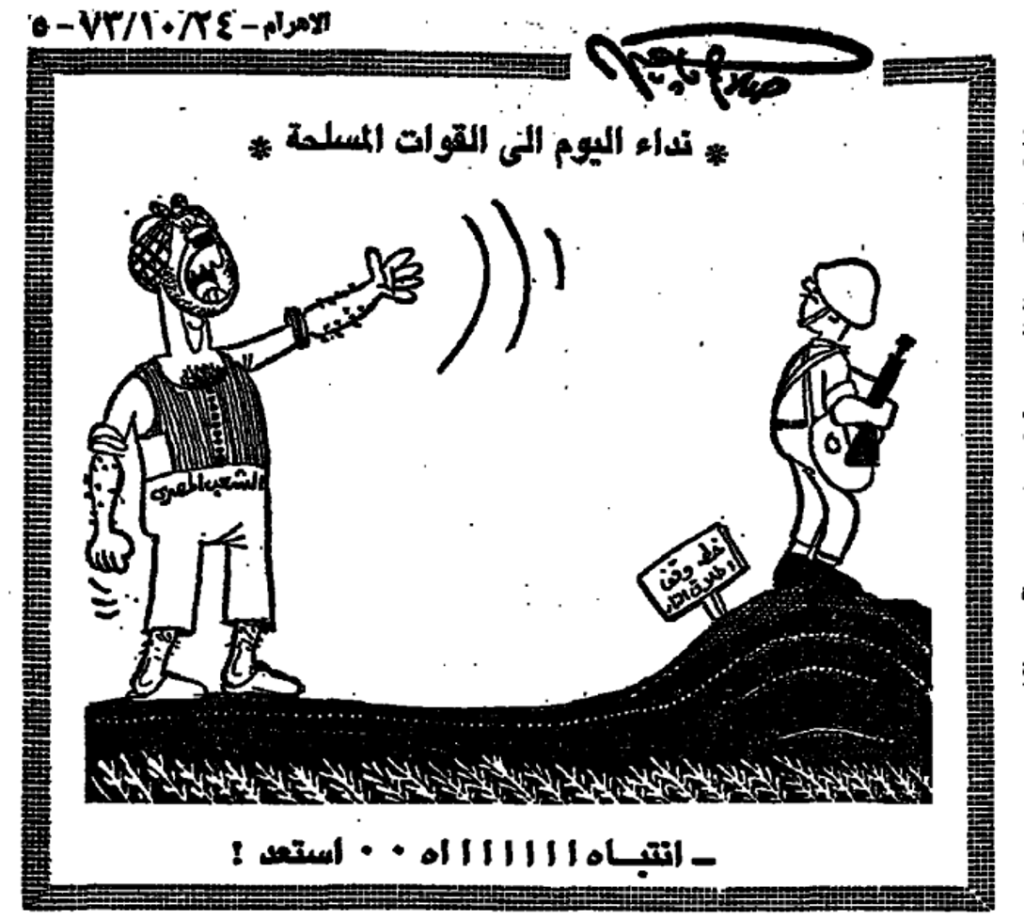
Jahin depicted an Egyptian soldier standing along the ceasefire line, with the Egyptian people behind him in the form of a huge peasant man shouting to the soldier. At the top, he wrote, “Today’s Call to the Armed Forces,” and at the bottom, “Attentionnnnn… Ready!” The cartoon expresses the need for the armed forces to remain prepared and vigilant, based on the portrayal of Israel as unwilling to honor its commitments and likely to resort to betrayal and failure to implement the ceasefire.
19. October 25, 1973 Cartoon: The United Nations and the Firefighter
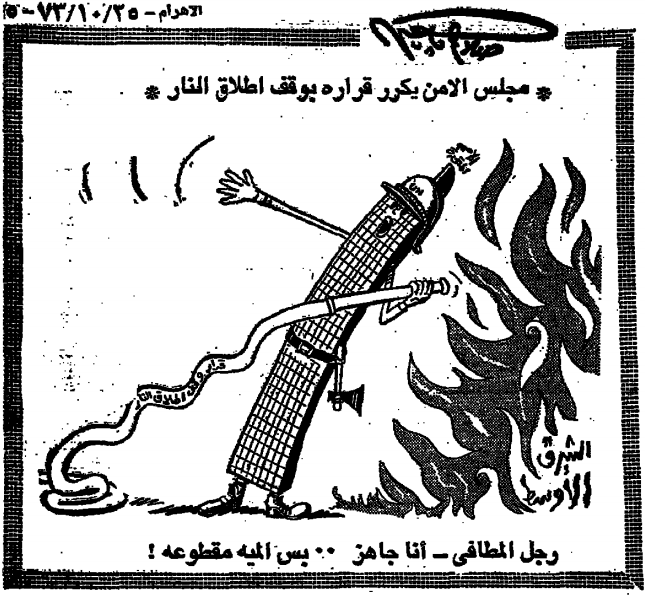
On October 25, 1973, Jahin addressed the UN Security Council’s ceasefire resolution, adopted for the second time on October 24 after Israel failed to comply with the resolution issued on October 22. He depicted the United Nations as a firefighter holding a hose, while a fire raged across the Middle East. The firefighter says, “The water is cut off.” The cartoon criticizes the ineffectiveness of the United Nations and its inability to compel Israel to implement the ceasefire.
20. October 27, 1973 Cartoon: The War in the Consciousness of the Egyptian Child
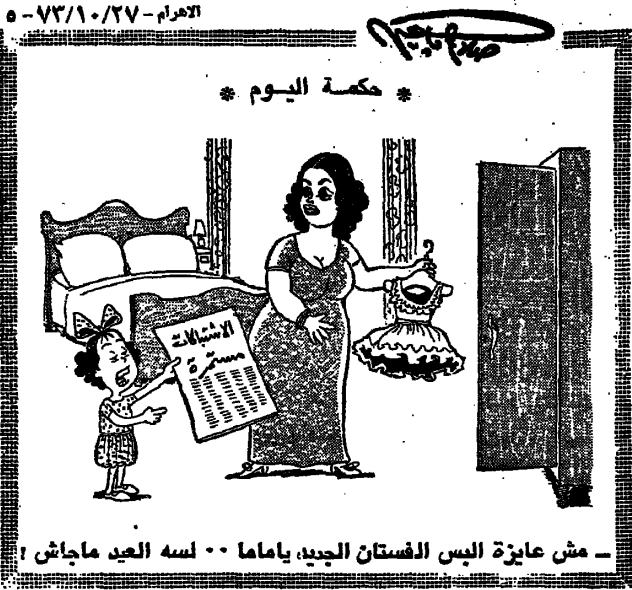
On October 27, 1973, Jahin depicted a young girl reading a newspaper reporting that fighting was continuing, while her mother tried to give her an Eid dress. The girl declares that she does not want the dress because Eid had not yet arrived. This reflects Jahin’s portrayal of Israel as violating the ceasefire and continuing the fighting even as Eid al-Fitr had arrived and Egyptians had begun celebrating. The girl’s awareness is evident in her declaration that she would not celebrate Eid until the ceasefire was observed, a significant aspect that Jahin chose to emphasize.
21. October 28, 1973 Cartoon: Moshe Dayan and the Bitter Lakes
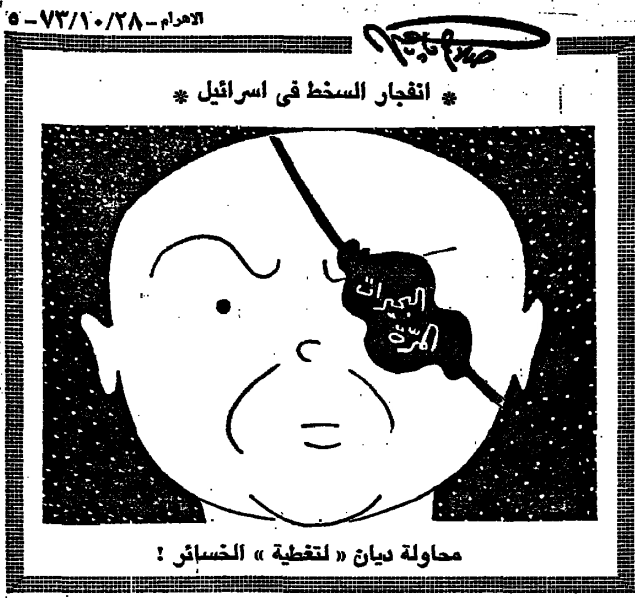
On October 28, 1973, Jahin addressed Israeli Defense Minister Moshe Dayan by drawing the Bitter Lakes over his eye, linking the image to Dayan’s attempt to conceal the losses associated with the Deversoir Gap, which Jahin depicted as a cover over his injured eye. In reality, the Bitter Lakes had, as their name suggests, become a symbol of the losses and bitter reality suffered by Israel, rather than of a media victory. Public discontent erupted inside Israel after the truth became known following the ceasefire.
22. October 29, 1973 Cartoon: The Peasants and the Wreckage of the Phantom
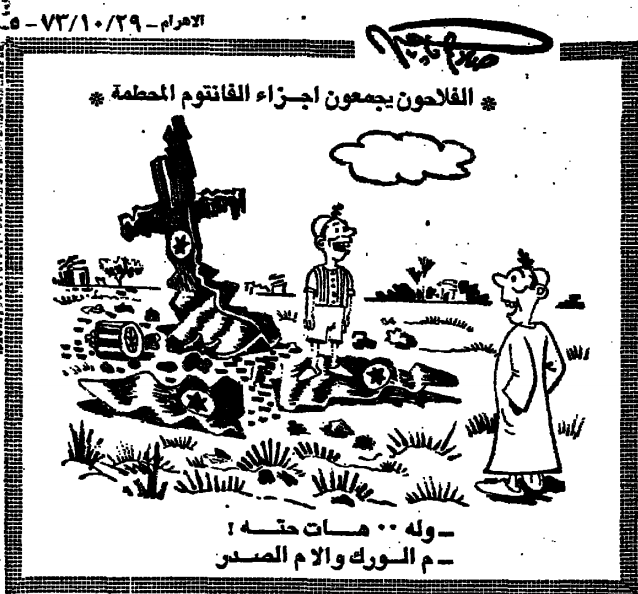
On October 29, 1973, Jahin depicted Egyptian peasants standing beside the wreckage of an Israeli Phantom aircraft, with one of them discussing the aircraft’s various parts. This cartoon is particularly significant in illustrating the collapse of the image of Israeli military superiority. The Phantom, representing an advanced weapon, is reduced to wreckage, while the Egyptian peasant, representing the ordinary citizen, treats it as nothing more than debris that can be collected. Through this contrast between the value attributed to the weapon before it was shot down and its condition afterward, Jahin presents a symbolic image of the Egyptian military achievement.
23- Cartoon of 30 October 1973: The Energy Crisis and the Middle East Crisis
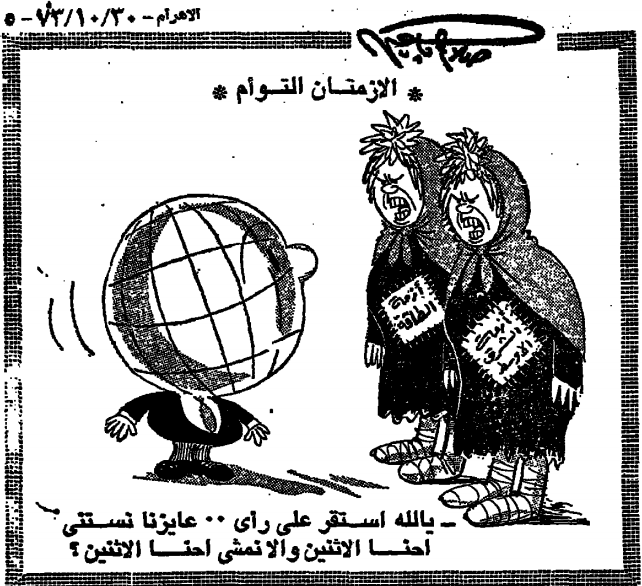
On 30 October 1973, Jahin produced a cartoon addressing two simultaneous crises: the energy crisis and the Middle East crisis. He personified them as two enormous women standing before the United Nations, depicted as a small man. The cartoon reflects an awareness of the dimensions of the war, which had extended beyond direct military confrontation to generate international and economic repercussions. The small size of the United Nations in comparison with the two crises also conveys a satirical view of the international organisation’s limited ability to address such interconnected crises.
24- Cartoon of 1 November 1973: Israel and the White House
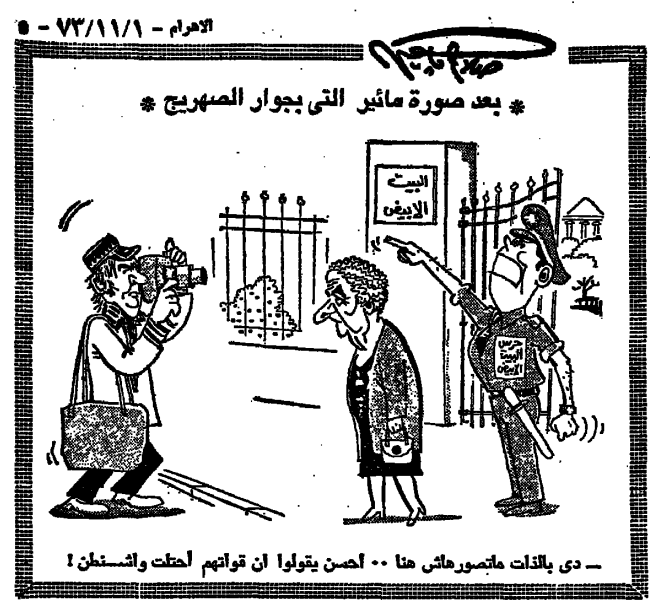
On 1 November 1973, Jahin depicted Golda Meir standing before the White House, comparing her with her appearance at the Ras El-Adab fuel tank, where Egyptian forces succeeded in raising the Egyptian flag east of the Canal during the War of Attrition. Israeli forces were unable to remove the flag for three days and could only do so after blowing up the tank from below. Jahin linked the scene to a satirical idea that the presence of Israeli forces in Washington could be interpreted as an American occupation. The cartoon continues his critical portrayal of the relationship between Israel and the United States, using caricatural exaggeration to depict the strength of the ties between the two sides. Through this exaggeration, Jahin transforms the political and diplomatic relationship into a satirical visual scene whose meaning can be immediately grasped by the viewer.
Conclusion:
The foregoing analysis of Salah Jahin’s cartoons during the October 1973 War shows that they provided a concentrated visual treatment of events, combining the speed of daily commentary with the ability to transform political and military developments into symbolic images that could be readily understood and widely circulated among the public. The cartoons examined in this study reveal a clear diversity of themes. Jahin addressed Israel’s positions in international forums, the image of its army, its military losses, and the positions of the United States and the United Nations, as well as the impact of the war on the daily lives of Egyptians. In constructing these meanings, he relied on visual irony, symbolism, and exaggeration, allowing the cartoon to perform a function that went beyond entertainment to commentary, criticism, and exposure of the contradiction between the claims of the warring parties and the realities revealed on the battlefield. Through this approach, the cartoon brought complex events and interconnected political positions closer to the reader and endowed them with direct popular meanings.
The significance of Jahin’s wartime experience also lies in its ability to combine a national dimension with a critical one. His cartoons were not merely celebrations of Egyptian military successes; rather, they offered a satirical reading of the broader context surrounding the war, including the Israeli position, US support, the international role, and efforts to bring the fighting to an end. Some cartoons also conveyed the emotions of Egyptian families and citizens, presenting the war as a comprehensive national experience that extended beyond the military front to society as a whole. Accordingly, Salah Jahin’s cartoons represent an important aspect of the cultural participation surrounding the October 1973 War. They contributed to shaping a visual discourse supportive of the battle, countering Israeli propaganda, and expressing the psychological and social condition of Egyptian society during the war. In this way, satirical imagery and satirical writing converged in performing a cultural and moral function: interpreting the events, shaping public awareness of them, and highlighting the impact of the military victory on reshaping the public perception of the Arab-Israeli conflict.
Conclusion:
A study of the satirical thought that accompanied the October 1973 War reveals the prominent role of satirical culture in expressing the October victory and the political, psychological, and social transformations associated with it. Satire was not merely a means of entertainment; it was a way of commenting on the war, reassessing its consequences, and engaging with its impact on Egyptian society. Its flexible nature made it possible to combine a national perspective with a critical outlook, allowing expressions of triumph and pride while retaining the capacity to question certain aspects of reality.
Ahmed Ragab represents one of the most prominent examples of satirical writing that accompanied the October War. He employed situations, dialogue, and satirical characters to offer an interpretation of the war, focusing on the contrast between the prevailing perceptions before the crossing and the shifts in attitudes and perceptions brought about by the war’s outcomes. His satire was distinguished by its ability to transform complex political and military issues into situations accessible to the reader, drawing on everyday language and irony to convey serious meanings in a light-hearted form.
Ragab also maintained the critical function of satire even amid the national mobilisation that accompanied the war. His writings did not become mere celebrations of victory; rather, they continued to view society through a critical lens, highlighting contradictions and behaviours worthy of comment. His distinctive approach thus lay in combining national commitment with social criticism.
Salah Jahin, by contrast, offered a different and more concentrated form of expression through caricature. The visual medium enabled him to condense a political or military position into a single scene and to employ symbolism, irony, movement, and suggestion to convey meanings that could sometimes be difficult to communicate through direct language. His wartime caricatures therefore acquired a particular capacity to reach the public, drawing on the immediacy, clarity, and accessibility of the visual image.
Jahin’s cartoons are particularly significant for their treatment of the image of the enemy as part of the psychological and cultural dimension of the conflict. Visual irony contributed to portraying Israeli soldiers and leaders in satirical terms, a transformation whose significance extended beyond humour, as it reflected a change in popular perceptions of the enemy following the crossing. At the same time, Jahin used his symbols and characters to express the Egyptian condition, linking his cartoons to popular sentiments and to a visual language readily understood by a broad audience.
The works of Ragab and Jahin demonstrate that satire was closely connected to the popular consciousness during the war. Drawing on everyday language, familiar situations, and the spirit of Egyptian humour, they did not present a cultural discourse detached from their audience. Consequently, they helped move the war from the military and political sphere into the social realm and reflected the ways in which Egyptians received the war, followed its developments, and responded to its news and outcomes.
From a historical perspective, these works constitute an important source for studying Egyptian perceptions of the October War, as they reveal aspects that do not emerge to the same extent from official documents or direct political discourse. Satirical writing and caricature provide indications of the nature of public sentiments, perceptions of self and other, and the issues that attracted public attention during the war. They can therefore serve as complementary material alongside political, military, and press sources in studying the history of October.
The experience of Ragab and Jahin also demonstrates that the military victory produced cultural repercussions extending beyond the battlefield. The event reshaped many perceptions that had emerged in the aftermath of the June 1967 War and opened the way for a more self-confident cultural discourse. In this context, satire performed an important symbolic function by transforming certain manifestations of earlier anxiety and fear into subjects of humor and by portraying the enemy from a perspective different from that which had prevailed before the crossing.
Accordingly, satirical thought during the October War represents an important dimension in the study of the cultural history of the conflict. Ahmed Ragab and Salah Jahin each contributed to shaping an aspect of the cultural memory of the October War, despite differences in their tools and approaches. This diversity made satirical thought an indispensable element in examining Egyptian cultural engagement with the war. It did not merely record the event; it offered a popular and artistic interpretation of it and connected the military victory with the transformation in the public mood, giving their works a significance that extends beyond the time of their publication to make them a testimony to a pivotal period in modern Egyptian history.
References
- Ahmed Ragab, Nuss Kalima [Half a Word], Kitab Al-Youm series, published by Akhbar Al-Youm, Egypt, 2006.
- Salah Jahin, The Caricature Collection of Salah Jahin, Dar Al-Mustaqbal Al-Arabi, Cairo, 1988.
- Abdel Rahman Badr, Satirical Journalism in Egypt: A Century, Al-Sahafa Al-Arabiya Publishers, Cairo, 2018.
Daily Newspapers
First: Al-Akhbar — Egypt
- Al-Akhbar, Issue No. 6644, “Half a Word”, Sunday, 7 October 1973.
- Al-Akhbar, Issue No. 6645, “Half a Word”, Monday, 8 October 1973.
- Al-Akhbar, Issue No. 6646, “Half a Word”, Tuesday, 9 October 1973.
- Al-Akhbar, Issue No. 6647, “Half a Word”, Wednesday, 10 October 1973.
- Al-Akhbar, Issue No. 6648, “Half a Word”, Thursday, 11 October 1973.
- Al-Akhbar, Issue No. 6649, “Half a Word”, Friday, 12 October 1973.
- Al-Akhbar, Issue No. 6650, “Half a Word”, Sunday, 14 October 1973.
- Al-Akhbar, Issue No. 6651, “Half a Word”, Monday, 15 October 1973.
- Al-Akhbar, Issue No. 6652, “Half a Word”, Tuesday, 16 October 1973.
- Al-Akhbar, Issue No. 6653, “Half a Word”, Wednesday, 17 October 1973.
- Al-Akhbar, Issue No. 6654, “Half a Word”, Thursday, 18 October 1973.
- Al-Akhbar, Issue No. 6655, “Half a Word”, Friday, 19 October 1973.
- Al-Akhbar, Issue No. 6657, “Half a Word”, Sunday, 21 October 1973.
- Al-Akhbar, Issue No. 6658, “Half a Word”, Monday, 22 October 1973.
- Al-Akhbar, Issue No. 6659, “Half a Word”, Tuesday, 23 October 1973.
- Al-Akhbar, Issue No. 6660, “Half a Word”, Wednesday, 24 October 1973.
- Al-Akhbar, Issue No. 6661, “Half a Word”, Thursday, 25 October 1973.
- Al-Akhbar, Issue No. 6662, “Half a Word”, Friday, 26 October 1973.
- Al-Akhbar, Issue No. 6664, “Half a Word”, Sunday, 28 October 1973.
- Al-Akhbar, Issue No. 6665, “Half a Word”, Monday, 29 October 1973.
- Al-Akhbar, Issue No. 6666, “Half a Word”, Tuesday, 30 October 1973.
Second: Al-Ahram
- Al-Ahram, Issue No. 31712, Sunday, 7 October 1973.
- Al-Ahram, Issue No. 31713, Monday, 8 October 1973.
- Al-Ahram, Issue No. 31714, Tuesday, 9 October 1973.
- Al-Ahram, Issue No. 31715, Wednesday, 10 October 1973.
- Al-Ahram, Issue No. 31716, Thursday, 11 October 1973.
- Al-Ahram, Issue No. 31717, Friday, 12 October 1973.
- Al-Ahram, Issue No. 31718, Saturday, 13 October 1973.
- Al-Ahram, Issue No. 31719, Sunday, 14 October 1973.
- Al-Ahram, Issue No. 31720, Monday, 15 October 1973.
- Al-Ahram, Issue No. 31721, Tuesday, 16 October 1973.
- Al-Ahram, Issue No. 31722, Wednesday, 17 October 1973.
- Al-Ahram, Issue No. 31723, Thursday, 18 October 1973.
- Al-Ahram, Issue No. 31724, Friday, 19 October 1973.
- Al-Ahram, Issue No. 31725, Saturday, 20 October 1973.
- Al-Ahram, Issue No. 31726, Sunday, 21 October 1973.
- Al-Ahram, Issue No. 31727, Monday, 22 October 1973.
- Al-Ahram, Issue No. 31728, Tuesday, 23 October 1973.
- Al-Ahram, Issue No. 31729, Wednesday, 24 October 1973.
- Al-Ahram, Issue No. 31730, Thursday, 25 October 1973.
- Al-Ahram, Issue No. 31732, Saturday, 27 October 1973.
- Al-Ahram, Issue No. 31733, Sunday, 28 October 1973.
- Al-Ahram, Issue No. 31734, Monday, 29 October 1973.
- Al-Ahram, Issue No. 31735, Tuesday, 30 October 1973.
- Al-Ahram, Issue No. 31737, Thursday, 1 November 1973.
Online Articles
- Gamal El-Sharqawi, “In Memory of the Late Ahmed Ragab: The Man Who Brought a Smile to Egyptians with Half a Word,” Sada El-Balad, Sunday, 11 September 2022, 11:10 p.m.
Article - Mohamed Ghoneim, “Ahmed Ragab, the Satirist and King of Half a Word,” Youm7, Tuesday, 12 September 2023, 5:30 p.m.
Article - Mohamed Tawfik, “Half a Century × Half a Word: How Did Ahmed Ragab Document Egyptians’ Lives?”, Haarf, Monday, 18 May 2026, 11:34 a.m.
Article