








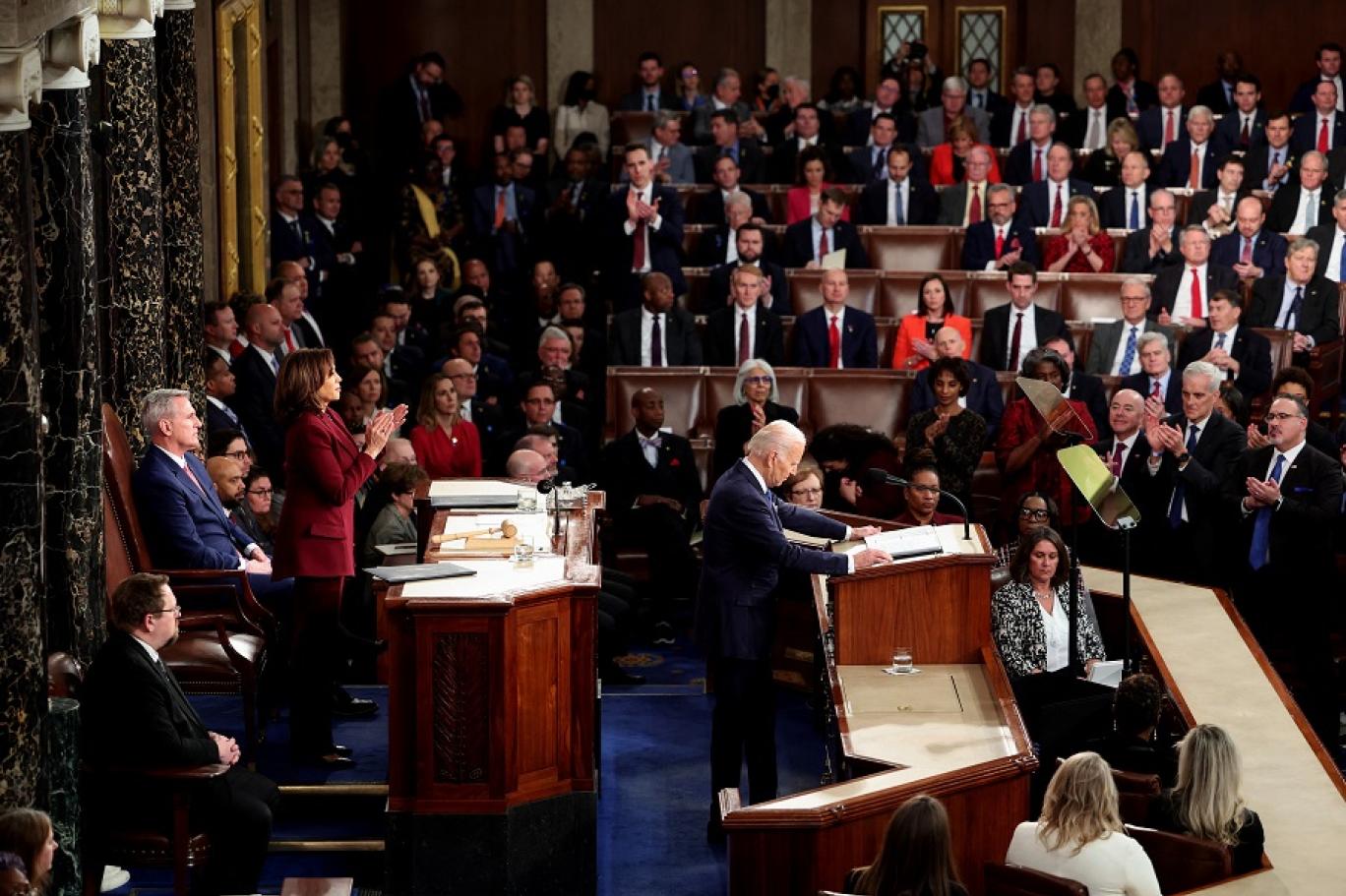
On 7 February, US President Joe Biden gave his State of the Union Address (SOTUA) to Congress, focusing primarily on US domestic issues and sparingly on foreign policy issues. This came as the first year of the Russian-Ukrainian War was drawing to a close and days after the balloon crisis with China had taken place. This year’s address stood in stark contrast to last year’s, which was clearly dominated by the reverberations of the Russian-Ukrainian war.
As a result, it appeared that President Biden was eager to develop a new philosophy for this year’s SOTUA based on reviewing his internal accomplishments that are currently occupying the US street to open the door for a presidential re-run, as some analysts speculated. This is why he adopted an upbeat and optimistic tone, placing emphasis on the economy and his administration’s success in generating new employment opportunities. In this regard, he made use of strong patriotic expressions. For instance, when reporting on the State of the Union, Biden noted, “Because the soul of this nation is strong, because the backbone of this nation is strong, because the people of this nation are strong, the State of the Union is strong.”
The SOTUA between Biden’s Employment and US Street Priorities
The first SOTUA was delivered in 1790 in accordance with Paragraph 1 of Article II, Section 3 of the US Constitution, which requires the President to report on the state of the union to Congress. The Address was formerly known as the “Annual Message” until it was officially renamed the “State of the Union Address” in 1947. Its significance stems from the fact that it provides insight into the reality of the situation on the ground, the scope of the accomplishments made over the previous year, and the policies that will be implemented in the coming year. In contrast to presidential inaugurations and state funerals, the SOTUA is unique in that it is attended by all branches of the federal government, with the President representing the executive branch, members of the House of Representatives and the Senate representing the legislative branch, and Supreme Court justices representing the judicial branch.
Amid the apparent division in the US, complexities of which became apparent with the recent midterm elections, which resulted in the division of Congress by a narrow margin for both camps, in a way that improved opportunities for them to settle political scores, particularly with rising expectations that the House Republicans would launch a number of investigations on the one hand, as well as working to obstruct President Biden’s agenda on the other, President Biden tended to emphasize, throughout his speech, the importance of unity and overcoming political division, urging Democratic and Republican members of Congress to work together. At the outset of the speech, Biden made light of Republican House Speaker Kevin McCarthy, saying to him, “I don’t want to ruin your reputation, but I look forward to working with you.”
In a similar vein, Biden attempted to commend the cooperative efforts between Democrats and Republicans over the previous two years, viewing them as a model that can be expanded upon for the following two years, saying, “We’re often told that Democrats and Republicans can’t work together. But over the past two years, we proved the cynics and naysayers wrong.” He addressed the Republicans, stating, “we disagreed plenty. And yes, there were times when Democrats went alone. But time and again, Democrats and Republicans came together.” Using motivational patriotic expressions, he said, “We’re the only country that has emerged from every crisis we’ve ever entered stronger than we got into it.”
Since the economy has a significant impact on poll results, Biden focused much of his speech on highlighting the economic successes of his administration, which succeeded in adding 12 million jobs in just two years, more than any other president has managed in four years. He tried to explain this by thinking back to when he took office as president two years ago and how the economy was “tottering,” bringing to mind the restrictions of “Covid-19” and the loss of investment value. He was aiming to provide a numerically supported review in this setting. In reference to unemployment, he stated that “the unemployment rate stands at 3.4%, which is the lowest level in 50 years.”
With regards to inflation, Biden made it crystal clear that it is on the decline, and that the United States is “better positioned than any country on Earth right now.” When discussing the chip crisis, he stated that the United States “once produced forty percent of the world’s chips,” adding, “In the last several decades, we lost our edge. We’re down to only producing 10 percent. We can never let that happen again. That’s why we came together to pass the bipartisan CHIPS and Science Act. This means that he attempted to confirm that while the previous administrations are to blame for the current crisis, it is actually his administration that has the answer.
He also praised the expansive infrastructure plan that his administration put forth and that Congress was able to pass. He noted that the United States now ranks thirteenth in the world in terms of infrastructure strength and emphasized that this will change after the law is passed. In addition, he referenced the “Made in America” bill, which mandates the use of American-made materials in federal or federally-funded construction projects. Regarding climate change, Biden stated, “We have an obligation not to ourselves, but to our children and grandchildren to confront it,” adding, “We will still need oil and gas for a while.” Hence, Biden used realistic language to address this problem.
He criticized the tax code, calling it “unfair” and stating “wealthy and big corporations [should] pay their fair share.” He also called for passing his “proposal for the billionaire minimum tax,” noting that “55 of the largest corporations in America, the Fortune 500, made $40 billion in profits and paid zero in federal taxes.” He criticized the tax system, calling it “unfair” and stressing that “wealthy and big corporations should pay their fair share.” He also called for passing his “proposal for the billionaire minimum tax”, noting that “55 of the largest corporations in America, the Fortune 500, made $40 billion in profits and paid zero in federal taxes.”
Regarding the national debt, Biden stated that his administration has reduced the deficit by more than $1.7 trillion and promised to further reduce the national debt this year. He requested that Congress pass a bill raising the nation’s debt ceiling, noting that some Republicans were threatening to hold the economy hostage unless he agreed to their economic plans. As a rebuttal to the Republican charges against his administration, he attempted to tie the current state of the national debt to the presidency of his predecessor, Trump, claiming that “no President added more to the national debt in any four years than my predecessor.” Following this line of thought, he continued, “instead of making the wealthy pay their fair share, some Republicans want Medicare and Social Security to sunset.”
Some of the Republicans in attendance shouted their opposition, but he managed to keep the peace by claiming that this is not a general partisan position but rather the viewpoint of a few people who “may not represent the majority of Republicans.” By doing this, he was trying to undermine the Republicans’ standing without directly confronting them while also capitalizing on it to emphasize that the plan he will present will reduce the deficit by an additional $2 trillion without affecting social security or healthcare in any way.
In addition to the aforementioned, Biden advocated for a pay raise for public school teachers and free preschool for children aged three and four. He discussed the cost of medications and urged efforts to turn more cancers from death sentences to treatable diseases. Additionally, he demanded that the police reform law be passed, claiming that it would help to create neighborhoods free from violence. Given the high rate of violence and mass killings that the American arena is witnessing on a regular basis, Biden also called for a ban on assault weapons and praised the Arms Regulatory Act passed by Congress. He emphasized the need for cooperation to address the issue of unlawful immigration, urging the House of Representatives to support immigration legislation and provide the border patrol with the necessary equipment.
In addition, he advocated for preventing drugs from entering the country by modernizing border crossings and equipping them with modern equipment, noting that fentanyl kills more than 70,000 Americans each year. He also advocated for a greater focus on mental health and holding social media companies accountable for running on children for profit.
Aware of the high number of veteran suicides, Biden also advocated for assisting veterans to afford their rent and supporting their mental health. Biden’s recognition of the significance of the abortion debate, which overshadowed the results of the midterm elections, was another key point. In this regard, he declared: “If Congress passes a national ban, I will veto it.”
Regarding international affairs, Biden reaffirmed his administration’s staunch support for Ukraine. He also invited members of Congress to applaud the Ukrainian ambassador who joined them and told her, “We’re going to stand with you as long as it takes.” He gave an explanation of the initiatives taken by his administration to support partners and allies and strengthen NATO, saying: “we did what America always does at our best. We led. We united NATO. We built a global coalition. We stood against Putin’s aggression. We stood with the Ukrainian people.”
In his remarks, Biden emphasized the strength of the interdependence of democracies around the world, saying that “in the past two years, democracies have grown stronger, not weaker. Autocracies have grown weaker, not stronger.” In display of power, Biden said that “those who bet against America are learning how wrong they are.”
Regarding China, he emphasized that the story about how the People’s Republic of China was increasing its power and America was failing in the world was prevalent before he took office, but that this is no longer the case and that he is “committed to work with China where they can advance American interests and benefit the world.” Biden said that he made it clear in personal conversations with President Xi that the United States “seeks competition, not conflict”. In reference to the balloon crisis, he cautioned, “If China threatens our sovereignty, we will act to protect our country. And we did.”
Important Remarks
The significance of the SOTUA lies in the indicators it reflects regarding the American arena and the dynamics of internal political interactions and the insight it provides into the administration’s and the public’s respective priorities. Typically, in the SOTUA, the president addresses the entire American populace, regardless of partisan affiliation, by emphasizing unity directly in the address and addressing the various issues that affect every segment of the population. Here are the key highlights from Biden’s SOTUA:
- Tone of National Pride
During the SOTUA, Biden purposefully employed a tone of national pride, which was reflected in multiple parts of his address, including his remark, “We’ve broken the COVID grip on us.”, his question, “where is it written that America can’t lead the world in manufacturing?”, his remark, “Because the soul of this nation is strong, because the backbone of this nation is strong, because the people of this nation are strong.” and his claim that the United States is “the only country that has emerged from every crisis we’ve ever entered stronger than we got into it” and that “those who bet against America are learning how wrong they are.” The final remark could be interpreted as Biden’s attempt to counter the populist nationalist discourse of Trump and his supporters.
- Focus on the US Interior
A common saying holds that domestic issues, especially those pertaining to the economy, have a strong and influential effect on the American street, while foreign policy is only of interest when American soldiers are killed overseas. In his speech, President Biden seemed to have adhered to this adage, by attempting to highlight the most internal accomplishments possible. Despite the momentum surrounding the balloon crisis with China, Biden’s speech did not give it enough attention and he made no mention of the recent earthquake in Syria and Turkey or the related dire humanitarian situation.
- Declining Focus on Ukraine
During last year’s SOTUA, the Russian-Ukrainian war occupied a prominent position, as Biden began his speech by discussing Russian aggression against Ukraine, before praising the valor of the Ukrainian people and emphasizing that the United States stands with Ukraine.
The atmosphere in the room, which was predominated by a state of positivity, support, and advocacy, was a reflection of this as the Address was repeatedly interrupted by applause from those in attendance. Even though Biden brought up the Ukraine war and the Ukrainian ambassador was present, the SOTUA this year did not draw much attention to it. This can be interpreted as a decline in internal US consensus on Ukraine, in light of rising voices calling for an end to further aid.
- Promoting Unity and Fighting Division
The division in America was evident in the midterm elections, and the division in Congress actually served to exacerbate it. In order to prevent the paralysis that his administration may experience as a result of the division, Biden was clearly aware of the need to contain this situation and to persuade the Republicans to work with his administration. In light of this, Biden has been quick to praise the bipartisan consensus reached over the past two years on issues such as infrastructure spending, high-tech investment, military aid to Ukraine, federal protection for same-sex marriage, etc. He has also called for the continuation of this consensus over the coming two years, particularly on the issue of raising the debt ceiling.
- Keeping the Republicans and Democrats’ Demands in Check
In order to appeal to the broadest possible audience, the SOTUA included a wide range of information about the majority of domestic issues. This does not appear to have happened at random, but rather in accordance with a conscious effort to address the concerns of both the Democratic and Republican parties. This led some analyses to view the SOTUA as Biden’s initial platform for the upcoming presidential election. He tried to balance Republican demands for fighting illegal immigration, maintaining border security, and bolstering the US business sector with Democratic demands for social and health care, support for the middle class, protection of the right to an abortion, and support for same-sex marriage. Biden thus appeared to have attempted to present a shared vision for the interior priorities of the US.
- Discrediting Trump without Involving the Republicans
Although Biden’s SOTUA was overwhelmingly positive and included repeated calls for cooperation and unity, he made several attempts to undermine Trump and the Trumpian trend without directly confronting the Republicans. He began by bringing up the storming of Congress and then stated that the current economic conditions are better than those he inherited from his predecessor two years prior.
Additionally, he claimed that the way the wealthy and large corporations are taxed is unfair. The issue of public debt was the most prominent point of contention between Democrats and Republicans, as Biden indicated that no president had added more to the national debt than Trump. He then attempted to link the Republicans’ demands regarding the debt limit to some proposals to cut Social Security and Medicare programs, which prompted some Republicans in the hall to call Biden a “liar,” but he attempted to absorb this wave of anger by clarifying that he was referring to a subset of Republicans and not all of them. In terms of foreign policy, he considered America’s declining position to be part of the negative legacy left by his predecessor, which he was able to rectify.
Overall, despite the positive aspects of Biden’s SOTUA and the chances he gave his administration to improve its image, there appears to be less of a connection between the SOTUA and the likelihood that Biden will run for president in the near future, let alone win the race. This is because of a number of factors, such as the president’s advanced age and poor health, the modest popularity of the Democratic Party as seen in the midterm elections, and the vigorous campaigns Trump is running to win the White House back. Last but not least, the election year, with all its surprises and events, will directly affect how the presidential race develops and who will win.