



By using ECSS site, you agree to the Privacy Policy and Terms of Use.
Accept
ECSS - Egyptian Center for Strategic StudiesECSS - Egyptian Center for Strategic Studies
  • Home
  • International Relations
    International Relations
    Show More
    Top News
    Intertwining factors: The Significance of the MoU between the Syrian Democratic Council and the People’s Will Party
    September 18, 2020
    Pre-emptive fallacies Refuting Ethiopia’s claims on the second filling of GERD
    April 26, 2021
    the New Republic: Egypt’s Role in Africa
    October 20, 2021
    Latest News
    Israel’s security and economic conundrum:How does Israel confront the challenges of a protracted war with Iran?
    May 2, 2026
    Reshaping the US position toward Israel: From the erosion of the old consensus to a new conflict across parties, state, and society
    April 23, 2026
    Israel’s African gambit
    March 6, 2026
    Geopolitical realism: What does Washington’s return to the African Sahel mean?
    March 5, 2026
  • Defense & Security
    Defense & Security
    Show More
    Top News
    Turkey and the Muslim Brotherhood: A temporary refuge and alternative Havens
    October 1, 2020
    Clashes in Tripoli: Do Rapid Developments in Libya Clash with the Road Map?
    August 22, 2023
    Assessing Deterrent Measures and the Prospects of War: US Military Movement in the Gulf to Confront Iran
    June 22, 2020
    Latest News
    Between two camps: Reading into ISIS discourse on the US-Israeli war on Iran
    April 15, 2026
    Encrypted messages “Roaring Lion”: The hidden messages behind the name of the operation against Iran
    March 11, 2026
    Iran war developments
    March 9, 2026
    Manufacturing the enemy : Reframing terrorism in contemporary Western discourse
    March 7, 2026
  • Public Policy
    Public Policy
    Show More
    Top News
    Favorable circumstances: Investing in Egyptian banks
    May 11, 2021
    Real Estate Transaction Tax: Addressing Challenges of Egypt’s Real Estate Sector
    March 24, 2022
    Investment in Egypt amid Covid-19
    July 25, 2021
    Latest News
    From global shock to Egypt’s economy: Analyzing the impact of the Iran war on energy security
    May 3, 2026
    Egypt as a balancing power: Why Cairo rejects the logic of wars in the Middle East
    April 30, 2026
    Militarizing water in Middle East wars A strategic analysis of the Iran-US-Israel war
    April 18, 2026
    Reading into attacks on maritime navigation in the Arabian Gulf
    March 17, 2026
  • Analysis
    • Opinion
    • Analysis
    • Situation Assessment
    • Readings
  • Activities
    • Conferences
    • ECSS Agenda
    • Panel Discussion
    • Seminar
    • Workshops
  • ECSS Shop
  • العربية
  • Defense & Security
  • International Relations
  • Public Policy
All Rights Reserved to ECSS © 2022,
Reading: Heat in the Arabian Gulf Waters
Share
Notification Show More
Latest News
From global shock to Egypt’s economy: Analyzing the impact of the Iran war on energy security
Economic & Energy Studies
Israel’s security and economic conundrum:How does Israel confront the challenges of a protracted war with Iran?
Palestinian & Israeli Studies Research Programs
Egypt as a balancing power: Why Cairo rejects the logic of wars in the Middle East
Media Studies
Reshaping the US position toward Israel: From the erosion of the old consensus to a new conflict across parties, state, and society
American Studies
Militarizing water in Middle East wars A strategic analysis of the Iran-US-Israel war
Economic & Energy Studies
Aa
ECSS - Egyptian Center for Strategic StudiesECSS - Egyptian Center for Strategic Studies
Aa
  • اللغة العربية
  • International Relations
  • Defense & Security
  • Special Edition
  • Public Policy
  • Analysis
  • Activities & Events
  • Home
  • اللغة العربية
  • Categories
    • International Relations
    • Defense & Security
    • Public Policy
    • Analysis
    • Special Edition
    • Activities & Events
    • Opinions Articles
  • Bookmarks
Follow US
  • Advertise
All Rights Reserved to ECSS © 2022, Powered by EgyptYo Business Services.
Arab & Regional Studies

Heat in the Arabian Gulf Waters

Khaled Okasha
Last updated: 2023/08/15 at 11:03 AM
Khaled Okasha
Share
8 Min Read
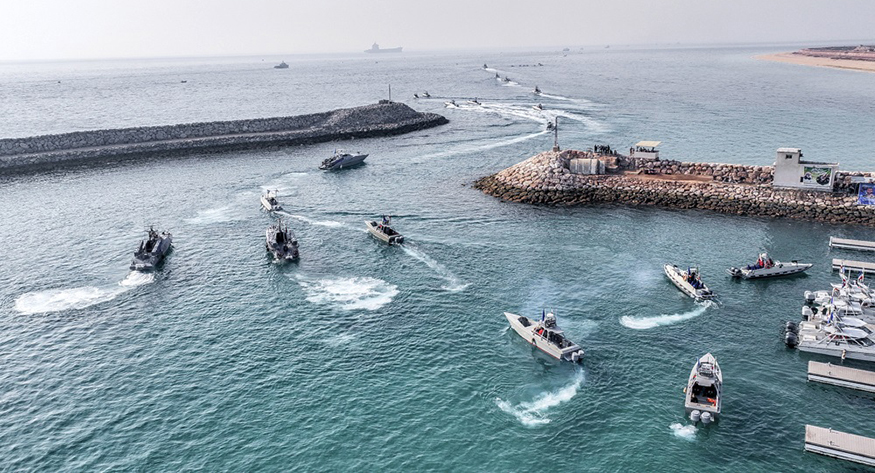
Iranian Revolutionary Guard Corps’ speedboats move during an exercise in Abu Musa Island, Credit: AP
SHARE

The Islamic Revolutionary Guard Corps (IRGC) announced on Wednesday it was conducting a military maneuver on the UAE-occupied islands of Greater and Lesser Tunbs and Abu Musa, dubbing it the “Martyr Brigadier General Ishaq Dara” maneuver. 

The exercises, according to the official Iranian news agency IRNA, were primarily focused on Abu Musa Island, but the IRGC also deployed forces to Greater Tunb Island, noting that ships, drones, and missile units participated in the drill. In his statements on the maneuver, Brigadier General Abolfazl Shekarchi, the spokesman for the Iranian General Staff, subtly threatened the countries in the region, saying: “The avaricious need to get a glimpse of our arsenal so that they avoid making a mistake in their calculations.”

In typical Iranian fashion, however, he intended to pack the maneuver and his words with multiple messages. Speaking to Tasnim News Agency, he explained that the maneuver that took place close to the Strait of Hormuz was intended to send a message to the countries in the area about the need to stop depending on outsiders for security. He urged these countries to strengthen their relationship with Iran and promised them that if this occurred, security would be established in the waters of the Arabian Gulf.

In response, the United States immediately dispatched the amphibious assault ship USS-Bataan and the landing ship USS Carter Hall, with over 3,000 US Marines aboard. This remarkable action may have a number of implications, chief among them being the protection of this strategic shipping route from the potential for regional conflict that could disrupt 20 percent of the world’s oil trade and affect the stability of already high oil prices due to the Russian-Ukrainian war.

Despite the significance of this step, the United States did not stop there. There were many messages sent to various parties in and outside the region. Indeed, Washington’s step represented a reversal from its previously announced strategic direction, which prioritized interest in the East Asian region at the expense of reducing attention and involvement in the Middle East region’s problems.

The first US message was sent to its Gulf allies in an effort to mend relations and rebuild trust that had recently been severely damaged by the United States’ declining interest in the Middle East, which they found to be inconsistent with their needs for security in Gulf waters, let alone other issues where the US  took a stance on gray areas, which made it possible for other global powers to take advantage of this retreat and access previously inaccessible areas. 

The second message was unmistakably meant for China, the most worrisome of the world’s superpowers to the United States in light of China’s diplomatic success in serving as a diplomatic intermediary between Saudi Arabia and Iran. There is potential for this Chinese role to expand in the future to include joint military and security mediation between the two countries or between the countries on either side of the Gulf, as a wager on its future relations with Iran and a means of putting an end to the legacy of the United States, which voluntarily declared indifference to the worries of the nations in that region.

Some believe the American election has a bearing on this US action, since the current democratic administration, which plans to run for president, will enter the presidential race without making much progress on the Iranian nuclear issue. Notably, the previous Republican administration abandoned the nuclear deal while highlighting the futility of negotiations with Tehran. The Joe Biden administration believes that this file will inevitably represent weaknesses that the Republicans will exploit, which is what prompted him to make such a snap decision before the presidential election campaign begins at the beginning of next year.

The US military buildup undoubtedly heats the Gulf waters, particularly after the US military disclosed that it is considering sending Marines to sail on board commercial ships and oil tankers passing through the Strait of Hormuz. Although it is an unprecedented action, the Pentagon wants to stop Iran from capturing, bothering, or crippling civilian vessels. Prior to this, in response to Iran’s detention and harassment of commercial cargo ships, the Pentagon sent additional F-35 and F-16 fighter jets and a warship to the Middle East to monitor the region’s major waterways.

In recent years, the US military has documented a number of incidents in which Iran was actually involved. During the past two years alone, Iran has been reported to have detained or attempted to seize close to 25 ships of various nationalities in the region. Possibly the most heated moments in the ongoing conflict between the United States and Iran occurred in 2019, when a series of attacks on cargo ships in Gulf waters sparked a conflict known as the “tanker war”.

At the time, Tehran claimed that both the United States and the United Kingdom were attempting to forcibly seize Iranian oil under the guise of carrying out sanctions that Tehran does not recognize. Since then, the conflict over the Arabian Gulf and its surrounding waters has escalated at regular intervals for a wide range of reasons. Each side has its own goals as well as general concerns about navigational security, as was the case last July, which may have served as a harbinger of the current situation. After the United States declared on 5 August that its forces had prevented two Iranian attempts to seize commercial tankers in international waters off Oman, Iran seized a ship the following day.

In light of analogous earlier chapters, the current escalation in tensions between the United States and Iran may seem deliberate and unlikely to spiral out of control. However, this time, their motivations might outweigh their common sense, and a decline seems more likely than ever before, in light of an atmosphere far more volatile than that which is necessary for pacification.

Related Posts

Analysis| Turkey without terrorism: Assessing the trajectory of Turkish–Kurdish reconciliation

2025 Yearender: China’s multipolar world

Trump’s Gulf Tour: US Economic Gains and Reshaping the Geopolitical Landscape

Ethnic Frontiers: What Drives Israel’s Escalatory Actions in Syria?

Khaled Okasha August 15, 2023
Share this Article
Facebook Twitter Whatsapp Whatsapp LinkedIn Telegram Email Copy Link Print
Khaled Okasha
By Khaled Okasha
General Manager

Stay Connected

Facebook Like
Twitter Follow
Instagram Follow
Youtube Subscribe

Latest Articles

Egyptian-Greek Trade Relations to Prepare for the Next Step
International Relations September 1, 2020
of Sudan’s neighboring countries, Egypt is the most impacted by the current situation in Sudan because it has taken in and is still taking in large numbers of internally displaced people from Sudan and other countries, writes Mahmoud Salama.
The Humanitarian Dimension: Egypt’s Role to Ease Sudan Crisis
African Studies May 16, 2023
Why Have TikTok Security Concerns Grown Globally?
Cyber Security April 16, 2023
Book Review | The struggle for economic sovereignty: Who owns the instruments of power?
Readings January 31, 2026

Latest Tweets

//

The Egyptian Center for Strategic Studies is an independent non-profit think tank providing decision-makers by Policy alternatives, the center was established in 2018 and comprises a group of experts and researchers from different generations and scientific disciplines.

International Relations

  • African Studies
  • American Studies
  • Arab & Regional Studies
  • Asian Studies
  • European Studies
  • Palestinian & Israeli Studies

Defence & Security

  • Armament
  • Cyber Security
  • Extremism
  • Terrorism & Armed Conflict

Public Policies

  • Development & Society
  • Economic & Energy Studies
  • Egypt & World Stats
  • Media Studies
  • Public Opinion
  • Women & Family Studies

Who we are

The Egyptian Center for Strategic Studies (ECSS) is an independent Egyptian think tank established in 2018. The Center adopts a national, scientific perspective in examining strategic issues and challenges at the local, regional, and international levels, particularly those related to Egypt’s national security and core national interests.

The Center’s output is geared toward addressing national priorities, offering anticipatory visions for policy and decision alternatives, and enhancing awareness of various transformations through diverse forms of scientific production and research activities.

All Rights Reserved to Egyptian Center for Strategic Studies - ECSS © 2023

Removed from reading list

Undo
Welcome Back!

Sign in to your account

Lost your password?