







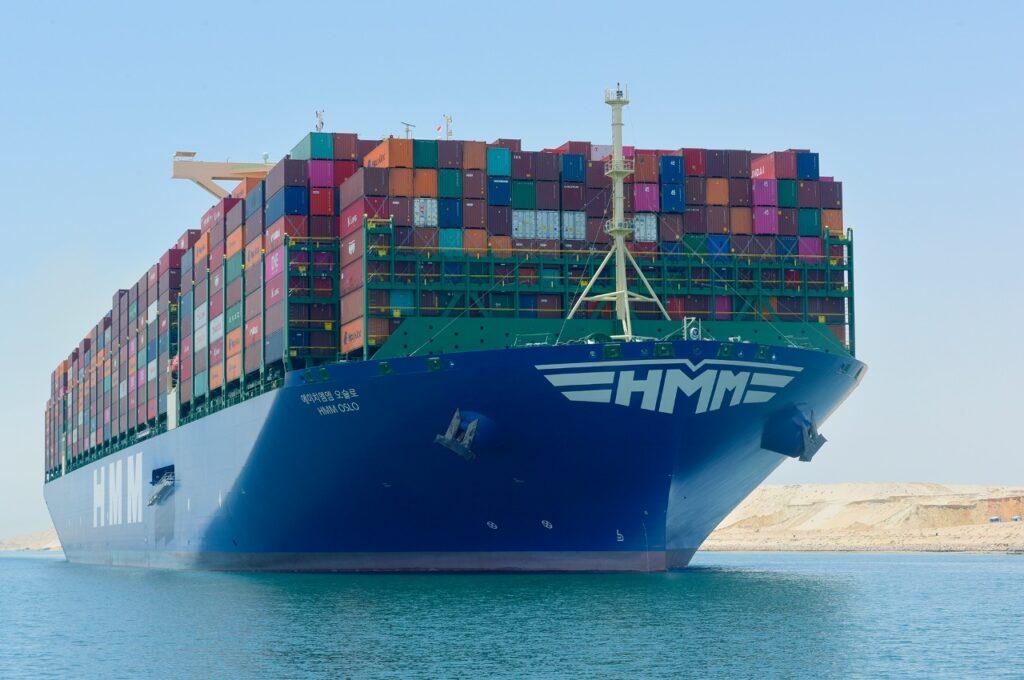
The Suez Canal holds significant strategic value for both the Egyptian and global economies, making it one of the world’s most significant waterways. Egypt’s Suez Canal links the Mediterranean and Red Seas and serves as a short but crucial commercial route connecting Asia and Europe. Egypt derives a significant portion of its economic revenue from the Suez Canal as transit fees are levied by the Egyptian government on ships and containers that use the Canal as a transit point for shipments. These fees help fund infrastructure projects and boost the country’s economy.
Performance of the Suez Canal for Fiscal Year 2022–2023
The Suez Canal is regarded as one of the most significant sea lanes for trade between Europe and Asia as well as a major source of foreign exchange for the Egyptian government. It also provides direct and indirect employment opportunities in numerous fields. In 2022-2023, the Canal’s annual revenue increased by approximately 34.7% to $9.4 billion, up from $7 billion in 2021-2022. Transit-wise, the number of ships using the Suez Canal increased by 55.1%, making 25,900 the highest number of ships ever to pass through the Canal in 2022–2023, up from 16,700 in 2013–2014.
Figure 1: Evolution of Suez Canal-passaging vessels

Sources: Central Bank of Egypt, June 2023 issue of the Monthly Statistical Bulletin
Suez Canal General Authority, performance report on the Suez Canal for fiscal year 2022-2023
In addition, net tonnage passing through the Suez Canal climbed by 66.7 percent to 1.5 billion tons in 2022–2023, the highest amount in the Canal’s history when compared to 0.9 billion tons in 2013–2014.
Figure 2: The Suez Canal Ship Payload’s Evolution

Sources: Central Bank of Egypt, June 2023 issue of the Monthly Statistical Bulletin
Suez Canal General Authority, performance report on the Suez Canal for fiscal year 2022-2023
Effective 15 January 2024, regular transit fees for a number of ship types will increase by 15%. Additionally, normal transit fees for dry bulk, general cargo, and ro-ro vessels will increase by 5%. The Suez Canal’s traffic fees increased by a reasonable amount to $2 billion, up from $1.7 billion in the second quarter of 2022-2023.
Figure 3: The Suez Canal’s traffic fees

Sources: Central Bank of Egypt, June 2023 issue of the Monthly Statistical Bulletin
In 2021–2022, the gross domestic product from the Suez Canal increased by EGP 73.42 billion, or 178.16 percent, from EGP 76.71 billion in 2016–2017 to EGP 114.63 billion at current prices, resulting in the highest revenue ever recorded for the Suez Canal. In the fiscal year 2021–2022, public investments in the Suez Canal climbed by 61.86% to approximately EGP 16.72 billion, from approximately EGP 10.33 billion in the fiscal year 2019–2020.
Figure 4: GDP variations at current prices resulting from the Suez Canal

Sources: Ministry of Planning and Economic Development
Factors Contributing to the Suez Canal Boom
High Oil Prices: As oil prices have risen, the Suez Canal’s competitive advantage has grown. Prices have peaked since the start of the third quarter of 2023, and the oil market is still experiencing a strong upward trend due to the higher costs of competing and alternative routes to the Canal, particularly the Cape of Good Hope route. This forces ships to select routes that are less expensive, require less fuel, and have shorter distances. One such route is the Suez Canal, which makes it easier and faster for ships to connect to the Red Sea from the Mediterranean. This will result in a significant increase in commercial traffic and the revival of maritime trade, both of which will be profitable for Egypt.
The comparison between traversing the Suez Canal and any other alternative route is not amenable to generalization owing to the absence of precise numerical data. Each vessel’s type, nature, and operating conditions vary, as do the routes they travel. Additionally, daily charter rates, operating costs, and fuel consumption fees vary for every vessel. A comparison was conducted between a VLCC-class oil tanker travelling from the port of Ras Tanura to the port of Rotterdam via the Cape of Good Hope route and container ships of the PPMX class, which have a 10,000 container capacity and sail from the port of Singapore to Rotterdam via the Suez Canal. The distance travelled from Singapore to Rotterdam via the Suez Canal was 8288 nautical miles, or 13 days and 20 hours. When the same ship uses the Cape of Good Hope route, the distance is 11,755 nautical miles, or 19 days and 14 hours.
In contrast, when examining the route taken by VLCC oil tankers from the port of Ras Tanura in the Arabian Gulf to the port of Rotterdam via the Cape of Good Hope, the situation is different. VLCC oil tankers have an average fuel consumption of 115 tons per day and an average speed of 15 knots at the conclusion of their journey. The tanker needs 17 days and 21 hours to arrive at the port of Rotterdam based on the 6,436 nautical miles travelled during the voyage via the Suez Canal route. With the Cape of Good Hope route, the tanker will travel 11,169 nautical miles, which translates to a journey time of 31 days and 1 hour.
Suez Canal Area Development: Enhancements have been implemented along the Suez Canal shipping lane, including enlargement projects and the establishment of marine garages for ship maintenance, thereby reducing the likelihood of traffic disruptions. Ten marine garages have been built up to this point. As part of the upgrading work, the Canal’s depth was increased to 24 meters. Additionally, the southern area was developed, and efforts were made to widen it from the east and deepen it to a depth of 27 meters, which resulted in a 28% increase in the navigational safety factor. The Bitter Lakes region was also developed by doubling the width of the Canal in this region from 250 to 500 meters, a distance of 10 kilometers. As a result, the Canal can now accommodate roughly eight ships, in addition to the amount it could before development work began. Further, Mohab Mameesh and Hussein Tantawi dredgers, the largest in the Middle East, entered service. In order to keep up with the growing number of ships passing through the Canal, the development strategy included the addition of 28 tugboats to the existing fleet. As part of its efforts to fortify its tugboat fleet, the Suez Canal Authority (SCA) recently finalized a partnership with the South Red Sea Shipyard Company to construct 10 tugboats with a pulling force of 90 tons and contracted with the Alexandria Shipyard to construct two massive tugboats with a pulling force of 190 tons. Three pollution control units of the type MultiCleaner 128 were recently delivered to the SCA by the French shipyard EFINOR, which is one of the world’s largest shipyards specializing in the construction of pollution control units.
The Suez Canal, a Green Canal: The Suez Canal supports the efforts of the International Maritime Organization (IMO) to promote the green transition in the maritime industry. Along with saving time and distance over other routes, the Suez Canal complies with environmental regulations and controls, which helps to cut down on harmful carbon emissions and fuel consumption by 20% to 80%. Furthermore, the application of hybrid systems—solar cells and wind turbines—was expanded to generate electricity for vessel guidance stations along the Suez Canal. This keeps the essential navigational equipment operating continuously and helps protect the environment from emissions equivalent to carbon dioxide. In comparison to other routes, the Suez Canal helped reduce carbon dioxide emissions by approximately 31 million tons in 2021 and saved about 10.3 million tons of fuel. Additionally, the new Suez Canal saved 53 million tons of carbon dioxide equivalent.
The Suez Canal Economic Zone: Approximately $18 billion was spent on infrastructure and investments in the Suez Canal economic zone, creating direct employment opportunities for 100,000 people. In addition, partnerships with 14 local industrial developers were formed, and 250 industrial and service facilities in a variety of sectors and crucial industries were established.
Regarding the most notable port infrastructure projects, the restoration and expansion of certain wharves at the West Port Said Port, estimated to cost around EGP 1.4 billion, and the construction of a 5-kilometer-long wharves at the East Port Said Port, estimated to cost around EGP 6.8 billion, stand out. With the opening of the port-side canal, the number of hours that vessels had to wait decreased.
In addition to the EGP 37 billion investment in the development of Ain Sokhna Port, port infrastructure initiatives encompassed the reopening of Al-Arish Port in January 2021, following an eight-year hiatus, with EGP 4 billion allocated for its further development, and an EGP 250 million investment in the establishment of Adabya Port.
In the economic zone, the establishment of manufacturing facilities for creating, supplying, and fixing up mobile railway units east of Port Said was one of the most exciting and lucrative investment opportunities. The project was executed with a total investment of $240 million and is anticipated to generate 2,000 direct and indirect job opportunities. Relatedly, there is the Russian industrial zone in eastern Port Said, which represents an investment of $6.9 billion and is anticipated to create 35,000 jobs. Other projects included the largest fiber optic factory in Ain Sokhna, with investments exceeding EGP 1 billion and an annual production capacity of 4 million kilometers of cables, in addition to the project’s current capacity to serve internal and external markets. Add to this the $100 million worth of projects that are being carried out in the area. In October 2023, a framework agreement was also signed with the goal of establishing a project to produce 210,000 tons of green hydrogen and 1.2 million tons of green ammonia annually, with investments totaling $6.75 billion in the industrial zone in Sokhna, Egypt, on a 500,000-square-meter area.
To put it succinctly, the Suez Canal is unique among international waterways, both for Egypt and for the rest of the world. It is the most significant shipping corridor in the world, as over 12 percent of global maritime trade traffic and 20 percent of international container trade pass through it. Additionally, it forms one of Egypt’s political, economic, and strategic pillars. Since none of the proposed corridors can move large containers as ships can through the Suez Canal, there will always be disruptions to the corridors that are being discussed as potential alternatives. The Suez Canal can accommodate a variety of ship types and sizes, including 62.2% of oil tankers, 92.6% of bulk cargo ships, 100% of container ships, car carriers, and general cargo ships, as well as 100% of the world’s fleet of other ships.