




Amidst the prolonged Sudanese war, which involved the Sudanese Armed Forces (SAF) led by First Lieutenant General Abdel Fattah Al-Burhan, who also serves as the Chairman of the Transitional Sovereignty Council, and the Rapid Support Forces (RSF) led by Mohamed Hamdan Dagalo, aka Hemedti, a number of regional and international powers became entangled in this conflict, transforming Sudan into an arena of polarization, attraction, and international score-settling following a number of crises and wars, the most prominent of which was the conflict in Ukraine. Recently, there has been a lot of talk about the involvement of Ukrainian forces in the Sudanese conflict, alongside the SAF. This development begs the question: What are the limits and underlying reasons for Ukraine’s involvement in the conflict in Sudan?
This article seeks to examine the indicators that suggest Ukrainian participation in the Sudanese conflict while also exploring the various motives that may underlie Kiev’s decision to join the SAF in the Sudanese war.
I. Signs of Ukrainian Involvement in the Conflict in Sudan
There are numerous indicators and evidence that demonstrate the increasing military cooperation between Ukraine and Sudan in the recent period subsequent to the Sudanese and Ukrainian conflicts. These can be delineated as follows:
1. The Wall Street Journal Discloses the Involvement of Ukraine in the Sudanese Conflict: According to a report published by the Wall Street Journal (WSJ), Ukrainian Special Forces are providing training to SAF members on combat tactics that have proven effective in countering the progress of Russian forces in the Ukrainian conflict, particularly in the utilization of unmanned aircraft. The SAF has made a request to Kiev for explosive drones that detonate upon impact. Ukraine has supplied the SAF with such aircraft, along with advanced Turkish Bayraktar TB2 unmanned aircraft that can carry out accurate air strikes.
The WSJ further elucidated that the Ukrainian forces, armed with night vision goggles and drones, gained a strategic advantage on the Sudanese battlefield due to the warring parties’ incapacity to execute significant nocturnal assaults.
The Ukrainian forces would initiate their offensive at approximately eight o’clock in the evening, employing combat groups comprising six individuals, in order to launch an assault on the RSF, which were accustomed to occupying exposed positions along the front line but subsequently resorted to concealing their positions with the multiplicity of nocturnal assaults. Following this, the Ukrainian forces would retreat and reestablish themselves at their base the following morning, making every effort to obscure their presence and involvement in the conflict.
The Ukrainian forces in Sudan were also tasked with cutting off RSF supplies from the capital, Khartoum, by attacking roads linking them to RSF-controlled areas in western Sudan with unmanned aircraft, as well as planting mines along the supply routes.
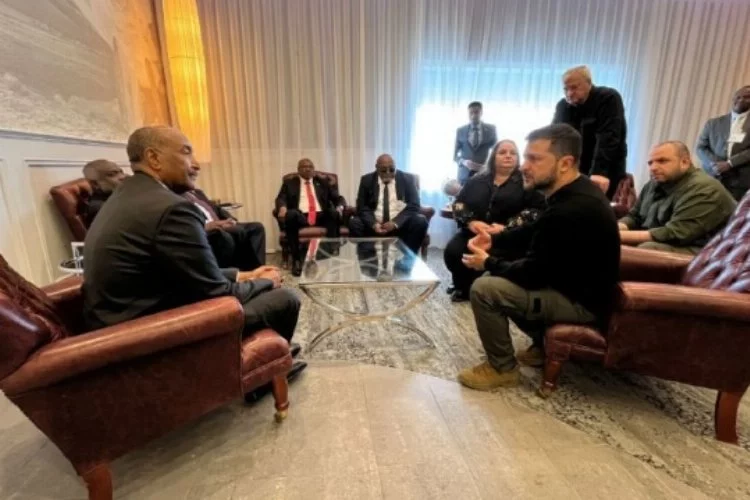
Furthermore, the WSJ reported that the initial objective of the Ukrainian forces’ involvement in the Sudanese conflict was to assist Al-Burhan, the Commander of the SAF, in leaving Khartoum following the siege by the RSF. The objective was to relocate Al-Burhan to Port Sudan, the capital of the Red Sea State, which served as an alternative administrative and governance hub for Al-Burhan. Weeks after completing this mission, Al-Burhan met with President Zelensky at the Irish Shannon Airport in September 2023. During their meeting, they deliberated on shared security concerns, with particular emphasis on the operations of illicit armed groups financed by Russia. In addition, it seems that the purpose of the meeting was to finalize the discussions and strengthen bilateral coordination in order to counter Russian activities in Sudan.
2. Technical Support from Ukraine to the Sudanese Air Force: A Ukrainian military delegation visited the Wadi Seidna military base in Omdurman on August 19, 2023, to perform essential maintenance on Sudanese Air Force fighters. This visit demonstrates Ukrainian military backing for the Sudanese Air Force and efforts to enhance its capabilities in response to the ongoing conflict with the RSF. It is worth noting that the army’s air force is its most visible weapon in combat, particularly given that the RSF lacks aircraft and instead relies on weapons and tanks.
3. The Involvement of Ukrainian Drones in the Sudanese War: US reports that surfaced on September 20, 2023, suggested that a sequence of assaults against the RSF might have been initiated by Ukrainian drones. CNN, on the other hand, aired video footage of sudden drone attacks on RSF sites in and around Omdurman, which utilized a combat strategy that is not typical in Sudan or Africa and was accompanied by statements from military Ukrainian commanders who characterized the targeting operation as an un-Sudanese act, which reveals Ukrainian military support for the SAF.
II. Factors Driving Ukrainian Involvement in the Sudanese Conflict
While it was surprising that General Al-Burhan turned to Ukrainian President Volodymyr Zelensky for military aid in the Sudanese conflict, given that Ukraine itself is in dire need of such assistance, Zelensky appears to have numerous motives for complying with Al-Burhan’s request, the most prominent of which is to repay Sudan’s favor. According to the WSJ report, after the Ukrainian war began in February 2022, Al-Burhan offered military assistance to Kiev. This led President Zelensky to respond to Al-Burhan’s request a few weeks after a phone conversation with him. In mid-August 2023, President Zelensky dispatched Ukrainian commando forces to Sudan to aid the SAF in stopping the progress of the RSF in Khartoum. The Ukrainian commando forces consisted of approximately 100 soldiers, primarily from the Timur unit associated with Ukrainian military intelligence. Additionally, the Ukrainian military supplied the SAF with AKM rifles that were upgraded with silencers.
The second rationale for the involvement of Ukrainian forces in the Sudanese conflict, in conjunction with the SAF, pertains to the acquisition of two appealing resources for Ukrainian engagement: weaponry and gold. During the tenure of deposed President Omar al-Bashir, the Sudanese arena underwent significant transformation, developing into a burgeoning arms market. This transformation was primarily driven by the proliferation of armed movements and the proliferation of internal conflicts, particularly in the border region encompassing Sudan, Ethiopia, and Eritrea, which has a long history of being a center for arms trade, especially in the Butana Plain region, which stretches from Khartoum in the capital to eastern Sudan, passing through the states of Kassala, Al Qadarif, Al Jazirah, and the Nile River.
In December 2022, prior to the commencement of the Sudanese conflict, the Disarmament Committee, a governmental entity established in 2017, released a report affirming the presence of approximately five million firearms among the general populace, excluding those belonging to the insurgent movement in Darfur, South Kordofan, and the Blue Nile region. Given the protracted conflict in Sudan that erupted in April 2023 and the entrenched demands from both belligerent parties for the popular resistance to arm themselves and engage in hostilities, substantial expansion is expected in the Sudanese arms market. This is supported by the increased demand for weaponry that was previously underutilized. In contrast to the past, when only pistols were permitted, the demand for sniper rifles and machine guns, whether produced in Iran, Israel, or the United States, has increased.
As a result, the Sudanese arms market garnered Ukrainian interest as a consequence of Kiev’s limited access to Western military support and its pressing need for diverse weaponry. Kiev actively pursued conflict zones characterized by a burgeoning arms trade, with the Sudanese market emerging as the most favorable destination. Ukrainian military intelligence commander Kyrylo Budanov made this clear when he said: “At one time, we took a lot of weapons out of Sudan. Different countries paid for it. They had a wide range of weapons; everything from Chinese to American can be found there.”
When looking at the connection between Sudanese gold and the Ukrainian involvement in the Sudanese war, one thing becomes clear: controlling Sudanese gold entails obtaining an important and significant source of funding for the activities of the international forces controlling it or allied with the national forces controlling it. Furthermore, the conflicting party that possesses dominion over gold possesses the greatest potential to shift the equilibrium of the conflict in its favor as well as in favor of the regional and international forces that provide support for it. Significantly, Sudan boasts an annual gold production exceeding 100 tonnes, with Khartoum being a prominent gold producer in Africa and ranking thirteenth globally in terms of gold production. Furthermore, Khartoum possesses gold reserves amounting to a potential 1,550 tonnes.
Although the Hemedti family controls the majority of Sudan’s gold mines, including Jebel Amir, Africa’s third largest gold producer, as well as at least three other mines in South Kordofan and elsewhere, Al-Burhan, as chairman of the Transitional Sovereignty Council, shares control of the country’s gold mines with Hemedti. Gold mines are distributed across diverse geographical areas, encompassing the arid deserts and mountainous regions located to the east of the Nile River along the Red Sea and the highest summit in the Red Sea Hills, as well as in the Nuba Mountains, Kordofan, and Darfur areas.
It is important to highlight that a substantial percentage, surpassing 89%, of gold is exported through unofficial channels. Prior to the outbreak of the Sudanese war, the Central Bank of Sudan had documented that a mere 30% of the gold extracted within the country was officially documented. Additionally, an estimated $4 billion in gold revenues were not accounted for in official records. These revenues are shared on an annual basis between the Sudanese government, under the leadership of Al-Burhan and Hemedti through five or more gold exploration companies associated with China, Italy, Russia, and other countries. An exceptional feature of the Russian partner is its capacity to work simultaneously with both parties involved in the conflict. There are Russian companies working with the Sudanese government, as well as others affiliated with the Wagner Group collaborating with the RSF. The Russian collaboration facilitated by the Wagner Group is widely acknowledged to be an extremely contentious partnership in Sudan. This is primarily due to the interactions between mining companies owned by the RSF and Wagner, as well as the support and training provided by Wagner to the RSF both prior to and following the Sudanese war. In return, Wagner is supplied with substantial quantities of gold, which are used to fund Moscow’s military operations in Ukraine.
Following the commencement of the Sudanese conflict, Wagner relocated a collection of weaponry, including shoulder-fired anti-aircraft missiles, from Central Africa, where it maintains a base, to Sudan. Furthermore, it enlisted various personnel from Central Africa to engage in combat in Sudan. This significantly contributed to the progress achieved on the ground by the RSF. Therefore, the investment partnership between Wagner and the RSF in mineral resources, specifically gold, may incentivize Ukraine to participate in the Sudanese conflict in order to investigate opportunities for obtaining financial resources and investments to support its war economy while also taking advantage of the expanding arms market.
Consequently, the Sudanese arena has become a focal point for Ukrainian-Russian polarization and rivalry, thereby indicating a novel aspect of Ukraine’s strategic approach to addressing the special Russian military operation in Kiev beyond the confines of the battlefield. This strategy involves Kiev engaging in competition with Moscow within its spheres of influence, which serve as an optimal setting for weapon provision and war funding. Along with the military assistance from Ukraine, this strategy is also demonstrated by Kiev’s shipment of wheat to Port Sudan in February 2024 as part of President Zelensky’s humanitarian Grain from Ukraine initiative, which comes at a time when Sudan is experiencing a catastrophic humanitarian crisis due to the aftermath of the Sudanese war and the ongoing drought. Through this initiative, Zelensky endeavors to further crack down on Moscow, acquire a negotiable bargaining chip, and increase the financial burden of the conflict on Moscow—as exemplified by the Ukrainian forces’ capture of a Wagner force member during the battles in Sudan.
Furthermore, commander of Ukrainian intelligence Kyrylo Budanov commented on the deployment of Ukrainian forces in Sudan, stating that it was of interest to send Ukrainian forces overseas, adding, “Russia has units in different parts of the world, and we sometimes try to strike them there.” One of the Ukrainian brigade commanders in Sudan asserted that defeating Russia solely through fighting on a limited area, such as the front line in Ukraine, is unattainable. This highlights President Zelensky’s decision to participate in the Sudanese war alongside the SAF and the Ukrainian efforts and ongoing demands for Western countries to transfer frozen Russian assets valued at €300 billion to Kiev for assistance in the country’s reconstruction, as a means of exerting pressure on Russia.
In short, it appears that there are shared perspectives between the President of Ukraine and the Chairman of the Sudanese Transitional Sovereignty Council regarding strategies to curtail the expanding Russian influence in Sudan, specifically through the Russian Wagner Group. This mutual interest is further reinforced by Kiev’s pursuit of armament and financial resources for its military operations. Kiev could not have found a more advantageous location to contest and engage with Russian influence than the Sudanese arena, given Kiev’s support for the RSF in its conflict with the SAF, as well as Wagner’s significant role in Moscow’s war against Kiev and its substantial funding for Moscow’s war against Ukraine. This illustrates Kiev’s proclivity to extend the conflict beyond the Ukrainian border to include the Sudanese sphere, implying the possibility of heightened Ukrainian military support in Sudan in the foreseeable future, with some analysts attributing, at least in part, the progress made by the SAF on the battlefield to the assistance provided by Ukrainian forces. This Ukrainian involvement in the Sudanese conflict may serve as a motivation for Kiev to expand its actions and venture into new arenas that embody additional spheres of influence for Moscow.


