





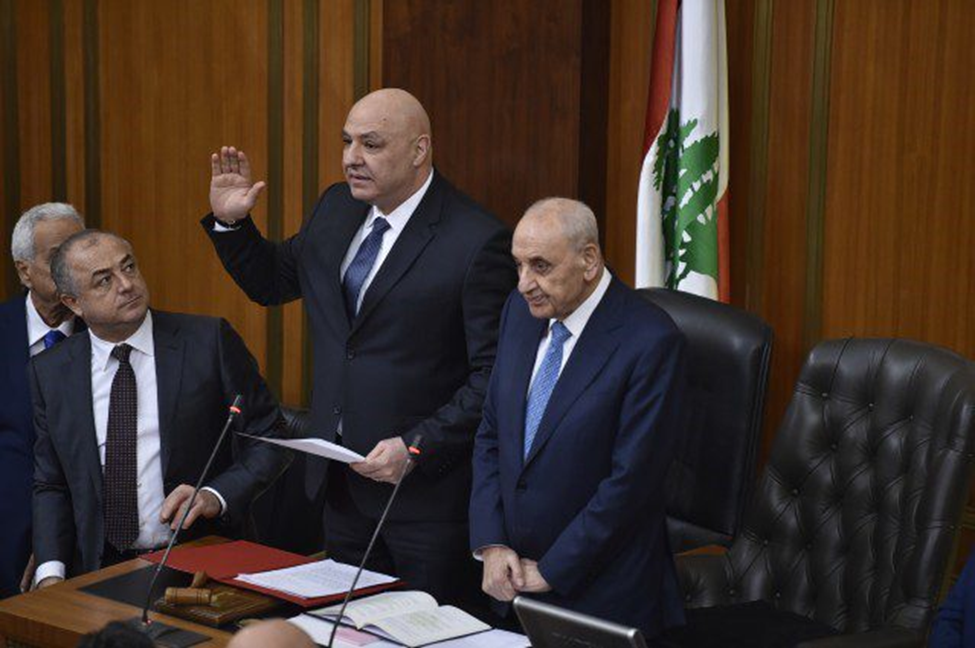
On January 9, 2025, the Lebanese Parliament, in the presence of international representatives, elected Army Commander Joseph Aoun as head of the state, putting an end to over two years of presidential vacancy following the conclusion of Michel Aoun’s term in October 2022. Prior to this breakthrough, Parliament convened nearly 12 times, with the most recent session on June 14, 2024, but failed to elect a president due to political deadlock and quorum issues.
In this article, we delve into the circumstances leading to Joseph Aoun’s election, the obstacles confronting his administration, and the prospects for Lebanon amidst these pressing challenges.
The Big Picture
The race for Lebanon’s presidency initially featured several prominent figures, including Suleiman Franjieh, leader of the Marada Movement, Former Minister of Interior and Municipalities Ziyad Baroud, and Army Commander Joseph Aoun. However, both Franjieh and Baroud eventually withdrew from the race, paving the way for General Joseph Aoun to take center stage. Following tradition, the Lebanese Parliament convened to elect the President of the Republic. Two sessions were held on January 9, attended by international representatives, including French Foreign Minister Jean-Yves Le Drian and Saudi Prince Yazid bin Farhan.
In the first parliamentary session, President Joseph Aoun secured 71 votes, while 37 deputies submitted blank ballots, and 20 votes were deemed invalid. Since the threshold of 86 votes—out of a total 128 deputies—was not met, a second session was convened later the same day, during which President Aoun garnered 99 votes, with 9 blank ballots and 18 invalid votes recorded.
Article 49 of the Lebanese Constitution stipulates that, “the President of the Republic shall be elected by secret ballot and by a two-thirds majority of the Chamber of Deputies. After a first ballot, an absolute majority shall be sufficient. The President’s term is for six years. He may not be re-elected until six years after the expiration of his last mandate. No one may be elected to the Presidency of the Republic unless he fulfills the conditions of eligibility for the Chamber of Deputies.” Additionally, it mandates that “it is not possible to elect judges, Grade One civil servants, or their equivalents in all public institutions to the Presidency during their term or office or within two years following the date of their resignation or their leaving office for whatever reason.”
Based on this, concerns were raised about the legality of General Joseph Aoun’s candidacy due to his role as army commander. However, his nomination received widespread support from domestic, regional, and international actors, particularly from the Group of Five overseeing Lebanon’s affairs—comprising the United States, France, Egypt, Saudi Arabia, and Qatar, which held multiple meetings over the past two years to address Lebanon’s crisis. Key figures, including US envoy Amos Hochstein and Saudi representative Yazid bin Farhan, endorsed Aoun’s candidacy, with France also voicing its backing during a committee meeting in Paris in February 2024. Following the successful election of Joseph Aoun by the Lebanese Parliament, the international and regional community welcomed the outcome. The French presidency issued a statement underscoring its support for the national dialogue to be led by President Aoun, as well as its continued backing of the Lebanese Armed Forces both on the national stage and within the framework of UNIFIL.
Regional and international dynamics have acted as a catalyst for Lebanon’s presidential election process, especially in light of the war between Hezbollah and Israel. The war, which lasted from October 8, 2023, until a truce was achieved on November 26, 2024, dealt a severe blow to Hezbollah’s strength and highlighted the urgent necessity of rebuilding the Lebanese state after the extensive destruction it has faced, starting with advancing reforms—electing a president, forming a government to confront domestic challenges, and resolving lingering border disputes with Israel.
President Aoun enjoys Saudi backing, and Lebanon’s dire circumstances highlight the necessity of Gulf support for the country’s reconstruction, particularly as the damage from the war with Israel is estimated at $8.5 billion. The war inflicted widespread destruction, especially in Shiite-majority villages, which likely compelled Hezbollah and the Amal Movement to make concessions and allow the presidential selection process to proceed, rather than obstructing it. This development reflects Hezbollah’s weakened state, Tehran’s reduced ability to provide backing amid waning regional influence, and its attempts to recalibrate strategies in response to intensifying pressures, including the advent of the second Trump administration on January 20, 2025.
Persistent Challenges
President Aoun will have to tackle a critical agenda packed with pressing challenges that call for immediate and resolute action, including:
Formation of the New Government: Lebanon now faces the challenge of forming the new government after the parliamentary consultations on January 13, which endorsed Nawaf Salam as Prime Minister. The subsequent steps involve allocating ministerial portfolios among political factions, the President issuing a decree to officially appoint the Prime Minister, and the government’s formation in agreement with its head. The government must then submit its policy statement to secure parliamentary confidence within a month of its formation. Once established, the government will initiate the process of referring draft laws to the Parliament. The previous government’s caretaker status left many laws in limbo, alongside mounting demands for reforms in state institutions and public service delivery. Public trust in Lebanon’s political class, particularly Hezbollah, remains critically low, as many hold them accountable for the country’s recent devastation.
Economic Crisis: Lebanon’s economic situation continues to deteriorate, with the World Bank estimating a 6.6% contraction in GDP for 2024. This decline stems from reduced public finance revenues, a default on national debts, the sharp devaluation of the Lebanese pound, and the severe erosion of salaries for Lebanese army soldiers, now below $100. Unemployment soared to 29.6% in 2022, further exacerbating the crisis, while severe fuel shortages have led to recurring power outages, disrupting critical services like healthcare and water provision. Compounding these challenges is the lingering impact of the August 2020 Beirut port explosion, which undermined the state’s structural integrity. Additionally, Lebanon faces significant challenges in implementing an agreement with the International Monetary Fund.
Addressing Captagon Smuggling: Lebanon struggles with securing its borders as Hezbollah’s activities have significantly fueled Captagon smuggling operations. The group wields considerable influence in border villages between Lebanon and Syria, where it is taking a central role in the production and trafficking of drugs originating from the Beqaa Valley in southern Lebanon. Hezbollah’s political dominance within Lebanese state institutions has facilitated its engagement in illicit trade with little accountability. The instability in Syria has further compounded the situation, enabling its control over border regions and the establishment of drug production facilities in nearby Syrian areas. Villages like Madaya and Al-Zabadani witnessed the displacement of their residents, with the Syrian Army and Hezbollah taking control. Captagon production in these areas has been overseen by Hezbollah in collaboration with the Syrian Fourth Armored Division.
Hezbollah has been actively acquiring real estate and land in various eastern areas along the Lebanese-Syrian border, establishing military zones inaccessible to Lebanese authorities or individuals unaffiliated with the group. These zones have enabled the group to conduct and oversee activities across the border, extending its security control over surrounding villages. Local workers, often pressured by harsh living conditions or intimidation from armed militias, were recruited into drug production facilities, while some youth abandoned school to join the trade. Hezbollah has collaborated with non-governmental entities to smuggle chemicals essential for drug manufacturing, using Syria’s Latakia port as a gateway. Captagon produced in these facilities was then exported through Hezbollah-controlled infrastructure, including the Beirut port and the Beirut–Rafic Hariri International Airport, to markets in Saudi Arabia and Europe.
The responsibility now lies with President Aoun and the Lebanese government to tackle the significant issue of drug trafficking and smuggling across the Syrian border and in eastern Lebanon. This challenge is amplified by recent developments in Syria, the deep economic crisis, the state’s financial collapse, and the lack of sustainable development policies amid persistent political instability.
The Armistice Agreement and Southern Border Control: The president faces the daunting task of securing the southern borders, ensuring state control, and implementing the armistice agreement with Israel reached on November 26. This includes enforcing SC Resolution 1701, deploying the Lebanese army following Hezbollah’s withdrawal and disarmament, and maintaining internal stability to prevent escalations with Israel, especially given that the armistice agreement grants Israel the right to military intervention in Lebanon if breached by Hezbollah, creating a potential justification for continued conflict if Resolution 1701 is not upheld. Under the terms of the agreement, Israeli forces are to withdraw from southern Lebanon two months following the commencement of the accord.
Potential Paths
Based on the outlined challenges, two possible trajectories for the Lebanese state can be identified after the election of Joseph Aoun:
1. The Stability Path: One potential path for Lebanon involves achieving relative stability and fostering an internal balance among political forces. Aoun’s leadership is viewed favorably by several Lebanese parties and those supporting Lebanon’s stability, which could decrease Hezbollah’s dominance over state institutions and improve internal security. Before his appointment as army commander in March 2017, Aoun led the Ninth Infantry Brigade, where he oversaw key missions, such as expelling Daesh from eastern Lebanon near the Syrian border. His decisive role during the 2021 Beirut clashes demonstrated his ability to manage crises effectively as the army safeguarded civilians, detained armed operatives from both sides, and de-escalated the conflict between the Shiite duo of Hezbollah and the Amal movement and Lebanese Forces party supporters.
President Aoun also possesses the capacity to address critical national issues, including negotiating the disarmament file, securing border control, and balancing efforts to garner international support for strengthening the Lebanese army and attract foreign logistical and humanitarian aid, as evidenced by the United States doubling its military assistance to Lebanon by approximately $120 million in 2021 to maintain army equipment. Aoun has also demonstrated the ability to consult with Hezbollah and coordinate efforts regarding disarmament. He consulted with the head of Hezbollah’s coordination and liaison unit, Wafiq Safa, to coordinate the deployment of the army south of the Litani River and lay the groundwork for the disarmament process scheduled for December 2024.
2. Path of Continued Instability: Lebanon could continue along a path of political and security instability, exacerbated by threats from Hezbollah, including obstructing efforts toward stability, attempting to infiltrate army institutions, and undermining the unity and strength of the Lebanese armed forces. As commander-in-chief, the president must carefully monitor appoints to military and security positions to ensure they remain free from Hezbollah’s influence. Additionally, Hezbollah’s refusal to disarm and its obstruction of government formation efforts hinder progress in addressing Lebanon’s economic, political, and security crises. This scenario risks Lebanon’s marginalization on the international stage, further entrenching its status as a failed state and forfeiting vital international and Arab support. It also raises the specter of civil war, particularly if hostilities with Israel persist, potentially causing mass displacement from the southern border to other regions, which may hinder the promotion of societal cohesion.