





Through systematic media mobilization, the movement succeeded in shaping perceptions, influencing public opinion, and preparing audiences to accept—and often legitimize—Zionist behavior. Since its first congress in Basel, Switzerland, in 1897, the Zionist movement has placed a premium on gaining influence over global media outlets and establishing lobbying and propaganda organizations aimed at directing international public opinion toward supporting the Zionist project of creating a Jewish national homeland. Leaders of the global Zionist movement regarded pro-Israel propaganda as a central instrument for shaping the attitudes of individuals, societies, and states alike.
David Ben-Gurion, Israel’s first prime minister, articulated this conviction with remarkable clarity when he stated: “The media placed our state on the map. It succeeded in securing international legitimacy for it and entrenching the justification for its existence before it became a concrete reality on the ground.”
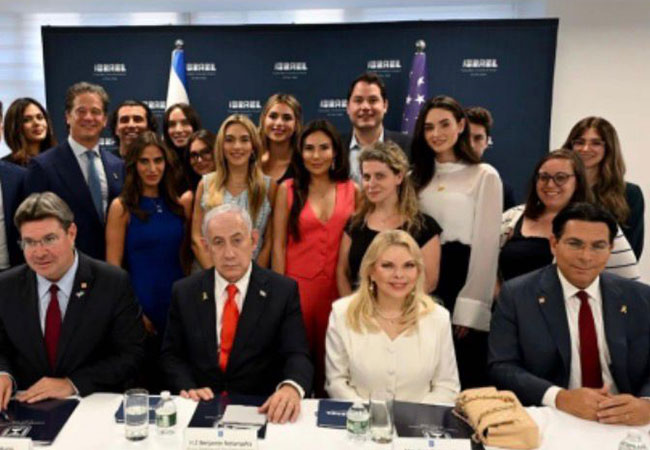
A meeting between Israel PM Benjamin Netanyahu and US influencers in the Israeli consulate in New York in September 2025.
For decades, Israel invested heavily in propaganda and media operations to advance objectives that evolved in response to changing political circumstances. Propaganda functioned alongside military and political action, targeting governments, media institutions, cultural elites, and Jewish communities abroad. The aim was to frame the Zionist project initially as a national liberation movement and later as a democratic state facing existential threats.
The centrality of Israel’s media defense became particularly evident during its successive wars, where the dominant narrative revolved around “self-defense” and the portrayal of Israel as a besieged victim in a hostile region. Israeli propaganda institutions developed a coordinated set of narratives and practices directed at global public opinion along two parallel and synchronized tracks. The first emphasized a “positive” discourse, highlighting Israel’s supposed civilizational and democratic attributes. The second focused on delegitimizing and demonizing adversaries, alongside a broad, overarching propaganda framework.
Israel came to treat propaganda as a strategic weapon complementary to military force. Military operations were consistently accompanied by extensive media campaigns aimed at reframing events and steering international opinion. Each time Israel faced accusations of committing war crimes against Arab populations, it responded with intensified propaganda efforts designed to justify its actions, cast doubt on documented facts, and divert debate away from the substance of the violations themselves.
Over several decades, Israel succeeded in constructing one of the most effective propaganda systems in the world, aided by the structural bias of much Western media and the dominance of pro-Israel lobbying networks in the United States and Europe over major media institutions.
Yet despite Israel’s efforts over two years of war in Gaza to suppress the Palestinian narrative—through the deliberate targeting of journalists, the destruction of Gaza’s media infrastructure, and the prevention of foreign correspondents from entering the Strip—citizen journalism and digital platforms, particularly TikTok, emerged as alternative windows into reality. These platforms transmitted events in real time and played a significant role in undermining Israeli discourse within Western societies.
As a result, Israel found itself facing one of the deepest crises in its international image. The scale of civilian casualties and the widespread circulation of images depicting destruction and humanitarian suffering severely eroded the narrative Israel had cultivated for decades as a victimized state. As international human rights voices increasingly accused Israel of grave violations amounting to war crimes, Israel experienced an unprecedented decline in Western sympathy—sympathy that had long constituted a cornerstone of its diplomacy.
This decline prompted Israel to launch an aggressive image-repair campaign, led personally by Prime Minister Benjamin Netanyahu and the Israeli Ministry of Foreign Affairs, with a particular focus on the United States and the broader Western public.
Israel invested heavily in information and propaganda warfare in an effort to amplify its narrative, legitimize, and justify what many describe as a genocidal war in Gaza. It deployed all available tools to control the narrative across traditional media and digital spaces alike, utilizing influencers, training artificial intelligence systems, financing specialized companies established for this purpose, and exploiting its own influence—along with that of its allies—over major technology firms. Through algorithmic manipulation and platform governance, Israel sought to promote its narrative in response to the tangible shift in Western public opinion, which had expanded beyond leftist and human-rights circles to reach much broader constituencies. This shift manifested on the ground in mass demonstrations, university sit-ins, and evolving rhetoric among figures and institutions that had initially been closer to Israel at the outset of the war.
Against the backdrop of this accelerating narrative erosion, which exerted direct pressure on decision-makers in Tel Aviv and attracted the attention of Washington, U.S. President Donald Trump acknowledged in an interview with the Daily Caller in September 2025 that “Israel may win the war militarily, but it is losing the public relations battle.”
A similar assessment appeared in a letter sent by conservative American activist Charlie Kirk to Prime Minister Netanyahu prior to his assassination, warning of declining popular support for Israel within the United States—including among conservative and evangelical constituencies—and urging Israel to treat the narrative battle with the same seriousness accorded to military fronts.

In response, Israel embarked on constructing an integrated system aimed not merely at refining its messaging but at reshaping the Western cognitive environment itself. The core shift lay in moving from a focus on message content to control over the platform—determining how content appears, who sees it, and what is suppressed or removed within the digital sphere.
The Netanyahu government is currently leading what is arguably the largest propaganda campaign in Israel’s history. This campaign relies on a comprehensive strategy that blends digital and on-the-ground tools, artificial intelligence, religious discourse, and targeted influence via social media platforms. Its objective is to reengineer Western public opinion, rehabilitate Israel’s image, and divert attention from violations committed against the Palestinian people over the past two years.
This is pursued through political advertising, algorithmic control, influencer mobilization, and content steering to entrench Israeli narratives while undermining Palestinian ones.
Investigative reporting has revealed a contract between the Israeli Prime Minister’s Office and Google worth 150 million shekels (approximately $45 million), enabling Israeli propaganda campaigns to run across Google platforms, including YouTube, Google Maps, and the app store, targeting Western audiences—particularly in the United States, the United Kingdom, and Europe.
These advertisements were often categorized under “Family and Community” rather than “Politics,” allowing them to reach broader audiences. Their content emphasized Israel’s alleged role in facilitating aid to Gaza while blaming the United Nations—especially UNRWA—for obstructing distribution, alongside attacks on Iran and Hamas and efforts to soften Israel’s image regarding aid restrictions.
A review of Google’s ad library showed that Israel financed hundreds of ads targeting the United States, France, Germany, the United Kingdom, and other European countries. Following the joint European statement in July 2025 condemning the use of starvation as a weapon of war in Gaza, Israel intensified its advertising campaigns in Europe, claiming it permitted aid entry while accusing the UN of “deliberate sabotage.”
In parallel, Israel relied on cooperation with major technology companies, particularly Meta, the parent company of Facebook and Instagram, to restrict pro-Palestinian content. Public statements by Jordana Cutler, Meta’s Head of Public Policy for Israel, confirmed her oversight of monitoring and removing Palestinian or anti-Zionist posts under the pretext of protecting the Jewish community.
Investigations revealed that Meta complied with approximately 94 percent of Israeli takedown requests since October 2023, removing more than 90,000 posts and restricting or suppressing tens of millions more.
Israeli influence extended beyond Meta. The government spent millions of dollars on campaigns with X, which in November 2025 suspended automatic Hebrew translation, citing the need to limit incitement—an action widely viewed as an attempt to curb the global spread of translated violent discourse.
TikTok also underwent a notable shift following President Trump’s executive order in September 2025 transferring operational control of the platform to a U.S. company. Although Israel was not formally linked to the deal, the pro-Israel affiliations of the new investors raised concerns over political bias.
American users and content creators reported increased restrictions on pro-Palestinian content and algorithmic re-ranking aligned with security and political considerations—a development welcomed by Israeli officials.
In its effort to control algorithms, Israel opted to train global AI models rather than develop an independent local system. To this end, the Israeli government contracted a U.S. firm, Clock Tower LLC, to develop digital content and linguistic analysis, create websites, and employ predictive AI tools to improve the ranking of Israeli narratives in search engines—ultimately influencing the outputs of AI models such as ChatGPT and Gemini.
The strategy also relies heavily on deploying non-political influencers, particularly in entertainment and lifestyle sectors, to reach younger audiences who engage more with digital content than traditional media. Influencers thus function as powerful instruments of opinion shaping—not through direct political messaging alone, but via cultural and lifestyle framing.
Israeli efforts included hosting prominent influencers in Israel, organizing field tours at aid crossings, and funding a media initiative known as the “Esther Project.” This campaign employed American influencers to disseminate pro-Israel content without transparent disclosure that it was funded through Bridges Partners, a firm established in July 2025 by Israeli consultants Uri Steinberg and Yair Levy in Delaware.
U.S. Justice Department Foreign Agents Registration Act disclosures revealed a $900,000 contract between the firm and the Israeli government via the German company Havas Media. Reports about the project coincided with Netanyahu’s September interview with a group of content creators at the Israeli consulate in New York. Although no definitive evidence links these influencers directly to the campaign, a review of their accounts shows a marked increase in pro-Israel postings during that period.
Notably, the project’s name mirrors an initiative launched in October 2024 by the Heritage Foundation to combat antisemitism, with both projects aiming to eliminate Western support for Palestinians.
Israel also employed public relations firms to execute influence campaigns combining traditional media engagement—training spokespeople for appearances on outlets such as Fox News and CNN—with digital amplification using automated tools to boost message reach across Instagram, TikTok, YouTube, and LinkedIn.
At Israel’s request, Stagwell Global Group and its subsidiary SKDK conducted extensive public opinion research to assess perceptions of the Gaza war and attitudes toward Israel. Based on these findings, they crafted highly targeted messages and tested video content to determine which narratives most effectively shifted opinions.
The most effective message, according to the research, was fear of “Islamic extremism” and “jihadism,” a theme the study suggested could be exploited to replace the “genocide” narrative through automated bot networks amplifying such messages across platforms.
Israeli propaganda efforts also expanded into the podcast sphere, both through programs produced by Zionist lobbying organizations and through appearances by Israeli officials—most notably Netanyahu—on popular youth-oriented podcasts to reach audiences less reliant on traditional media.
Given the centrality of evangelical support in the United States and evidence of its decline—attributed to younger evangelicals’ reliance on digital media and diminishing attachment to traditional religious narratives linking Israel to biblical prophecy—conservative Republican activist Chad Stienger, in coordination with the Israeli government, developed a $3.2 million strategy targeting Christian communities via his firm Show Faith by Work.
The campaign aimed to restore Christian support for Israel using evangelical arguments, encompassing seven pillars: building church networks, distributing multilingual religious materials, deploying virtual-reality exhibits about October 7, enhancing activity in Christian universities, launching a weekly podcast with Christian and Israeli leaders, mobilizing influencers to counter pro-Palestinian content, adapting messaging during Christmas to reinforce Israel’s symbolic role as Christ’s birthplace, and implementing a digital campaign targeting 47 million impressions, alongside geographic targeting of churches to frame support for Israel as a religious obligation.
It is important to note that these Israeli propaganda efforts are not isolated initiatives. Contract tracking suggests they are coordinated within a broader framework inside the Israeli Ministry of Foreign Affairs known as “Project 545,” led by Eran Shaivitch, reflecting the institutionalization of propaganda as an operational arm parallel to military action.
In conclusion, Israel’s current strategies for confronting what it terms the “eighth front” reflect a shift from defending its narrative to engineering the Western narrative and cognitive environment itself. Through massive funding, influence networks, digital platforms, algorithms, artificial intelligence, and the instrumentalization of religion and popular culture, Israel has dramatically expanded its public diplomacy (hasbara) budget, which reached approximately 2.35 billion shekels in the 2026 state budget.
This escalation signals a growing Israeli recognition that the narrative crisis following October 7, 2023, is structural rather than temporary—rooted in the collapse of Israel’s ability to monopolize the story in an open digital environment.
Consequently, the battle over legitimacy and perception has become as decisive as military fronts, requiring sustained, long-term intervention to reshape consciousness and narratives within Western societies, rather than mere crisis management or reactive media rebuttals.
Published in cooperation between the Egyptian Center for Strategic Studies, Al-Ahram Weekly, and the English-language portal Ahram Online