



By using ECSS site, you agree to the Privacy Policy and Terms of Use.
Accept
ECSS - Egyptian Center for Strategic StudiesECSS - Egyptian Center for Strategic Studies
  • Home
  • International Relations
    International Relations
    Show More
    Top News
    Widening the scope: Ethiopia’s diplomatic activity amid unrest
    March 4, 2021
    The New Republic: Determinants of Egypt’s Foreign Policy
    September 30, 2021
    Limited Alternative: Can Venezuela offer the United States a Replacement for Russian Oil?
    April 24, 2022
    Latest News
    Israel’s security and economic conundrum:How does Israel confront the challenges of a protracted war with Iran?
    May 2, 2026
    Reshaping the US position toward Israel: From the erosion of the old consensus to a new conflict across parties, state, and society
    April 23, 2026
    Israel’s African gambit
    March 6, 2026
    Geopolitical realism: What does Washington’s return to the African Sahel mean?
    March 5, 2026
  • Defense & Security
    Defense & Security
    Show More
    Top News
    Arms Internationalization: The UN and Israeli Armament Activities
    March 13, 2024
    Egypt’s Defense Industries: Steady Steps and Promising Prospects
    Egypt’s Defense Industries: Steady Steps and Promising Prospects
    December 18, 2021
    Reiterated Calls: Repercussions of Iraq’s Demand for the Global Coalition against Daesh to Leave
    January 27, 2024
    Latest News
    Between two camps: Reading into ISIS discourse on the US-Israeli war on Iran
    April 15, 2026
    Encrypted messages “Roaring Lion”: The hidden messages behind the name of the operation against Iran
    March 11, 2026
    Iran war developments
    March 9, 2026
    Manufacturing the enemy : Reframing terrorism in contemporary Western discourse
    March 7, 2026
  • Public Policy
    Public Policy
    Show More
    Top News
    Egypt’s IPO Program: Maximizing the Private Sector’s Role in the Economy
    Egypt’s IPO Program: Maximizing the Private Sector’s Role in the Economy
    January 25, 2022
    The Repercussion of Reduced Oil Prices amid the Coronavirus on Egypt’s Economy
    September 20, 2020
    Scenarios for Energy Crisis Management in the European Union
    May 20, 2023
    Latest News
    From global shock to Egypt’s economy: Analyzing the impact of the Iran war on energy security
    May 3, 2026
    Egypt as a balancing power: Why Cairo rejects the logic of wars in the Middle East
    April 30, 2026
    Militarizing water in Middle East wars A strategic analysis of the Iran-US-Israel war
    April 18, 2026
    Reading into attacks on maritime navigation in the Arabian Gulf
    March 17, 2026
  • Analysis
    • Opinion
    • Analysis
    • Situation Assessment
    • Readings
  • Activities
    • Conferences
    • ECSS Agenda
    • Panel Discussion
    • Seminar
    • Workshops
  • ECSS Shop
  • العربية
  • Defense & Security
  • International Relations
  • Public Policy
All Rights Reserved to ECSS © 2022,
Reading: Meeting the president
Share
Notification Show More
Latest News
From global shock to Egypt’s economy: Analyzing the impact of the Iran war on energy security
Economic & Energy Studies
Israel’s security and economic conundrum:How does Israel confront the challenges of a protracted war with Iran?
Palestinian & Israeli Studies Research Programs
Egypt as a balancing power: Why Cairo rejects the logic of wars in the Middle East
Media Studies
Reshaping the US position toward Israel: From the erosion of the old consensus to a new conflict across parties, state, and society
American Studies
Militarizing water in Middle East wars A strategic analysis of the Iran-US-Israel war
Economic & Energy Studies
Aa
ECSS - Egyptian Center for Strategic StudiesECSS - Egyptian Center for Strategic Studies
Aa
  • اللغة العربية
  • International Relations
  • Defense & Security
  • Special Edition
  • Public Policy
  • Analysis
  • Activities & Events
  • Home
  • اللغة العربية
  • Categories
    • International Relations
    • Defense & Security
    • Public Policy
    • Analysis
    • Special Edition
    • Activities & Events
    • Opinions Articles
  • Bookmarks
Follow US
  • Advertise
All Rights Reserved to ECSS © 2022, Powered by EgyptYo Business Services.
Opinions Articles

Meeting the president

Dr. Noha Bakr
Last updated: 2020/06/06 at 6:32 PM
Dr. Noha Bakr
Share
7 Min Read
SHARE

Some days ago, I received a call from the Presidential Office inviting me to join a meeting chaired by the president of Egypt on the occasion of Egyptian Women’s Day. 

It took me a moment to comprehend the invitation. Meeting the president would be an honour, of course, but I could not help asking myself “why me” and also whether if it was a large meeting whether it would be safe to attend given the threat of the Covid-19 coronavirus.

However, as if the caller had read my thoughts, he assured me that the meeting was only a round table to share in a dialogue with the president and that all health precautions would be applied and respected. He answered my thoughts, but he did not reply to my question of “why me”.

I was very excited to receive the invitation. I felt honoured and that my career as a university professor, researcher and at one point a civil servant had been crowned by the invitation. I have had the honour of meeting various political leaders and other figures worldwide and have also attended various conferences in which President Abdel-Fattah Al-Sisi has been in attendance. But even so, meeting the president of your country in a small group and getting a chance to share a dialogue with him is very different.

Egypt celebrates Egyptian Women’s Day every year on 16 March to mark women’s historic struggle for their rights and to recognise their achievements and the obstacles that currently face them. March 16 is a special day in the history of Egyptian women’s struggle for their rights, as the roots of the day date back to 1919 when women participated for the first time in political demonstrations during the 1919 Revolution in Egypt.

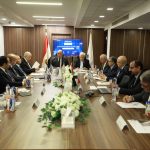
When I entered the Ittihadeya Presidential Palace for the meeting, all health and safety measures were applied with a smile and a welcoming note. As promised, the meeting was a limited one, with distances maintained when seated and when taking an official photograph.

The meeting was attended by Speaker of the House of Representatives Ali Abdel-Al, Prime Minister Mostafa Madbouli and the ministers of planning and economic development, finance, health and population, social solidarity, and media, and the president of the National Council for Women. It included a MP, two mothers of martyrs who had died in terrorist attacks, an academic, an active NGO member and myself.

The meeting was attended by Maya Morsi, head of the National Council for Women, who expressed her gratitude to the political will and determination of the president to support women’s rights and to empower women on the social, political and economic levels. I looked at Maya Morsi with great respect, as although she has recently lost her son, she has never neglected her role and goal to support women’s rights. Her strength at such a difficult time is worthy of great respect and appreciation.

The president discussed the role of women in society, and he also touched on developments regarding the spread of the Covid-19 virus worldwide. He explained the health and safety measures put in place to protect the country and urged the women attendees to continue to play their positive role in society during this global crisis that has crossed borders and manifested itself in a national one. 

He called on women to play an active role in encouraging all citizens to show further discipline in complying with health instructions in dealing with the coronavirus crisis. He elaborated on the economic and financial measures that have been taken to give economic support to industry and the tourism sector and capital market. He said it had been decided to extend the moratorium on taxes on agricultural land for a period of two years, and he elaborated on the government’s decision to pay five bonuses to pensioners representing 80 per cent of the basic wage, in addition to granting annual periodic bonuses of 14 per cent in the next fiscal year. He came across as being both transparent and confident.

Those attending the meeting shared their views with the president, saying that in every crisis there could be a blessing. Discussion took place about how young people could play a role virtually or physically in helping society at the present time, and words were said expressing the belief in Egypt’s young people among those present and their capacity to help and loyalty to their society. Other ideas were discussed about how to maintain the legacy of martyrs who had lost their lives defending Egypt from the threat of terrorism.

As the meeting ended, with no shaking of hands but loads of sharing of respect and pride in the leadership of the country, there came the question of whether there should be a collective photograph given the threat of the Covid-19 coronavirus. The answer was that there could be, provided that we all maintained our physical distance from each other, even if this of course did not apply to our emotional distance. 

This warm meeting with the president on the occasion of Egyptian Women’s Day ended with hope and confidence in the political will and determination of the country’s leadership to work with hearts full of belief, confidence and good faith for the good of Egyptian women and for the country as a whole.

A version of this article appears in print in the 26 March, 2020 edition of Al-Ahram Weekly

Related Posts

Egypt as a balancing power: Why Cairo rejects the logic of wars in the Middle East

The end of economic globalization: Reading into the 2025 U.S. National Security Strategy

Gaza Crisis between Israeli and American Perspectives

Sudan Matters, Always

TAGGED: Abdel-Fattah Al-Sisi, Egypt, NGO
Dr. Noha Bakr June 6, 2020
Share this Article
Facebook Twitter Whatsapp Whatsapp LinkedIn Telegram Email Copy Link Print
Dr. Noha Bakr
By Dr. Noha Bakr
Advisory Board Member

Stay Connected

Facebook Like
Twitter Follow
Instagram Follow
Youtube Subscribe

Latest Articles

What does the Russian Nuclear Threat Mean?
International Relations October 18, 2022
What’s the Rush?
Opinions Articles April 10, 2020
Rethinking the European Security Equation
Opinion March 23, 2025
Reading into Egypt’s Foreign Debt
Economic & Energy Studies May 13, 2023

Latest Tweets

//

The Egyptian Center for Strategic Studies is an independent non-profit think tank providing decision-makers by Policy alternatives, the center was established in 2018 and comprises a group of experts and researchers from different generations and scientific disciplines.

International Relations

  • African Studies
  • American Studies
  • Arab & Regional Studies
  • Asian Studies
  • European Studies
  • Palestinian & Israeli Studies

Defence & Security

  • Armament
  • Cyber Security
  • Extremism
  • Terrorism & Armed Conflict

Public Policies

  • Development & Society
  • Economic & Energy Studies
  • Egypt & World Stats
  • Media Studies
  • Public Opinion
  • Women & Family Studies

Who we are

The Egyptian Center for Strategic Studies (ECSS) is an independent Egyptian think tank established in 2018. The Center adopts a national, scientific perspective in examining strategic issues and challenges at the local, regional, and international levels, particularly those related to Egypt’s national security and core national interests.

The Center’s output is geared toward addressing national priorities, offering anticipatory visions for policy and decision alternatives, and enhancing awareness of various transformations through diverse forms of scientific production and research activities.

All Rights Reserved to Egyptian Center for Strategic Studies - ECSS © 2023

Removed from reading list

Undo
Welcome Back!

Sign in to your account

Lost your password?