







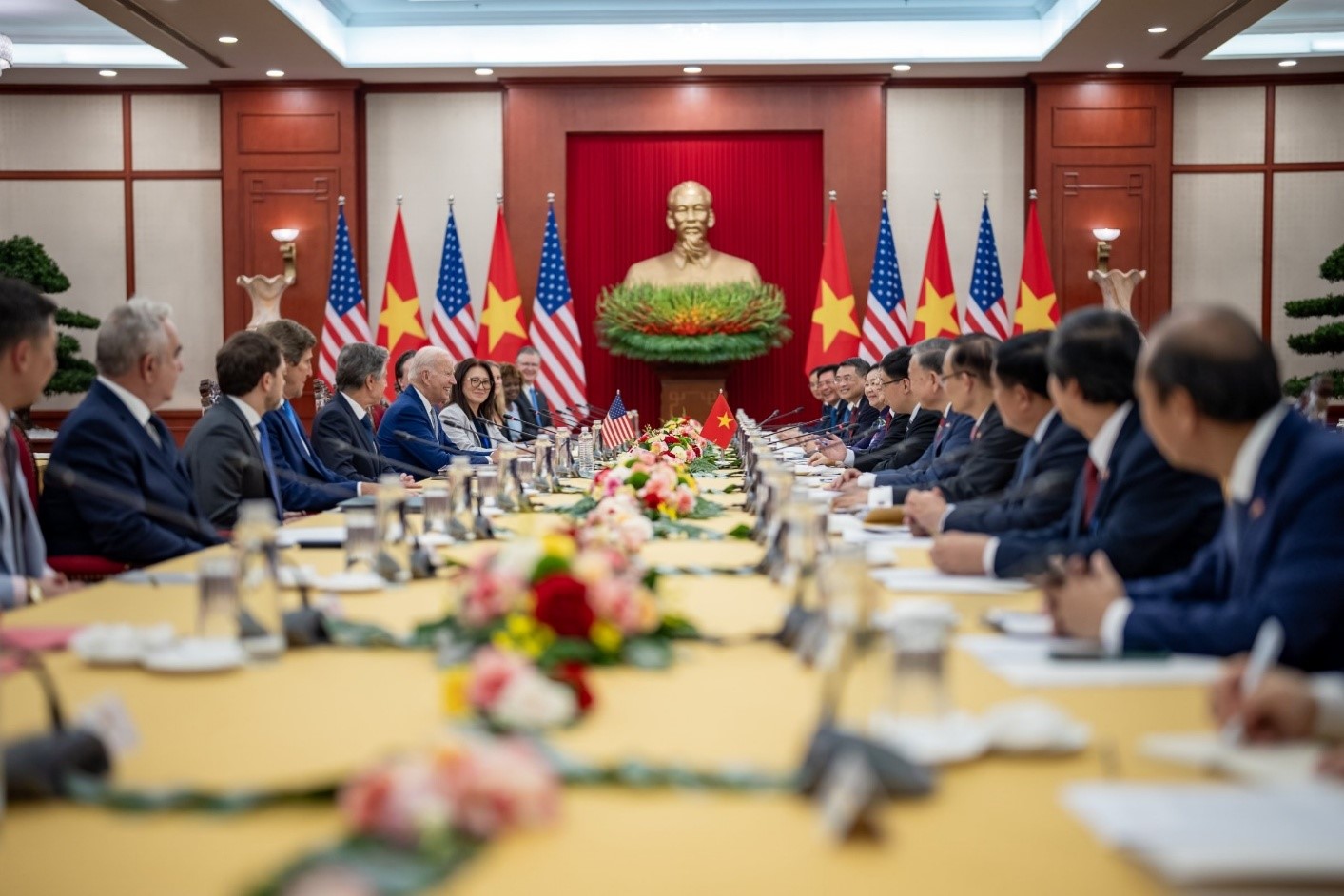
On 10 September, US President Joe Biden made a historic visit to Vietnam and agreed with his Vietnamese counterpart Vo Van Thuong to advance bilateral relationship to a Comprehensive Strategic Partnership, the highest degree of cooperation between two countries. The two administrations also discussed the largest arms transfer in history. If the two countries reach an agreement on this deal, it will alter the regional balance of military power, infuriate China, diminish Russia’s influence, and cause additional unrest.
From Hostility to Collaboration: How Have US-Vietnam Relations Changed Over Time?
Over the years, US-Vietnam relations have undergone significant changes, which can be categorised into several key phases:
Vietnam War (1955-1975): During this time, the United States supported the Republic of South Vietnam in its fight against the People’s Democratic Republic of North Vietnam and the Viet Cong. In 1973, US troops left Vietnam, and the Republic of South Vietnam was overthrown in 1975, bringing the war to an end.
Post-Cold War: After the end of the Cold War, relations between the United States and Vietnam were tense and communication was poor for a very long time.
Normalisation and Cooperation: In the 1990s, relations between Washington and Hanoi improved gradually. 1995 saw the reopening of the US Embassy in Hanoi. Economic and trade ties strengthened as well, with Vietnam becoming one of the United States’ key trading partners in Southeast Asia.
Growing Partnership: In recent years, the United States and Vietnam’s relationship has evolved into a growing partnership. Along with cooperation in fields like climate change and public health, this cooperation also involved economic and security cooperation.
Strengthening Security Cooperation
From the perspective of geopolitics and security, the recent visit to Vietnam by President Biden has strengthened the United States’ presence in the region, from the gate of Hanoi, and has increased Beijing’s anger and Moscow’s anxiety. To achieve a more even playing field in the geopolitical competition with China in the Pacific region, Biden’s administration negotiated the largest arms transfer in history between the two Cold War foes, the United States and Vietnam.
However, the final details of the deal have not yet been worked out, and it is possible that the negotiations will stall. Nevertheless, this subject dominated the official discussions between the United States and Vietnam.
The United States sees great potential in its security partnership with Vietnam. Hanoi is keen on acquiring some US systems, particularly those that can help it better monitor its maritime territory, as well as transport aircraft and cutting-edge weapons.
Vietnam previously relied heavily on Russia for its armaments, but the conflict between Russia and Ukraine has strained Hanoi’s relations with Moscow and made it more challenging to get supplies and replacement parts for Russian-made weapons.
Washington is more optimistic that a portion of Vietnam’s estimated $2 billion annual budget for arms imports can be diverted in the long run to weapons from the United States or its allies and partners, particularly South Korea and India. In order to assist the financially strapped Hanoi in ending its reliance on less expensive Russian weapons, Washington is also taking special financing conditions into consideration.
There was also talk of the United States providing Hanoi with F-16 fighter aircraft. Hanoi has also expressed a strong interest in a number of American-made defense systems, particularly transport and maritime patrol aircraft, including fighter aircraft.
Some US officials have suggested that the sale of American F-16 fighter jets to Hanoi is part of the package that could be implemented next year. Given that the Vietnamese Air Force has historically relied on Russian-made fighters like the Su-30, Su-27, and Su-22, the acquisition of the Lockheed Martin F-16 by Vietnam will be a historic event. The F-16 Block 70 Viper, which is the most advanced version of the aircraft and is outfitted with a variety of weapons systems as well as some fifth-generation technology, is anticipated to be made available by Washington to Hanoi.
What Does the Conclusion of the US-Vietnam’s Arms Deal Signify?
If the US and Vietnam are able to reach an agreement on the historic arms deal, many different effects, particularly on geopolitical and economic levels, are likely to follow, including 1) a significant growth of Vietnam’s military capabilities, which could irritate China and increase tensions between the two countries; 2) bolstering military and strategic ties between the United States and its ally, Vietnam, to counter Chinese influence; 3) Russia losing a significant market for exporting its weapons, which will reduce its strategic influence in the region; 4) positive economic effects on the United States through the defense industry and job creation; and 5) long-term complication of regional relations and escalation of tensions with China.
Infuriating China
The conclusion of a major arms deal between the US and Vietnam will undoubtedly enrage China in light of the escalation of the long-standing territorial dispute between Vietnam and China in the South China Sea, for a variety of considerations, including:
- Vietnam and China have political and territorial disagreements regarding who has the right to control the South China Sea. Any increase in Vietnam’s military prowess could therefore be interpreted as a potential danger to Beijing’s interests.
- China believes that the United States is attempting to weaken China’s influence by boosting its own in the Asia-Pacific region. As a result, US-Vietnamese security cooperation could be seen as a component of an American effort to confront China.
- China thinks that this agreement will give Vietnam access to cutting-edge US technologies, tipping the balance of power against it.
- China is thus anticipated to voice its disapproval and irateness towards a deal that supports Vietnam’s military capabilities.
Russia’s Worries
Once concluded, the significant arms deal between the US and Vietnam is very likely to cause concern in Russia for a number of reasons, including:
- Vietnam depends heavily on Russian arms and military equipment. Historically, Moscow has been one of Vietnam’s most important arms suppliers, and this agreement marks Vietnam’s entry into the American sphere of influence.
- In addition, Russia views Southeast Asia as strategically significant to its ability to exert influence globally; as a result, Hanoi signing a significant agreement with the US could reduce Russian influence over Vietnam and increase US presence.
- Moscow is extremely concerned and incensed by any increased American interference in its spheres of influence because it sees the United States as a global strategic rival that is vying with it for influence.
- If this deal goes through, Vietnam will gradually stop relying on Russian weapons as its primary supplier of military hardware, and Russia will lose one of its most significant military clients in the region, which will reduce its influence there. Consequently, this agreement could represent a blow to Russia’s military influence in Vietnam.
In conclusion, we have multiple lenses through which to examine Washington’s possible decision to sell weapons to Vietnam. The United States’ overarching strategy to increase its presence in the Indo-Pacific region, which includes bolstering its diplomatic and military ties with Vietnam, may have played a role in the decision. Hanoi is viewed as an important player in the fight against Chinese expansionism and for regional stability in Southeast Asia. If this deal goes through, it will change the balance of military power in the region and threaten regional stability. China will not keep quiet, and we might see a rise in diplomatic or military tensions between China and the United States or Vietnam. Given that Vietnam’s purchase of advanced US weapons will help to bolster its deterrent capabilities against China, this deal may encourage China to increase defense spending in order to maintain its military balance. Furthermore, since the agreement will give Vietnam access to US expertise in a variety of areas, including air and naval defense, it will increase the fears of other nations, including North Korea, which will encourage them to improve their military prowess. Last but not least, once this agreement is finalized, security alliances in the region will become more nuanced, with pro- and anti-deal groups emerging. Trust between the different actors may erode over time, which makes it difficult to work together to solve many other challenges.