








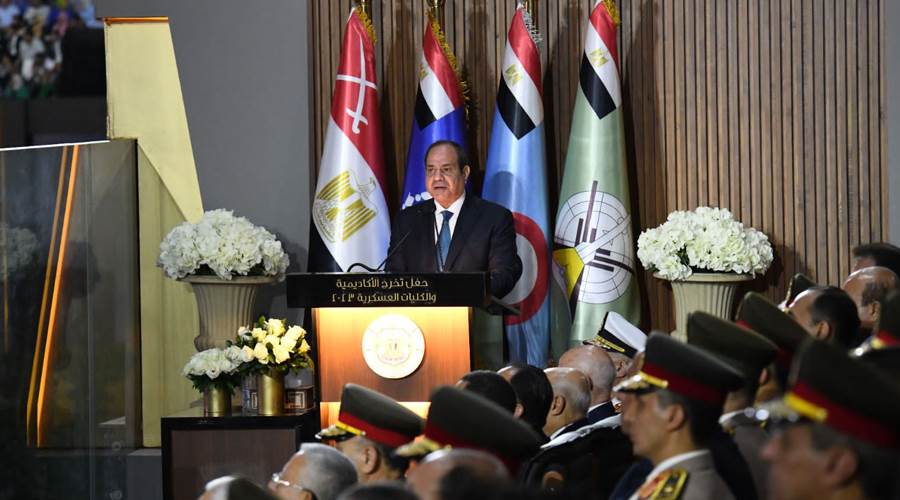
“We have never failed the Arab nation, and we never will.” With these words at the Military Academy and Colleges graduation ceremony on October 12, President Abdel-Fattah El-Sisi confirmed Egypt’s clear and unwavering stance on Arab issues, particularly those pertaining to regional threats.
In the years following the 30 June Revolution, Egypt has placed a high priority on maintaining and advancing Arab national security. The Egyptian decision-maker’s strong emphasis on Arab nation security came at a time when the entire Arab region was facing increasing threats, particularly from the activities of armed non-state actors and terrorist organisations. Add to this the expansion of outside interference in Arab affairs, the transformation of the Arab world into a theatre of “war by proxy”, and the escalating number of “failed states” in the Arab region over the past few years, which necessitated that Egypt, given its historical role and geopolitical and strategic weight, develop a vision for addressing these threats in a manner that ensures the maintenance and advancement of Arab national security.
Urgent Threats
Following the overthrow of Muslim Brotherhood rule in the wake of the 30 June Revolution, the period during which the Egyptian state began to regain its strength and effective regional role was marked by a discernible increase in threats to Arab and regional security, as well as Arab national security. The following threats stood out as the most significant:
1- The Proliferation of the “Failed State” Phenomenon: From 2013 to the present, the number of failed states in the Arab region has increased. Failed states are, by definition, those that are unable to impose their control over specific geographic regions through their sovereignty, provide a set level of services to their citizens, monopolise the use of force, and stabilise the economic environment, let alone the existence of a legitimacy crisis brought on by the presence of rival institutions vying for control of the state. The Arab world has experienced the highest prevalence of failed states over the past ten years. This has increased the severity of threats to Arab national security, especially given that the repercussions of this phenomenon, particularly those pertaining to security, extend to geographical and regional neighbours.
2. The Rise of Terrorist Groups: Since 2013, the nature and spread of terrorism in the Arab world has undergone significant changes. In terms of quantity, the region witnessed the expansion of dozens of terrorist organisations that exploited the lack of security in some nations to expand their presence and influence. Concerning the level or nature of terrorist activity, the Arab world has recently witnessed, for the first time, the control of one terrorist group over 30 percent of the territory of some nations (Daesh in Iraq and Syria in 2014 and 2015) and the establishment of networks of connections with a number of local armed groups in some countries. These changes have led to an increase in the number of threats to Arab national security as well as the growth and spread of terrorism.
3. The Problem of Outside Interventions: Due to the deteriorating security situation in several Arab countries and the external ties of a number of local actors in some Arab countries, the number of foreign interventions in the affairs of Arab countries has increased in recent years. These interventions, whether they were primarily military to support one party at the expense of others, as was the case with Turkish interventions in Syria and Iraq, or whether they involved providing all forms of support to some agents, as was the case with Iranian interventions in Iraq, Syria, and Yemen, took a variety of forms and contributed to instability in some countries.
4. Unconventional Security Threats: Recent years have served as a stark illustration of the fact that conventional security threats to Arab national security are no longer the only threats facing the region, with numerous unconventional dangers plaguing it. These non-traditional threats include climate change and its potentially catastrophic effects, as well as pandemics such as the Covid-19 pandemic, especially in light of the growing belief that pandemics will increase in the coming years due to the intensification of biological warfare between international forces. This necessitated the development of security approaches that combined the technical and proactive aspects of addressing these specific threats.
Rebuilding the Egyptian state in the wake of the June 30 Revolution, which entailed restoring Egypt’s role and standing on the regional and international levels, occurred in the midst of a turbulent context in the Arab region characterised by the existence of numerous threats to Arab national security, thereby increasing the challenges facing the Egyptian state, especially given that these threats relate to Egypt’s dynamic field, in which it engages and is affected from a variety of perspectives.
A Multi-Dimensional Egyptian Approach
Any attentive observer of Egypt’s foreign policy in the years following the 30 June Revolution would have observed a tighter connection between foreign policy and national security. Possibly, the dynamics Egypt has experienced over the past decade and the pressing threats that have accompanied them, in addition to the aforementioned Arab national security threats, have contributed significantly to the strengthening of the organic relationship between foreign policy and national security.
This manifested itself in the institutionalisation of the role of security agencies in foreign policymaking through the establishment of a number of national councils, including the National Defence Council and the National Council to Confront Terrorism and Extremism, which serve this vision. Egypt was also keen to emphasise the importance of addressing Egyptian national security threats first when speaking to the international community in all forums.
A careful examination of Egypt’s foreign policy over the past ten years, its stance on all Arab matters, particularly with regard to threats to Arab national security, as well as the official speeches of President El-Sisi over the past years’ policies, particularly with regard to threats to Arab national security, and policies and directions that he approved and adopted, would reveal that the Egyptian state had a clear strategy to deal with such threats, which is based on the following fundamental pillars:
1. The National State’s Centrality: The national state, an antonym for “failed state”, can be defined as a powerful state with cohesive institutions that exerts control over all of the territories within its geographical boundaries. The “national state” has played a significant role in recent years in shaping Egypt’s response to regional crises. In this regard, we find that President El-Sisi has consistently emphasised the significance of preserving and rebuilding the national state as the cornerstone of any long-term solutions for countries in both his official speeches and the positions announced through the Ministry of Foreign Affairs. The Egyptian government, on the other hand, has made it clear that it rejects any actions taken by non-state armed actors or parallel organisations that seek to undermine the legitimacy of the constitutional state’s institutions, as was the case in Syria, Libya, and Yemen, for example.
2. Rejecting Foreign Interventions: Egypt has consistently opposed outside interference in the internal affairs of Arab countries. This position is supported by the fact that international constitutional and legal considerations have repeatedly confirmed the incompatibility of external interventions with the principles of state sovereignty and independence. Moreover, Egypt’s stance is consistent with its perspective on the problems and difficulties the region has been experiencing recently, a perspective that views foreign interference in the internal affairs of Arab nations as one of the primary factors fostering instability.
3. Promoting Arab Security Cooperation: President El-Sisi has emphasised countless times that “any threat to an Arab country represents a threat to Egyptian national security” since the beginning of his first election campaign in 2014 until the present. The President advocated repeatedly for the formation of a joint Arab force to combat terrorism and worked within the framework of the Arab League to achieve this objective. In 2021, Egypt also made significant contributions to the formation of the Arab Intelligence Forum, which it adopted as a mechanism for coordinating intelligence operations in response to threats to Arab national security.
In a document presented at the 2019 Arab Emergency Summit in Jeddah, President El-Sisi outlined Egypt’s objectives for advancing Arab cooperation in the fight against security threats. The document focused on a few fundamental ideas, such as establishing mechanisms for joint Arab action to protect Arab national security, developing an approach that focuses not only on the military aspect of addressing these threats but also incorporates political and developmental aspects, emphasising the centrality of the Palestinian cause, and highlighting the fact that finding long-term solutions to these threats is the key to regional stability.
4. Centrality of the Palestinian Cause: In light of the new threats that have emerged since the 30 June Revolution, some political and academic circles have argued that the Palestinian cause will become less central on the Arab level and in Egypt. Nevertheless, Egypt was able to highlight the importance of the Palestinian cause and the fact that settling this dispute in a manner that is consistent with international legitimacy and the rights of the Palestinian people to establish an independent state with East Jerusalem as its capital is one of the cornerstones of achieving regional security and stability. This was emphasised in official Egyptian speeches over the past decade. In addition, significant multifaceted Egyptian efforts have been made to address developments regarding the Palestinian cause, including the intense Egyptian efforts to defuse the escalation that followed the October 7 Al-Aqsa Flood operation by Palestinian factions.
In conclusion, it can be argued that the Egyptian state’s foreign policy over the past ten years has prioritised Arab national security above all else and has become a doctrine that governs the work of the Egyptian state’s foreign and security institutions, in accordance with Egypt’s geopolitical and strategic position as, in the words of scholar Gamal Hamdan, “the principal regional power pole in the Arab world”.


