








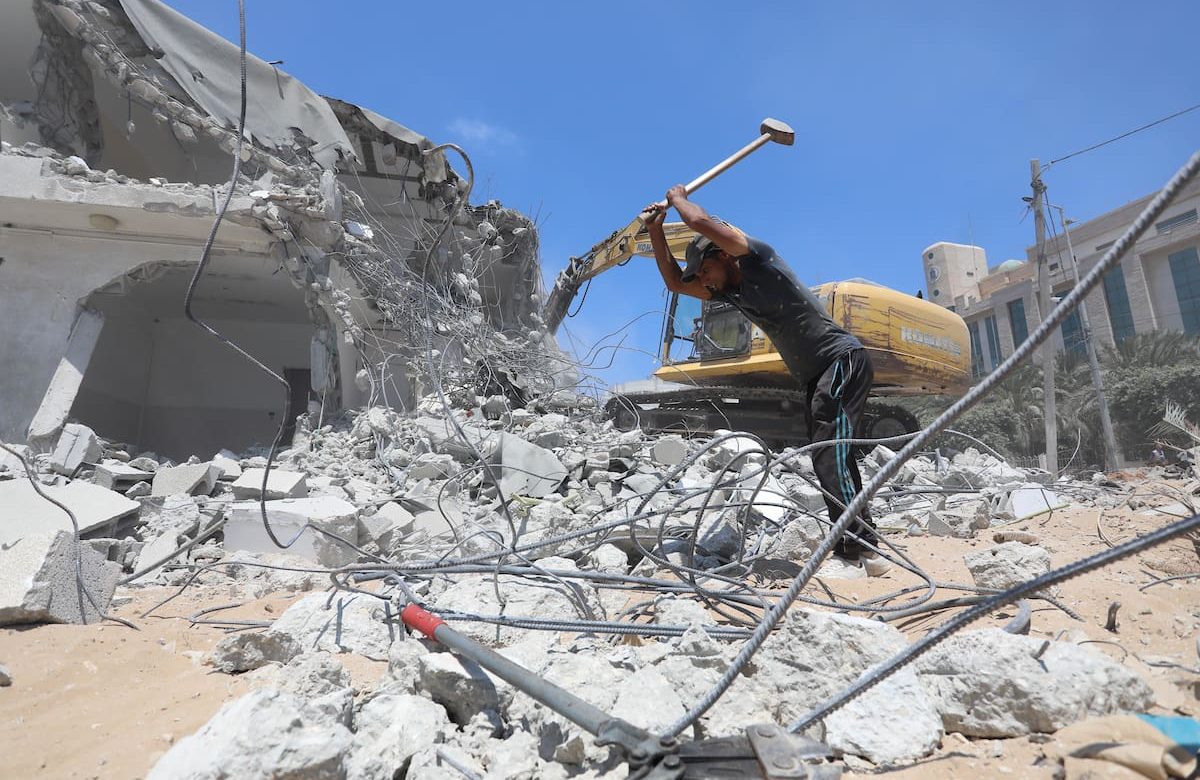
Since October 2023, the Israeli airstrikes on the Gaza Strip have persisted, resulting in significant economic and humanitarian devastation. This includes direct losses such as the destruction of infrastructure, homes, and buildings, as well as indirect losses such as increased unemployment rates, poverty, and scarcity of goods due to the imposed siege on Gaza.
To address the aftermath of the Israeli bombing in Gaza, it is crucial for donor countries to demonstrate their dedication by allocating billions of dollars for the purpose of reconstruction. This raises the question of how much money will be required for reconstruction and what response mechanisms will be used.
The Cost of Reconstruction
The initial economic losses resulting from the Gaza conflict are estimated to be $11 billion, according to figures released in late December 2023 by Ismail Thawabta, the director of the government media office in Gaza. Add to this $12 billion in indirect losses caused by the destruction of over 305,000 housing units since the start of the war, with 52,000 units completely destroyed and 253,000 partially destroyed. The total value of losses incurred at homes is $7.4 billion. Estimates suggest that different sectors incurred losses, with the commercial sector suffering $650 million, the industrial sector $450 million, and the agricultural sector $420 million.
Within the service sector, losses totaled $230 million in the health sector, $720 million in education, $120 million in electricity, $400 million in entertainment, $600 million in communications and the Internet, and $480 million in transportation. According to estimates provided by the Euro-Mediterranean Human Rights Monitor, the potential financial losses amount to approximately $20 billion.
Furthermore, Muhammad Qalalwa, the Director of Statistics at the Central Bureau of Statistics in Palestine, approximated the magnitude of the private sector’s incurred losses at approximately $700 million. This figure reflected the cessation of operations for 56,000 establishments and 147,000 employees. He also anticipated that the unemployment rate in Gaza would approach 65% and the poverty rate would increase to approximately 90%. Meanwhile, the United Nations Office for the Coordination of Humanitarian Operations (OCHA) has stated that the estimated cost of addressing the humanitarian needs of 2.7 million individuals in the Gaza Strip and 500,000 others in the West Bank amounts to approximately $1.2 billion.
In November 2023, Majdi Al Saleh, the Palestinian Minister of Local Government, estimated that the reconstruction of the Gaza Strip would require over $10 billion, given the damage caused by the Israeli aggression. He put the total cost of rebuilding the housing sector at $8.4 billion, with 20% to 25% going towards debris removal. He stressed that it will take at least six months after the war ends to determine the sector’s needs and losses.
This figure is relatively small when compared to initial estimates in January 2024, which indicate that the reconstruction cost could exceed $50 billion. As the Israeli operations broaden and persist, this quantity will undoubtedly escalate.
Response Mechanisms
Reconstruction is typically discussed following the termination of the war, but that has not occurred thus far. Hence, in order to initiate reconstruction efforts, it is imperative to engage in negotiations to establish the ultimate terms of the final status of the relationship between the Palestinian Authority, the Palestinian resistance, and the Gaza Strip with Israel. This will convey a favorable message to countries that plan to offer aid for the rebuilding of Gaza. The following are the most obvious potential response mechanisms that can be employed:
- Establishing an Arab Fund to Support Gaza: Given the daily economic losses the Gaza Strip is suffering, Arabs must help rebuild Gaza by setting up a fund that all Arab countries can contribute to. This will both meet the costs of reconstruction and demonstrate their support for the Palestinian cause.
- Mobilizing International Funds: The reconstruction of Gaza requires securing international funding, particularly from Western countries and allocating it to critical sectors, such as healthcare, which have been severely impacted by the Israeli airstrikes. This will be achieved through the organization of an international conference that will involve potential donor countries.
- Preventing a Recurrence of the Crisis: With the war showing no signs of abating, the cost of rebuilding Gaza is likely to be enormous. Hence, resolving the reconstruction predicament becomes arduous without cessation of the war while simultaneously guaranteeing non-recurrence of conflicts between the Palestinian resistance and the Israeli occupation. Countries are likely to slow down in providing aid for Gaza’s reconstruction due to apprehensions about facility destruction and the resumption of hostilities, which has been a recurring pattern.
Nevertheless, the implementation of reconstruction may encounter various challenges and obstacles, which can be detailed as follows:
- Failure to Fulfil Financial Pledges: Historical evidence has demonstrated that countries often fail to fulfil their commitments when it comes to providing financial support for reconstruction efforts. Countries must therefore make attainable commitments, with an emphasis on facilitating a speedy restoration of normalcy through delivering humanitarian aid, repairing damaged infrastructure, and restoring essential services that were disrupted due to conflicts, ensuring that they are brought back to at least the same level as before the conflicts.
- Incapacitating Conditions: Israel typically enforces stringent conditions that impede the advancement of the reconstruction endeavor, such as reinforcing the siege, imposing limitations on border crossings, and stipulating that reconstruction will only commence once Hamas settles the issue of Israeli hostages.
- Challenges in Determining Who Should Manage the Reconstruction: To achieve the desired outcome, the reconstruction of Gaza requires the identification of the organizations that shall be in charge of overseeing the funding and the consistent implementation of reconstruction. The process of reconstruction is closely linked to both the resolution of the war and the establishment of a governing body for the Gaza Strip. Therefore, it is imperative to establish a suitable mechanism once the war ceases, as the extensive destruction in the region necessitates the collaboration of various parties to support the reconstruction efforts.
In short, rebuilding Gaza is a complex undertaking given the political division in Palestine, the conditions imposed by Israel that impede and cause delays in reconstruction, inadequate international funding, lack of international commitment, and the recurrent Israeli attacks that undermine reconstruction progress. Therefore, reconstruction is dependent on a ceasefire, an end to the attacks on Gaza, a resolution to the conflict, and guarantees that, unlike what is currently happening, the Gaza Strip will not be destroyed once more after reconstruction.