





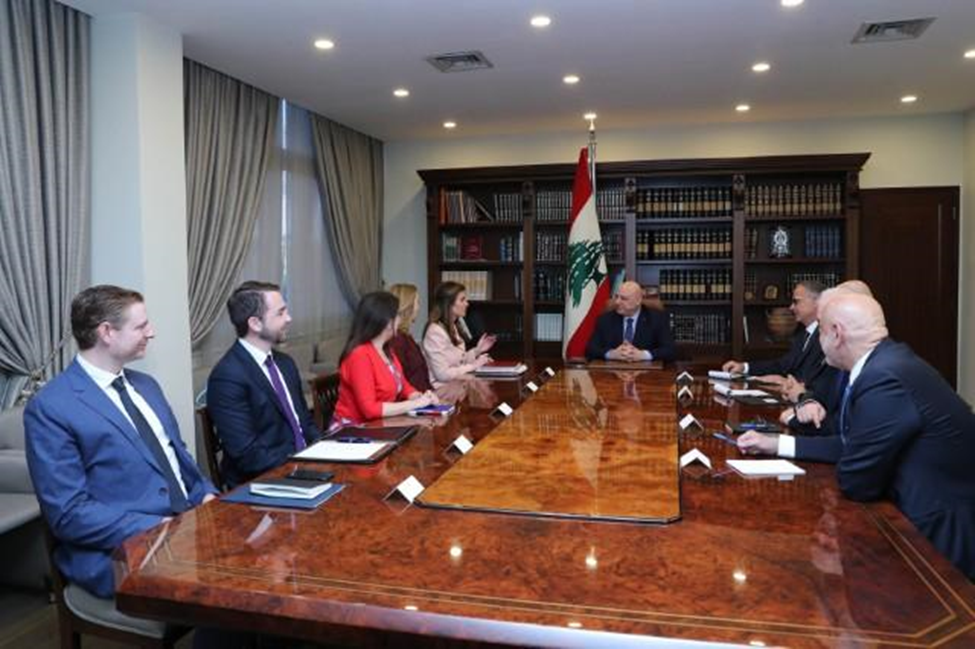
On April 5, Morgan Ortagus, US Deputy Special Envoy for Middle East Peace, arrived in Lebanon alongside Natasha Francesca, Deputy Assistant Secretary for the Levant and Syria, and US Ambassador Lisa Johnson. Their meeting with Lebanese President Joseph Aoun focused on southern Lebanon’s challenges, the work of the five-member monitoring committee, Israel’s withdrawal, developments along the Lebanese-Syrian border, and Lebanon-Syria coordination. In a continuation of diplomatic outreach, the US Working Group to Support Lebanon delegation met Aoun on April 7. The US conveyed its intent to tackle Lebanon-Israel disputes diplomatically, suggesting working groups to negotiate the release of Lebanese detainees, resolve contested border points along the Blue Line, and address the five sites still occupied by Israeli troops. This came after the sixth military leadership meeting at the UN peacekeepers’ headquarters in Naqoura, with participants from Israel, Lebanon, the United States, and France.
Although the ceasefire, signed on November 27, 2024, for an initial two-month period and later extended to February 18, 2025, required Israel’s withdrawal from Lebanon, breaches have continued. In April 2025, Israeli airstrikes hit Beirut’s outskirts and southern Lebanon, killing a Hezbollah member and two others in response to rocket attacks from Lebanon targeting northern Israel.
Drivers of the Ceasefire’s Endurance
While breaches persist, the durability of Lebanon’s ceasefire can be traced to a set of underlying factors that reveal the strategic calculations of the United States, Lebanon, Saudi Arabia, Israel, Iran, and Hezbollah, which can be outlined as follows:
• The United States: The United States is diligently working to preserve the ceasefire in Lebanon, communicating directly with Lebanese authorities through Morgan Ortagus, US Deputy Special Envoy for Middle East Peace. Ortagus made repeated visits to Lebanon in February 2025 and during April to collaborate with President Joseph Aoun on sustaining the Israel-Lebanon truce and ensuring border security. Ortagus delivered US messages emphasizing the push for demarcating the land border between Lebanon and Israel and pursuing a diplomatic path to resolve contentious issues, while the US- and France-led committee continues to monitor the ceasefire agreement. Previously, a proposal was made to deploy a French unit under UNIFIL alongside the Lebanese army at the five forward positions controlled by Israel. This proposal was agreed upon by UN Secretary-General António Guterres, but Israel has not approved it, citing concerns about Hezbollah’s potential return to the strategic hills where it is currently positioned.
The ceasefire agreement stipulated Hezbollah’s withdrawal north of the Litani River, 20 kilometers from the border, the dismantling of its military infrastructure in southern Lebanon, and the implementation of UN Security Council Resolution 1701 that calls for the deployment of Lebanese forces and UN peacekeepers in southern Lebanon, as well as the disarmament of armed groups in the country. However, over the years, this resolution has not been enforced, enabling Hezbollah to bolster its strength along the Israel-Lebanon border.
Despite the ceasefire’s continuation and its extension until February 2025, Israeli violations persist. The United States is pushing efforts, and Israel expresses a desire, to normalize relations with Lebanon and maintain the truce without escalation, allowing Israel to destroy Hezbollah’s infrastructure, monitor its movements, and weaken its capabilities. Simultaneously, pursuing the diplomatic track helps Israel achieve some objectives. The agreement has established a mechanism enabling Israel to identify Hezbollah’s positions for destruction and monitor the group’s weapons and ammunition transfers within Lebanon.
The United States has formed working groups to discuss and resolve border disputes between Israel and Lebanon, exploring Israeli withdrawal, the release of Lebanese captives, and pushing for normalized relations between the two countries in return for financial aid to Lebanon. This aid would help counter economic challenges, strengthen the Lebanese army’s capabilities, and reassess UNIFIL’s mandate. Nevertheless, the Lebanese army continues to struggle with securing the volatile border with Syria, where clashes persist between Syrian militias and Hezbollah-supported tribal fighters, alongside Sunni-Alawite tensions in Tripoli and the Akkar region.
The United States supports strengthening the Lebanese army, as evidenced by its decision to halt military aid to certain countries while exempting Lebanon from the freeze. The US State Department unfroze approximately $95 million in funding for the Lebanese army, reflecting a desire to bolster its capabilities to address security challenges and diminish Hezbollah’s role in Lebanon. Nonetheless, aid remains a complex issue under the Trump administration, which resists offering support without clear outcomes. Future aid may hinge on Lebanon’s economic reforms, its ability to enforce sovereignty, and its efforts to disarm militias.
Lebanon: The Lebanese army, under General Rodolph Haykal—who replaced Brigadier General Joseph Aoun—has undertaken efforts to secure the border, deploying about 6,000 troops to southern Lebanon. This number remains below the 10,000 soldiers mandated by the ceasefire agreement. The armed forces have also taken control of 550 Hezbollah-linked sites and seized 100 weapons caches belonging to the group. Furthermore, the army successfully raided bases of armed factions in the Beqaa Valley near the Syrian border, including locations like Jabal Sultan Yacoub, Kafr Zabad, Qousaya, and Naameh village south of Beirut, uncovering weapons tied to Hezbollah.
With dwindling numbers of Lebanese soldiers due to the economic crisis and a 98% drop in the lira’s value, Lebanon desperately requires assistance, particularly as the war with Israel has caused economic damages of about $14 billion, and rebuilding devastated areas is projected to cost $11 billion, according to World Bank estimates. This puts Lebanon at a crossroads, needing to pursue economic and security reforms while asserting its sovereignty in the coming phase. Under the new leadership of President Joseph Aoun, there is a strong desire to rebuild state institutions, with a focus on delineating borders, countering Israeli threats, and maintaining the ceasefire to foster stability and address economic woes. At the same time, the state steers clear of clashing with Hezbollah to avoid sparking sectarian strife or civil war, opting instead for political negotiations with the group.
Relatedly, talks on demarcating the land border may take considerable time due to the dispute over the Shebaa Farms, which Israel claims as its own despite Syria’s recognition of the area as Lebanese territory, coupled with the lack of border demarcation between Lebanon and Syria. Diplomatic efforts in this regard may continue, potentially leading to understandings among Lebanon, Syria, and Israel under US sponsorship concerning border delineation, alongside the normalization of relations between Lebanon and Israel. In this context, the Syrian and Lebanese defense ministers signed an agreement in Jeddah on March 28, aimed at demarcating the border between the two countries, activating bilateral coordination mechanisms, and forming specialized legal committees across various fields, with a follow-up meeting scheduled to take place in Saudi Arabia. This agreement followed tensions along the Lebanese-Syrian border after Hezbollah’s involvement in entering Syria and killing three soldiers, which prompted the Syrian army to shell positions in Lebanon.
Saudi Arabia: Saudi Arabia is leveraging regional dynamics that have diminished Hezbollah’s influence, aiming to alter Lebanon’s power dynamics after the election of Saudi-backed President Joseph Aoun and working in tandem with the United States and France via envoy Yazid bin Farhan. It also supports the Lebanese government under Prime Minister Nawaf Salam, who stated that Hezbollah’s “people, army, resistance” mantra is outdated. Both the Lebanese president and prime minister visited Saudi Arabia to gain its backing, yet Riyadh is closely observing Lebanon’s reform efforts, especially since Hezbollah’s influence persists through ministers loyal to it, which weakens the case for true change. Should a robust anti-Hezbollah electoral coalition emerge in Lebanon, it might encourage Saudi Arabia to lift its restrictions on Lebanon, boost investments, and extend financial assistance.
Israel: Despite Israeli violations of the ceasefire through airstrikes on southern Lebanon targeting Hezbollah sites, rockets, and weapons infrastructure, Israel seeks to maintain a controlled level of confrontation to avoid returning to the escalation levels seen in Lebanon in October 2023. Such escalation could provide Hezbollah with a pretext to reassert its role as a resistance force in Lebanon, threatening Israeli security. Israel is stationed at five strategic locations in southern Lebanon, claiming the need to protect Israelis returning to the north while monitoring and tracking Hezbollah to dismantle its infrastructure and ensure security. There appears to be an intention to remain in these positions, as indicated by the Israeli Defense Minister’s statement on February 27, 2025, that Israel “received a green light from the United States. We gave them a map, and we are staying indefinitely–this is situation-dependent, not time-dependent” Israel is positioned at strategic hilltops in southern Lebanon, near Hamames Hill in Khiam, a site in Labbouneh in the western sector close to Naqoura and Aalma El Chaeb, near the Metula settlement, the Western Galilee settlements, Jabal Blat, and near the settlements of Zar’it and Shtula.
Some Israeli officials support the idea of continuing to track Hezbollah, destroying its infrastructure, and maintaining a presence in southern Lebanon as part of the ceasefire agreement. This stance is bolstered by intelligence-sharing with the United States regarding Hezbollah’s movements, US approval to respond to Hezbollah’s violations and threats from Lebanon, and Israel’s ability to enter Lebanese airspace for surveillance purposes. On the other hand, Israel announced on March 11, its agreement to engage in border demarcation talks with Lebanon and released five Lebanese prisoners, reflecting a joint Israeli-US push to advance the delineation of the land border between Lebanon and Israel. This aims to undermine Hezbollah’s role as a resistance force and enable the Lebanese state to disarm the group.
Iran: Iran is pushing Hezbollah to avoid escalating tensions with Israel and to comply with the ceasefire agreement, as continued conflict in Lebanon undermines Iran’s regional influence and risks weakening one of its key proxies. This escalation could further erode Hezbollah’s domestic standing, given dissatisfaction among some Lebanese political factions with the group’s war against Israel and frustration in southern Lebanon’s Shiite villages over the destruction of homes and displacement caused by the conflict. Against this backdrop, Iran is pressing Hezbollah to control ceasefire breaches and uphold the truce, possibly delaying escalation as a bargaining chip in negotiations over the Iranian nuclear deal and seeking de-escalation to advance its goals during negotiations with the second Trump administration. Additionally, regional shifts, the weakened state of Iran’s resistance proxies, and Tehran’s inability to provide Hezbollah with funds to compensate those affected in Lebanon or rebuild damaged areas have contributed to efforts to avoid escalation.
Hezbollah: During its conflict with Israel since October 2023, Hezbollah suffered heavy losses, with about 2,500 fighters killed, many of them senior figures, pushing the group to prioritize reconstructing its organizational framework after months of destruction. It is also committed to supporting war-affected communities, including families of the killed, injured, and displaced, with over 317,000 homes damaged and roughly 43,000 obliterated, per estimates from Hezbollah’s Jihad al-Bina Foundation. The group’s long-standing political coalitions, such as its alliance with Gebran Bassil of the Free Patriotic Movement, who condemned its war efforts, have frayed. Hezbollah has also been cut off from Iranian supply lines through Syria after Israel demolished border crossings used to transfer weapons from Tehran to the group via Syria. Moreover, Hezbollah fears Israel may provide material support to armed groups in Syria hostile to Iran’s regional proxies, leading the group to avoid provoking Israel further to prevent fighting on multiple fronts and to brace for possible confrontations with Syrian armed groups. These dynamics compel Hezbollah to refrain from escalating tensions with Israel at present, as it grapples with its diminished capacity, undergoes restructuring, and focuses on domestic priorities in Lebanon. Consequently, Hezbollah might accept Lebanese state control over southern Lebanon, enabling it to rebuild its political and grassroots influence internally while reconstructing war-ravaged Shiite villages—critical to its popular base—destroyed in Israel’s escalation.
In short, despite internal and external motives for maintaining calm in Lebanon, challenges persist, including the Lebanese army’s limited strength and ability to control the borders, dismantling Hezbollah’s military infrastructure south of the Litani River, and Hezbollah’s commitment to de-escalation and disarmament—key factors shaping the future of the ceasefire. These dynamics suggest two potential trajectories. The first is a diplomatic route, with Israel breaching the truce through targeted strikes on Hezbollah positions without provoking a response, enabling Hezbollah to achieve political wins like reconstructing Shiite villages, preserving its governmental influence, restoring public support, and progressing on land border delineation while bolstering the Lebanese army’s border control. The alternative is renewed conflict between Hezbollah and Israel, fueled by Israeli provocations, failure to withdraw completely from southern Lebanon, escalated actions, Houthi aggression toward Israel and the United States, or friction over Iran’s nuclear ambitions, including failed US talks or attacks on Iranian nuclear sites. Such developments might lead Tehran to instruct Hezbollah to resume escalation to rebalance regional deterrence.


