





Investment and economic growth rates in Egypt have been flourishing since 2014 with a stable investment plan being introduced, more national projects implemented, and a clear transparent economic policy adopted. In parallel, the government introduced facilitative policies to pursue reforms in the energy sector building on several pillars, including diversifying energy resources, improving energy efficiency, addressing debt accumulation, abolishing subsidies, modernizing the oil and gas sector, and encouraging private sector investment. Egypt’s launch of a project to develop and modernize the petroleum sector in 2016 resulted in the country becoming a leading gas producer in Africa after Nigeria and Algeria, in addition to playing a vital role in regional and global energy markets.
Formerly importing natural gas to meet the growing local demand due to low production levels, Egypt now has natural gas sufficient enough to meet the local demand and also export to neighbouring countries. This increase in production came following a number of big natural gas discoveries that elicited the interest of commercial investors. These discoveries, particularly the Zohr field, gave rise to a significant increase in Egypt’s natural gas reserves over the past few years.
This article reviews the evolution of natural gas discoveries in Egypt and their related economic implications.
First: Egypt’s Prominent Natural Gas Discoveries and Projects
According to the Ministry of Petroleum and Mineral Resources (MPMR), Abu Madi onshore gas field in the Nile Delta was the first natural gas field to be discovered in 1967. Two years later in 1969, the Abu Qir offshore field was discovered in the Mediterranean, then the Abu Gharadig field was discovered in the Western Desert in 1971. Since then, natural gas discoveries continued to unfold.
The largest share of natural gas production in Egypt comes from the Mediterranean at 62 percent, then the Nile Delta at 19 percent, and the Western Desert at 18 percent. Top companies involved in natural gas extraction in Egypt include Belayim Petroleum Company (Petrobel), Khaleda Petroleum, Pharaonic Petroleum Company (PhPC), Badr El-Din Petroleum Company (BAPETCO), Burullus Gas Company (BGC), Eni (Italian), Apache (American), and Shell (Dutch).
To make practical use of these discoveries, Egypt implemented a number of projects geared towards increasing natural gas production. As per Egypt’s Projects Map, these projects included Zohr Development Project which lies in an area of 100 km² with maximum depth of 4,131 meters and its reserves are estimated at 30 Tcf (i.e. 5.5 billion barrels of oil equivalent). Zohr field, considered the biggest natural gas discovery in the Mediterranean and one of the largest worldwide, was discovered in 2015 and brought on stream in 2017.
Also, there is the Nooros Development Project in the Nile Delta. The field’s reserves are estimated at about 2 Tcf, through drilling 15 wells at a cost of $290 million. In March 2019, the field’s pipeline was completed in March 2019 and started operation mid-May 2019. The pipeline aimed at transferring 700 Mcf a day of the Nooros field production to the Jameel Gas Plant to increase the extraction of butane and natural-gas condensate.
Further, there is the Atoll Field Development project in North Damietta, which adds an estimated production of 350 Mcf of gas a day and 10,000 barrels of natural-gas condensate per day, through 3 wells at a cost of $855 million.
The Northern Alexandria West Delta fields for Natural Gas Production Project is also one of the projects Egypt implemented to revive the gas sector. Total investments in these fields are estimated at $10.5 billion. Production from the Libra and Taurus fields started in March 2017 at a rate of 720 million Mcf/d whereas production from the Giza and Fayoum fields started in February 2019 at a rate of 400 Mcf/d. Currently, production rates from the Giza and Fayoum fields amount to 585 Mcf/d. According to the MPMR, production from the Raven field was projected to start in April 2020 at a rate of 850 Mcf/d.
Furthermore, other projects aimed at developing the gas sector included the West Delta Deep Marine (WDDM) phase 9B project, Baltim South West offshore project in the Mediterranean, and Desouq field development phase B.
Second: Changes in Natural Gas Production and Consumption in Egypt
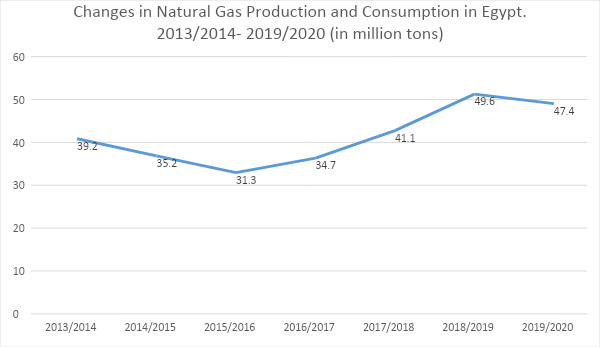
Egypt’s growing consumption of natural gas was accompanied by similar increases in natural gas production. This enabled Egypt to achieve self-sufficiency of natural gas. Figure (1) shows changes in natural gas production and consumption in Egypt.
- Changes in Natural Gas Production and Consumption in Egypt
Figure 1: Changes in natural gas production and consumption in Egypt, 2013/2014 – 2019/2020 (in million tons)
Source: MPMR
As shown in Figure 1, Egypt’s highest production of natural gas was in 2018-2019 attained with 49.6 Mt. However, this rate decreased a little to 47.4 Mt in 2019-2020 due to the negative repercussions of COVID-19 on demand and prices. Looking at the changes in natural gas production over the review period, we find that there has been a quantum leap in the total production increasing to 47.4 Mt in 2019-2020, up from 39.2 Mt in 2013-2014.
- Changes in local consumption of natural gas in Egypt
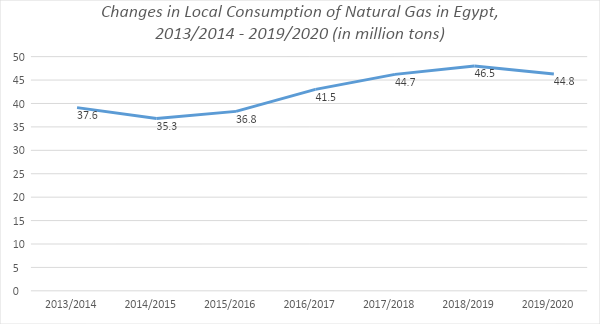
Figure 2: Changes in local consumption of natural gas in Egypt, 2013/2014 – 2019/2020
(Million tons)
Source: MPMR
According to the MPMR, Egypt’s domestic consumption of natural gas dropped in 2019-2020 to 44.8 Mt, compared to 46.5 Mt in 2018-2019. Thus, Egypt’s production was sufficient to cover local consumption with excess production of 2.6 Mt in 2019-2020. As for the distribution of natural gas consumption, we find that the electricity sector accounted for 60.4 percent of total natural gas consumption followed by the industry sector which accounted for 23 percent of total natural gas production.
Third: Major Uses of Natural Gas in Egypt
Achieving self-sufficiency, Egypt sought optimal utilization of its excess production of natural gas. As such, in line with the global trend towards clean energy to reduce the impact of climate variability and address the global warming crisis, Egypt followed a policy to convert petrol-run cars to natural gas, established several natural gas fuel stations, and implemented projects to supply natural gas to residential units. The below table shows changes in natural gas uses over a seven-year period.
Table 1: Changes in natural gas uses in Egypt, 2013/2014 – 2019/2020
| No. of Natural gas Vehicles (in thousands) | No. of natural Gas Subscribers (in millions) | No. of Residential Units Connected with Natural Gas (in thousands) | |
| 2013-2014 | 204 | 6.2 | 666 |
| 2014-2015 | 215.6 | 6.9 | 709.6 |
| 2015-2016 | 223.5 | 7.6 | 715.4 |
| 2016-2017 | 230 | 8.1 | 579.5 |
| 2017-2018 | 243.7 | 8.7 | 598.4 |
| 2018-2019 | 276 | 10 | 1230 |
| 2019-2020 | 318.3 | 11.2 | 1070 |
Source: MPMR
Since mid-1990s, Egypt has been working on implementing a Power-to-Gas project realizing the benefits of converting to natural gas being the cleanest and least polluting hydrocarbon fuel. As the number of natural gas discoveries increased, there has been an expansion in converting vehicles to natural gas. In 2019-2020, the number of natural gas vehicles amounted to 318.3 thousands, the highest within the review period.
According to Egypt’s Projects Map, the government targeted connecting residential units with natural gas to alleviate the suffering of citizens facing difficulties obtaining butane cylinders. Implementation of the first phase of the project included elven governorates, namely Giza, Alexandria, Ismailia, al-Qalyubia, al-Menofia, al-Dakahlia, Qena, al-Gharbia, Aswan, Sohag, and Marsa Matruh, benefiting 1.7 million residential units in 2019-2020, up from 666, 000 units in 2013-2014.
With Egypt’s expansion of natural gas projects and investments, the recent major discoveries that added to Egypt’s reserves, and the enormous capabilities for future discoveries, natural gas is expected to become critical to the future of energy in Egypt, particulaly with Egypt’s shift to less-polluting sources of energy. Egypt’s current production of natural gas enables it to achieve self-sufficiency and meet the domestic demand. According to the Cabinet, Egypt’s exports of liquefied natural gas amounted to 1.6 bcm in the last quarter of 2020.


