









Following the conclusion of the COP26 in Glasgow, and what has been agreed upon concerning Nationally Determined Contributions (NDCs), ambitions to decrease the reliance on fossil fuels, gradually phase out coal, increase reliance on renewable energy, as well as many other ambitious results that were announced in the Glasgow Climate Pact 2021, this year, however, brought many international events that have affected the action of governments, the revival of the Paris Agreement goals, as well as the promotion of climate policies and goals.
Extreme weather conditions, such as floods in Pakistan and heatwaves and droughts in Europe and the United States, worriedly remind us of the importance of promoting climate change mitigation, especially in less developed regions. Meanwhile, Russia’s invasion of Ukraine, and the subsequent energy crisis, cast a shadow of doubt over global cooperation and the pledge signed in COP26. All of this shapes our view of the 27th Conference of the Parties (COP27), which began on November 6, 2022, in Sharm El-Sheikh, and will continue to run until November 18, 2022. International debates and negotiations will perhaps be crucial this year to transition from promises and pledges to implementations, according to the four main themes, which are climate finance, the 1.5 degrees Celsius goal, adaptation and mitigation, and loss and damage.
The Opening of COP27
The world’s most important Climate Change Summit was launched in Sharm El-Sheikh. The opening sessions included a ceremony of handing over and receiving the presidency of the conference to the host state, with words from Alok Sharma, the president of COP26, and Minister Sameh Shoukry, president of COP27. Then the general session was completed with speeches made by the Executive Secretary of the United Nations Framework Convention on Climate Change and the Chair of the Intergovernmental Panel on Climate Change (IPCC).
It’s worth noting that everyone agreed that the luxury of time is no longer available and that the twenty-seventh session of the Climate Conference should exit the framework of discussions and commitments, and should enter the phase of very quick implementation with required funding. Elaborating, the national goals set to be achieved by 2050, which is the time when the world needs to achieve zero net emissions to reach the 1.5 degrees Celsius goal of the Paris Agreement and to avoid disastrous consequences of climate change, have become inadequate and need to be reviewed for a minute by all states, especially those causing enormous amounts of emissions.
The 1.5 Degrees Celsius Goal
Current nationally determined contributions, or the countries’ commitments that cover policies agreed upon for the climate, may likely lead to an increase of 2.4-2.6 degrees Celsius in global temperatures by 2100, which is well above the Paris Agreement target that is currently negotiated on how to achieve it. The International Energy Agency estimates are perhaps slightly more optimistic, where they indicate that it’s likely that global temperatures will increase by 1.7 degrees Celsius by 2100 if all governmental climate ambitions are met in full and on time. Therefore, there’s a gap between ambition and current policies, where indicators estimate that the newest plans put the world on the path of increasing by 2.5 degrees Celsius by the end of the century, with a 10% chance of temperatures increasing by more than 3.2 degrees Celsius. This tells us that not only are the climate policies put by governments insufficient, but also the climate goals themselves are incomprehensive. Thus, it’s expected that the focal point of COP27 will be the announcement of strengthening national-level determined contributions and the announcement of the effective implementation of investment plans to combat climate change.
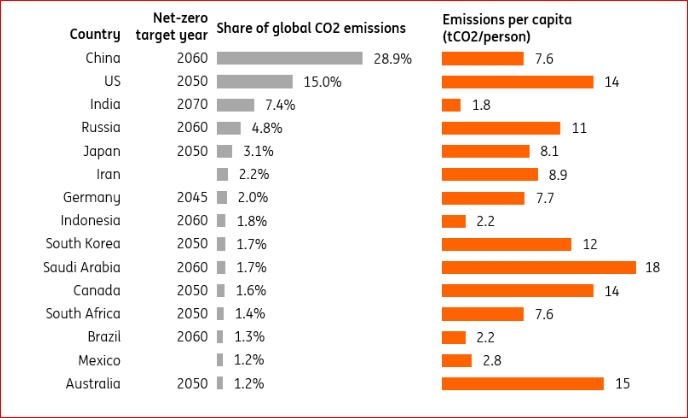
The following figure shows the world’s 15 largest emitters and their plans to reach net zero emissions:
Climate Finance
Another hot topic that is discussed at COP27 is climate finance from developed to developing countries. The urgency of this issue this year is due to the changing conditions that have been witnessed by many areas in the world, not just developing regions, which are becoming more frequent and intense. Moreover, these extreme events will have disproportionate impacts on poor countries that won’t be able to effectively mitigate the adverse effects of climate change. Therefore, it’s essential that COP27 focuses strongly on financing, especially for the African continent, since it will likely suffer more than others from climate change, so it will need money and technology to mitigate its effects. Working on closing the gap between the required funding is not limited to providing money, but includes helping developing countries improve their flexibility and access financing, optimizing the use of available resources, and providing them with technical support, ultimately making the achievement of funding targets more sustainable.
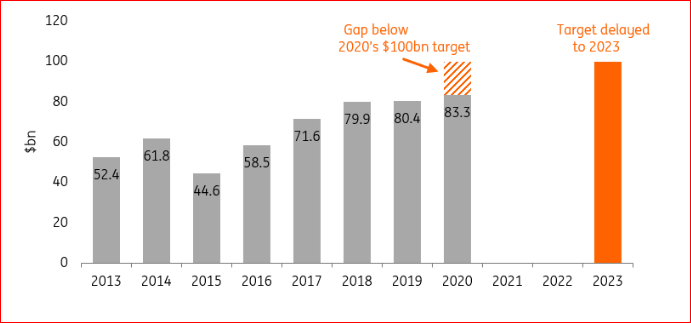
Developed countries haven’t achieved their funding goal of $100 billion annually, which was scheduled to be achieved in 2020, where the sum of climate finance from developed countries reached only $83.3 billion that year. Additionally, COP26 failed to establish a funding mechanism, so this year the burden will remain heavy until it’s achieved.
The following figure shows the total climate financing from a number of developed countries, according to the Organisation for Economic Cooperation and Development:
Is the Priority Mitigation or Adaptation?
Climate finance usually means funding adaptation or mitigation from climate change impacts procedures. Mitigation are the actions taken to reduce and limit greenhouse gas emissions, while “adaptation” measures are based on reducing vulnerability to effects of climate change. Therefore, mitigation is concerned with causes of climate change, while adaptation addresses its effects.
It’s not a priority here to make one at the expense of the other. To give an example, many states are interested in mitigation actions such as:
- Exercise energy efficiency
- Increased investment in renewable energy
- Transition to a green economy
- Clean and effective transportation: electric public transport, bicycles, and shared cars
- Carbon Tax and Emissions Markets
On the other hand, states experiencing the devastating effects of climate change are interested in adaptation measures, such as:
- More sustainable and secure infrastructure for facilities
- Flexible and varied agriculture to be ready for natural disasters
- Research and development on potential disasters, temperature behavior, etc.
- Preventive and precautionary measures (evacuation plans, health issues, etc.)
While both mitigation and adaptation measures are important, global actions are what attract global attention. Mitigation is currently the issue with the most global attention due to its long-term benefits. Moreover, most climate finance is concentrated in the energy, transport and industrial sectors.
The first day of COP27 promised a fruitful conference with global momentum around transitioning to implementation. Additionally, with the participation of over 40,000 representatives of international, media, and research actors, as well as climate change specialists and over 90 world leaders, and leaders in exceptional global circumstances, it’s necessary to agree upon international action mechanisms in the coming period, and frameworks for their operationalization and implementation. It’s also essential that the whole world be on the same steps in achieving climate goals.