







On December 31, 2024, Daesh launched a significant assault on a military base in Puntland, northeastern Somalia, resulting in approximately 20 fatalities and multiple injuries. The following day, the group claimed responsibility in a statement disseminated by its Amaq News Agency while Puntland forces announced they had thwarted the attack and neutralized all the attackers. In view of Daesh’s recent strategy of orchestrating sophisticated and impactful operations characterized by precise tactics and layered objectives, this article aims to provide analytical insights into the attack by examining how it was executed and highlighting the core messages, along with the tactical, temporal, and spatial aspects that can be inferred from the available information.
Dissecting the Attack
The assault unfolded as a textbook example of the “immersion attack” tactic, a signature strategy frequently employed by Daesh to create widespread impact. Twelve Daesh militants, equipped with light and medium machine guns, rocket-propelled grenades, hand grenades, and suicide belts, executed the attack with remarkable complexity. The assault commenced with a suicide car bombing at a supply headquarters for Puntland forces in Dharjalevillage, situated in the Iskushuban area. After the initial blast, five infiltrators attacked a military position close to the supply headquarters while two other suicide bombers drove a vehicle loaded with explosives into the main forces’ camp, triggering a devastating detonation. Subsequently, four additional infiltrators stormed the camp, engaging in intense combat with the security forces. The details provided demonstrate that the attack was executed with exceptional precision, advanced training, and meticulous pre-execution planning, complemented by the systematic coordination of the operatives’ movements.
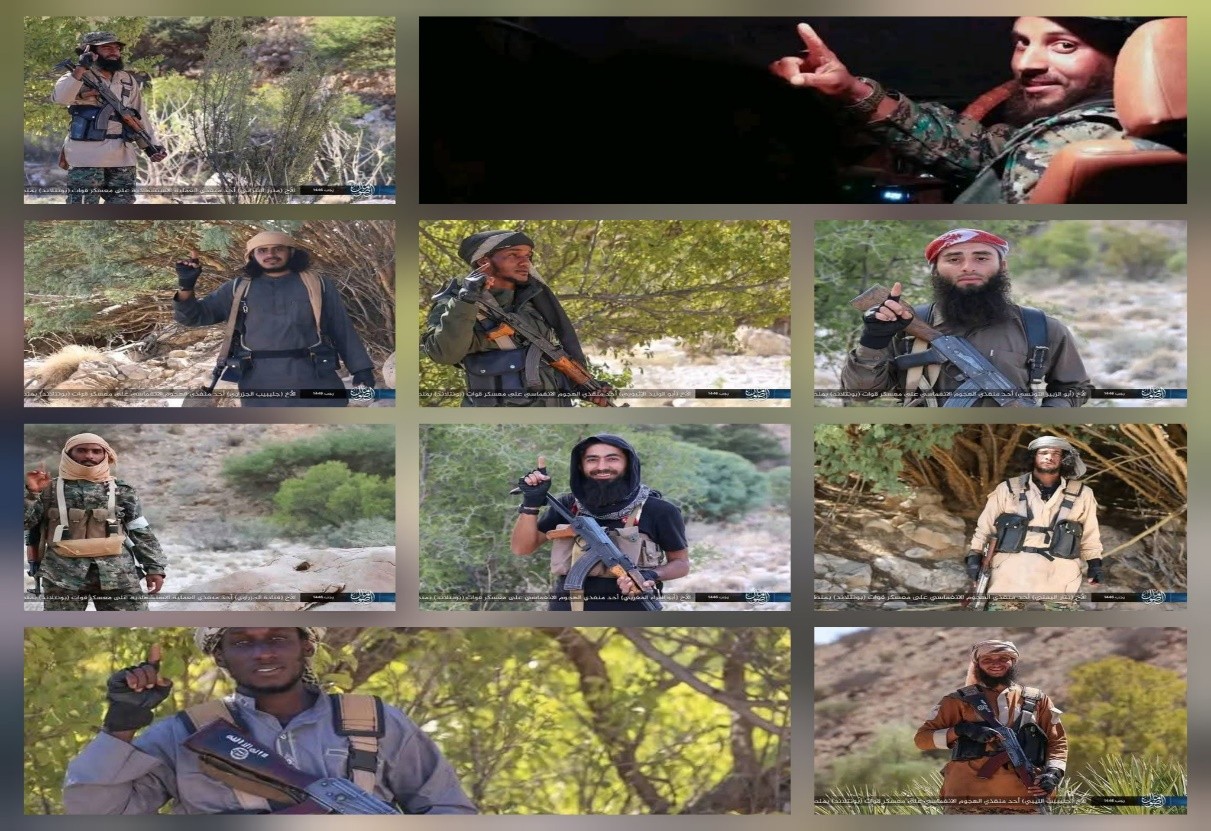
The attackers were identified as hailing from seven distinct Arab and African nationalities, including Yemen, Tunisia, Morocco, Algeria, and Tanzania. This provides several insights. Firstly, Daesh was keen to deliberately ensure that the identities, ethnicities, and nationalities of its attackers convey significant messages. In this case, the organization aimed to highlight the diverse origins of its members and demonstrate the global resonance of its ideology. That’s why it publicized details about the attackers’ nationalities and released their photos, names, and backgrounds through its media platforms. Secondly, the varied nationalities of those involved in the Puntland attack underscore the “dual structure” of Daesh’s Somali branch, which integrates both local and foreign operatives. This strategic composition enhances the group’s resilience and adaptability in the face of security operations, whether from Somali forces or its main jihadist rival, al-Shabaab, affiliated with al-Qaeda.
Thirdly, the identities of the attackers in the Puntland assault further indicate that Daesh maintains a powerful network of facilitators and smugglers, which facilitates the movement of its fighters from the Middle East and North Africa into Somalia. This hypothesis is corroborated by the Puntland police’s 2024 announcement of foreign Daesh members’ arrests, along with recent UN reports noting a significant growth in Daesh’s Somali branch, which has expanded to 600-700 fighters due to an influx of foreign militants from Syria, Yemen, Ethiopia, Sudan, Morocco, and Tanzania, traveling via sea and land routes. The entry of these foreign fighters has played a key role in strengthening the group’s military capabilities significantly bolstering its field presence, particularly in the Cal Miskaad mountain range of Puntland in 2024. As the situation in Syria evolves, it is likely that Daesh will continue to transfer additional personnel to Somalia and may also seek to leverage the foreign elements within its ranks to expand its operations beyond Somalia, targeting other countries.
Numerous Implications
The recent attack by Daesh in Puntland carries several significant implications, particularly concerning the context in which it unfolded. The most prominent among these can be summarized as follows:
• Undermining Counterterrorism Efforts: The attack took place amidst intensified military preparations by Puntland forces to launch wide-ranging operations against Daesh fighters hiding in mountainous areas. Through its calculated timing, the organization sends a clear signal of its capacity to endure security offensives and exploits the situation to cast doubt on the Somali government’s ability to maintain security. This serves to both bolster the morale of its current members and attract new recruits to its ranks.
• Competition for Dominance: The attack occurs during a resurgence of activity across multiple Daesh branches, including those in Mozambique and Khorasan. This reflects a competitive dynamic in Daesh Somalia’s strategy, as it seeks to carry out sophisticated operations to assert its relevance and gain additional backing and resources. At the same time, it positions itself in rivalry with other terrorist groups operating in Africa, most notably its direct competitor, the al-Shabaab Movement, an affiliate of al-Qaeda.
• Reaffirming Presence and Operational Prowess: The Puntland attack, along with other recent operations by Daesh affiliates and cells—such as the vehicle-ramming incident in New Orleans on January 1—reflects the group’s ongoing efforts to assert its significant presence within the global jihadist landscape for 2025 and its ability to conduct strategic attacks, galvanize its followers, and reinvigorate its ranks, especially following a challenging 2024 marked by targeted strikes that depleted its financial resources and leadership and created a pressing need for the organization to execute major operations, both to reaffirm its capacity to endure despite the challenges it faces and to inspire confidence and loyalty among its members and affiliates.
• Rising Threats of Daesh’s Somalia Province: The Puntland attack highlights the growing dangers associated with the resurgence of Daesh activity in Somalia, a trend observed through monitoring the group’s movements throughout 2024. Notable among these developments is Daesh’s success in reorganizing within the Cal Miskaad mountain range, spanning eastern to northern Somalia, capitalizing on reduced local and international military efforts against its bases, global preoccupation with other conflicts, and the weakening of the al-Shabaab movement due to intensified government military campaigns in southern Somalia. Al-Shabaab’s retreat from the northern regions allowed Daesh to assert control over the Cal Miskaad mountain range following several clashes. Additionally, Daesh extended its influence in Bosaso and remote villages in Qandala, leveraging northern Somalia’s rugged terrain to establish hideouts and training camps, providing strategic advantages for battles against both government forces and al-Shabaab.
Although Daesh’s Somalia branch exhibits lower operational activity rates compared to other branches, its associated risks and threats are disproportionately high. These threats extend globally, as Somalia has hosted the al-Karrar office since 2022—one of Daesh’s nine regional hubs, responsible for channeling material and logistical support to its global branches. Notably, al-Karrar is the most powerful of these offices, operating with a decentralized structure that complicates security forces’ efforts to disrupt its activities. Despite having a relatively small membership, Daesh Somalia has leveraged this to its financial advantage, ensuring self-sufficiency and generating surplus revenues, which were funneled to other branches via the al-Karrar office.
• A Shift Towards Increased Operational Activity: Observing the trajectory of the Daesh Somalia branch over recent years reveals that its primary role has been administrative, functioning as a central hub for financial collection and coordination between branches, rather than focusing on field operations like other Daesh affiliates. However, the Puntland attack, along with the group’s activities during 2024 and certain field gains—albeit modest compared to al-Shabaab’s operational presence—suggests a strategic pivot. Daesh-Somalia appears to be ramping up its operational activities, all while sustaining its central role in funneling financial support to other branches.
In conclusion, Daesh is undergoing a revival across its branches, marked by operational activity rivaling its peak a decade ago, a trend likely to escalate further amid ongoing global and regional dynamics that fuel such growth, including the ongoing conflicts in Gaza and Ukraine, alongside global distractions by geopolitical tensions at the expense of counterterrorism efforts. Somalia, in particular, is poised to witness increased terrorist activity, not only from Daesh but also from the al-Shabaab movement affiliated with al-Qaeda, which strives to expand its influence within the jihadist landscape in Somalia.


