








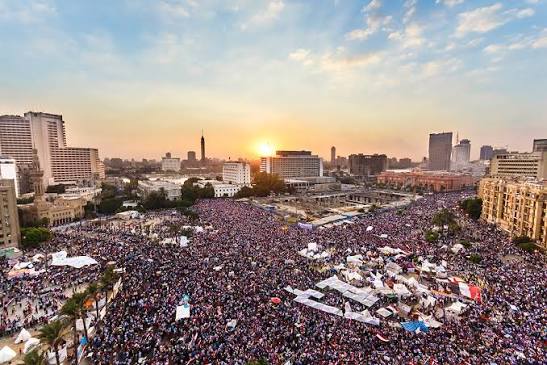
Egyptian society is commemorating these days two of the most influential revolutions in its history, both of which raised the slogan “Egypt for the Egyptians.”
While the July 1952 Revolution placed at the forefront of its priorities the eradication of colonialism and the domination of government by capital allied with it, to put an end to the assault on Egypt’s national identity, the 30 June Revolution placed at the top of its priorities the restoration of Egypt’s identity after what had befallen it during the Muslim Brotherhood’s year in power.
In both revolutions, the people and the army were present: the July Revolution was carried out by the vanguard of the Egyptian army, the Free Officers, and embraced by the people, whereas the 30 June Revolution was initiated by the people and backed by the people’s army.
There were numerous reasons behind the July Revolution, foremost among them the continuation of the occupation, the deterioration of Egypt’s political conditions, Britain’s failure to acknowledge the services rendered by the Egyptians and their role during the war, its unwillingness to show any desire to ease its grip on the occupation or bring it to an end, its continued deployment of forces in Egypt’s major cities, its procrastination in evacuating them, and its efforts to prevent Egyptians from acquiring the capabilities that would enable them to remove the occupation.
It even imposed a British military mission on the Egyptian army, which was used to conspire against it and weaken it, after Britain had resisted increasing the Army’s manpower and equipment so that its weakness would serve as a justification for Britain’s continued stay in Egypt for as long as its ambitions desired.
Britain was encouraged in this by the weakness of the Royal Court, the rivalry among Egypt’s political parties for power, and their tendency to appease the occupation authorities and rely on them to remain in power, including the Wafd Party, which accepted the formation of a government following the incident of 4 February 1942.
The implementation of the 1923 Constitution did not prevent the spread of political corruption in Egypt, not because of any inherent flaw in the Constitution itself, but due to shortcomings in its application and the political and social system prevailing in Egypt at the time.
That system enabled the landed elite to dominate government and turn it into an instrument for serving their own interests by controlling parliament through their influence over the peasants in their constituencies, who elected them regardless of whether they possessed the qualifications required for parliamentary membership.
This was compounded by the widespread practice of vote-buying among the electorate due to poverty, illiteracy, and weak political awareness. Consequently, vested interests came to dominate both the Senate and the House of Representatives, influencing legislation and taxation in ways that safeguarded their own interests.
The period, therefore, failed to witness political stability, as the 1923 Constitution granted the King the authority to dissolve parliament whenever he wished. Consequently, not a single House of Representatives completed its constitutionally prescribed five-year term.
The result was the absence of governmental stability. Indeed, not only did no government remain in office long enough to implement its policies, but some ministries remained in power for no more than a day, or even part of a day. This led to a decline in public confidence in successive governments and widened the gap between rulers and the ruled.
Nor were Egypt’s economic and social conditions any better than its political situation. The policies of the occupation contributed to the deterioration of Egypt’s economic and social conditions by transforming the country into one of the economic units subordinate to the British economy specializing in cotton production.
This gave rise to a class of large landowners, while the overwhelming majority of Egyptian peasants became either smallholders possessing tiny plots of land that could not provide them with the necessities of life or destitute labourers working under harsh conditions on the estates of the great landowners.
At the same time, the occupation actively obstructed Egypt’s industrialization despite the efforts of Bank Misr in this regard. This contributed to the absence of social justice and the emergence of class conflict, expressed in attacks by peasants against landowners or their agents, and by workers against factory owners, as occurred in Shubra El-Kheima in 1948. The conflict reached its height with the Cairo Fire on 26 January 1952.
In the face of the continuing occupation, the deterioration of Egyptian society, and what had befallen the Egyptian army during the 1948 Palestine War, many Egyptian politicians, and even some officials of the occupation authorities, expected a revolution that might threaten Egypt’s entire social order.
At dawn on 23 July 1952, the Egyptian people awoke to that revolution after army units had moved in the middle of the night to occupy government headquarters, the radio station, and key public facilities.
Within hours, the revolution compelled King Farouk to abdicate in favour of his son, Ahmed Fouad, and to leave the country no later than 26 July 1952. At the same time, and to affirm its legitimacy, the revolution began implementing its objectives by abolishing the 1923 Constitution, dissolving the political parties, abolishing the monarchy, proclaiming the republic, issuing the Agrarian Reform Laws, and dissolving private religious endowments as the first step toward achieving social justice.
In preparation for compelling Britain to evacuate Egypt, the July Revolution, from its earliest days, embarked on strengthening the Armed Forces, establishing military training camps, and forming the National Guard. These measures prompted Britain to yield to the demands of the Egyptian people and sign the Evacuation Agreement on 19 October 1954, which provided for the abrogation of the 1936 Treaty and the withdrawal of British forces from Egyptian territory within twenty months of its signing.
In return, Egypt agreed to the continued presence of a limited number of British experts at the Canal Base and to allow British forces to return to use the base should Egypt, any Arab state, or Turkey come under threat.
The implementation of the agreement brought to an end seventy-four years of British occupation in Egypt. Following the Tripartite Aggression against Egypt on 31 October 1956, launched in response to the nationalization of the Suez Canal, Egypt decided in January 1957 to abrogate the Evacuation Agreement.
When several countries waged an economic war against Egypt by freezing its financial assets, refusing to purchase Egyptian cotton, and halting supplies of foodstuffs and medicines, Egypt responded by taking over the British base in the Canal Zone, nationalizing British and French assets in Egypt, opening new markets for Egyptian cotton, and importing the foodstuffs, medicines, and other essential goods the country required.
Ultimately, this economic war failed, and the countries concerned returned to negotiations with Egypt over the release of its frozen assets and the restoration of commercial relations. The Suez Canal Company also reached an agreement with the Egyptian government in 1958 that settled the dispute between them and provided fair compensation to its shareholders.
The setback came as a result of the war launched by Israel without warning against the frontline Arab states on 5 June 1967, representing the gravest challenge faced by the July Revolution. The regime responded in a balanced and constructive manner by deciding, only a few days after the defeat, to wage a War of Attrition while rebuilding the Armed Forces in preparation for a battle that would erase the effects of the aggression. The Egyptian Armed Forces, backed by Egyptian society, fought that battle on 6 October 1973.
Victory opened the way for Israel to seek a peace treaty with Egypt, through which Egypt regained all the territories occupied in 1967. At the same time, relations between Egypt and global capitalism were restored through the adoption of the Open Door Policy (Infitah) and efforts to absorb its repercussions following the Bread Riots of 1977.
When government policies proved incapable, over successive decades, of addressing the various consequences of the Open Door Policy, millions of Egyptians took to the streets on 25 January 2011, raising the slogan: “Bread, Freedom, Social Justice, and Human Dignity.”
The demands of the street subsequently evolved into calls for President Mubarak to step down, culminating in his relinquishing power and transferring authority to the Supreme Council of the Armed Forces, which bore a heavy burden in containing the state of upheaval in the Egyptian street, particularly after members of the Muslim Brotherhood’s youth movement appeared in the public squares under instructions from the Guidance Bureau and sought to ride the revolutionary wave by misleading young people with hollow slogans upon which they had been raised since childhood.
The Brotherhood’s hijacking of an achievement in which it had played no part was consistent with its historical conduct since entering the political arena before the July Revolution. When Egyptian society was engaged in armed struggle against the occupation forces in the Canal Zone following the Ismailia incident, and the leaders of the Brotherhood were asked to encourage their youth to participate in the resistance, they replied that they were less concerned with the issue of evacuation and national independence than with purifying society of vice, sin, and frivolity. This position perhaps explains the fate suffered by entertainment venues and cinemas during the Cairo Fire.
Likewise, before the July Revolution, the Brotherhood deliberately distanced itself from preparations for the revolution out of fear that it might be exposed before succeeding. Once the revolution had triumphed, however, the Brotherhood not only declared its support but also attempted to promote the claim that it had played a leading role in preparing for and protecting it.
The Free Officers recognized the Brotherhood’s opportunism and its efforts to impose its tutelage over a revolution for which it had not been willing to make even the slightest sacrifice. Accordingly, they kept the Brotherhood at arm’s length from the revolution from the very beginning.
It was therefore only to be expected that the Brotherhood would hijack the 25 January youth movement and seek to impose its tutelage over it after succeeding in sowing divisions among the young protesters, leaving them fragmented into factions and parties, preoccupied with their internal disputes. At the same time, the Brotherhood’s youth sought to prevent women from continuing to play their role in the Egyptian street.
Once the Brotherhood became confident of its control over the political scene, it entered the presidential race, which brought one of its members to the presidency for a term that lasted no more than a year. That experience prompted society to participate in a revolution aimed at bringing down the Brotherhood’s rule and correcting the course of events after the group had failed to govern the state.
The Guidance Bureau became the real centre of power, preoccupied with dismantling state institutions and bringing them under its control, including the military and security establishments, by placing Brotherhood members within them. At the same time, it distracted society with successive crises that diverted attention from its political practices.
After Egyptian society had grown weary of the Brotherhood and its management of the state, more than 30 million Egyptians gathered in public squares across the country on 30 June 2013, demanding an end to its rule. This unprecedented mobilization prompted the Armed Forces and their leadership to move swiftly to protect those gathered in the streets from the Brotherhood’s battalions.
On 3 July, the demands of the revolution were met, the Brotherhood’s rule was brought to an end, and it was decided that the president of the Supreme Constitutional Court would assume the administration of the country pending early presidential elections.
Elections were subsequently held under a new Constitution, resulting in the election of President Abdel-Fattah El-Sisi as president of the republic, at a time when Egyptian society was confronting formidable challenges, foremost among them terrorism, which sought to undermine the foundations of the Egyptian state and facilitate its dismantling, in addition to deteriorating economic and social conditions.
Accordingly, the state gave priority to combating terrorism and bringing extremist groups under control to achieve security and stability, create a climate conducive to investment, and provide the necessary foundation for the sustainable development plan being implemented under exceptionally difficult international circumstances.
These included continued attempts to place pressure on the 30 June Revolution, the COVID-19 pandemic, the Russian-Ukrainian war, and subsequently the American-Israeli war against Iran, all of which placed additional strain on the global economy.
Despite these challenges, the development process continues across all sectors, while Egyptian society steadfastly bears its burdens so that future generations may reap its rewards.
————-
Published in cooperation between the Egyptian Center for Strategic Studies, Al-Ahram Weekly, and the English-language portal Ahram Online