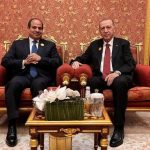





On 24 January Egyptian President Abdel-Fattah Al-Sisi arrived in New Delhi at the invitation of Indian Prime Minister Narendra Modi to participate as the chief guest in India’s Republic Day celebrations, held annually on 26 January.
This was President Al-Sisi’s third visit to India, following his first visit in October 2015 to attend the third summit of the India-Africa Forum, and his second visit in September 2016, which paved the way for the two countries’ relations to be strengthened, based on three main axes that form the basis of bilateral partnership, namely: political and security cooperation, economic and scientific cooperation, and cultural and popular relations.
President Al-Sisi’s visit came at a time when India is attempting to assert its global role on an international and regional scale. On the occasion of the 74th anniversary of Republic Day, India is making moves at various regional and international levels to occupy a leading position in a multipolar world order.
Republic Day’s Symbolism in Indian Foreign Relations
The Indian people hold the invitation to the Republic Day celebration as the highest form of protocol honor bestowed by the Indian state. The presence of a guest president at one of India’s most significant national celebrations is a sign of the depth and breadth of the bilateral relationship between the two countries.
Republic Day is one of the three national holidays observed in India. It honors the 26 January 1950 date on which India’s Constitution was adopted. On 15 August 1947, India declared its independence from the United Kingdom. However, for the next three years, the country was governed by the Government of India Act of 1935, which was similar to the rule of the British Commonwealth. It wasn’t until 1950 that India’s constitution was enacted, establishing a truly independent and democratic government.
The 26th of January was selected as the official start date for the new constitution to coincide with the anniversary of the Indian National Congress’ declaration of complete independence (Purna Swaraj) from British colonial rule in 1930, which was the first tangible and significant step towards India’s independence from Britain. The Congress demanded a break in ties with Britain and full independence after talks between Congress leaders and Britain’s government over India’s sovereignty ended in failure.
For the past 74 years, it has become customary for world leaders to attend the Republic Day celebration. Usually, India’s choice of the chief guest is based on its goals of bolstering ties with a specific country. For instance, French President Nicolas Sarkozy attended the celebrations in 2008, the Japanese Prime Minister Shinzo Abe attended the celebrations in 2014, US President Barack Obama attended the celebrations in 2015, and French President François Hollande attended the celebrations in 2016. At the Arab level, Abdelaziz Bouteflika, the president of Algeria, Saudi King Abdullah bin Abdulaziz Al Saud, and Sheikh Mohammed bin Zayed Al Nahyan, the crown prince of Abu Dhabi and the time deputy supreme commander of the UAE Armed Forces, all attended the celebrations in 2001, 2006, and 2017, respectively.
As such, the Indian government takes great care in selecting the chief guest, with two main considerations in mind: the guest leader’s ability to garner widespread support in India and the significance of India’s strategic alliance with its country.
Beyond this, the historical aspect, specifically the guest country’s involvement with the Non-Aligned Movement (NAM), stands out as a crucial consideration in the guest selection process. NAM was a global political movement that aimed to keep newly independent countries out of Cold War disputes and aid one another in development processes. The first notable visitor to the Republic Day celebration (in 1950) was Indonesian President Ahmed Sukarno, who along with Egyptian President Gamal Abdel Nasser, Ghanaian President Kwame Nkrumah, Yugoslavian President Josip Tito, and Indian President Jawaharlal Nehru was one of the five founding members of the NAM. In view of this, the historical significance of India’s invitation to President Al-Sisi stands out, as it both recalls and emphasizes the NAM’s history while also celebrating the 75 years of close bilateral relations between the two countries.
Egypt in the Indian Strategy
The “Looking West” policy, initiated by Indian Prime Minister Manmohan Singh in 2005 and expanded upon by his successor, Narendra Modi, stands out in light of the expansion of the scope of the Indian global movement. In pursuing this policy, the two prime ministers aimed to establish a strong presence in West Asia, a region whose strategic importance is growing due to the large number of Indian expatriates living there, along with New Delhi’s need to ensure energy security in India, secure its maritime trade that passes through the region, and counterbalance the growing Chinese presence in the region in contrast to the declining US interest in the region in favor of expanding further in the Indo-Pacific region.
In light of India’s efforts to increase its sphere of influence in the western hemisphere, the Indian government has worked over the past years to fortify its bilateral political, economic, and military ties with a number of countries in the region. This has included expanding government-to-government and business-to-business ties, as well as fostering closer ties between the Indian and local populations.
This policy had some positive aspects. On a bilateral level, India and the UAE signed the Comprehensive Economic Partnership Agreement (CEPA) in May 2022. In November 2020, a $1.3 billion investment agreement was signed by the Saudi Public Investment Fund with Reliance Retail Ventures Limited, one of India’s top retailers, under which the fund acquired a 2.04 percent stake in the company. Aside from its expanding political, economic, and infrastructure investment relations with Iran, India also has close political, economic, and defense ties with Israel.
On a multilateral scale, India’s participation in the inaugural I2U2 Leaders’ Virtual Summit in July 2022 is distinct. The I2U2 Group aims to coordinate efforts to address some of the most pressing problems the world is currently facing, with a focus on joint investments and fresh ideas in the areas of water, energy, transportation, space, health, and food safety.
In October 2022, India, France, and the United Arab Emirates held their first tripartite ministerial meetings on the sidelines of the 77th session of the United Nations General Assembly, to discuss ways to deepen cooperation in the Indo-Pacific region, emphasizing the significance of maritime security, safeguarding connectivity and infrastructure in the region, ensuring energy and food security, and strengthening supply chains.
In light of India’s ongoing efforts to increase its economic and strategic involvement in the region, strengthening ties with Egypt is crucial given the following considerations:
I- Geopolitical Considerations: Thanks to its geographical location, Egypt is active in four strategic locations, namely the Mediterranean, the Red Sea, Africa, and West Asia. Egypt is regarded as the world’s entry point to Africa and the Middle East. Additionally, the Suez Canal ensures Egypt’s strategic position in the Red Sea and its immediate surroundings. Egypt’s natural gas discoveries in the eastern Mediterranean further highlight how important Egypt is to the Mediterranean.
II- Economic Considerations: One of the objectives of Indian policy in the region is to strengthen economic ties with Egypt. In addition to the Egyptian-Indian cooperation in the field of green hydrogen production, which culminated in the signing of a memorandum of understanding between ReNew Power and the Sovereign Fund of Egypt, Egyptian Electricity Transmission Company (EETC), and the General Authority of the Suez Canal Economic Zone (SCZone), to establish a green hydrogen production plant with investments totaling $1 billion, India imports crude oil, fertilizers, cotton, and inorganic chemicals from Egypt.
The amount of trade between Egypt and India in the fiscal year 2021–2022 was roughly $7.26 billion, up 75 percent from the fiscal year 2020–2021, with a goal for this trade volume to reach approximately $12 billion by 2027. On the other hand, by strengthening its ties with Egypt, India is hoping to gain access to several markets in Africa, the Middle East, and Europe, which are home to about 1.4 billion people. This presents a huge opportunity for Indian business and investors.
III- Political Considerations: When it comes to the international polarization brought about by the conflict in Ukraine, India and Egypt have similar non-alignment-based viewpoints. This reminds us of their previous alliance within the NAM, where they worked to advance their respective countries’ interests in the face of great power competition and the ensuing uncertainty about the future of the world economy and security. This calls for closer ties with like-minded countries with whom it is possible to create a new front that expresses the voice of regional and medium powers and can come up with solutions to the polarization and rivalry that currently exist.
IV- Military and Security Considerations: Egypt and India are aware of how crucial it is to maintain the Red Sea’s security because it serves as the starting point for the security of the Indian Ocean and is connected to the security of the Suez Canal. Similarly, the security of the Indian Ocean is another guarantee for the security of the Suez Canal. Perhaps this explains the Indian-Egyptian interest in developing their defense and security relations, as evidenced by joint naval and air drills between the two countries and the memorandum of understanding in the defense sector signed by the Egyptian and Indian defense ministers during the latter’s visit to Cairo in September 2022.
Another aspect of Egyptian-Indian security cooperation is combating terrorism, where both sides agree on the importance of leveraging Egypt’s experience in combating terrorism, a threat that necessitates a multifaceted approach that addresses its social, cultural, economic, developmental, educational, and ideological dimensions. In this vein, in 2016 and 2018, the Egyptian Ministry of Foreign Affairs hosted the first and second meetings of the Joint Egyptian-Indian Working Group on Counter-Terrorism, as well as a series of meetings between national security advisors and other officials concerned with counter-terrorism and extremism.
Overall, President Al-Sisi’s trip to India shows Egypt’s commitment to pursuing a strategy of diversifying its international relations in light of the world system’s rapid shift towards multipolarity. In this framework, India stands out as one of the rising powers that is actively working to advance its position among the influential poles through regional and global moves and alliances.