







NATO countries conducted several naval and air exercises in the Baltic Sea from 4 to 24 June. In response, Russia flexed its muscles and carried out a sizable naval, air, and ground exercise in the same area from 9 to 19 June.
While these maneuvers are routine, the size of the units participating in them was the largest since NATO’s establishment in 1949, let alone the caliber of the exercises and practical drills that were carried out, reflecting the eagerness of NATO countries and the countries bordering the Baltic Sea, including Russia, to secure their interests in this crucial region by preparing their armed forces to increase the efficiency of their performance in the face of hostilities and expected threats, taking into account the significant changes in battle tactics, patterns, and forms that occurred during the conflict between Russia and Ukraine.
In this article, we provide a concise overview of these maneuvers by elaborating on three key elements:
- The Present Geostrategic Situation in Baltic Sea
- The Scale and Nature of NATO Drills in Baltic Sea
- The Scale and Nature of Russia’s Drills in Baltic Sea
I- An Overview of the Present Geostrategic Situation in the Baltic Sea
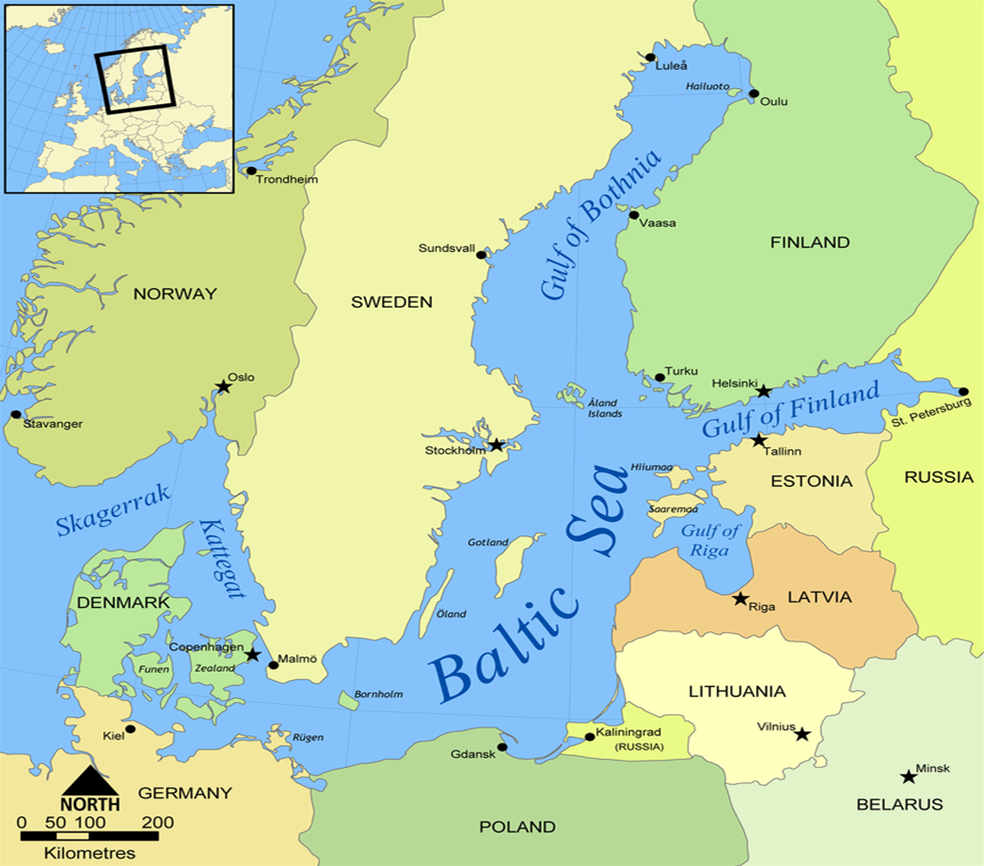
The Baltic Sea is located in northern Europe and is surrounded on all sides by NATO member states: Denmark, Estonia, Germany, Latvia, Lithuania, Poland, and Finland (which joined NATO last month), as well as Russia and Sweden (which is expected to join NATO pending Turkey’s approval).
Finland and Sweden control the northern coasts of the Baltic Sea. Germany, Poland, and the three Baltic states (Estonia, Latvia, and Lithuania) control the southern and eastern coasts. Denmark, Germany, and Sweden control the western entrance to the Baltic Sea (Germany from the south and Sweden from the north); therefore, all coasts are controlled by NATO members.
Notably, Russia has a limited front of the Baltic Sea through the Kaliningrad Province and has a coastline that measures about 140 km (75 nautical miles), in addition to a limited coastline in the middle of the port of St. Petersburg at the far eastern end of the Gulf of Finland. During the Soviet era, Russia had control over a 1,000-mile coastline.
The Baltic Sea has a high strategic value for NATO countries and Russia for a variety of reasons. This sea, for instance, is one of the main exits for the Russian Navy to the Atlantic Ocean, and from there to the Indo Pacific region and the Pacific Ocean through Mediterranean Sea and the rest of the world’s seas. It is also the main artery for seaborne trade to and from the riparian countries. For instance, the port of St. Petersburg in Russia handled 300 million tons in one year, and the port of Kaliningrad is one of the warmest ports operating throughout the majority of the year. This is a significant advantage for Russia, given that the port of Petersburg is closed for nearly six months of the year due to ice. In addition, there are several vital infrastructure at the sea bottom, such as gas pipelines and international and regional communications cables, whose security has become of utmost importance following the incident involving the sabotage of the Russian gas pipeline to Germany and Europe. In addition to the many other military and technical considerations, reports indicate the existence of oil, gas, and minerals such as iron and manganese reserves in the southern part of the Gulf of Finland, as well as fishing areas.
To round out the picture of the current geopolitical situation in the Baltic Sea, three major events that happened last year should be mentioned.
- Former British Prime Minister Boris Johnson and Sweden signed a Security Pact that aims to provide mutual support in the event that either of the two countries is subject to hostilities.
- Following the vandalism of the Nord Stream 2 gas pipeline, which transports Russian gas to Germany and from there to Europe and was deemed to be the start of an energy war between Russia and NATO, NATO increased the number of its warships in the Baltic Sea by two, to a total of 30 vessels.
- In May, Russia announced its withdrawal from the Council of the Baltic Sea States (CBSS) after the CBSS became a tool for implementing anti-Russian policies, according to Lavrov, the Russian foreign minister, upon leaving the CBSS’s headquarters in Stockholm.
In light of this, the Baltic Sea can be regarded as an internal sea for NATO countries, given its current geopolitical situation.
II- Overview of NATO Drills in Baltic Sea
The largest NATO naval exercise took place in the Baltic Sea from 4 to 16 June, involving 45 vessels, more than 75 aircraft, and 7,500 combatants from 14 NATO countries, including the newly-admitted Finland and the soon-to-be-admitted Sweden. The exercise was designed to prepare participants for the execution of collective defense measures to safeguard Baltic Sea navigation and secure sea lines of communication.
This maneuver was accompanied by the largest air exercise ever conducted by NATO, which involved 250 aircraft from 25 countries, including 100 US aircraft and 10,000 fighters (12–23 June). The maneuver, which was carried out over the North Sea (Baltic Sea) south of Germany with the intention of carrying out a number of Air Defender exercises, sends a strong and clear message that NATO countries are stable and capable of defending every inch of the alliance’s borders and reflects the strength of ties between the United States and European NATO members. It also serves as a reassuring message to Sweden and Finland.
By integrating air operations, surveillance, classification, and control systems with the various air bases, this maneuver seeks to increase the ability of the air forces of the NATO countries to cooperate and ensure interoperability while ensuring the efficient collective use of all participating weapon systems and participating aircraft from various countries. It is noteworthy that this exercise was run from the NATO Allied Air Command at Ramstein Air Base, Germany.
The training focused on repelling hostile air attacks, destroying air targets, especially missiles of all types (ballistic/ cruise missiles), drones of all types, and aircraft that target cities and the vital infrastructure of NATO countries, as well as providing support of all types to allied naval and land forces, as well as evacuations.
Spring Storm was held in Estonia on 20 May 2023. Although it takes place every year, it was the biggest this year in terms of the size and caliber of the forces and equipment, which included patrolling ships, minesweepers off the coast, landing vessels, tanks, armored vehicles, howitzer artillery, and all types of aircraft.
The exercise covered methods for moving and storing US personnel and equipment to cross the border and expand the NATO battle group in Poland from a battalion to a brigade.
It is noteworthy that 11 nations, including Canada, Denmark, France, Georgia, Italy, Germany, Latvia, Poland, England, and the United States, along with Estonia, took part in this exercise.
III- Overview of Russia’s Drills in the Baltic Sea
Between 9 and 19 June, Russia conducted a significant naval exercise in which the ground and air forces participated. There were 10,000 soldiers, 60 different types of warships, 45 aircraft, and helicopters involved.
The tasks covered in the training included locating and destroying enemy surface ships and submarines as well as putting into practice measures to defend naval bases using the anti-access/area denial (A2/AD) strategy, which entails preventing enemy ships from entering anti-access areas and preventing them from using certain areas of the sea to conduct Area Denial.
Additionally, training was provided on how to defend allied sea lines of communication against a variety of hostilities (surface, air, subsurface, and space). This is in addition to live-fire training exercises conducted by Kaliningrad-based ground forces to fend off and destroy enemy landing forces that have reached the coast.